

What is a Descriptive Essay?
- Definition
- A descriptive essay is a type of essay in which you describe people, places, events, or objects in detail.
- The goal is to use descriptive writing to paint a vivid picture in the reader’s mind.
- Unlike contrast essays or abstract arguments, it focuses on sensory details such as sight, touch, smell, and sound.
- Purpose
- Helps develop writing skills by teaching how to convey emotions, thoughts, and surroundings.
- Enhances academic writing for university students and different academic levels.
- Allows students to use their imagination, reflect on experiences, and practice narrative essays.
- Key Features
- Strong use of adjectives and adverbs to make descriptions engaging.
- Figurative language (similes, metaphors) to tell the reader deeper meaning.
- Works as both a short descriptive essay or longer assignments depending on the assignment needs.
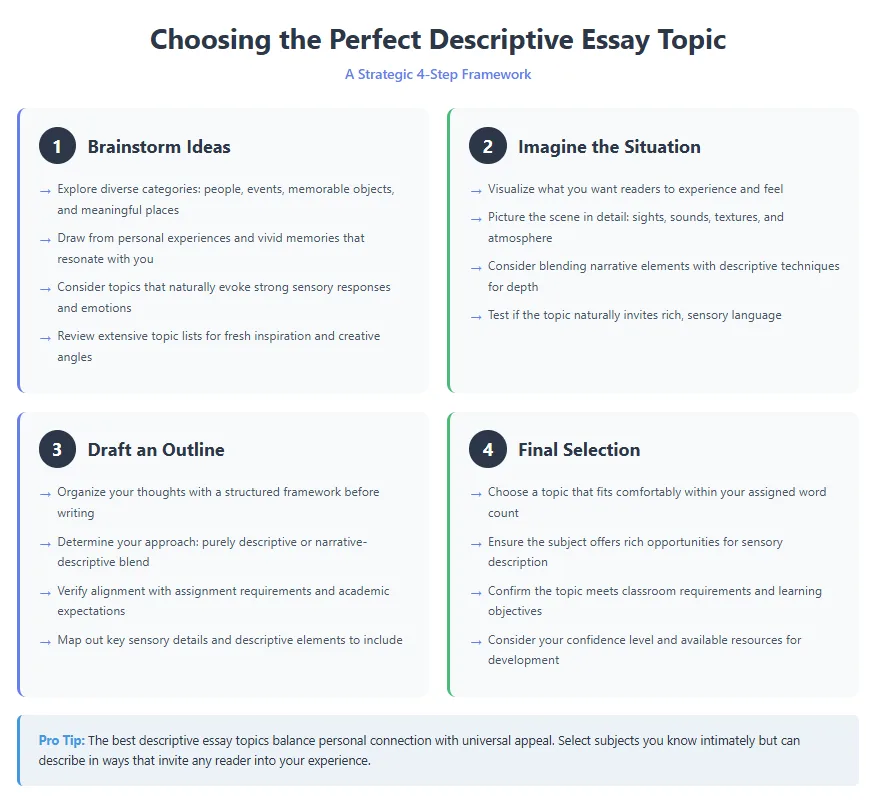
A 4-Step Guide for Choosing Descriptive Essay Topics
- Step 1: Brainstorm Ideas
- Consider a wide list of top descriptive topics such as people, events, objects and places, or personal memories.
- Use a list of 150+ descriptive essay topic ideas below for your inspiration.
- Think about what topic for a descriptive essay can make your descriptive work vivid and personal.
- Step 2: Imagine the Situation
- Ask yourself: “What do I want the reader to picture?”
- Imagine the situation and visualize the painting a vivid picture approach.
- Pick a narrative descriptive essay theme if you want to combine storytelling with description.
- Step 3: Draft an Outline
- Create an outline before writing to keep your creative process organized.
- Decide whether the paper will be descriptive or blended with narrative style.
- Ensure the assignment aligns with essay writing requirements at your academic levels.
- Step 4: Final Selection
- Select a descriptive essay topic that is manageable within your word limit.
- Make sure it allows space to use sensory details and painting techniques.
- Consider whether the chosen topic for a descriptive essay fits classroom needs or could even benefit from an essay writing service if guidance is needed.
Tips for Writing a Good Descriptive Essay
- Use Sensory Details
- Appeal to all five senses to keep the reader’s mind engaged.
- Add description of smell, color, touch, and sound.
- Enhance with Language
- Apply strong adjectives, adverbs, and figurative language.
- Focus on writing an effective descriptive essay by combining clarity with creativity.
- Be Vivid and Reflective
- Always describe in a way that allows readers to imagine the situation clearly.
- Reflect on deeper meanings behind objects or experiences.
- Practical Academic Advice
- Practice with a sample or short descriptive essay before tackling longer tasks.
- Assign yourself practice prompts from a list of top descriptive essay topics.
- For challenging descriptive essay writing, consider professional support from an essay writing service.
Categories of Descriptive Essay Topics
Descriptive Essay Topics on Literature and Academic Themes
- These descriptive essay topics focus on books, authors, classrooms, and the overall academic experience.
- They allow students to capture the intellectual atmosphere of learning, research, and the impact of literature on the reader’s mind.
- Once you’ve selected a topic, read our descriptive essay examples to see how details can bring your writing to life.
- Describe your favorite novel’s main character.
- The library at your university as a place of inspiration.
- The atmosphere during exam preparation week.
- A classroom filled with eager students.
- The process of writing a research paper.
- A literature lecture that inspired your imagination.
- The role of poetry in shaping emotions.
- A famous author you admire.
- The impact of reading Shakespeare for the first time.
- The feeling of finishing a long academic assignment.
- The look and smell of old books.
- A debate competition in your university.
- A moment of achievement in academic writing.
- The experience of presenting in front of classmates.
- The excitement of receiving a scholarship.
- A study group session before finals.
- The silence in a research library late at night.
- The thrill of discovering a new piece of literature.
Descriptive Essay Topics on Objects and Daily Life
- This category highlights everyday items and routines, from coffee mugs to laptops, showing how ordinary objects shape experiences.
- The topics invite writers to describe the details of common life that often go unnoticed but carry meaning.
- To move beyond topics into full analysis, read our breakdown of thematic essays for inspiration on building strong themes.
- Your morning coffee mug and what it represents.
- The alarm clock that starts your day.
- A pair of shoes you wear most often.
- The comfort of your bed after a long day.
- A backpack that carries your essentials.
- Your laptop as a daily companion.
- The smell of freshly laundered clothes.
- The sound of your phone’s notification tone.
- A bicycle you ride in your neighborhood.
- The taste of your favorite breakfast meal.
- The mirror you look into every morning.
- A diary or notebook you write in daily.
- The desk where you complete your assignments.
- A favorite chair in your living room.
- The television in your home.
- A pen that feels smooth while writing.
- The grocery store near your house.
- The cooking pot that makes your family meals.
Descriptive Essay Topics on Favorite Things and Activities
- These topics center on hobbies, passions, and personal interests that bring joy and fulfillment.
- They help writers describe activities such as reading, painting, or playing sports with vivid sensory details that reflect individual personality.
- If you’d like to shift from describing to debating, check out our list of argumentative essay topics.
- Descriptions often overlap with explanation — explore our full guide to expository essay topics.
- Your favorite hobby and how it makes you feel.
- The book you love rereading.
- Playing your favorite musical instrument.
- Watching your favorite TV series.
- Cooking your favorite meal.
- Listening to your favorite song.
- Collecting items that fascinate you.
- A board game you enjoy playing.
- The comfort of your favorite blanket.
- Painting or drawing as a creative escape.
- Reading your favorite magazine.
- Playing sports in your free time.
- The joy of gardening.
- Dancing to your favorite music.
- Watching a sunrise or sunset.
- Photography as a favorite activity.
- Shopping at your favorite store.
- Writing stories as a favorite pastime.
Descriptive Essay Topics on Geography and Traveling
- This group of descriptive essay topics explores landscapes, cities, journeys, and cultural encounters.
- Writers can describe new destinations, natural wonders, or the excitement of travel to convey adventure and discovery.
- After picking a descriptive idea, you might also enjoy exploring creative narrative essay topics.
- A city you dream of visiting.
- The landscape of your hometown.
- A mountain you have climbed.
- The desert and its endless horizons.
- The beauty of the ocean waves.
- A famous landmark you visited.
- The peacefulness of the countryside.
- A road trip with friends.
- A forest you explored.
- The busy streets of a capital city.
- An island holiday destination.
- The climate of your country.
- Traveling on a train for the first time.
- A hotel you stayed in during travel.
- The experience of being at an airport.
- A safari experience.
- The cultural richness of a city.
- The night sky in a rural area.
Descriptive Essay Topics on Memories and Associations
- This category captures personal recollections and emotional connections from the past.
- These topics guide writers to describe significant moments, from childhood experiences to milestone events, with reflection and nostalgia.
- Want to see how details strengthen persuasive writing? Review our argumentative essay examples for inspiration.
- Looking for ways to expand descriptive ideas with facts? Read our expository essay examples to see how it’s done.
- Your first day at school.
- A family wedding memory.
- The day you received your first award.
- A childhood birthday party.
- A visit to your grandparents’ house.
- The memory of your first pet.
- A picnic you enjoyed as a child.
- The memory of your first crush.
- A trip with your family.
- A memory of playing outside with friends.
- The first book you read.
- The memory of moving to a new house.
- A school trip that you remember vividly.
- The moment you learned to ride a bike.
- A memory of a hospital visit.
- The day you learned how to cook.
- A holiday celebration you cannot forget.
- The memory of your first stage performance.
Descriptive Essay Topics on People and Personalities
- This category of descriptive essay topics allows writers to capture the essence of individuals who have influenced their lives, from family members to historical figures.
- It focuses on describing personality traits, habits, and unique qualities that leave lasting impressions on the reader’s mind.
- Descriptions often lead naturally into stories — check out our narrative essay examples to see them in action.
- Describe the personality of your best friend.
- A family member who inspires you daily.
- The unique qualities of your favorite teacher.
- A childhood hero who shaped your imagination.
- The leader you admire most.
- The kindness of a stranger you once met.
- The charisma of a celebrity you follow.
- The confidence of your mentor.
- The smile of someone you love.
- A sibling’s habits that make them unique.
- The determination of an athlete you respect.
- The humor of your closest friend.
- The courage of a nurse or doctor.
- The discipline of your favorite professor.
- A historical figure you’d like to meet.
- The creativity of an artist you admire.
- A person in your community who makes a difference.
- The resilience of someone who overcame adversity.
Descriptive Essay Topics on Events and Experiences
- These topics encourage students to reflect on significant personal events, from birthdays and graduations to travel and volunteer work.
- The aim is to describe these moments with vivid detail, helping the reader relive the emotions and atmosphere of the experience.
- Your first day at high school or university.
- A birthday party you will never forget.
- A family wedding celebration.
- The day you graduated.
- Your first job interview.
- A concert you attended with friends.
- A holiday celebration in your home.
- A sports competition you participated in.
- The first time you traveled abroad.
- A childhood camping trip.
- The moment you won an award.
- A public speaking experience.
- The experience of volunteering.
- The memory of a funeral you attended.
- The joy of celebrating New Year’s Eve.
- An exam day that tested your patience.
- A family reunion event.
- The excitement of moving to a new city.
Descriptive Essay Topics on Nature and Environment
- This group of descriptive essay topics highlights the beauty and power of the natural world, from sunsets and rainstorms to forests and wildlife.
- Writers use sensory details to bring the sights, sounds, and smells of nature alive for the reader.
- The beauty of a sunrise.
- A sunset over the ocean.
- The calm of a forest walk.
- The sound of rainfall on your window.
- The vastness of the desert.
- The power of a thunderstorm.
- A mountain you once visited.
- The freshness of spring mornings.
- The brightness of a starry night.
- The waves of the sea crashing on the shore.
- The colors of autumn leaves.
- The stillness of a lake.
- The smell of blooming flowers.
- The warmth of summer days.
- The coldness of winter snow.
- The beauty of a rainbow.
- The wildlife in a safari.
- The peacefulness of the countryside.
Descriptive Essay Topics on Culture and Traditions
- Topics in this category explore the richness of heritage, rituals, and celebrations that define different communities.
- They give writers the chance to describe cultural practices, traditional foods, clothing, and festivals with detail that conveys both meaning and emotion.
- A traditional wedding in your community.
- A cultural dance performance.
- A religious celebration you attend.
- Traditional foods that define your culture.
- The music of your heritage.
- The customs of your grandparents.
- A national holiday in your country.
- The clothing styles of your tradition.
- The rituals of a coming-of-age ceremony.
- The art and craft of your people.
- The stories passed down through generations.
- A local festival in your hometown.
- The architecture of historic temples.
- A parade that celebrates culture.
- The language expressions of your culture.
- The meaning behind cultural symbols.
- The tradition of family gatherings.
- The values celebrated in your culture.
Descriptive Essay Topics on Imagination and Fantasy
- These descriptive essay topics invite writers to step beyond reality and explore creative worlds filled with magic, adventure, and futuristic ideas.
- By using imagination and figurative language, writers can paint vivid pictures of places, characters, and possibilities that do not exist in everyday life.
- Describe a world where animals can talk.
- A castle in the clouds.
- A magical forest full of secrets.
- A superhero you invent.
- A journey to another planet.
- Living in a world without gravity.
- A dragon you meet in a dream.
- A city under the sea.
- A time travel adventure.
- Meeting aliens from another galaxy.
- A school for young magicians.
- Flying across the world on a magic carpet.
- A treasure hunt on a deserted island.
- A parallel universe where you are someone else.
- The life of an invisible person.
- A kingdom ruled by children.
- A talking robot friend.
- A futuristic city powered by imagination.
Key Takeaways
- Definition: A descriptive essay is a type of essay that describes people, places, events, or objects in detail, focusing on sensory details such as sight, touch, smell, and sound.
- Purpose: Builds writing skills, enhances academic writing for university students across academic levels, and encourages imagination, reflection, and narrative expression.
- Key Features: Uses adjectives, adverbs, and figurative language to paint a vivid picture; can be written as a short descriptive essay or a longer academic assignment.
- Choosing Topics: Brainstorm widely, imagine the situation, draft an outline, and select a topic that allows effective use of sensory details.
- Writing Tips: Engage all five senses, use strong language, be vivid and reflective, and practice with samples or prompts.
- Practical Advice: Leverage topic lists for inspiration, align with academic requirements, and seek essay writing service support when necessary.
Sources
- Descriptive Essays. Available at: https://owl.purdue.edu/owl/general_writing/academic_writing/essay_writing/descriptive_essays.html
- How to Take Descriptive Writing to the Next Level. Available at: https://www.grammarly.com/blog/writing-tips/descriptive-writing/
- Strategies for Essay Writing. Available at: https://writingcenter.fas.harvard.edu/pages/strategies-essay-writing