
Chapter guide
Literature Review Chapter: Step-by-Step Guides and Examples
Your literature review chapter shows what is known about your topic, how strong the evidence is and where the gap lies. These guides take you through Chapter 2 in the order you work on it, from your first database search to the conclusion, with templates and weak and strong examples throughout.
You will also find full literature review chapters written on real research topics, with verified references.
Nothing matches that search. Try a shorter word, such as “problem” or “theory”.
Recommended first
Start here
Step by step
Write Chapter 2 Step by Step 12 steps
Follow the guides in order, from understanding the task to formatting the final chapter. Guides appear here as they are published.
- What Is a Literature Review? Understand what the chapter does and what examiners expect. 18 min
- Types of Literature Review Choose between narrative, thematic, scoping and systematic reviews. 16 min
- Literature Review vs Systematic Review See how the two differ in method, scope and reporting. 14 min
- How Long Should It Be? Plan the word count and number of sources for your level. 15 min
- Search With Boolean Operators Build search strings with AND, OR and NOT for any database. 14 min
- Evaluating Sources Judge credibility with the CRAAP test before you cite. 14 min
- Citation Management Software Keep every source in Zotero, Mendeley or EndNote. 15 min
- Using AI Tools Safely Use AI to search and sort, and verify every source. 14 min
- Critical Appraisal Judge each study with CASP, JBI or other checklists. 14 min
- Critical Literature Review Write about the evidence critically, not descriptively. 12 min
- The 5 Cs of a Literature Review Cite, compare, contrast, critique and connect in every paragraph. 12 min
- Thematic Literature Review Organize the body of the chapter around key themes. 12 min
Example library
Full Literature Review Chapter Examples 2 chapters
Complete Chapter 2 examples written on real research topics, with every reference checked. More examples are added as they are written.
Browse
All guides in Literature Review Chapter 16 posts
- Guide Literature Review AI: Best AI Tools for Literature Review Use literature review AI the right way: the best AI tools for literature search, summaries and citation mapping, their limits and a safe step-by-step workflow.
- Guide Citation Management Software: Best Reference Managers Compare citation management software for your literature review: Zotero, Mendeley and EndNote, with features, costs and a step-by-step reference manager setup.
- Guide Critical Appraisal of Research: Tools, Checklist & Guide A critical appraisal guide: how to critically appraise research studies for a literature review or systematic review, with CASP and JBI tools and a checklist.
- Guide Evaluating Sources for a Literature Review: The CRAAP Test A guide to evaluating sources: how to evaluate sources and evaluate information with the CRAAP test, plus a quick checklist for your literature review.
- Guide Boolean Operators: How to Search Library Databases (Guide) Use Boolean operators AND, OR and NOT to narrow or broaden a database search. See each Boolean operator with examples, parentheses, phrases and truncation.
- Guide How Long Should a Literature Review Be? Words & Sources How long should a literature review be? Word count guidance for a thesis or dissertation, how many sources to cover on a particular topic, and how to plan it.
- Guide Literature Review vs Systematic Review: 7 Key Differences Literature review vs systematic review: learn the difference between a systematic review and a literature review, with a side-by-side table and how to choose.
- Guide Types of Literature Review: 8 Types and How to Choose One Compare the types of literature review, from narrative and scoping to systematic reviews, and learn how to choose the right type of literature review for you.
- Guide What Is a Literature Review? Definition, Purpose & Parts What is a literature review? A clear definition, its purpose in research, the main parts, and how to conduct a literature review, with research guides and tips.
- Guide 5 Cs of Writing a Literature Review: Cite to Connect Learn the 5 Cs of writing a literature review: cite, compare, contrast, critique and connect, each with an example sentence, plus a paragraph template.
- Guide Critical Literature Review: How to Write One in 6 Steps A critical literature review evaluates studies instead of summarizing them. Use 6 steps and a model paragraph to write a literature review that is critical.
- Guide Literature Review Examples: 7 Samples by Type and Field Browse 7 literature review examples by field and type, from nursing to business, with a library-style guide to what each example of literature review does well.
- Guide Criticality of a Literature Review: 11 Ways to Show It Improve the criticality of a literature review with 11 practical techniques, a critical vocabulary bank and before-and-after examples of critical writing.
- Guide Writing a Literature Review: 12 Tips and Mistakes to Avoid Writing a literature review? Use 12 tips to write a literature review with a clear voice, strong paragraphs, the right tense and signposts, and avoid mistakes.
- Guide How to Write a Literature Review: 7 Steps (With Examples) Learn how to write a literature review in 7 steps: define the scope, conduct a literature search, evaluate, synthesize, outline, draft and revise Chapter 2.
- Guide Writing a Thematic Literature Review | 6-Steps with Examples Learn how to structure and write a thematic literature review effectively with this 6-step guide. Understanding the concept of thematic review process
Overview
What Goes in a Literature Review Chapter?
The literature review chapter, usually Chapter 2 of a dissertation, shows what is already known about your topic, how well it is known and what is still missing. It is not a list of summaries: it evaluates and synthesizes the research to build an argument that ends in the gap your study fills.
Most literature review chapters contain the parts below. Names and order vary by university and field, so check your program handbook as well.
- Introduction: the topic, purpose, scope and organization of the review.
- Search strategy: the databases, keywords and limits you used, especially in systematic or scoping reviews.
- Thematic sections: the body, where sources are grouped by theme, method or period and compared.
- Critical evaluation: how strong the evidence is, judged with clear appraisal criteria.
- Theoretical or conceptual framework: the theory or map of concepts that the literature supports.
- Conclusion and research gap: the main patterns, what is missing and how your study responds.
How a Literature Review Chapter Comes Together
A strong chapter follows a clear path: you search for sources, evaluate them, synthesize what they say and organize it into sections that lead to your research gap.
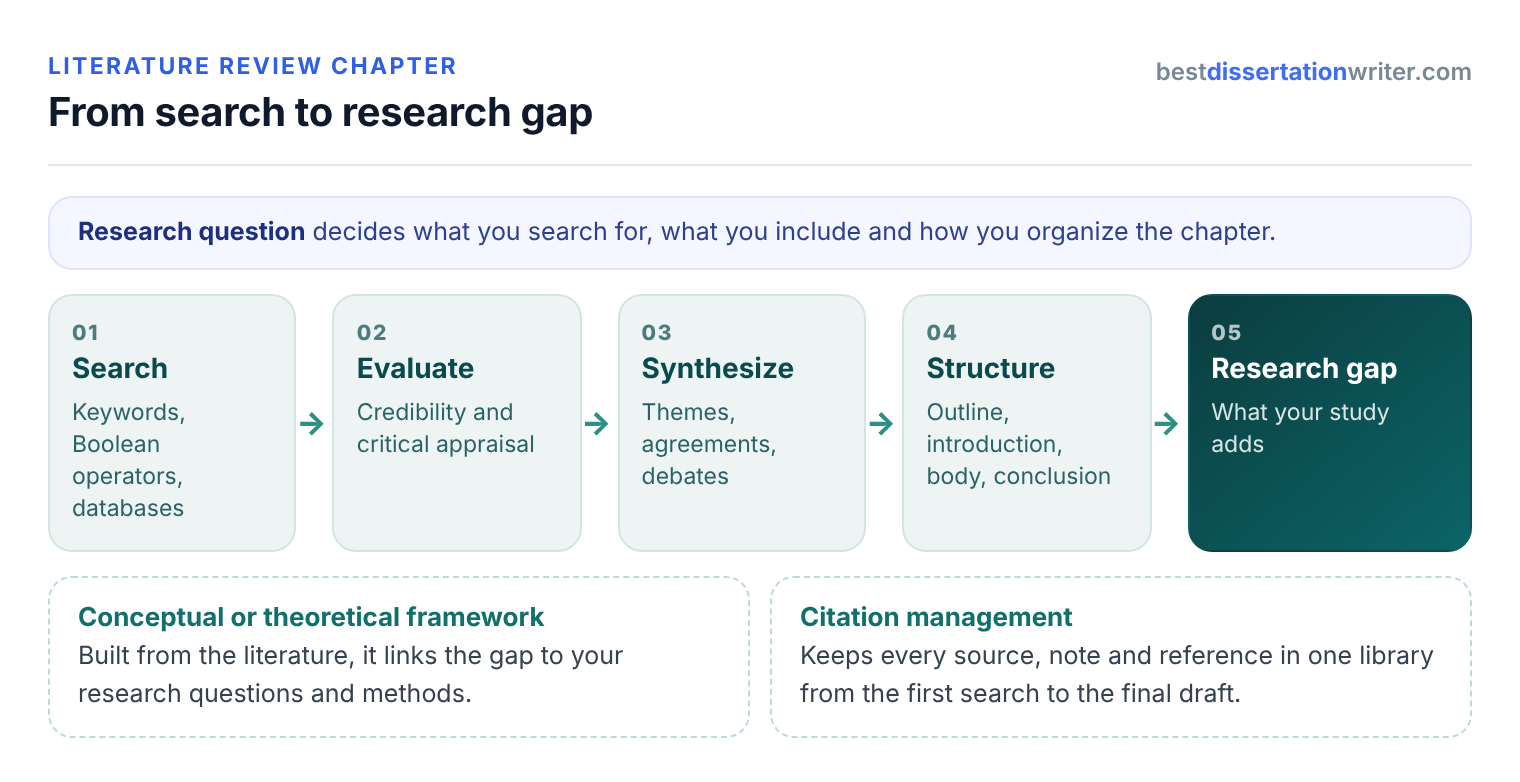
A useful check is to read your chapter introduction and conclusion together. The conclusion should answer the purpose the introduction set out, using the same themes in the same order.
How the Type of Review Changes the Chapter
A narrative or thematic review in a dissertation has more freedom in how sources are found and organized. A systematic or scoping review follows a published method, reports its search in full and appraises every included study.
The guides on this page cover both, so you can match your chapter to what your program expects.
Common Mistakes in the Literature Review Chapter
- Summary, not synthesis: one paragraph per source instead of sources grouped around ideas.
- No evaluation: reporting findings without judging how strong the evidence is.
- A vague gap: ending with “more research is needed” instead of a specific gap.
- Unverified sources: citing references from AI tools without checking that they exist.
Organize Your Sources From Day One
Set up a reference manager and a synthesis matrix before your first search. Every source you read then has a place, and the chapter almost organizes itself.
Before you submit, check that every in-text citation appears in your reference list and every reference is cited.
FAQs
Frequently asked questions
Quick answers to the questions students ask most about the literature review chapter.
Still have a question?
Our writers can review your draft or write the section with you.
Ask an expertWhat should be included in a literature review chapter?
A literature review chapter usually includes an introduction that sets out the topic, purpose and scope, a body organized into themes or other sections, a critical evaluation of the evidence and a conclusion that identifies the research gap. Many dissertations also present a theoretical or conceptual framework in this chapter.
If your review is systematic or scoping, you will also describe your search strategy, inclusion criteria and appraisal method. Check your program handbook for required sections, then use the guides on this page to write each part.
How long should a dissertation literature review be?
There is no single correct length. University guidance often suggests that the literature review takes up a substantial share of the dissertation, and some guides give a rough proportion of the total word count, but requirements differ by level, field and program.
Focus on covering the key themes, debates and evidence that your research question needs, rather than on a word count. A doctoral review is usually longer and covers more sources than a master’s or undergraduate one. Ask your supervisor for the expected range in your department.
In what order should I write the literature review chapter?
Start by searching and reading, and record every source in a reference manager. As you read, evaluate each study and note it in a synthesis matrix, so themes and gaps start to show early.
Next, write an outline with a claim for each theme, then draft the body sections. Write the conclusion once the body is finished, and write or revise the introduction last, so it matches the chapter you actually wrote. Finish by checking the format and every citation against your reference list.
What is the difference between a literature review and an annotated bibliography?
An annotated bibliography lists sources one by one, each followed by a short summary and evaluation. It is usually arranged alphabetically, and each entry stands on its own.
A literature review is an essay that synthesizes many sources around themes, compares their findings and builds an argument that leads to a research gap. Many students write an annotated bibliography first, because annotating each source makes it easier to see the themes, agreements and disagreements that the literature review then brings together into one connected discussion.
Keep going
Other dissertation chapters
Best Dissertation Writers
Need help with your literature review?
Get a critical, well-structured review with current sources and a clear research gap.