

Evaluating Sources: How to Evaluate Sources and Evaluate Information in a Literature Review
 By Dr. Robertson Prime, Research Fellow
Updated November 16, 2026
16 min read
About 3,200 words
Evaluating sources means checking whether a book, article, report or website is credible, relevant and accurate enough to use in your research. It is one of the most important research skills you can learn, because every claim in your literature review is only as strong as the sources behind it.
This guide shows you how to evaluate sources step by step. It explains the main types of source, walks through the CRAAP test (currency, relevance, authority, accuracy and purpose), shows how to check websites and online content, and ends with a source evaluation checklist you can use on every source you find.
- The criteria: the five CRAAP test questions for evaluating sources, each explained with examples of what to look for.
- The method: a step-by-step process to evaluate sources quickly, plus lateral reading for websites and news.
- The tools: a comparison of source types, weak-vs-strong examples, a source evaluation template and a checklist.
On this page
Key takeaways
- Evaluating sources protects your argument: weak sources weaken every claim built on them.
- The CRAAP test asks five questions about currency, relevance, authority, accuracy and purpose.
- For websites and news, read laterally: check what other trusted sources say about the source.
- Always find the original source of a claim before you cite it in your literature review.
What Is Evaluating Sources, and Why Does It Matter?
Evaluating sources is the process of judging whether information is trustworthy and suitable for your purpose, and it is a habit worth building every time you are conducting research. In academic research, it happens at every stage of the research process, from the first search to the final draft.
- It protects your argument: a literature review built on outdated, biased or inaccurate information can mislead readers and lose marks. Evaluating sources is crucial because examiners judge your work partly by the quality of what you cite.
- It saves time: searches return far more credible sources and weak ones than you can read. When you evaluate sources early, using titles, abstracts and author details, you spend your reading time on the material most likely to answer your research question.
- It shows research skills: choosing credible sources and explaining why you trusted them demonstrates that you can work like a researcher, not just collect references.
- It matters more than ever: search engines, social media and AI tools make it easy to find information, but they do not check it for you. The responsibility to evaluate information sits with the researcher.
Types of Information Source: Scholarly Article, Academic Source or Popular Source
Knowing the type of source is the first step in evaluating sources, because there are many types of information. Different source types are useful for different purposes, and each needs a slightly different check.
| Source type | Examples | Best used for | Main thing to check |
|---|---|---|---|
| Scholarly article | Peer-reviewed journal articles | Evidence and theory in a literature review | Methods, sample and peer review |
| Scholarly book | Academic monographs, edited volumes | Theory, history, in-depth discussion | Author expertise, publisher, date |
| Official report | Government and agency reports, statistics | Data, policy and background information | Who produced it and why |
| Popular source | News, magazines, blogs | Current events, public debate | Accuracy and the original source |
| Website or social media | Organization pages, posts, videos | Context, examples, leads to other sources | Author or publisher and purpose |
- Primary sources: these present original research or first-hand evidence, such as a study reporting its own data, a historical document or an interview. In a literature review, peer-reviewed empirical studies are the primary sources you rely on most.
- Secondary sources: these discuss or summarize primary sources, such as review articles, textbooks and news reports about research. They are useful for background information and for finding primary studies, but you should find the original study before citing a specific finding.
- Scholarly vs popular: when you evaluate sources, remember that scholarly sources are written by experts for experts, cite their evidence and usually go through peer review. Popular sources are written for the public, are rarely peer reviewed and often simplify findings, so use them with care in academic research.
The CRAAP Test: 5 Criteria for Evaluating Sources
The CRAAP test is one of the best-known tools for evaluating sources. Developed at California State University, Chico’s Meriam Library, it asks five sets of questions; you can download the original CRAAP test from the Meriam Library.
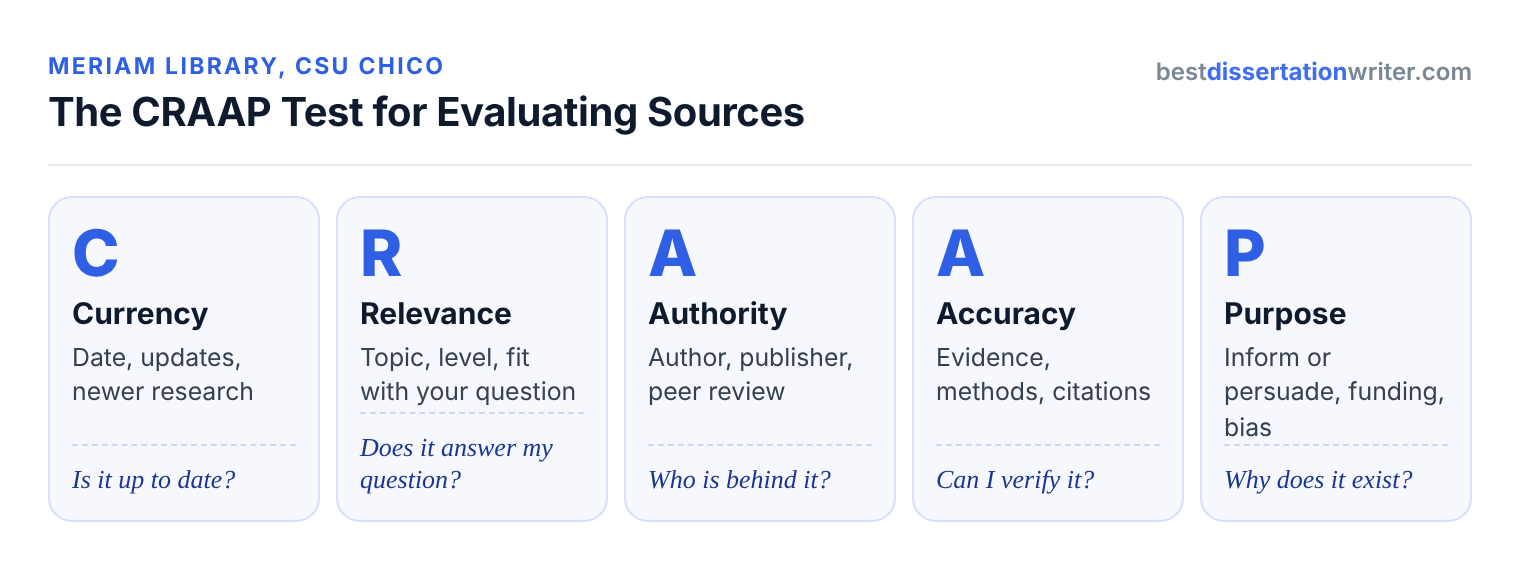
1. Currency: is the information up to date?
Currency is about the timeliness of the information. How much it matters depends on your field and your topic.
- Questions to ask: when was the source published or last updated? Has newer research changed the picture? If it is a website, are the links still working, and does it offer up-to-date information?
- How to judge it: in fast-moving fields such as technology or medicine, older sources may be out of date within a few years. In history or philosophy, older sources can remain essential.
- A balanced approach: combine newer sources for current information with older sources that are still widely cited, and explain why you include any older work.
2. Relevance: does it answer your question?
Relevance asks whether the source actually helps answer your research question. A credible source can still be the wrong source for your project.
- Questions to ask: does it address your topic, population and setting? Is it written at the right level for academic research? Have you looked at other sources before choosing this one?
- How to judge it: read the abstract, introduction and conclusion first. If the source only touches your topic in passing, it is probably not central to your review.
- What a strong answer looks like: the source addresses your research question directly, for a similar population or setting, and adds something the other sources you find do not. When evaluating sources for relevance, one source that answers your question closely is worth more than five that mention it.
3. Authority: who is behind it?
Authority is about the expertise and credibility of the author or publisher. It tells you whether the source comes from someone qualified to write about the topic.
- Questions to ask: who is the author or publisher? What are their qualifications or institutional affiliations? Is the source published in a peer-reviewed journal or by a reputable academic press?
- How to judge it: check the author’s other publications and affiliation, and look up the journal or publisher. Peer-reviewed journals and university presses are usually authoritative; anonymous web pages are not.
- What a strong answer looks like: a named author with relevant expertise, published in academic journals or by a reputable publisher in their field of study. Library guides, including many university libguides on evaluating sources, suggest checking whether the journal is listed in your library’s database as peer reviewed.
4. Accuracy: is the information reliable?
Accuracy concerns whether the information presented is correct and supported by evidence. It is the heart of evaluating sources.
- Questions to ask: where does the information come from? Is it supported by evidence, citations and references? Has it been reviewed? Can you verify it in another source?
- How to judge it: look for clear methods, data and citations. Errors, exaggerated claims and missing references are warning signs of inaccurate information.
- What a strong answer looks like: research studies that explain how their data were collected, cite sources that provide the evidence behind each claim, and match what other credible sources report. If you cannot verify a claim anywhere else, do not rely on it.
5. Purpose: why does it exist?
Purpose asks why the source was created: to inform, teach, sell, entertain or persuade. It is the CRAAP criterion that reveals possible bias.
- Questions to ask: is the purpose to inform or to persuade? Are the authors’ intentions clear? Is the information fact, opinion or advertising? Are different points of view acknowledged?
- How to judge it: check who funded the work and whether the author or publisher benefits from a particular conclusion. A study funded by a company that sells the product it tests is not automatically wrong, but it deserves extra scrutiny.
- What a strong answer looks like: a clear aim to inform, transparent funding and a fair account of other views. Credible sources acknowledge their limitations and the evidence that disagrees with them.
How to Evaluate Sources Step by Step
The CRAAP test tells you what to look for; this method tells you in what order. Follow these steps to evaluate sources quickly and consistently.
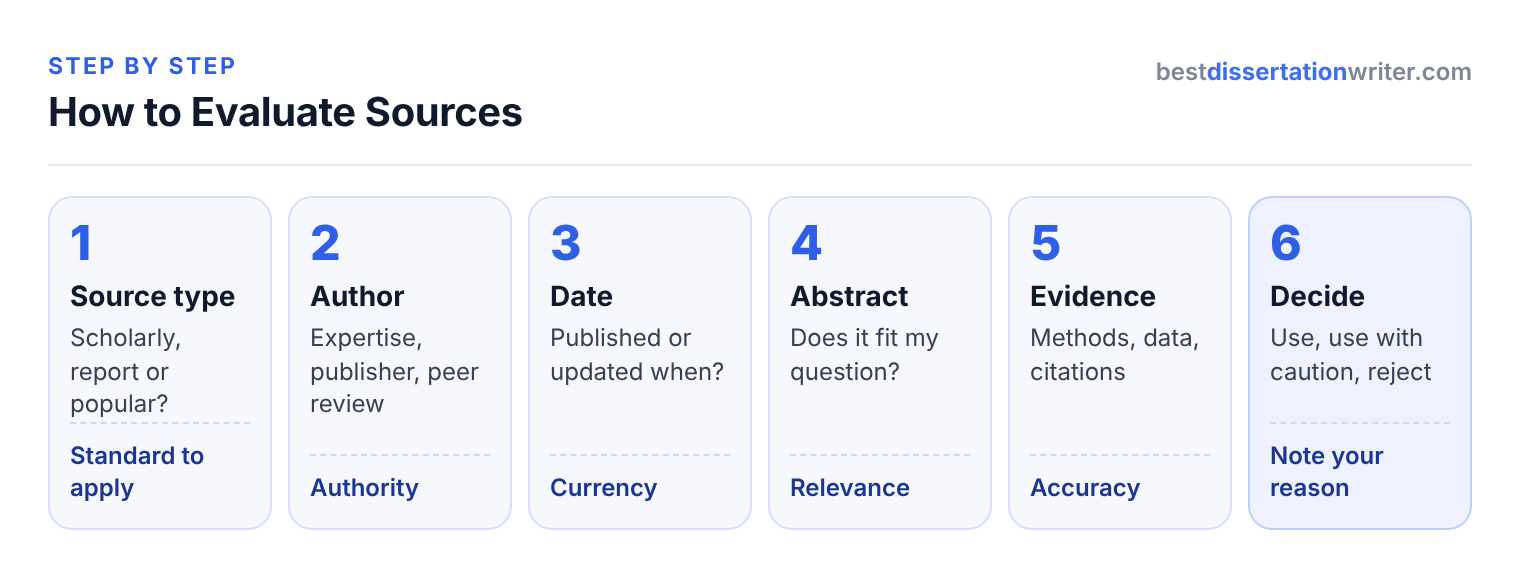
- Identify the type of source. Decide whether it is a scholarly article, a book, a report or a popular source. This tells you what standard to hold it to and which checks matter most.
- Check the author and publisher. Look up the author’s qualifications and affiliation, and check whether the journal is peer-reviewed or the publisher is reputable. A quick search of the author’s name often shows their field and other work.
- Check the date of publication. Note when it was published and whether it has been updated recently. Ask whether newer research might have changed its conclusions.
- Read the abstract and conclusion. Decide whether the source is relevant to your research question before reading the whole thing. If it is not, move on.
- Check the evidence. Look at the methods, data and citations. For a study, ask whether the sample and design support the conclusions; for any claim, ask whether it is backed by evidence you can verify.
- Decide and record. Decide whether to use the source, use it with caution or reject it, and note your reason. These notes help when you explain your choices in your literature review.
Evaluating a source in practice: how to evaluate information and check each citation
Here is how the steps work on one source you find. Imagine a database search on remote work returns a journal article titled “Remote work and employee wellbeing: a two-year study”.
- Type and authority: it is a scholarly article in a peer-reviewed academic journal, written by researchers at a university business school. That is a strong start, so you keep evaluating sources of this kind in detail.
- Currency and relevance: it was published four years ago, which is recent enough for your topic, and its population matches your research objectives. The information in the source is clearly relevant to your research topic.
- Accuracy: the methods section reports a sample of employees surveyed twice, and the authors discuss their limitations. You check two citations from the introduction and find that they say what the article claims, a good sign of quality information.
- Purpose: the study was funded by a public research council, not a company with an interest in the result, so the risk of bias from funding is low.
- Decision: you keep it as one source among several relevant sources for your wellbeing theme, and note its main limitation in your synthesis matrix.
Doing this for every source takes practice, but it quickly becomes routine. Over a whole research project, evaluating sources this way gives you credible evidence for every claim and a record of why you chose it.
Template
Source: [citation] | Type: [scholarly article / book / report / popular] | Currency: [date, still current?] | Relevance: [how it answers my question] | Authority: [author, publisher, peer reviewed?] | Accuracy: [evidence, methods] | Purpose: [inform / persuade, funding] | Decision: [use / use with caution / reject]
Evaluating Websites, News and Online Content
Online information needs extra care when evaluating sources, because anyone can publish it. Evaluating sources on the web works best when you look beyond the page itself.
Read laterally
Lateral reading means leaving the page to find out what other trusted sources say about it. Professional fact-checkers use this approach because a website’s description of itself is not always reliable.
- Open new tabs: search for the organization or author by name and see what reputable sources say about them. A quick search often reveals funding, political aims or a poor track record.
- Find better coverage: look for the same claim in other, more authoritative sources. If no reliable source reports it, treat it with suspicion.
- Trace claims to the original: follow links and citations back to the original source, such as the study or report a news article describes. Check that the original says what the article claims it says.
Check images, statistics and AI-generated text
- Images: a reverse image search can show where a picture first appeared and whether it has been altered or taken out of context.
- Statistics: find the original data source, check the date and the definitions used, and be wary of numbers with no source at all.
- AI tools: text from AI chatbots can sound authoritative while containing errors or invented references. Never cite an AI answer as a source; verify every claim and reference in the original publication.
Evaluating Sources for a Literature Review and Academic Research
When evaluating sources for a literature review, the main question shifts from “Is this credible?” to “How much weight should this evidence carry?” Most of your sources will be scholarly, so the checks focus on the quality of research.
- Prefer peer-reviewed empirical studies: peer-reviewed journals are the backbone of most literature reviews. Peer review is not a guarantee of quality, but it means experts have checked the work before publication.
- Look at the research design: to assess the quality of a study, ask whether its design fits its question, whether the sample is large and varied enough, and whether the conclusions follow from the data. Strong designs deserve more weight in your synthesis.
- Balance older and newer sources: include recent studies for current research and influential older studies that the field still relies on. Explain your date range in your search strategy.
- Use review articles wisely: review articles help you map the field and find studies, but cite the original studies for specific findings.
- Record your judgments: add a column for strengths and limitations in your synthesis matrix. These notes become the critical analysis in your writing.
Judging the quality of individual studies in depth is a step called critical appraisal, which uses design-specific checklists. To see how evaluation becomes critical writing, read our guide to the critical literature review and our guide to the criticality of a literature review.
Source Evaluation Checklist and Examples
Use this checklist when evaluating sources for any assignment, so you only cite credible sources. If a source fails several checks, look for a better one.
- Type. I know whether the source is scholarly, an official report or popular.
- Currency. The date is suitable for my field, or I can justify using an older source.
- Relevance. The source helps answer my research question directly.
- Authority. The author or publisher is qualified and identifiable.
- Accuracy. Claims are supported by evidence and citations that I can check.
- Purpose. I know why the source exists and have considered possible bias.
- Original source. For specific findings, I have found and read the original.
Evaluating sources: two sources on the same claim
Weak
A blog post stating that “studies show remote workers are 50% more productive”, with no author, no date and no link to the studies.
Fails authority, accuracy and currency: no author, no evidence and no way to check the claim.
Strong
A peer-reviewed study in an academic journal that reports its sample, methods and productivity measures, with its limitations discussed.
Meets the CRAAP criteria and lets you judge the evidence yourself.
Once you know how to evaluate sources, the next step is to combine them. See the 5 Cs of writing a literature review, our step-by-step guide on how to write a literature review, and our guide on how to write a dissertation. The UNC Writing Center guide to literature reviews also discusses choosing sources.
FAQs About Evaluating Sources
How do I use the CRAAP test to identify credible sources?
Apply its five questions to each source. Check currency (is it up to date?), relevance (does it answer your question?), authority (who wrote or published it?), accuracy (is it supported by evidence?) and purpose (why does it exist?). A source that does well on all five is likely to be credible.
Use the CRAAP test as a guide rather than a score. A source can be old but still essential, or credible but not relevant, so weigh the answers against your research question before you decide to include it.
How do you evaluate a source for credibility?
Start with the author and publisher: check their qualifications, affiliation and whether the work is peer reviewed. Then look at the evidence, including the methods, data and citations, and check the date to see whether the information is still current.
For websites and news, read laterally by searching for what other trusted sources say about the author or organization, and trace claims back to the original study or report. A credible source is transparent about who produced it and what its evidence is.
What are the 5 criteria for evaluating sources?
The five criteria of the CRAAP test are currency, relevance, authority, accuracy and purpose. Currency is about how up to date the information is, relevance is about whether it fits your research question, and authority is about the expertise of the author or publisher.
Accuracy concerns whether the information is supported by evidence and can be verified, and purpose asks why the source was created and whether it may be biased. Together they give a quick, structured way of evaluating sources.
Which CRAAP criterion shows whether a source is biased?
Purpose is the CRAAP criterion most concerned with bias. It asks why the source exists, whether it aims to inform or persuade, whether it is fact or opinion, who funded it and whether the author or publisher benefits from a particular conclusion.
Authority and accuracy also help when evaluating sources, because an identifiable expert author and well-documented evidence make bias easier to detect. A source with a clear agenda may still be useful, but you should note its purpose when you discuss it.
Best Dissertation Writers
Need help with your literature review?
Get a critical, well-structured review with current sources and a clear research gap.