
ICU Pain Assessment in Intubated and Non-Communicative Patients: A Systematic Review of Observational Tools
 By Dr. Robertson Prime, Research Fellow
Updated October 17, 2026
14 min read
About 2,900 words
In this review
Abstract
Background: ICU pain assessment is difficult because many critically ill adults are intubated, sedated or delirious and cannot report their pain. Behavioural tools such as the Behavioral Pain Scale (BPS) and the Critical-Care Pain Observation Tool (CPOT) allow nurses to recognise pain from facial expressions, movements and responses to ventilation.
Aim: This systematic review aimed to examine the evidence on observational tools for pain assessment in intubated and non-communicative critically ill adults and the effects of systematic assessment on outcomes.
Methods: Evidence was identified through targeted searches of openly accessible bibliographic records, publisher websites and the reference lists of key reviews. Five sources published between 2007 and 2021 were included: a multicentre observational study, a post hoc cohort analysis, two systematic reviews and a validation study, synthesised narratively.
Findings: In 44 French ICUs, only 42% of ventilated patients had analgesia assessed on day 2, although 90% received opioids. Patients whose pain was assessed had shorter ventilation (8 compared with 11 days) and ICU stays (13 compared with 18 days). A review of nine behavioural tools found the strongest psychometric properties for the BPS, BPS-NI and CPOT, and a systematic review linked pain assessment with better pain management and shorter ventilation. The CPOT-Neuro was valid in brain-injured adults.
Conclusion: Critical care nurses should assess pain routinely with a validated behavioural tool when patients cannot self-report, and link assessment to analgesia protocols.
Keywords: ICU pain assessment, CPOT, BPS, intubated patients
Introduction
This systematic review critically examines recent evidence on ICU pain assessment and its implications for critical care nursing practice.
Pain is common in intensive care. Patients experience pain from surgery, trauma, invasive lines and tubes, and from routine care such as turning, suctioning and wound dressing. Survivors frequently describe pain as one of their most distressing memories of critical illness. Unrecognised and untreated pain contributes to agitation, sleep disruption, delirium, physiological stress and, in the longer term, chronic pain and psychological distress.
The gold standard for assessing pain is the patient’s own report, but many critically ill adults cannot communicate. Intubated patients cannot speak, and sedation, delirium and neurological injury may prevent them from pointing to a scale or nodding. Vital signs such as heart rate and blood pressure change for many reasons and are unreliable indicators of pain on their own. Nurses therefore need other ways of recognising when patients are in pain.
Behavioural pain assessment tools were developed to fill this gap. The BPS and the CPOT score observable behaviours such as facial expression, body movements, muscle tension and tolerance of the ventilator or vocalisation. They are now recommended in international guidance and widely used in intensive care, but their use in practice is variable.
A systematic review approach was chosen to bring together evidence on current practice, the psychometric properties of tools and the effects of assessment on patients.
Pain in intensive care is also closely linked to sedation. When pain is not recognised, agitated behaviour may be treated with sedatives rather than analgesics, deepening sedation and prolonging ventilation without relieving the underlying problem. Good ICU pain assessment therefore supports lighter, more targeted sedation as well as better comfort, and it is a foundation of modern approaches to sedation management.
Review question
What does the evidence show about observational tools for pain assessment in intubated and non-communicative critically ill adults, and does systematic assessment improve outcomes?
Background to ICU Pain Assessment
Pain is a subjective experience, and in ICU pain assessment observational tools can only infer it from behaviour. They cannot measure intensity as precisely as self-report, and behaviours can be influenced by other factors such as agitation, delirium, neuromuscular disease or deep sedation. Nevertheless, a structured observational approach is more reliable than unstructured clinical impressions, which tend to underestimate pain.
The BPS rates three domains, facial expression, upper limb movements and compliance with ventilation, each from one to four, giving a total from three to twelve. A version for non-intubated patients, the BPS-NI, replaces ventilator compliance with vocalisation. The CPOT rates four domains, facial expression, body movements, muscle tension and either compliance with the ventilator or vocalisation, each from zero to two, giving a total from zero to eight. Both tools are quick to use and can be applied at rest and during procedures.
ICU pain assessment is only useful if it leads to action. Assessment should guide analgesia, including pre-emptive analgesia before painful procedures, and re-assessment should check whether treatment has worked. Many units use analgesia-first sedation protocols, in which pain is treated before sedatives are added, and nurses are often authorised to titrate analgesia according to assessment scores.
Nurses carry out most ICU pain assessment. Their knowledge of the tools, confidence in interpreting behaviour and ability to advocate for analgesia are therefore central to effective pain management. Barriers include workload, lack of training, concern about opioid side effects and uncertainty about how to assess deeply sedated or neurologically injured patients.
Families often notice signs of pain before staff do, because they know how their relative usually expresses discomfort. Involving families in ICU pain assessment, for example by asking about usual pain behaviours or inviting them to share observations, can add valuable information, particularly for patients with dementia, learning disabilities or language barriers.
Search Strategy and Methods
Evidence for this example was identified through targeted searches of openly accessible bibliographic records, publisher websites and the reference lists of key reviews. Search terms combined keywords for the concept (“pain assessment”, “pain measurement”, “Behavioral Pain Scale”, “Critical-Care Pain Observation Tool”) with terms for the population (“critically ill”, “intensive care”, “mechanically ventilated”, “non-communicative”, “intubated”), joined with the Boolean operators AND and OR. A full systematic review for assessment would run the same strategy in CINAHL, PubMed/MEDLINE, the Cochrane Library and Embase and report the number of records screened in a PRISMA flow diagram.
Sources were eligible if they examined pain assessment practice, the validity of observational pain tools or the effects of pain assessment on outcomes in critically ill adults who could not self-report. Systematic reviews and large multicentre studies were prioritised, and a recent validation study was included to address patients with brain injury. Studies of children were excluded.
Five sources published between 2007 and 2021 were included: a multicentre observational study of practice, a post hoc analysis of a cohort study, two systematic reviews and a multisite validation study (Table 1). The quality of each source was considered using the Critical Appraisal Skills Programme (CASP) checklists, and findings were synthesised narratively.
Key Findings on ICU Pain Assessment
Three themes were identified: gaps between treatment and assessment in practice, the validity of behavioural tools, and the effects of ICU pain assessment on patient outcomes. Table 1 summarises the included sources, and Figure 1 compares rates of assessment and treatment in ventilated patients.
| Author, year | Design | Setting and sample | Key finding |
|---|---|---|---|
| Payen et al. (2007) | Prospective multicentre observational study | 1,381 ventilated adults, 44 ICUs, France | Day 2: 90% received opioids but only 42% had analgesia assessed; fewer than 25% had procedural pain managed. |
| Payen et al. (2009) | Post hoc analysis of a cohort study (DOLOREA) | 513 assessed vs 631 non-assessed ventilated patients | Pain assessment linked to shorter ventilation (8 vs 11 days) and ICU stay (13 vs 18 days). |
| Georgiou et al. (2015) | Systematic review | 10 studies of critically ill adults | Pain assessment linked to better pain management, lower pain and shorter ventilation; evidence insufficient for firm conclusions. |
| Gélinas et al. (2019) | Systematic psychometric review | 106 articles; 9 ICU tools and 4 other tools | BPS, BPS-NI and CPOT had the strongest psychometric properties. |
| Gélinas et al. (2021) | Prospective multisite validation cohort | 226 brain-injured adults, Canada and USA | CPOT-Neuro scores rose during painful procedures and correlated with self-report; valid across levels of consciousness. |
Theme 1: A Gap Between Treatment and Assessment
A prospective multicentre study of 1,381 mechanically ventilated adults in 44 French intensive care units examined sedation and analgesia practice on days 2, 4 and 6 (Payen et al., 2007). On day 2, 90% of patients received opioids and 72% received sedatives, yet only 42% had their analgesia assessed and 43% their level of sedation. Between 40% and 50% of assessed patients were deeply sedated, and fewer than a quarter had pain managed during procedures.
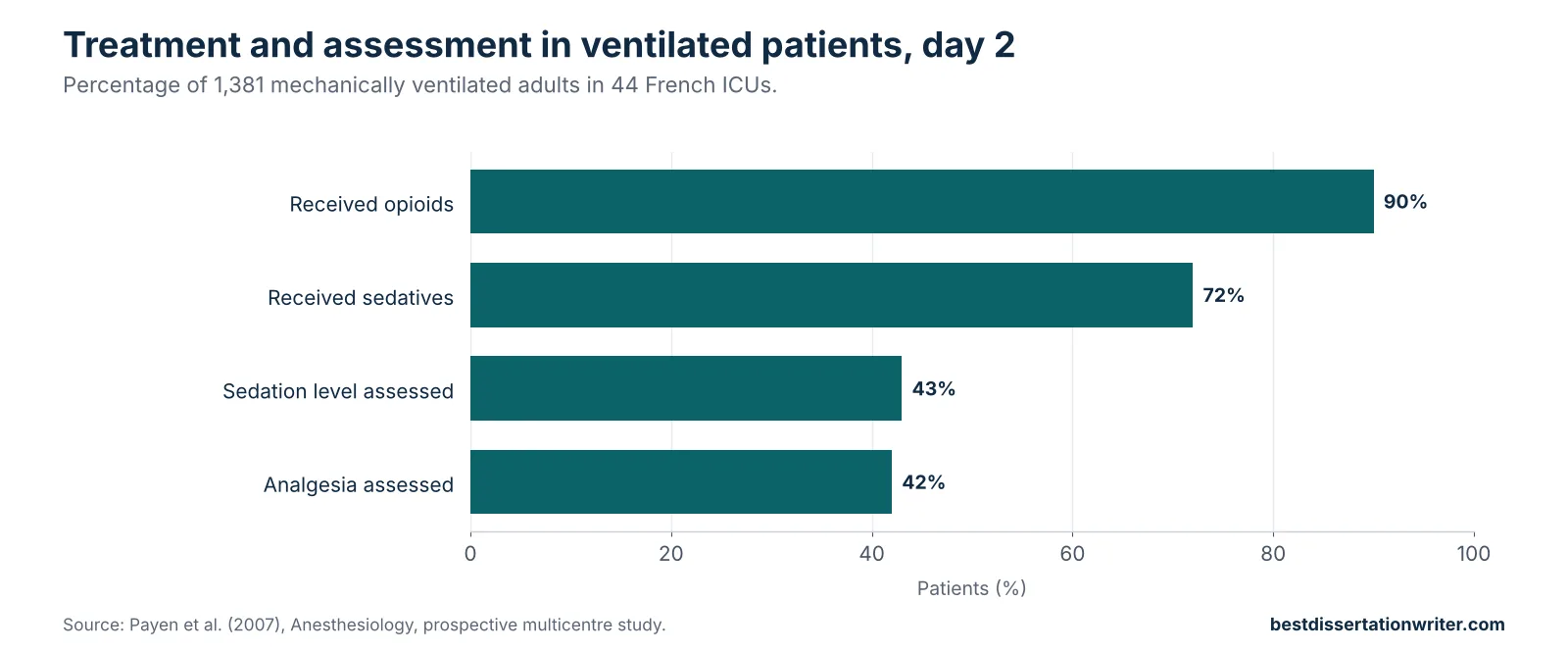
The study showed that patients were commonly treated without being assessed, and that the use of sedation and analgesia protocols reduced the proportion of patients treated without assessment. The authors called for education and protocols to prevent excessive sedation and inadequate analgesia during painful procedures. Although the data are now dated, they illustrate the gap that behavioural tools and protocols were designed to close.
For ICU pain assessment, the gap between treatment and assessment matters because analgesics given without assessment may be too much or too little. Patients may be oversedated and exposed to side effects, or left in pain during procedures. Assessment makes it possible to match analgesia to need and to evaluate its effect.
Theme 2: The Validity of Behavioural Tools
A systematic review updated the psychometric evidence on behavioural pain tools for non-communicative critically ill adults, drawing on 106 articles (Gélinas et al., 2019). Nine tools developed for this population and four from other populations were rated on development, reliability, validity, feasibility and clinical utility. The BPS, BPS-NI and CPOT had the strongest psychometric properties, with validation in multiple countries and languages. Other tools may be good alternatives but need further research.
Patients with brain injury present a particular challenge, because their behaviours may be altered by neurological damage. A multisite cohort study in Canada and the United States validated a revised version, the CPOT-Neuro, in 226 adults with brain injury (Gélinas et al., 2021). Scores were higher during painful procedures than at rest or during non-painful procedures, did not differ by level of consciousness, and correlated with self-reported pain in conscious patients. Interrater reliability was acceptable, and the authors called for implementation studies to test the tool in everyday practice.
Together, these studies support the use of the BPS or CPOT for intubated patients and suggest that adapted tools can extend ICU pain assessment to patients with brain injury. However, behavioural tools are less valid in deeply sedated or paralysed patients, who may be unable to show pain behaviours, and nurses must interpret scores in the context of each patient’s condition.
Choosing between the BPS and CPOT is often a matter of local preference, training and familiarity, since both have strong evidence. What matters most is that a unit chooses one tool, trains all staff to use it consistently, and builds it into documentation and protocols so that ICU pain assessment becomes a routine part of care rather than an occasional task.
Theme 3: Effects of ICU Pain Assessment on Outcomes
A post hoc analysis of the French DOLOREA cohort compared 513 ventilated patients whose pain was assessed on day 2 with 631 who were not (Payen et al., 2009). After adjustment, patients who were assessed had shorter mechanical ventilation (8 compared with 11 days) and shorter intensive care stays (13 compared with 18 days). They also received more sedation assessments, more non-opioid analgesics and more analgesia during procedures, and fewer hypnotic drugs. As an observational analysis, it shows association rather than causation.
A systematic review of 10 studies examined the impact of pain assessment on outcomes in critically ill adults (Georgiou et al., 2015). Systematic assessment was associated with more frequent documentation of pain, better pain management decisions, lower pain intensity, shorter mechanical ventilation and intensive care stay, and fewer adverse events. Heterogeneity prevented pooling, several studies were rated as weak, and the authors concluded that more randomised trials are needed.
These findings suggest that the value of ICU pain assessment lies partly in the wider changes it brings: more attention to analgesia, less reliance on sedatives and more consistent monitoring. Assessment appears to act as a gateway to better overall management of comfort, sedation and ventilation.
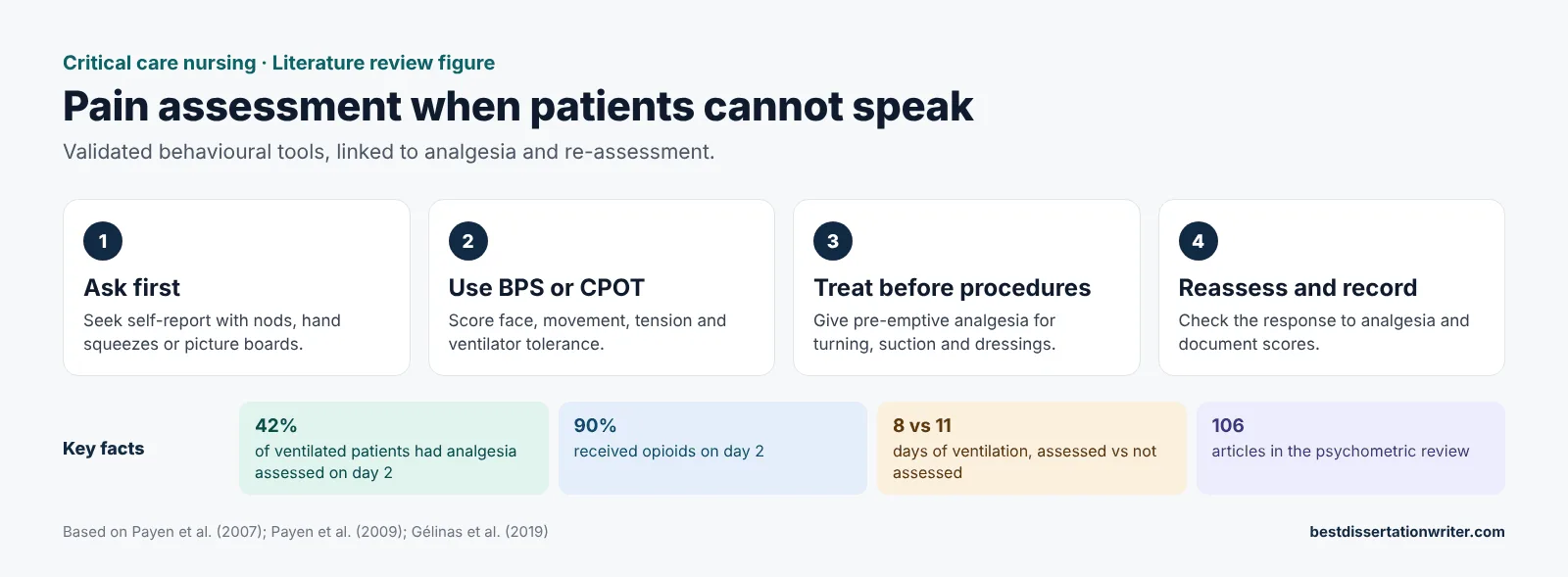
Across the three themes, a consistent picture emerges. Tools exist that allow nurses to recognise pain in patients who cannot speak, practice has historically fallen short of using them, and where assessment is done, care tends to improve in ways that matter to patients. Closing the gap between available evidence and everyday practice is therefore the main task for critical care teams.
Discussion
This review found that pain assessment in ventilated patients has historically lagged behind treatment, that validated behavioural tools are available, and that systematic assessment is associated with better pain management and shorter ventilation and intensive care stays. The BPS and CPOT have the strongest evidence, and adapted tools are extending assessment to patients with brain injury.
The evidence linking ICU pain assessment to outcomes comes mainly from observational and before-and-after studies, so it cannot prove that assessment itself causes better outcomes. Units that assess pain may differ in other ways, such as staffing, culture and use of protocols. Nevertheless, the consistency of findings, together with the ethical imperative to recognise and relieve pain, supports routine assessment.
For nurses, the key challenge is turning assessment into action. A score is only useful if it prompts treatment and re-assessment, and if nurses are confident to advocate for analgesia. Analgesia-first approaches, pre-emptive analgesia before procedures and clear protocols that authorise nurses to titrate analgesia can help. Education should cover not only how to score the tools but how to respond to scores.
Limitations of behavioural tools in ICU pain assessment should also be recognised. Deeply sedated patients may score low even when in pain, and agitation from delirium or other causes may produce high scores without pain. Families can sometimes help by describing how their relative usually expresses discomfort. Whenever possible, nurses should try to obtain self-report, even from intubated patients, using nods, hand squeezes or picture boards.
This review has limitations. The included sources are mainly observational, the practice data are from one country and are dated, and the review did not examine pharmacological management in detail. This review relied on openly accessible, English-language sources and did not involve independent double screening. Future research should test whether implementing tools with protocols improves patient-centred outcomes in randomised designs.
Implementation research also highlights the importance of leadership and audit. Units that introduce a tool without education, protocols and regular feedback may find that it is used inconsistently or that scores are recorded without action. Auditing ICU pain assessment, including whether high scores lead to treatment, can help to sustain improvement.
Implications of ICU Pain Assessment Evidence for Practice
Critical care nurses should assess pain at least every shift, before and after painful procedures and after analgesia, using the BPS or CPOT when patients cannot self-report, and should document scores and responses. Assessment should guide analgesia-first sedation, building on wider principles for managing acute and chronic pain, and should be repeated during activities such as early mobilisation.
Because unrelieved pain contributes to agitation and ICU delirium, regular assessment supports delirium prevention. Good pain control also supports weaning from mechanical ventilation by allowing lighter sedation and active participation in breathing trials.
Patients who recover can also be asked about their memories of pain during follow-up, and their accounts can help units to identify procedures or situations in which pain was poorly recognised or treated. Feedback from survivors is a powerful reminder of why structured assessment matters.
Conclusion
This systematic review examined the evidence on observational tools for pain assessment in intubated and non-communicative critically ill adults. Validated tools such as the BPS and CPOT are available, and systematic assessment is associated with better pain management and shorter ventilation and intensive care stays, although the evidence is largely observational.
ICU pain assessment is a core nursing responsibility. Routine use of validated tools, linked to analgesia protocols and supported by education, can help to ensure that patients who cannot speak for themselves receive the pain relief they need.
Above all, ICU pain assessment expresses a commitment to take seriously the pain of people who cannot speak for themselves.
References
Georgiou, E., Hadjibalassi, M., Lambrinou, E., Andreou, P., & Papathanassoglou, E. D. E. (2015). The impact of pain assessment on critically ill patients’ outcomes: A systematic review. BioMed Research International, 2015, 503830. https://doi.org/10.1155/2015/503830
Gélinas, C., Bérubé, M., Puntillo, K. A., Boitor, M., Richard-Lalonde, M., Bernard, F., Williams, V., Joffe, A. M., Steiner, C., & Marsh, R. (2021). Validation of the Critical-Care Pain Observation Tool-Neuro in brain-injured adults in the intensive care unit: A prospective cohort study. Critical Care, 25(1). https://doi.org/10.1186/s13054-021-03561-1
Gélinas, C., Joffe, A. M., Szumita, P. M., Payen, J.-F., Bérubé, M., Shahiri T, S., Boitor, M., Chanques, G., & Puntillo, K. A. (2019). A psychometric analysis update of behavioral pain assessment tools for noncommunicative, critically ill adults. AACN Advanced Critical Care, 30(4), 365–387. https://doi.org/10.4037/aacnacc2019952
Payen, J.-F., Bosson, J.-L., Chanques, G., Mantz, J., Labarère, J., et al. (2009). Pain assessment is associated with decreased duration of mechanical ventilation in the intensive care unit: A post hoc analysis of the DOLOREA study. Anesthesiology, 111(6), 1308–1316. https://doi.org/10.1097/ALN.0b013e3181c0d4f0
Payen, J.-F., Chanques, G., Mantz, J., Hercule, C., Auriant, I., Leguillou, J.-L., Binhas, M., Genty, C., Rolland, C., & Bosson, J.-L. (2007). Current practices in sedation and analgesia for mechanically ventilated critically ill patients: A prospective multicenter patient-based study. Anesthesiology, 106(4), 687–695. https://doi.org/10.1097/01.anes.0000264747.09017.da
Cite this example
Best Dissertation Writers (2026) ICU Pain Assessment in Intubated and Non-Communicative Patients: A Systematic Review of Observational Tools. Available at: https://bestdissertationwriter.com/icu-pain-assessment-literature-review/
Best Dissertation Writers
Get expert help with your nursing literature review
Share your topic and deadline with Best Dissertation Writers and get support tailored to your module brief.