The Role of Nurses in Assessing and Managing Acute and Chronic Pain in Adult Patients: An Integrative Review
 By Dr. Robertson Prime, Research Fellow
Updated October 12, 2026
16 min read
About 3,100 words
By Dr. Robertson Prime, Research Fellow
Updated October 12, 2026
16 min read
About 3,100 words
In this review
Abstract
Background: Many hospitalised adults experience acute and chronic pain together, for example a patient with long-standing back pain who is admitted for surgery. Poorly controlled pain causes distress, delays mobilisation and recovery and can contribute to complications, and between one-third and one-half of UK adults are estimated to live with chronic pain.
Aim: This integrative review aimed to explore the nurse’s role in assessing and managing pain in adult patients and the factors that help or hinder effective practice.
Methods: Evidence was identified through targeted searches of openly accessible bibliographic records, publisher websites and the reference lists of key reviews. Eight sources published between 2016 and 2024 were included: four systematic reviews, one clinical practice guideline, one professional position statement, one consensus paper on the definition of pain and one qualitative study. Following the Whittemore and Knafl approach, sources were appraised with CASP checklists and grouped into themes.
Findings: Between 37.7% and 84% of hospitalised adults reported pain and between 9% and 36% reported severe pain, with medical wards a particular blind spot. Pain assessment was often incomplete, with nurses relying on physiological signs rather than validated behavioural tools and underestimating pain in sedated patients. Barriers included limited knowledge, fear of causing addiction, stigma, heavy workloads and poor collaboration, and education for nurses improved documentation but had mixed effects on patients’ pain scores.
Conclusion: Nurses should assess pain regularly with validated tools, respect patients’ reports without judgement and advocate for those who cannot self-report. Pain management education is most effective when supported by protocols, audit and access to pain specialists.
Keywords: acute and chronic pain, pain assessment, pain management
Introduction
This integrative review critically examines recent evidence on acute and chronic pain and its implications for adult nursing practice.
Pain is one of the most common reasons people seek healthcare and one of the most frequent problems patients experience once they are admitted to hospital. Poorly controlled pain causes distress, disturbs sleep, delays mobilisation and recovery, and can contribute to complications such as chest infections, blood clots and delirium. It also shapes how patients judge the quality of their care, and it is one of the experiences of hospital that patients and families remember most clearly.
Nurses spend more time with patients than any other professional group, which places them at the centre of pain assessment and pain management. They ask about pain, observe behaviour, give and evaluate analgesia, offer non-drug measures and advocate for patients when treatment is not working. Yet studies across many countries continue to report that hospitalised patients experience moderate or severe pain, suggesting that knowledge and good intentions do not always translate into effective care.
An integrative design was chosen because the question is best answered by combining different types of evidence, including prevalence studies, guidelines, reviews of nursing education and qualitative research on nurses’ experiences.
Review question
What is the nurse’s role in assessing and managing acute and chronic pain in adult patients, and what factors help or hinder effective practice?
Background to Acute and Chronic Pain
The International Association for the Study of Pain revised its definition of pain in 2020, describing it as an unpleasant sensory and emotional experience associated with, or resembling that associated with, actual or potential tissue damage (Raja et al., 2020). The accompanying notes emphasise that pain is always a personal experience shaped by biological, psychological and social factors, and that a person’s report of pain should be respected. This definition underpins the nursing principle that pain is what the patient says it is.
Acute pain has a recent onset and a clear cause, such as surgery, injury or an acute illness, and usually improves as tissues heal. Chronic pain persists for more than three months and may continue after healing, often affecting mood, sleep, function and relationships. Many hospitalised adults experience both, for example a patient with long-standing back pain who is admitted for surgery. Caring for these patients requires nurses to manage new acute pain while respecting existing treatments and the patient’s own coping strategies.
Chronic pain is common in the general population. In a meta-analysis of UK population studies, Fayaz et al. (2016) estimated that between one-third and one-half of adults live with chronic pain, equivalent to just under 28 million people. As the population ages, more patients will arrive in hospital already living with chronic pain, which makes the combined assessment and management of acute and chronic pain an increasingly important part of adult nursing.
Search Strategy and Methods
Evidence for this example was identified through targeted searches of openly accessible bibliographic records, publisher websites and the reference lists of key reviews. Search terms combined keywords for pain (“acute pain”, “chronic pain”, “postoperative pain”) with terms for nursing practice (“pain assessment”, “pain management”, “nurse*”, “education”, “barriers”) and for the hospital setting, joined with the Boolean operators AND and OR. A full integrative review for assessment would run the same strategy in CINAHL, PubMed/MEDLINE, PsycINFO and the Cochrane Library and report the number of records screened in a PRISMA flow diagram.
Sources were eligible if they addressed the assessment or management of acute and chronic pain in adults in hospital, with a focus on nursing practice. Systematic reviews, clinical guidelines, position statements, prevalence studies and qualitative studies were included. Studies of children, of pain in palliative care at home and of purely pharmacological trials without relevance to nursing were excluded. Sources focused on intensive care were included where their findings were relevant to acute and chronic pain on general wards.
Eight sources published between 2016 and 2024 were included: four systematic reviews, one clinical practice guideline, one professional position statement, one consensus paper on the definition of pain and one qualitative study (Table 1). In line with the Whittemore and Knafl approach to integrative reviews, the quality of each source was appraised with a tool matched to its design, using the Critical Appraisal Skills Programme (CASP) checklists. Data were extracted into a matrix, compared and grouped into themes.
Key Findings on Acute and Chronic Pain
Three themes emerged: the scale of unrelieved pain in hospital, the challenges of assessing pain accurately, and the nurse, patient and organisational barriers that limit effective management. Table 1 summarises the included sources.
| Author, year | Design | Setting and sample | Key finding |
|---|---|---|---|
| Raja et al. (2020) | Consensus paper (IASP task force) | International pain experts | Revised definition: pain is a personal sensory and emotional experience; a person’s report should be respected. |
| Fayaz et al. (2016) | Systematic review and meta-analysis | UK population studies | Chronic pain affects between one-third and one-half of UK adults (pooled 43.5%). |
| Gregory and McGowan (2016) | Systematic review | Hospitalised adults | Pain prevalence 37.7–84%; severe pain 9–36%; up to 55% of medical patients reported pain. |
| Chou et al. (2016) | Clinical practice guideline | Adults having surgery; United States | Pain management should begin before surgery; multimodal analgesia and patient education recommended. |
| Herr et al. (2024) | Professional position statement (ASPMN) | Patients unable to self-report | No objective pain measure exists; use a hierarchy of assessment and advocate for patients. |
| Rababa et al. (2021) | Systematic review | 20 studies of critical care nurses | Barriers: limited knowledge, reliance on vital signs, workload, lack of protocols; facilitators: education, protocols, handover. |
| Drake and de C Williams (2017) | Systematic review | 12 studies of nursing education | Education improved pain documentation; effects on patients’ pain mixed. |
| Horner et al. (2019) | Qualitative interview study | 22 inpatient nurses; one United States hospital | Caring for patients with opioid use disorder involved stigma, doubt about pain reports and moral strain. |
Theme 1: The Scale of Acute and Chronic Pain in Hospital
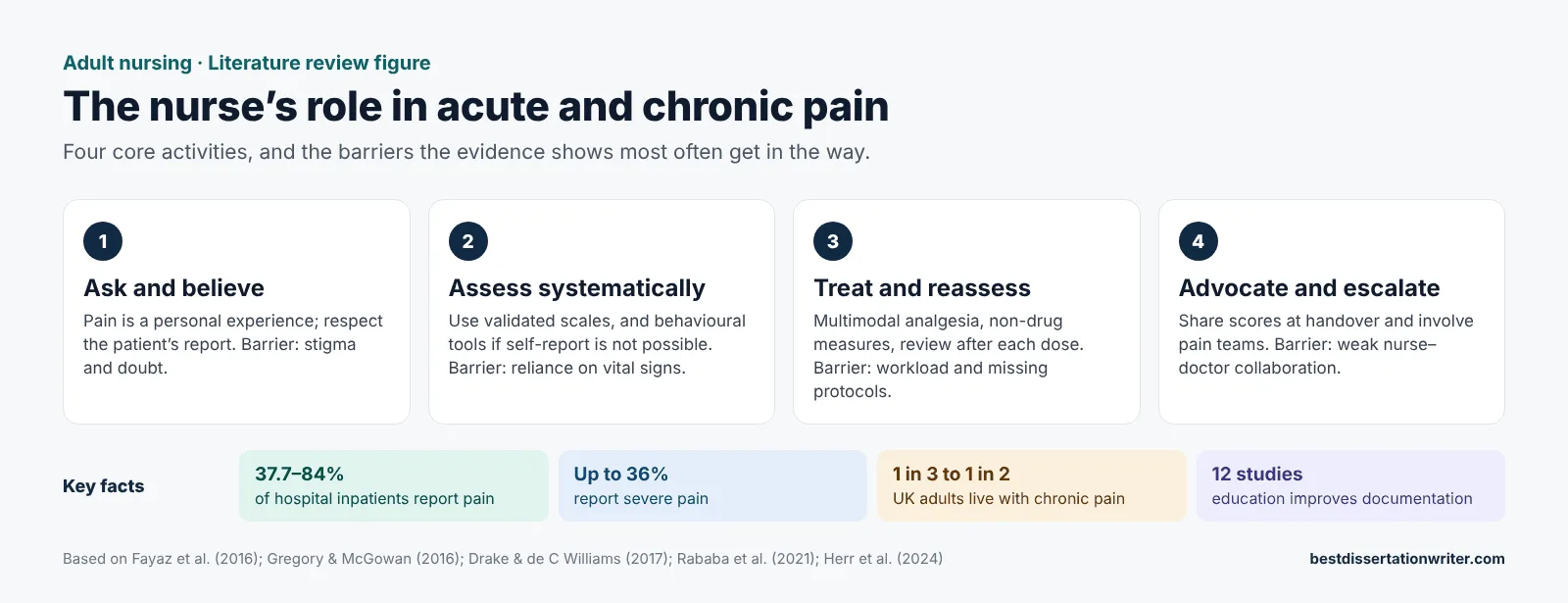
Pain remains common among hospital inpatients. In a systematic review of acute pain prevalence, Gregory and McGowan (2016) found that between 37.7% and 84% of hospitalised adults reported pain, and that between 9% and 36% reported severe pain. Surgical patients reported more pain than medical patients, but up to 55% of medical patients also reported pain, a group that often receives less attention from pain services. The authors recommended that acute pain services cover all hospital areas, including medical wards.
The wide range of estimates reflects differences in how pain was measured and in the populations studied, but the overall pattern is clear: a substantial proportion of patients experience pain that is not adequately controlled. Combined with the high population prevalence of chronic pain reported by Fayaz et al. (2016), these findings suggest that many patients admitted with acute and chronic pain do not receive the relief they need, and that medical wards may be a particular blind spot.
Undertreated pain has consequences beyond discomfort. Pain that limits deep breathing and coughing increases the risk of chest infection, pain that prevents walking increases the risk of blood clots and deconditioning, and severe pain after surgery is a recognised risk factor for persistent postsurgical pain. Addressing acute and chronic pain effectively in hospital is therefore a safety issue as well as a matter of comfort and dignity.
Theme 2: Assessing Pain Accurately
Accurate pain assessment is the foundation of effective care. Clinical guidance recommends that management begins with assessment and planning before surgery, followed by regular reassessment and adjustment of treatment (Chou et al., 2016). The guideline from the American Pain Society and partner organisations also recommends multimodal analgesia, which combines different drugs and techniques, together with patient education, to improve relief while limiting the side effects of opioids.
Self-report is the most reliable measure of pain, but some patients cannot provide it because of sedation, delirium, dementia, critical illness or communication difficulties. The American Society for Pain Management Nursing position statement stresses that no objective test can measure pain and that nurses must therefore combine several sources of information to infer whether pain is present and to judge the response to treatment (Herr et al., 2024). The statement describes a hierarchy of pain assessment and calls on nurses to advocate for patients who cannot speak for themselves.
Assessing patients with long-standing pain brings additional challenges. A single pain score may not show a change from the person’s usual level, and some people who have lived with pain for years show few outward signs of distress. Asking about the patient’s usual pain, what normally helps and how the current pain differs gives a more meaningful picture than a number alone. This approach reflects the emphasis on pain as an individual experience (Raja et al., 2020) and helps nurses separate new acute pain from the background of acute and chronic pain the patient already lives with.
In practice, assessment is often incomplete. In a systematic review of 20 studies in critical care, Rababa et al. (2021) found that nurses frequently relied on physiological signs rather than validated behavioural tools, underestimated pain in sedated patients and were hampered by the absence of standardised tools and protocols. Although that review focused on critical care, similar problems are likely on general wards, where patients with dementia or delirium are common.
Theme 3: Barriers, Attitudes and Education
Rababa et al. (2021) identified barriers at several levels. Nurse-related barriers included limited knowledge of pain assessment tools and analgesia, negative attitudes and fear of causing addiction. Patient-related barriers included inability to communicate and a history of substance misuse. Organisational barriers included heavy workloads, staff shortages, inadequate training, poor documentation and weak collaboration between nurses and doctors. Facilitators included ongoing education, evidence-based protocols and discussing pain scores at handover.
Caring for patients with complex acute and chronic pain can be particularly difficult when opioid use is involved. In interviews with 22 inpatient nurses in the United States, Horner et al. (2019) found that caring for patients with opioid use disorder created moral and emotional strain. Nurses described stigma, difficulty judging whether pain reports were genuine, burnout and poor communication between professionals, and called for clearer hospital policies and support. These findings show how attitudes and organisational culture can affect whether a patient’s pain is believed and treated.
Education is the most frequently tested response to these barriers. In a systematic review of 12 studies, Drake and de C Williams (2017) found that education for nurses usually improved the documentation of pain assessment, but that effects on patients’ pain scores were mixed, with some studies reporting less pain and greater satisfaction. The authors concluded that education programmes should draw on behaviour-change theory and address the relational, emotional and contextual aspects of pain management, rather than focusing on knowledge alone.
Discussion
This review shows a persistent gap between what is known about pain care and what patients experience. Guidelines and position statements clearly set out the principles of regular assessment, multimodal analgesia and advocacy, yet studies continue to report high levels of moderate and severe pain in hospital. The evidence suggests that this gap is explained less by a lack of effective treatments than by inconsistent assessment, limited knowledge, negative attitudes and organisational pressures that make good care difficult to deliver for patients with acute and chronic pain.
The findings also highlight the particular challenge of acute and chronic pain occurring together. Patients with chronic pain or opioid tolerance may need higher doses of analgesia, may describe pain differently and may be viewed with suspicion. The qualitative evidence from Horner et al. (2019) suggests that stigma can influence clinical judgement, which conflicts with the principle that pain is a personal experience to be respected (Raja et al., 2020). Nurses therefore need both clinical knowledge and reflective awareness of their own attitudes.
Education appears necessary but not sufficient. Training improves documentation, but improving patients’ pain may also require changes to systems, such as standardised assessment tools, clear escalation routes, protocols for multimodal analgesia and access to specialist pain teams across medical as well as surgical wards. This is consistent with the facilitators identified by Rababa et al. (2021), which combine individual learning with organisational support and teamwork.
The role of patients themselves also deserves attention. Several sources emphasise education and partnership, from explaining analgesia plans before surgery (Chou et al., 2016) to involving people with long-standing pain in decisions about their treatment. Patients who understand how to report pain, when to ask for analgesia and how non-drug measures can help are better able to take part in their own care. Building this partnership into everyday nursing practice is likely to strengthen the effect of staff education and protocols on acute and chronic pain.
The evidence base has limitations. Prevalence studies used different measures, many studies of barriers were cross-sectional surveys, and two key sources focused on critical care or a single United States hospital. The guideline and position statement draw on North American practice. This review relied on openly accessible, English-language sources, so findings from other settings may have been missed. Future research should test combined education and system interventions on general wards and measure patients’ pain and function, not only documentation.
Implications of Acute and Chronic Pain Evidence for Practice
For adult nurses, the evidence on acute and chronic pain supports asking every patient about pain regularly, using a validated scale, and using behavioural tools for patients who cannot self-report. Nurses should reassess after giving analgesia, discuss pain scores at handover and escalate when pain remains uncontrolled. Patients with chronic pain should have their usual treatments and coping strategies recorded on admission, and their reports of pain should be respected without judgement. Non-drug measures such as positioning, relaxation and distraction should be offered alongside medicines, and their effect recorded.
Ward managers and educators should combine pain education with audit and feedback, standardised tools and clear access to pain specialists. Good pain management also supports other safety goals, because uncontrolled pain can limit mobility and increase the risk of hospital-acquired pressure ulcers and falls. Safe analgesia depends on accurate prescribing and administration, linking pain care to the prevention of medication administration errors, while recovery from surgery is affected by hospital-acquired infections.
Conclusion
This integrative review examined the nurse’s role in assessing and managing acute and chronic pain in adult patients. Pain remains common and often undertreated in hospital, particularly on medical wards and among patients who cannot report their pain. The main obstacles are inconsistent assessment, gaps in knowledge, negative attitudes and organisational pressures, rather than a lack of effective treatments.
Nurses can improve care for patients with acute and chronic pain by assessing pain systematically, believing and acting on patients’ reports, advocating for those who cannot speak for themselves and working with colleagues to make multimodal pain management routine. Education is most effective when it is supported by clear protocols, audit and a ward culture that treats pain relief as a core part of nursing care.
References
Chou, R., Gordon, D. B., de Leon-Casasola, O. A., Rosenberg, J. M., Bickler, S., Brennan, T., Carter, T., Cassidy, C. L., Chittenden, E. H., Degenhardt, E., Griffith, S., Manworren, R., McCarberg, B., Montgomery, R., Murphy, J., Perkal, M. F., Suresh, S., Sluka, K., Strassels, S., … Wu, C. L. (2016). Management of postoperative pain: A clinical practice guideline from the American Pain Society, the American Society of Regional Anesthesia and Pain Medicine, and the American Society of Anesthesiologists’ Committee on Regional Anesthesia, Executive Committee, and Administrative Council. The Journal of Pain, 17(2), 131–157. https://doi.org/10.1016/j.jpain.2015.12.008
Drake, G., & de C Williams, A. C. (2017). Nursing education interventions for managing acute pain in hospital settings: A systematic review of clinical outcomes and teaching methods. Pain Management Nursing, 18(1), 3–15. https://doi.org/10.1016/j.pmn.2016.11.001
Fayaz, A., Croft, P., Langford, R. M., Donaldson, L. J., & Jones, G. T. (2016). Prevalence of chronic pain in the UK: A systematic review and meta-analysis of population studies. BMJ Open, 6(6), e010364. https://doi.org/10.1136/bmjopen-2015-010364
Gregory, J., & McGowan, L. (2016). An examination of the prevalence of acute pain for hospitalised adult patients: A systematic review. Journal of Clinical Nursing, 25(5–6), 583–598. https://doi.org/10.1111/jocn.13094
Herr, K., Anderson, A. R., Arbour, C., Coyne, P. J., Ely, E., Gélinas, C., & Manworren, R. C. B. (2024). ASPMN 2024 position statement: Pain assessment in the patient unable to self-report. Pain Management Nursing, 25(6), 569–570. https://doi.org/10.1016/j.pmn.2024.09.009
Horner, G., Daddona, J., Burke, D. J., Cullinane, J., Skeer, M., & Wurcel, A. G. (2019). “You’re kind of at war with yourself as a nurse”: Perspectives of inpatient nurses on treating people who present with a comorbid opioid use disorder. PLoS ONE, 14(10), e0224335. https://doi.org/10.1371/journal.pone.0224335
Rababa, M., Al-Sabbah, S., & Hayajneh, A. A. (2021). Nurses’ perceived barriers to and facilitators of pain assessment and management in critical care patients: A systematic review. Journal of Pain Research, 14, 3475–3491. https://doi.org/10.2147/JPR.S332423
Raja, S. N., Carr, D. B., Cohen, M., Finnerup, N. B., Flor, H., Gibson, S., Keefe, F. J., Mogil, J. S., Ringkamp, M., Sluka, K. A., Song, X.-J., Stevens, B., Sullivan, M. D., Tutelman, P. R., Ushida, T., & Vader, K. (2020). The revised International Association for the Study of Pain definition of pain: Concepts, challenges, and compromises. Pain, 161(9), 1976–1982. https://doi.org/10.1097/j.pain.0000000000001939
Cite this example
Best Dissertation Writers (2026) The Role of Nurses in Assessing and Managing Acute and Chronic Pain in Adult Patients: An Integrative Review. Available at: https://bestdissertationwriter.com/acute-and-chronic-pain-review-review/
Best Dissertation Writers
Get expert help with your nursing literature review
Share your topic and deadline with Best Dissertation Writers and get support tailored to your module brief.