Nurse-Led Education and Medication Adherence in Adults with Hypertension: A Systematic Review
 By Dr. Robertson Prime, Research Fellow
Updated October 12, 2026
15 min read
About 2,900 words
By Dr. Robertson Prime, Research Fellow
Updated October 12, 2026
15 min read
About 2,900 words
In this review
Abstract
Background: Medication adherence describes the extent to which a person takes their medicines as agreed with their health professional, and poor adherence is one of the main reasons why many people with hypertension do not reach their treatment targets. Because high blood pressure rarely causes symptoms and treatment is usually lifelong, motivation to continue taking medicines can be difficult to sustain.
Aim: This systematic review aimed to examine whether nurse-led education and support interventions improve medicine-taking and blood pressure control in adults with hypertension, and which components appear most effective.
Methods: Evidence was identified through targeted searches of openly accessible bibliographic records, publisher websites and the reference lists of key reviews. Six sources published between 2010 and 2024 were included: five systematic reviews with meta-analysis, including one Cochrane review, and one World Health Organization global report, appraised with the CASP systematic review checklist and synthesised narratively into themes.
Findings: Nurse-led care lowered systolic blood pressure, with the largest reductions when nurses followed a stepped treatment algorithm (8.2 mm Hg) or could prescribe (8.9 mm Hg), although effects in primary care were smaller in the long term. Interventions produced a modest overall improvement in adherence, but one review found no significant long-term difference, and measures of adherence varied. Linking medicines to daily habits, feedback, self-monitoring of blood pressure, pill boxes and motivational interviewing were among the most effective components.
Conclusion: Nurses should ask non-judgementally about medicine-taking, explore beliefs, agree practical strategies such as pill organisers and home monitoring, and provide planned, ongoing follow-up. Patient education works best when combined with practical tools and the ability to adjust treatment.
Keywords: medication adherence, hypertension, patient education, blood pressure
Introduction
This systematic review critically examines recent evidence on medication adherence and its implications for adult nursing practice.
Hypertension, or high blood pressure, is one of the most important causes of stroke, heart attack, heart failure and kidney disease. Effective medicines have been available for decades, and for most people they can bring blood pressure under control. Yet across the world, many people with diagnosed hypertension do not reach their treatment targets, and one of the main reasons is that medicines are not taken as prescribed.
Medication adherence describes the extent to which a person takes their medicines as agreed with their health professional, including taking the right dose at the right time and continuing treatment over the long term. Poor adherence can be intentional, when people decide not to take a medicine because of side effects, beliefs or cost, or unintentional, when they forget or find the regimen confusing. Nurses in primary care, hospital clinics and community settings are often responsible for supporting people with hypertension to start and continue treatment.
A systematic approach was chosen so that systematic reviews and meta-analyses of randomised controlled trials, which provide the strongest evidence on effectiveness, could be identified and appraised. Understanding what works matters because poor medication adherence remains one of the main barriers to controlling hypertension.
Review question
Do nurse-led education and support interventions improve medication adherence and blood pressure control in adults with hypertension, and which components appear most effective?
Background to Medication Adherence
The global burden of hypertension is substantial. In its first global report on the condition, the World Health Organization (2023) estimated that the number of adults with hypertension doubled between 1990 and 2019 to 1.3 billion, around one in three adults worldwide. Nearly half did not know they had the condition, and only about one in five had their blood pressure under control. The organisation estimated that improving treatment could prevent 76 million deaths by 2050.
Medication adherence is a major part of this treatment gap. Antihypertensive medicines must usually be taken every day for life, often in combination, even though high blood pressure rarely causes symptoms. People may stop taking tablets when they feel well, experience side effects or worry about long-term use. Because the consequences of poor adherence, such as stroke, may not appear for years, the motivation to continue treatment can be difficult to sustain.
Several factors are known to make taking medicines harder. Regimens involving several tablets taken at different times of day, side effects such as ankle swelling or frequent urination, and frequent changes to treatment can all reduce consistency. Older adults may also have memory problems or difficulty opening packaging, while younger working adults may find it hard to fit medicines and appointments into busy lives. Recognising these barriers is the first step in offering support that fits each person’s circumstances.
Improving adherence is difficult. A Cochrane review of 182 randomised trials of interventions to enhance medication adherence across chronic conditions found that even the most effective interventions produced only modest improvements, and that only five of the 17 trials at lowest risk of bias improved both adherence and clinical outcomes (Nieuwlaat et al., 2014). The most effective approaches were usually complex, combining education, counselling and ongoing support, which suggests a natural role for nurses in supporting people to take their medicines.
Search Strategy and Methods
Evidence for this example was identified through targeted searches of openly accessible bibliographic records, publisher websites and the reference lists of key reviews. Search terms combined keywords for the outcome (“medication adherence”, “compliance”, “blood pressure control”) with terms for the population and intervention (“hypertension”, “nurse-led”, “patient education”, “self-monitoring”), joined with the Boolean operators AND and OR. A full systematic review for assessment would run the same strategy in CINAHL, PubMed/MEDLINE, the Cochrane Library and Embase and report the number of records screened in a PRISMA flow diagram.
Sources were eligible if they evaluated interventions to improve medication adherence or blood pressure control in adults with hypertension, with a focus on nurse-led or nurse-deliverable interventions, or provided key epidemiological context. Systematic reviews and meta-analyses of randomised trials were prioritised. Studies of children, pregnancy-related hypertension and pharmacological comparisons without an adherence component were excluded.
Six sources published between 2010 and 2024 were included, reflecting the most comprehensive syntheses available on this question: five systematic reviews with meta-analysis, including one Cochrane review, and one World Health Organization global report (Table 1). The quality of each review was appraised using the Critical Appraisal Skills Programme (CASP) systematic review checklist, and findings on medication adherence and blood pressure were synthesised narratively and grouped into themes.
Key Findings on Medication Adherence
Three themes were identified: the effect of nurse-led care on blood pressure, the effect of interventions on medication adherence, and the components that make interventions more effective. Table 1 summarises the included sources, and Figure 1 shows the reductions in systolic blood pressure reported for different types of nurse-led care.
| Author, year | Design | Setting and sample | Key finding |
|---|---|---|---|
| Clark et al. (2010) | Systematic review and meta-analysis | 33 RCTs of nurse-led hypertension care | Systolic BP fell 8.2 mm Hg with algorithms and 8.9 mm Hg with nurse prescribing; smaller effects for clinics. |
| Nieuwlaat et al. (2014) | Cochrane systematic review | 182 RCTs across chronic conditions | Adherence interventions mostly complex and only modestly effective; 5 of 17 best trials improved adherence and outcomes. |
| Conn et al. (2015) | Systematic review and meta-analysis | 112 comparisons, 34,272 participants with hypertension | Modest improvement in adherence (SMD 0.30); habits, feedback, self-monitoring and pill boxes most effective. |
| Stephen et al. (2022) | Systematic review and meta-analysis | 11 RCTs, 4,454 participants; general practice | Short-term reductions in systolic and diastolic BP; improved medication adherence and lifestyle measures. |
| World Health Organization (2023) | Global report | Worldwide data | 1.3 billion adults with hypertension; only about one in five have it controlled. |
| Ito et al. (2024) | Systematic review and meta-analysis | 35 studies in primary care | Systolic BP −4.46 mm Hg short term and −2.33 mm Hg long term; no long-term difference in adherence. |
Theme 1: Nurse-Led Care and Blood Pressure
Several reviews show that nurse-led care can lower blood pressure. In a meta-analysis of 33 randomised trials, Clark et al. (2010) found that the largest reductions occurred when nurses followed a stepped treatment algorithm, which lowered systolic blood pressure by 8.2 mm Hg compared with usual care, and when nurses were able to prescribe, which lowered it by 8.9 mm Hg. Community monitoring and nurse-led clinics in primary care produced smaller reductions, while telephone monitoring alone did not significantly reduce systolic pressure, although patients were more likely to reach their targets.
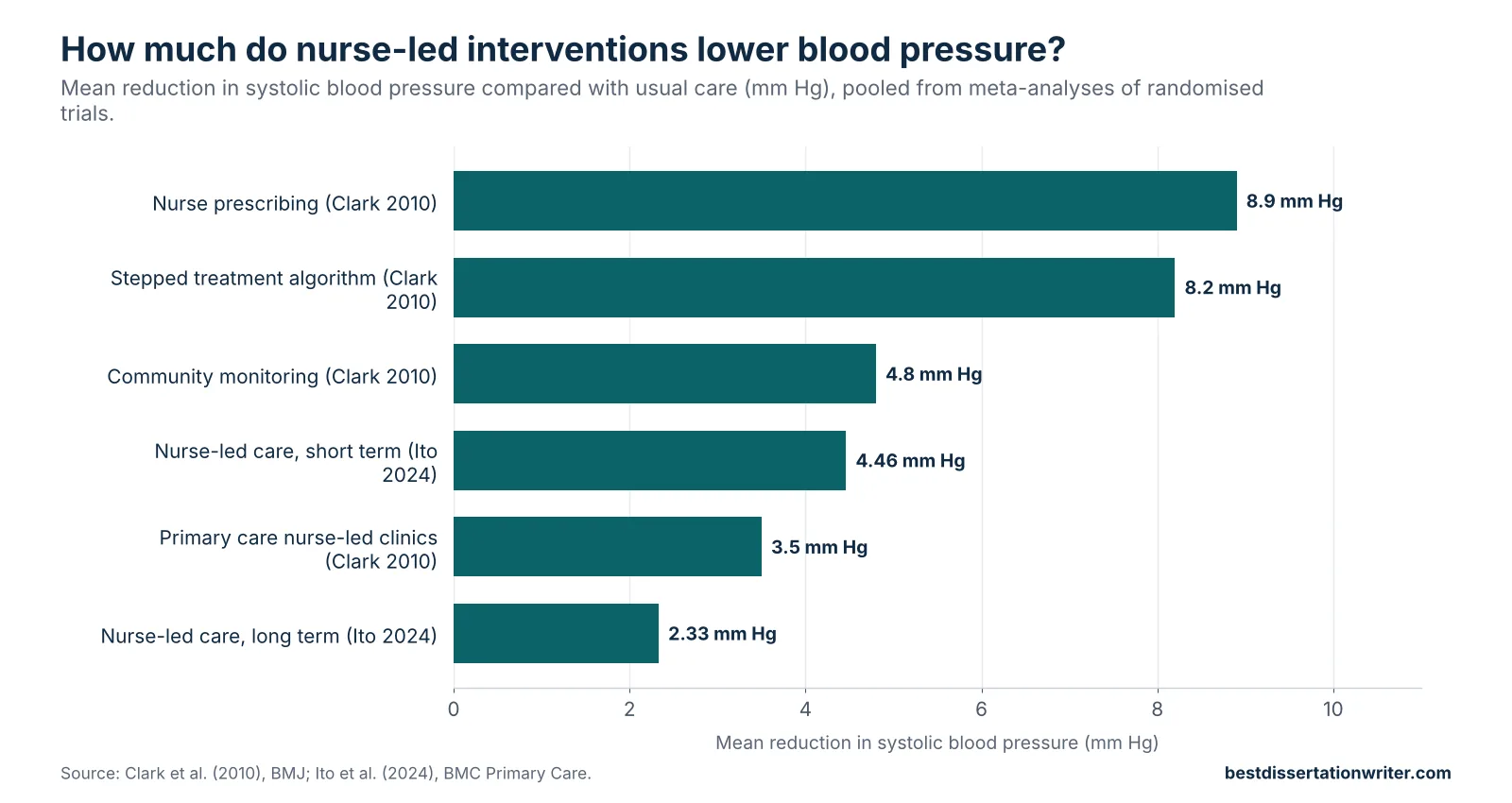
More recent evidence supports these findings but suggests that effects may be smaller over time. In a meta-analysis of 35 studies in primary care, Ito et al. (2024) found that nurse-led interventions reduced systolic blood pressure by 4.46 mm Hg in the short term and by 2.33 mm Hg in the long term, and improved the proportion of people reaching long-term blood pressure goals. Stephen et al. (2022), reviewing 11 trials in general practice, also reported significant short-term reductions in systolic and diastolic blood pressure.
These reductions may appear small, but at population level even a few millimetres of mercury can substantially reduce the risk of stroke and heart disease. The larger effects seen when nurses could adjust treatment suggest that nurse-led care works partly by intensifying treatment, rather than solely by helping people take their tablets more consistently.
Theme 2: Effects on Medication Adherence
Evidence on medication adherence itself is more mixed. In a meta-analysis of interventions to improve adherence among people with hypertension, Conn et al. (2015) analysed 112 comparisons involving 34,272 participants and found a modest overall improvement in adherence, with a standardised mean difference of 0.30. Stephen et al. (2022) reported that nurse-led interventions in general practice improved medication adherence alongside blood lipids and physical activity.
However, Ito et al. (2024) found no significant long-term difference in medication adherence between nurse-led care and usual care, based on three studies with 558 participants. Adherence was measured in different ways across studies, including self-report, pill counts and pillbox checks, which made comparison difficult. These inconsistencies reflect a wider challenge in this field of research: there is no single gold-standard measure, and self-report tends to overestimate how well people take their medicines.
Theme 3: Effective Components of Interventions
The reviews identified several components associated with greater effect. Conn et al. (2015) found that linking medicine-taking to existing daily habits, giving people feedback about their adherence, self-monitoring of blood pressure, using pill boxes or special packaging and motivational interviewing were among the most effective strategies. Interventions with several components delivered over a longer period worked better than brief, single-component education.
Self-monitoring of blood pressure deserves particular mention. When people measure their own blood pressure at home, they can see the effect of their medicines and may feel more in control of their condition. Readings shared with a nurse also allow treatment to be adjusted without waiting for clinic appointments. However, self-monitoring requires a validated device, correct technique and a clear plan for what to do with the readings, and some people find it a source of anxiety rather than reassurance. Nurses are well placed to teach technique and to help people interpret their results.
The way information is delivered also matters. Patient education that simply lists facts about hypertension is less likely to change behaviour than education that is tailored to the person’s concerns, uses plain language and checks understanding. Many people hold beliefs that medicines are only needed when they feel unwell, or worry about becoming dependent on tablets. Addressing these beliefs directly, and agreeing goals together, may be as important as the information itself.
These findings are consistent with the conclusion of Nieuwlaat et al. (2014) that effective adherence interventions are usually complex and involve ongoing support. Clark et al. (2010) similarly concluded that nurse-led care for hypertension requires an algorithm to structure care. Together, these sources suggest that patient education is necessary but not sufficient on its own; it works best when combined with practical tools, regular follow-up and the ability to adjust treatment.

Discussion
This review shows that nurse-led interventions can lower blood pressure in adults with hypertension and that interventions designed to improve medication adherence produce modest benefits. The strongest effects on blood pressure were seen when nurses followed structured algorithms or could prescribe, suggesting that the nursing role in hypertension care is most effective when it combines education with clinical decision-making.
The evidence on medication adherence is less clear-cut. Improvements were modest overall, varied between reviews and were difficult to sustain over time. This is consistent with the broader finding that adherence is hard to change (Nieuwlaat et al., 2014). One explanation is that adherence is influenced by many factors, including beliefs about medicines, side effects, cost, complexity of the regimen and trust in health professionals, which a single intervention cannot fully address.
A person-centred approach may help to explain why some interventions succeed. Strategies such as motivational interviewing and linking medicines to daily habits respond to individual beliefs and routines, rather than simply providing information. Nurses who explore why a person is not taking their medicines, without judgement, are better placed to tailor support. This requires good communication skills and time, which may be limited in busy clinics.
Equity is a further consideration. People on low incomes may struggle to pay for prescriptions or travel to appointments, and those with limited literacy or who do not speak the local language may find written information difficult to use. Conn et al. (2015) found larger effects among participants with moderate or high incomes, which raises the possibility that some interventions benefit more advantaged groups most. Nurses should therefore consider practical and social barriers, such as cost, transport and language, when supporting people to take their medicines, and adapt materials accordingly.
The decline in effect over time also deserves attention. Ito et al. (2024) found smaller long-term than short-term reductions in blood pressure, suggesting that the benefits of interventions fade unless support continues. Hypertension is a lifelong condition, so medication adherence support should be ongoing rather than a one-off education session.
The evidence base has limitations. The included reviews pooled trials with very different interventions, settings and measures of adherence, and many trials were conducted in high-income countries. Self-reported adherence may overestimate actual medicine-taking. This review relied on openly accessible, English-language sources and did not involve independent double screening. Future research should use objective measures of medication adherence and test sustained nurse-led support in diverse populations. Studies should also follow participants for longer, since hypertension is lifelong and short-term gains may not translate into fewer strokes and heart attacks.
Implications of Medication Adherence Evidence for Practice
For adult nurses, the evidence on medication adherence supports asking every person with hypertension, in a non-judgemental way, how they are getting on with their medicines and whether they have missed any doses. Nurses should explore beliefs and concerns, explain how treatment protects against stroke and heart disease, and agree practical strategies such as linking tablets to daily routines, using pill organisers and home blood pressure monitoring. Where local protocols allow, structured algorithms for adjusting treatment should be followed so that uncontrolled blood pressure is addressed promptly.
Nurses should also review the whole regimen with the prescriber where it is complex, since simplifying treatment, for example by using once-daily or combination tablets, can make medicines easier to take. Follow-up should be planned rather than left to chance, with regular contact by telephone or in person until blood pressure is controlled and periodically thereafter.
These skills draw on evidence about therapeutic communication skills, since trust and understanding influence whether people continue treatment. Similar principles apply to people with chronic obstructive pulmonary disease and other long-term conditions. Safe use of antihypertensive medicines in hospital links to preventing medication administration errors, and very high or very low blood pressure readings should be escalated through early warning scores.
Conclusion
This systematic review examined nurse-led education and support for medication adherence in adults with hypertension. Nurse-led care lowers blood pressure, particularly when nurses follow treatment algorithms or prescribe, and adherence interventions produce modest benefits, especially when they combine several practical components and continue over time.
Improving medication adherence requires more than information. Nurses can make a difference by building trusting relationships, tailoring support to each person’s beliefs and routines, using practical tools such as self-monitoring and pill organisers, and providing ongoing follow-up, supported by services that allow them to adjust treatment when blood pressure remains high.
References
Clark, C. E., Smith, L. F. P., Taylor, R. S., & Campbell, J. L. (2010). Nurse led interventions to improve control of blood pressure in people with hypertension: Systematic review and meta-analysis. BMJ, 341, c3995. https://doi.org/10.1136/bmj.c3995
Conn, V. S., Ruppar, T. M., Chase, J.-A. D., Enriquez, M., & Cooper, P. S. (2015). Interventions to improve medication adherence in hypertensive patients: Systematic review and meta-analysis. Current Hypertension Reports, 17(12), 94. https://doi.org/10.1007/s11906-015-0606-5
Ito, M., Tajika, A., Toyomoto, R., Imai, H., Sakata, M., Honda, Y., Kishimoto, S., Fukuda, M., Horinouchi, N., Sahker, E., … Furukawa, T. A. (2024). The short and long-term efficacy of nurse-led interventions for improving blood pressure control in people with hypertension in primary care settings: A systematic review and meta-analysis. BMC Primary Care, 25, 143. https://doi.org/10.1186/s12875-024-02380-x
Nieuwlaat, R., Wilczynski, N., Navarro, T., Hobson, N., Jeffery, R., Keepanasseril, A., Agoritsas, T., Mistry, N., Iorio, A., Jack, S., Sivaramalingam, B., Iserman, E., Mustafa, R. A., Jedraszewski, D., Cotoi, C., & Haynes, R. B. (2014). Interventions for enhancing medication adherence. Cochrane Database of Systematic Reviews, (11), CD000011. https://doi.org/10.1002/14651858.CD000011.pub4
Stephen, C., Halcomb, E., Fernandez, R., McInnes, S., Batterham, M., & Zwar, N. (2022). Nurse-led interventions to manage hypertension in general practice: A systematic review and meta-analysis. Journal of Advanced Nursing, 78(5), 1281–1293. https://doi.org/10.1111/jan.15159
World Health Organization. (2023). Global report on hypertension: The race against a silent killer. https://www.who.int/publications/i/item/9789240081062
Cite this example
Best Dissertation Writers (2026) Nurse-Led Education and Medication Adherence in Adults with Hypertension: A Systematic Review. Available at: https://bestdissertationwriter.com/medication-adherence-literature-review/
Best Dissertation Writers
Get expert help with your nursing literature review
Share your topic and deadline with Best Dissertation Writers and get support tailored to your module brief.