The Effectiveness of Self-Management Education Programmes for Adults with Chronic Obstructive Pulmonary Disease: A Systematic Review
 By Dr. Robertson Prime, Research Fellow
Updated October 12, 2026
15 min read
About 3,000 words
By Dr. Robertson Prime, Research Fellow
Updated October 12, 2026
15 min read
About 3,000 words
In this review
Abstract
Background: Chronic obstructive pulmonary disease is a long-term lung condition that causes persistent breathlessness, cough and sputum, and its course is punctuated by exacerbations that are a leading cause of emergency hospital admission. Because COPD is lifelong, much of its management depends on the person’s own knowledge, skills and confidence, and nurses deliver much of the self-management education that supports this.
Aim: This systematic review aimed to examine how effective self-management education programmes for adults with COPD are in improving quality of life and reducing hospital admissions, and whether they carry any risks.
Methods: Evidence was identified through targeted searches of openly accessible bibliographic records, publisher websites and the reference lists of key reviews. Six sources published between 2012 and 2022 were included, prioritising systematic reviews of randomised trials and large randomised trials, with one burden-of-disease analysis for context; they were appraised with CASP checklists and synthesised narratively into themes.
Findings: Self-management improved health-related quality of life by an average of 2.86 points on the St George’s Respiratory Questionnaire, below the four-point clinically important difference. Interventions reduced the odds of respiratory-related hospital admission, with a larger reduction when written action plans were included (odds ratio 0.69). However, one trial of a comprehensive care management programme was stopped early because of an unexpected excess of deaths, although a later Cochrane review found no difference in mortality.
Conclusion: Nurses should offer every person with COPD an agreed written action plan with education on inhaler technique, activity and smoking cessation, including clear thresholds for seeking urgent help. Regular review and individual assessment of confidence and health literacy are needed for self-management to be safe.
Keywords: chronic obstructive pulmonary disease, COPD, self-management, action plans
Introduction
This systematic review critically examines recent evidence on chronic obstructive pulmonary disease and its implications for adult nursing practice.
COPD is a long-term lung condition that causes persistent breathlessness, cough and sputum, and limits people’s ability to carry out everyday activities. Its course is punctuated by exacerbations, sudden worsening of symptoms often triggered by infection, which are a leading cause of emergency hospital admission. Each exacerbation can leave the person with lower lung function and reduced confidence, and frequent exacerbations are associated with poorer quality of life and higher mortality.
Because COPD is lifelong, much of its management takes place at home and depends on the person’s own knowledge, skills and confidence. Self-management education aims to help people understand their condition, use inhalers correctly, stay active, stop smoking, manage breathlessness and anxiety, and recognise and respond early to exacerbations, often using written action plans. Nurses deliver much of this education in hospitals, clinics, pulmonary rehabilitation and community services, and frequently act as case managers for people living with chronic obstructive pulmonary disease.
A systematic approach was chosen so that the strongest available evidence, including Cochrane reviews and randomised controlled trials, could be identified, appraised and synthesised in a transparent way.
Review question
How effective are self-management education programmes for adults with chronic obstructive pulmonary disease in improving quality of life and reducing hospital admissions, and are there any risks?
Background to Chronic Obstructive Pulmonary Disease
Chronic obstructive pulmonary disease is characterised by airflow limitation that is not fully reversible, caused mainly by long-term exposure to tobacco smoke and, in many countries, to smoke from biomass fuels and occupational dusts. The condition is usually diagnosed using spirometry, with a ratio of forced expiratory volume in one second to forced vital capacity below 0.7 indicating obstruction. Symptoms develop gradually, so many people are diagnosed only when the disease is already advanced.
The global burden is considerable. In a systematic review and modelling analysis, Adeloye et al. (2022) estimated that 10.3% of adults aged 30 to 79 years worldwide, around 392 million people, had chronic obstructive pulmonary disease in 2019, with around 80% living in low- and middle-income countries. Smoking, male sex, low body weight and exposure to biomass fuels and occupational dusts were the main risk factors identified.
Self-management is now recognised as a central part of care. Interventions vary widely, from brief education with a written action plan to comprehensive programmes delivered over several months that include case management, telephone follow-up and support for behaviour change. Most programmes share a focus on building self-efficacy, the person’s belief that they can take effective action, which is thought to underpin lasting changes in behaviour. This diversity makes it important to examine the evidence carefully, since different types of programme may have different benefits and risks for people with chronic obstructive pulmonary disease.
Search Strategy and Methods
Evidence for this example was identified through targeted searches of openly accessible bibliographic records, publisher websites and the reference lists of key reviews. Search terms combined keywords for the condition (“chronic obstructive pulmonary disease”, “COPD”) with terms for the intervention (“self-management”, “patient education”, “action plans”, “nurs*”) and outcomes (“quality of life”, “hospital admission”, “mortality”), joined with the Boolean operators AND and OR. A full systematic review for assessment would run the same strategy in CINAHL, PubMed/MEDLINE, the Cochrane Library and Embase and report the number of records screened in a PRISMA flow diagram.
Sources were eligible if they evaluated self-management education or action plans for adults with chronic obstructive pulmonary disease and reported health-related quality of life, hospital use or mortality. Systematic reviews of randomised trials and large randomised trials were prioritised, together with one burden-of-disease analysis for context. Studies of pulmonary rehabilitation alone, pharmacological trials and studies in asthma were excluded. Six sources published between 2012 and 2022 were included (Table 1), and their quality was appraised using the Critical Appraisal Skills Programme (CASP) checklists.
Key Findings on Chronic Obstructive Pulmonary Disease Self-Management
Three themes were identified: effects on quality of life, effects on hospital admissions, and safety concerns about intensive programmes. Table 1 summarises the included sources, and Figure 1 shows the pooled effects on hospital use from three Cochrane reviews.
| Author, year | Design | Setting and sample | Key finding |
|---|---|---|---|
| Fan et al. (2012) | Randomised controlled trial | 426 veterans with COPD; United States | No reduction in COPD hospitalisations; stopped early with 28 vs 10 deaths. |
| Howcroft et al. (2016) | Cochrane systematic review | 7 RCTs, 1,550 participants | Action plans with brief education: fewer admissions (OR 0.69) and ED visits (OR 0.55); more steroid and antibiotic courses. |
| Lenferink et al. (2017) | Cochrane systematic review | 22 studies, 3,854 participants | Self-management with action plans: SGRQ improved by 2.69 points; respiratory admissions OR 0.69. |
| Wang et al. (2017) | Systematic review and meta-analysis | 24 RCTs of self-management education | Improved quality of life, knowledge and fewer admissions and ED visits; no effect on mortality. |
| Adeloye et al. (2022) | Systematic review and modelling analysis | Global prevalence data, 2019 | 10.3% of adults aged 30–79 (about 392 million) had COPD; 80% in low- and middle-income countries. |
| Schrijver et al. (2022) | Cochrane systematic review | 27 studies, 6,008 participants | SGRQ improved by 2.86 points; respiratory admissions OR 0.75; no difference in mortality. |
Theme 1: Effects on Quality of Life
The most recent Cochrane review of self-management interventions for chronic obstructive pulmonary disease included 27 studies and 6,008 participants (Schrijver et al., 2022). Compared with usual care, self-management interventions improved health-related quality of life, measured with the St George’s Respiratory Questionnaire, by an average of 2.86 points. However, this improvement was below the four-point difference usually considered clinically important, and the certainty of the evidence was low.
Similar small improvements were reported for programmes that included written action plans for exacerbations. In a Cochrane review of 22 studies with 3,854 participants, Lenferink et al. (2017) found an improvement of 2.69 points on the same questionnaire, with high-certainty evidence. An earlier review of brief action plans by Howcroft et al. (2016) reported an improvement of 2.8 points. In a broader meta-analysis of 24 trials of disease-specific education, Wang et al. (2017) also found improvements in quality of life and disease-specific knowledge.
These findings suggest that self-management produces consistent but modest gains in quality of life. For individual patients, the benefits may be greater or smaller depending on their needs, confidence and the quality of support they receive, and an average change below the clinically important threshold does not mean that no patients benefit.
The way quality of life is measured may also hide important changes. The St George’s Respiratory Questionnaire combines symptoms, activity and the impact of disease on daily life into a single score. Self-management may improve confidence, reduce anxiety about breathlessness or help people to plan their activities, without large changes in the total score. Qualitative and patient-reported outcomes could therefore give a fuller picture of how people with chronic obstructive pulmonary disease experience self-management programmes, but these were rarely reported in the trials reviewed.
Theme 2: Effects on Hospital Admissions
Reducing hospital admissions is a key aim of self-management. Schrijver et al. (2022) found that self-management interventions reduced the odds of respiratory-related hospital admission (odds ratio 0.75), although the certainty of this evidence was very low. Lenferink et al. (2017) found a larger reduction for interventions that included action plans (odds ratio 0.69), with moderate-certainty evidence. Wang et al. (2017) also reported fewer COPD-related admissions and emergency department visits.
Even modest reductions in admissions matter. Exacerbations requiring hospital care are distressing, expose patients to infection and deconditioning, and are a major cost to health services, particularly in winter. If self-management prevents a proportion of these admissions while also improving quality of life, it represents good value, provided that it does not delay care for those who genuinely need hospital treatment.
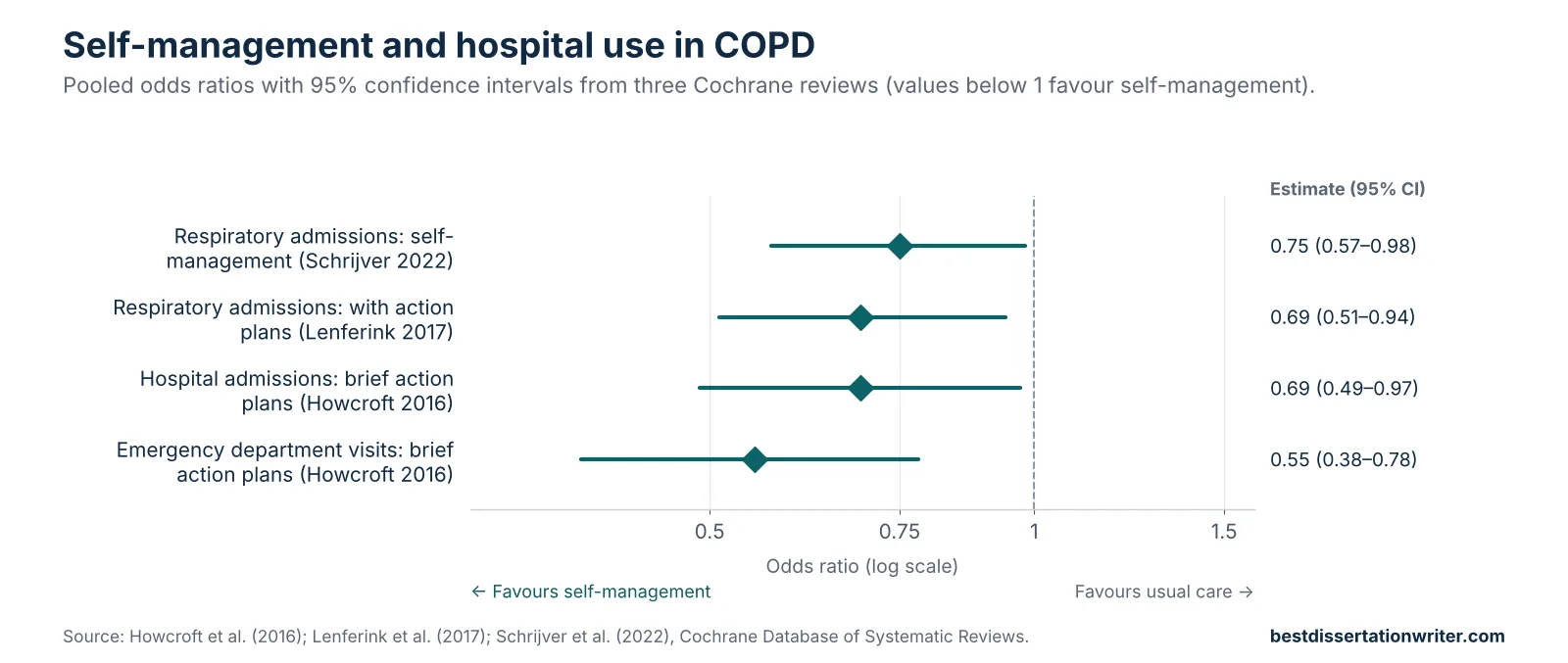
Brief action plans also appear to reduce hospital use. Howcroft et al. (2016) found lower odds of hospital admission (odds ratio 0.69) and emergency department visits (odds ratio 0.55) when patients were given an action plan with brief education. People using action plans received more courses of steroids and antibiotics, which suggests that they were treating exacerbations earlier, as intended. However, this also raises questions about the possible side effects of more frequent steroid use.
Earlier treatment of exacerbations is the main mechanism by which action plans are thought to work. When people recognise a change in breathlessness, sputum colour or volume and start treatment promptly, the exacerbation may be shorter and less severe, avoiding the need for hospital care. Nurses support this by helping patients to recognise their own early warning signs, which differ between individuals, and by ensuring that rescue medicines are available at home. Without this preparation, people with chronic obstructive pulmonary disease often wait until symptoms are severe before seeking help.
Theme 3: Safety Concerns About Intensive Programmes
Not all evidence is reassuring. In a randomised trial of a comprehensive care management programme for veterans with chronic obstructive pulmonary disease in the United States, Fan et al. (2012) found no reduction in COPD hospitalisations. The trial was stopped early because of an unexpected excess of deaths in the intervention group, with 28 deaths compared with 10 in the usual care group. The causes were not clearly linked to the intervention, but the finding prompted caution.
Lenferink et al. (2017) also identified a small but statistically significant increase in respiratory-related mortality in an exploratory analysis, although the evidence was of very low certainty and all-cause mortality did not differ. The later review by Schrijver et al. (2022) found no difference in respiratory-related or all-cause mortality. These findings suggest that self-management is generally safe but that programmes, particularly intensive ones, should include safeguards such as clear advice on when to seek urgent help.
Several explanations have been suggested for the safety signal. Patients who feel confident managing exacerbations at home may delay contacting services when symptoms become severe, and those with heart disease or other conditions may misinterpret new symptoms as part of their lung disease. Telephone-based case management may also miss signs that would be obvious in a face-to-face assessment. These possibilities underline the importance of individual assessment before self-management is introduced and of regular follow-up to check that patients are using their action plans safely.

Discussion
This review shows that self-management education for people with chronic obstructive pulmonary disease produces modest improvements in quality of life and reduces respiratory-related hospital admissions, especially when programmes include written action plans for exacerbations. The consistency of these effects across several Cochrane reviews strengthens confidence in the overall direction of benefit, even though the size of the effect is small and the certainty of some outcomes is low.
The safety findings deserve careful attention. The excess deaths in the trial by Fan et al. (2012) and the exploratory signal reported by Lenferink et al. (2017) suggest that encouraging people to manage exacerbations at home could, in some circumstances, delay necessary medical care. Action plans should therefore always include clear thresholds for seeking urgent help, and nurses should ensure that patients understand these limits, particularly those with severe disease or other serious conditions.
The variation between programmes also matters. Self-management interventions differ in content, intensity, duration and the professionals who deliver them, and the reviews were unable to identify which components were most effective. This makes it difficult to give precise guidance. Nevertheless, the evidence consistently favours programmes that combine education with an action plan and ongoing support, rather than education alone.
Health literacy, cognitive function and mood also influence how well people engage with self-management. Many people with chronic obstructive pulmonary disease are older, may have limited reading ability or mild cognitive impairment, and experience anxiety or depression. Programmes that rely heavily on written materials or complex decision rules may not suit everyone. Nurses can adapt education by using simple language, pictures, demonstration and teach-back, and by involving family members who help with daily care.
Nurses are well placed to deliver this support, and the evidence suggests that the quality of communication may be as important as the content of the programme. Helping people with chronic obstructive pulmonary disease to recognise early signs of an exacerbation, to use inhalers correctly and to feel confident about when to start treatment requires time, trust and repeated reinforcement.
The evidence base has limitations. Blinding was impossible, many studies were small and outcome measures varied. Much of the research came from high-income countries, even though most people with the condition live in low- and middle-income countries. This review relied on openly accessible, English-language sources and did not involve independent double screening. Future research should identify the most effective components of self-management and test programmes in diverse settings. Trials should also monitor safety closely and report outcomes that matter to patients.
Implications of Chronic Obstructive Pulmonary Disease Evidence for Practice
For adult nurses, the evidence supports offering every person with chronic obstructive pulmonary disease a written action plan, agreed with them and their prescriber, together with education on inhaler technique, breathing techniques, physical activity and smoking cessation. Action plans should include clear advice on when to start rescue medicines and when to seek urgent help. Inhaler use and the action plan should be reviewed at every contact, including after each hospital admission.
Nurses should also assess each person’s confidence, health literacy, mood and support at home before introducing an action plan, and adapt education accordingly. Family members and carers can be invited to education sessions so that they understand early warning signs and know when to call for help. Referral to pulmonary rehabilitation, smoking cessation services and psychological support should be offered where appropriate, since these services complement self-management education.
Supporting people to take their medicines as prescribed is central to self-management, linking this topic to evidence on medication adherence. Effective education also depends on therapeutic communication skills that build trust and confidence. Hospital teams should include self-management review in discharge planning after an exacerbation, and recognise that chest infections in people with COPD can progress to sepsis, making early use of the Sepsis Six important.
Conclusion
This systematic review examined self-management education programmes for adults with chronic obstructive pulmonary disease. The evidence shows modest improvements in quality of life and fewer respiratory-related hospital admissions, particularly when programmes include written action plans, but also highlights the need for safeguards in intensive programmes.
Nurses are central to delivering effective self-management support. By combining clear education, individualised action plans, regular review and well-defined thresholds for seeking help, nurses can help people with chronic obstructive pulmonary disease to live more confidently with their condition and to avoid unnecessary hospital admissions.
References
Adeloye, D., Song, P., Zhu, Y., Campbell, H., Sheikh, A., Rudan, I., & NIHR RESPIRE Global Respiratory Health Unit. (2022). Global, regional, and national prevalence of, and risk factors for, chronic obstructive pulmonary disease (COPD) in 2019: A systematic review and modelling analysis. The Lancet Respiratory Medicine, 10(5), 447–458. https://doi.org/10.1016/S2213-2600(21)00511-7
Fan, V. S., Gaziano, J. M., Lew, R., Bourbeau, J., Adams, S. G., Leatherman, S., Thwin, S. S., Huang, G. D., Robbins, R., Sriram, P. S., Sharafkhaneh, A., Mador, M. J., Sarosi, G., Panos, R. J., Rastogi, P., Wagner, T. H., Mazzuca, S. A., Shannon, C., Colling, C., … Niewoehner, D. E. (2012). A comprehensive care management program to prevent chronic obstructive pulmonary disease hospitalizations: A randomized, controlled trial. Annals of Internal Medicine, 156(10), 673–683. https://doi.org/10.7326/0003-4819-156-10-201205150-00003
Howcroft, M., Walters, E. H., Wood-Baker, R., & Walters, J. A. E. (2016). Action plans with brief patient education for exacerbations in chronic obstructive pulmonary disease. Cochrane Database of Systematic Reviews, (12), CD005074. https://doi.org/10.1002/14651858.CD005074.pub4
Lenferink, A., Brusse-Keizer, M., van der Valk, P. D. L. P. M., Frith, P. A., Zwerink, M., Monninkhof, E. M., van der Palen, J., & Effing, T. W. (2017). Self-management interventions including action plans for exacerbations versus usual care in patients with chronic obstructive pulmonary disease. Cochrane Database of Systematic Reviews, (8), CD011682. https://doi.org/10.1002/14651858.CD011682.pub2
Schrijver, J., Lenferink, A., Brusse-Keizer, M., Zwerink, M., van der Valk, P. D. L. P. M., van der Palen, J., & Effing, T. W. (2022). Self-management interventions for people with chronic obstructive pulmonary disease. Cochrane Database of Systematic Reviews, (1), CD002990. https://doi.org/10.1002/14651858.CD002990.pub4
Wang, T., Tan, J.-Y., Xiao, L. D., & Deng, R. (2017). Effectiveness of disease-specific self-management education on health outcomes in patients with chronic obstructive pulmonary disease: An updated systematic review and meta-analysis. Patient Education and Counseling, 100(8), 1432–1446. https://doi.org/10.1016/j.pec.2017.02.026
Cite this example
Best Dissertation Writers (2026) The Effectiveness of Self-Management Education Programmes for Adults with Chronic Obstructive Pulmonary Disease: A Systematic Review. Available at: https://bestdissertationwriter.com/chronic-obstructive-pulmonary-disease/
Best Dissertation Writers
Get expert help with your nursing literature review
Share your topic and deadline with Best Dissertation Writers and get support tailored to your module brief.