Evidence-Based Strategies for Preventing Falls Among Hospitalised Adults: A Review of the Literature
 By Dr. Robertson Prime, Research Fellow
Updated October 12, 2026
16 min read
About 3,200 words
By Dr. Robertson Prime, Research Fellow
Updated October 12, 2026
16 min read
About 3,200 words
In this review
Abstract
Background: Preventing falls is a central nursing responsibility because inpatient falls can cause fractures, head injuries and loss of confidence, extend the length of stay and lead to discharge to long-term care. Many widely used interventions, from risk scores to bed alarms, have been introduced without clear evidence that they work, and national guidance now advises against using falls risk prediction tools.
Aim: This systematic review aimed to identify which strategies are effective in reducing falls among hospitalised adults and what the evidence means for nursing practice.
Methods: Evidence was identified through targeted searches of openly accessible bibliographic records, publisher websites and the reference lists of key reviews. Eight sources published between 2010 and 2025 were included: two systematic reviews of fall prevention interventions, one systematic review of risk assessment tools, four randomised trials and one national guideline, appraised with CASP checklists and synthesised thematically.
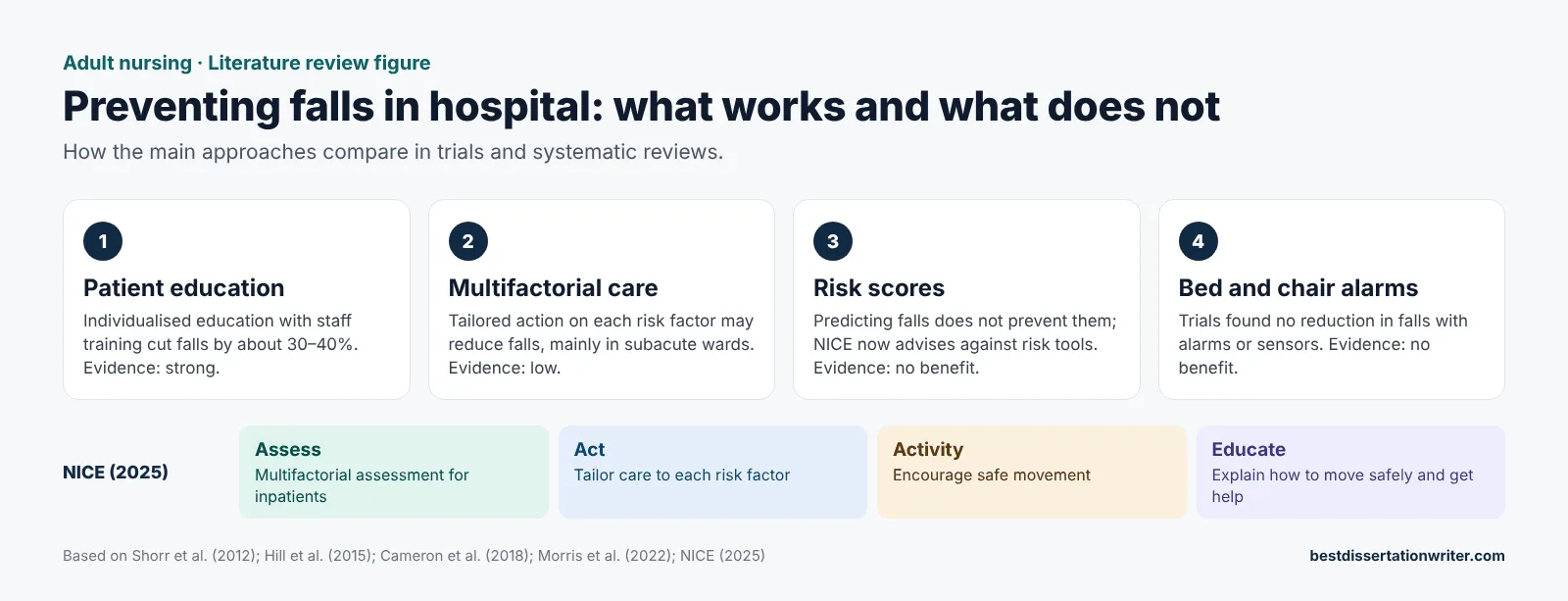
Findings: Scored risk assessment tools varied in accuracy between settings, and there was no evidence that they reduced inpatient falls. Multifactorial programmes may reduce falls, mainly in subacute and rehabilitation settings and with low-quality evidence, whereas bed and chair alarms showed no benefit. Education had the strongest evidence: in one trial, individualised patient education reduced the rate of falls from 13.78 to 7.80 per 1,000 patient-days, and a systematic review of 43 studies found that education reduced the rate of falls by about 30%.
Conclusion: Nurses should replace routine risk scoring with a multifactorial assessment that acts on each patient’s risk factors, and give patients clear, personalised advice on moving safely and asking for help.
Keywords: preventing falls, inpatient falls, falls prevention, risk assessment
Introduction
This systematic review critically examines recent evidence on preventing falls and its implications for adult nursing practice.
Falls are among the most frequently reported safety incidents in hospitals. A fall can cause fractures, head injuries and loss of confidence, extend the length of stay and lead to discharge to long-term care rather than home. Even falls without physical injury can make patients fearful of moving, which in turn reduces mobility and increases the risk of further falls. Falls are also distressing for families and staff, and those causing serious harm are investigated as patient safety incidents.
Nurses are at the centre of preventing falls on hospital wards. They assess patients on admission, plan and deliver care around the clock, and are usually the first to respond when a patient is found on the floor. Yet many interventions that are widely used, from risk scores to bed alarms, have been introduced without clear evidence that they work, and some consume large amounts of nursing time.
Using the PICO framework, the population is adults in acute and subacute hospital wards, the interventions are fall prevention strategies delivered or coordinated by nurses, the comparison is usual care, and the outcomes are the rate of inpatient falls, the number of fallers and fall-related injuries.
Review question
Which strategies are effective in preventing falls among hospitalised adults, and what does the evidence mean for nursing practice?
Background to Preventing Falls
Inpatient falls result from an interaction between the patient and their environment. Acute illness, delirium, dementia, low blood pressure on standing, urinary urgency, sedative medicines and reduced strength all increase risk, while unfamiliar surroundings, poor lighting, clutter, unsuitable footwear and equipment such as drips and catheters add further hazards. Older patients are most affected, but younger adults recovering from surgery or receiving sedating drugs can also fall.
Traditional approaches to preventing falls have relied on identifying high-risk patients with a scored tool and then applying standard precautions, such as low beds, call bells within reach and regular checks. Over time, many hospitals have added technology such as bed and chair alarms, as well as multifactorial programmes that combine several interventions. The cost of these approaches in staff time is considerable, which makes it important to know which elements are effective. Some precautions can also cause harm of their own, such as bed rails used inappropriately or restrictions that discourage patients from moving.
National guidance has recently shifted. The NICE guideline on falls assessment and prevention (NG249) advises against using falls risk prediction tools to predict whether a person will fall, and instead recommends a comprehensive multifactorial assessment for all hospital inpatients in the target groups, followed by action on each risk identified (National Institute for Health and Care Excellence [NICE], 2025). This change makes it timely to review the evidence on preventing falls in hospital and its implications for nurses.
Search Strategy and Methods
Evidence for this example was identified through targeted searches of openly accessible bibliographic records, publisher websites and the reference lists of key reviews. Search terms combined keywords for falls (“accidental falls”, “inpatient falls”, “fallers”) with terms for falls prevention (“prevention”, “intervention”, “risk assessment”, “bed alarm”, “education”, “multifactorial”) and for the hospital setting, joined with the Boolean operators AND and OR. A full systematic review for assessment would run the same strategy in CINAHL, PubMed/MEDLINE, the Cochrane Library and Embase and report the number of records screened in a PRISMA flow diagram.
Sources were eligible if they evaluated interventions for preventing falls in adults admitted to acute or subacute hospital wards, or the accuracy of tools used to predict inpatient falls. Systematic reviews and randomised trials were prioritised. Studies conducted only in care homes or the community were excluded unless hospital results were reported separately, as were opinion pieces. Current national guidance was included to describe the expected standard of care. Trials of exercise programmes delivered after discharge were excluded, because they address falls prevention in the community rather than preventing falls on the ward.
Eight sources published between 2010 and 2025 were included: two systematic reviews of fall prevention interventions, one systematic review of risk assessment tools, four randomised trials and one national guideline (Table 1). Each source was appraised with the relevant Critical Appraisal Skills Programme (CASP) checklist, and the certainty ratings reported by review authors were recorded.
Findings were synthesised thematically by comparing how the sources addressed risk assessment, multifactorial and technological interventions, and education for preventing falls. Because the studies used different designs, settings and outcome measures, statistical pooling was not appropriate. Particular attention was paid to whether interventions reduced inpatient falls rather than simply being implemented.
Key Findings on Preventing Falls
Three themes emerged: the limited value of scored risk prediction tools, the mixed evidence for multifactorial programmes and technology, and the strong evidence for patient and staff education. Table 1 summarises the included sources.
| Author, year | Design | Setting and sample | Key finding |
|---|---|---|---|
| Cameron et al. (2018) | Cochrane systematic review | 24 hospital trials; 97,790 participants | Multifactorial interventions may reduce the rate of falls, mainly in subacute settings (low-quality evidence); effect of bed alarms uncertain. |
| Morris et al. (2022) | Systematic review and meta-analysis | 43 studies; 23 in meta-analyses | Education reduced the falls rate (RaR 0.70) and odds of falling (OR 0.62); alarms, sensors and risk tools showed no significant effect. |
| Aranda-Gallardo et al. (2013) | Systematic review and meta-analysis | 14 studies in acute hospitals | STRATIFY had the best diagnostic accuracy, but performance varied widely between settings. |
| Hill et al. (2015) | Stepped-wedge cluster randomised trial | 8 rehabilitation units; 3,606 patients; Australia | Individualised education reduced falls (7.80 vs 13.78 per 1,000 patient-days; adjusted RR 0.60) and injurious falls. |
| Dykes et al. (2010) | Randomised trial (Fall TIPS) | Acute care units; United States | A patient-specific fall prevention toolkit significantly reduced falls. |
| Barker et al. (2016) | Cluster randomised trial (6-PACK) | Acute wards; six Australian hospitals | A nurse-led bundle was implemented successfully but did not reduce falls. |
| Shorr et al. (2012) | Cluster randomised trial | Hospital nursing units; United States | Increasing bed alarm use did not reduce falls. |
| NICE (2025) | National guideline (NG249) | Older adults and people over 50 at higher risk, all settings | Do not use risk prediction tools; offer multifactorial assessment and tailored interventions to inpatients. |
Theme 1: Risk Assessment Tools and Preventing Falls
Scored tools such as the Morse Fall Scale, STRATIFY and the Hendrich II Fall Risk Model have been used for decades to identify patients at high risk. In a meta-analysis of 14 studies in acutely ill adults, Aranda-Gallardo et al. (2013) found that STRATIFY had the best diagnostic accuracy of the three tools, but that performance varied considerably between populations and settings. The authors recommended that any tool be tested locally before it is introduced, because a score that works in one hospital may perform poorly in another.
A more fundamental problem is that predicting a fall does not prevent it. Most hospitalised older adults have several risk factors, so tools tend to classify a large proportion of patients as high risk, which offers little guidance on what to do next. Morris et al. (2022) found no evidence that scored risk assessment tools reduced inpatient falls. NICE (2025) now advises against using these tools to predict falls, on the grounds that they sort patients into categories without leading to action.
Instead, the guideline recommends a multifactorial assessment covering factors such as cognition and delirium, continence, vision, medication, lying and standing blood pressure, footwear, mobility and fear of falling, followed by tailored interventions. For nurses, this marks a shift from scoring risk to identifying and treating the specific causes of falls in each patient, which is a more demanding but more meaningful approach to preventing falls.
Theme 2: Multifactorial Programmes and Technology
Multifactorial programmes combine several interventions tailored to each patient’s risk factors. In the Cochrane review by Cameron et al. (2018), which included 24 hospital trials with 97,790 participants, multifactorial interventions may have reduced the rate of falls in hospitals, but the effect was mainly seen in subacute and rehabilitation settings and the evidence was of low quality. The effect on the number of people who fell was uncertain.
Individual trials illustrate both the promise and the limits of these programmes. In the Fall TIPS trial, Dykes et al. (2010) gave nurses a computer-generated, patient-specific fall prevention plan linked to bedside posters and patient education, and found a significant reduction in falls in acute care units. In contrast, the 6-PACK trial in acute wards across six Australian hospitals found that a nurse-led bundle of commonly used measures was implemented successfully, yet falls occurred just as often as on control wards (Barker et al., 2016). The authors suggested that hospitals should consider disinvesting from ineffective measures that take up staff time.
The contrast between Fall TIPS and 6-PACK is instructive. Fall TIPS linked each patient’s specific risk factors to specific actions and shared the plan with the patient through a bedside poster, whereas 6-PACK applied a fixed menu of common precautions. This suggests that tailoring and patient engagement, rather than the number of measures applied, may be the active ingredient in preventing falls. It also shows that successful implementation does not guarantee benefit, because a programme can be delivered exactly as planned and still have no effect if its components are ineffective.
Technology has also been widely adopted for preventing falls, but the evidence is disappointing. In a cluster randomised trial, Shorr et al. (2012) found that increasing the use of bed alarms did not reduce falls among hospitalised patients. Cameron et al. (2018) rated the evidence for bed and chair alarms as very low quality, and Morris et al. (2022) found no significant reduction in falls with bed alarms, chair alarms or wearable sensors. Alarms may alert staff after a patient has started to get up, but they do not address why the patient is trying to move unaided.
Theme 3: Patient and Staff Education
Education has the strongest evidence of any single intervention for preventing falls. In a stepped-wedge cluster randomised trial in eight rehabilitation units, Hill et al. (2015) added individualised patient education, delivered by trained staff, to usual care and fed patients’ concerns back to ward teams. The rate of falls fell from 13.78 to 7.80 per 1,000 patient-days, an adjusted reduction of 40%, and injurious falls were also reduced.
Morris et al. (2022) confirmed this finding in a systematic review of 43 studies. Education was the only intervention category with a significant effect in meta-analysis, reducing the rate of falls by about 30% and the odds of falling by almost 40%, supported by high-quality evidence. Education seems to work by helping patients understand their own risk, recognise when to ask for help and move safely, while staff training helps nurses respond to patients’ concerns and reinforce safe habits.
The education trials mostly included patients without significant cognitive impairment, so the findings may not apply to people with delirium or dementia, who make up a large proportion of inpatient falls. For these patients, NICE (2025) emphasises addressing underlying causes such as delirium, continence needs and medication, encouraging safe activity and adapting the ward environment, rather than relying on the patient to remember advice. Making sure that call bells, walking aids and personal items are within reach is one practical way of applying this guidance to preventing falls in this group.
Discussion
This review shows that many established approaches to preventing falls in hospital have weak or negative evidence. Scored risk tools do not reduce inpatient falls, bed and chair alarms have not shown benefit in trials, and even well-implemented multifactorial bundles have produced inconsistent results in acute wards. In contrast, structured patient education, supported by staff training, has consistently reduced falls in rehabilitation settings. These findings challenge the assumption that adding more precautions automatically makes patients safer.
One explanation is that many standard precautions are applied in the same way to all patients, regardless of why each person is at risk. Effective programmes for preventing falls, such as Fall TIPS and the education trials, were tailored to the individual and engaged patients as active partners. This is consistent with the move in NICE (2025) from risk scoring to multifactorial assessment, which links each identified factor, such as low blood pressure on standing or urinary urgency, to a specific action.
The evidence base has important limitations. Many trials were conducted in Australia or the United States and in subacute settings, so findings may not transfer directly to busy acute wards in other countries. Cameron et al. (2018) rated much of the hospital evidence as low or very low quality, and trials of education largely excluded patients with cognitive impairment. This review relied on openly accessible sources and English-language publications, so relevant studies in other languages may have been missed.
There are also practical challenges for nurses. Delivering individualised education and multifactorial assessment takes time, which is often scarce. However, the 6-PACK trial shows that time spent on ineffective measures is itself a cost. Redirecting nursing time from low-value activities, such as completing risk scores that do not change care or responding to frequent alarms, towards conversations with patients and action on their individual risk factors may offer better value for preventing falls.
It is also important to distinguish between preventing falls and preventing harm. Some patients will fall despite good care, particularly when mobility is being encouraged during rehabilitation. Keeping patients in bed to avoid falls would increase deconditioning, pressure damage and delirium, so the aim should be safe mobility rather than immobility. Good falls prevention therefore balances the risk of falling against the benefits of activity and includes a prompt, structured response when a fall does occur.
Future research should test multifactorial approaches in acute wards with adequately powered trials, include patients with delirium and dementia, and measure fall-related injuries as well as falls. Studies should also report how interventions were implemented, so that successful approaches can be reproduced in other hospitals.
Implications of Preventing Falls Evidence for Practice
For adult nurses, the evidence on preventing falls supports replacing routine risk scoring with a multifactorial assessment that identifies and acts on each patient’s risk factors, including medication, continence, delirium, blood pressure and mobility. Nurses should give patients clear, personalised advice on how to move safely, use the call bell and ask for help, and check their understanding. Managers should review whether alarms and other routine precautions are adding value and support staff with training in patient education.
These principles fit with wider ward safety work, including recognising deterioration with early warning scores, preventing hospital-acquired pressure ulcers, managing acute and chronic pain that can limit mobility, and reducing hospital-acquired infections that can trigger delirium.
Conclusion
This review examined strategies for preventing falls among hospitalised adults. Patient and staff education has the strongest evidence of benefit, multifactorial programmes may help when they are tailored to the individual, and scored risk tools and bed alarms have not been shown to reduce inpatient falls. National guidance now reflects this evidence by recommending multifactorial assessment instead of risk prediction tools.
Nurses can contribute most to preventing falls by understanding why each patient is at risk, acting on those reasons and helping patients take an active part in their own safety. Focusing nursing time on these effective activities, rather than on routine precautions with little evidence, offers the best chance of reducing falls and the harm they cause, while still allowing patients the activity they need to recover.
References
Aranda-Gallardo, M., Morales-Asencio, J. M., Canca-Sánchez, J. C., Mora-Banderas, A. M., Moya-Suárez, A. B., Barrero-Sojo, S., Pérez-Jiménez, C., Morales-Fernández, A., Enríquez de Luna-Rodríguez, M., & Saldaña del Campo, S. (2013). Instruments for assessing the risk of falls in acute hospitalized patients: A systematic review and meta-analysis. BMC Health Services Research, 13, Article 122. https://doi.org/10.1186/1472-6963-13-122
Barker, A. L., Morello, R. T., Wolfe, R., Brand, C. A., Haines, T. P., Hill, K. D., Brauer, S. G., Botti, M., Cumming, R. G., Livingston, P. M., Sherrington, C., Zavarsek, S., Lindley, R. I., & Kamar, J. (2016). 6-PACK programme to decrease fall injuries in acute hospitals: Cluster randomised controlled trial. BMJ, 352, h6781. https://doi.org/10.1136/bmj.h6781
Cameron, I. D., Dyer, S. M., Panagoda, C. E., Murray, G. R., Hill, K. D., Cumming, R. G., & Kerse, N. (2018). Interventions for preventing falls in older people in care facilities and hospitals. Cochrane Database of Systematic Reviews, 2018(9), CD005465. https://doi.org/10.1002/14651858.CD005465.pub4
Dykes, P. C., Carroll, D. L., Hurley, A., Lipsitz, S., Benoit, A., Chang, F., Meltzer, S., Tsurikova, R., Zuyov, L., & Middleton, B. (2010). Fall prevention in acute care hospitals: A randomized trial. JAMA, 304(17), 1912–1918. https://doi.org/10.1001/jama.2010.1567
Hill, A.-M., McPhail, S. M., Waldron, N., Etherton-Beer, C., Ingram, K., Flicker, L., Bulsara, M., & Haines, T. P. (2015). Fall rates in hospital rehabilitation units after individualised patient and staff education programmes: A pragmatic, stepped-wedge, cluster-randomised controlled trial. The Lancet, 385(9987), 2592–2599.
Morris, M. E., Webster, K., Jones, C., Hill, A.-M., Haines, T., McPhail, S., Kiegaldie, D., Slade, S., Jazayeri, D., Heng, H., Shorr, R., Carey, L., Barker, A., & Cameron, I. (2022). Interventions to reduce falls in hospitals: A systematic review and meta-analysis. Age and Ageing, 51(5), afac077. https://doi.org/10.1093/ageing/afac077
National Institute for Health and Care Excellence. (2025). Falls: Assessment and prevention in older people and in people 50 and over at higher risk (NICE guideline NG249). NICE. https://www.nice.org.uk/guidance/ng249
Shorr, R. I., Chandler, A. M., Mion, L. C., Waters, T. M., Liu, M., Daniels, M. J., Kessler, L. A., & Miller, S. T. (2012). Effects of an intervention to increase bed alarm use to prevent falls in hospitalized patients: A cluster randomized trial. Annals of Internal Medicine, 157(10), 692–699. https://doi.org/10.7326/0003-4819-157-10-201211200-00005
Cite this example
Best Dissertation Writers (2026) Evidence-Based Strategies for Preventing Falls Among Hospitalised Adults: A Review of the Literature. Available at: https://bestdissertationwriter.com/preventing-falls-literature-review/
Best Dissertation Writers
Get expert help with your nursing literature review
Share your topic and deadline with Best Dissertation Writers and get support tailored to your module brief.