The Influence of Therapeutic Communication Skills on Patient Satisfaction in Adult Nursing Care: A Narrative Review
 By Dr. Robertson Prime, Research Fellow
Updated October 12, 2026
15 min read
About 2,900 words
By Dr. Robertson Prime, Research Fellow
Updated October 12, 2026
15 min read
About 2,900 words
In this review
Abstract
Background: Therapeutic communication skills are the deliberate techniques nurses use to build trust, understand the patient’s perspective and support their wellbeing, including active listening, open questions, reflection, empathy and appropriate use of silence. These skills form the basis of the nurse-patient relationship, and patient satisfaction has become an important measure of healthcare quality.
Aim: This narrative review aimed to examine the evidence that nurses’ communication influences patient satisfaction and other outcomes in adult care, and what helps or hinders effective communication.
Methods: Evidence was identified through targeted searches of openly accessible bibliographic records, publisher websites and the reference lists of key reviews. Five sources published between 2014 and 2021 were included: one large analysis of patient experience surveys, one meta-analysis of randomised trials, one Cochrane review of communication skills training, one systematic review of educational interventions for nursing students and one literature-based conceptual study, appraised with CASP checklists and synthesised narratively into themes.
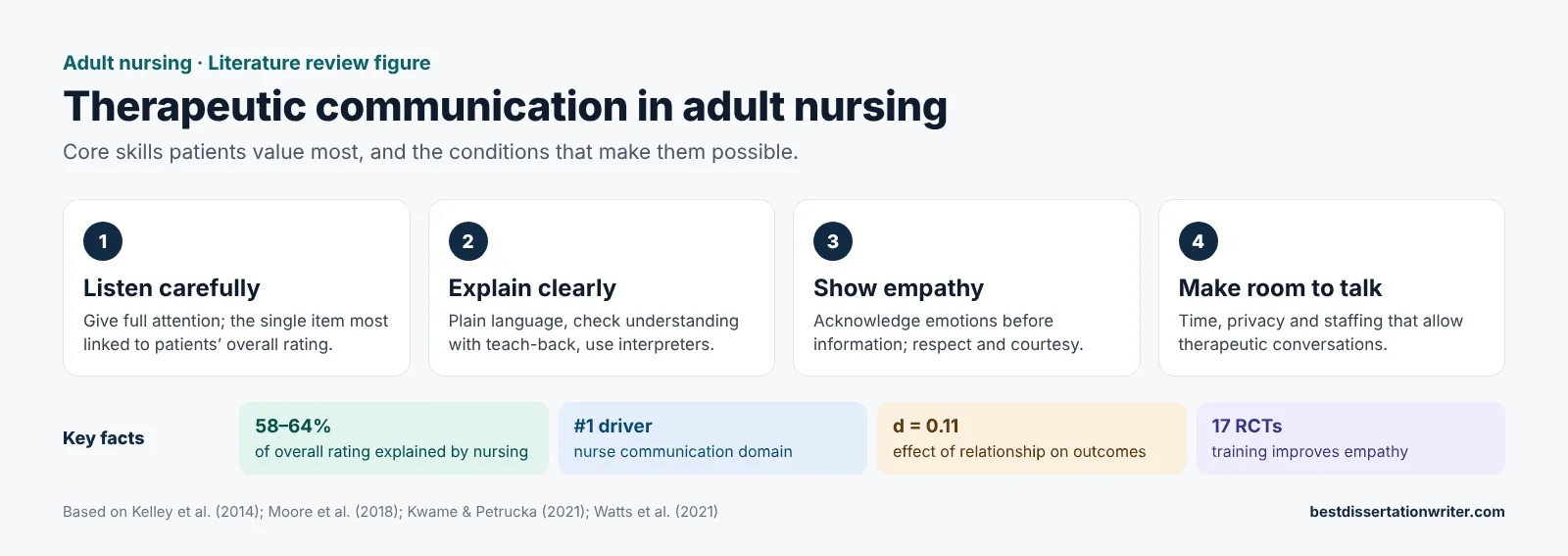
Findings: In an analysis of 112,283 HCAHPS surveys, nursing items explained between 58% and 64% of the variation in patients’ overall hospital rating, and nurse communication was the largest single driver. Enhancing the patient-clinician relationship had a small but significant effect on health outcomes (d = 0.11). Training probably improved professionals’ empathy and improved students’ skills, but there was no clear evidence that it improved patient satisfaction, while staffing, workload, language differences, noise and lack of privacy limited communication in practice.
Conclusion: Nurses should make active listening, clear explanation and teach-back a routine part of every interaction, using professional interpreters where needed. Managers should protect time and private space for conversations and offer training with practice and feedback.
Keywords: therapeutic communication skills, patient satisfaction, nurse-patient relationship
Introduction
This narrative review critically examines recent evidence on therapeutic communication skills and its implications for adult nursing practice.
Communication is at the heart of nursing. Every assessment, explanation, piece of health teaching and moment of reassurance depends on how well nurses listen, speak and respond to patients. When communication goes well, patients feel respected, understood and safe; when it goes badly, they may feel ignored, anxious or confused about their care. Many complaints about hospital care concern communication rather than clinical treatment.
Therapeutic communication skills are the deliberate techniques nurses use to build trust, understand the patient’s perspective and support their wellbeing. They include active listening, open questions, reflection, clarification, summarising, empathy and appropriate use of silence and touch. These skills form the basis of the nurse-patient relationship, which nursing theorists such as Hildegard Peplau placed at the centre of nursing practice. Peplau described the relationship as moving through phases, from getting to know the patient to working together on problems and finally to ending the relationship, with communication shaping each phase.
A narrative design was chosen because the question draws on varied evidence, including large patient experience surveys, meta-analyses of randomised trials, Cochrane reviews of training and conceptual reviews, which are best brought together through critical discussion rather than statistical pooling of therapeutic communication skills research.
Review question
What is the evidence that nurses’ therapeutic communication skills influence patient satisfaction and other outcomes in adult care, and what helps or hinders effective communication?
Background to Therapeutic Communication Skills
Therapeutic communication differs from everyday social conversation because it is goal-directed and centred on the patient’s needs. The nurse uses communication purposefully to gather information, to help the patient express concerns, to provide explanations and to support coping. Person-centred care, now a core principle of health policy in many countries, depends on these skills, since care cannot be tailored to a person’s priorities unless those priorities are first understood.
Patient satisfaction has become an important measure of healthcare quality. In the United States, the Hospital Consumer Assessment of Healthcare Providers and Systems (HCAHPS) survey asks patients about their experiences, including how often nurses treated them with courtesy and respect, listened carefully and explained things in a way they could understand. Results are publicly reported and linked to hospital payments, which has drawn attention to the role of nurse communication in patient experience.
However, satisfaction is a complex outcome influenced by expectations, health status and the wider care environment, as well as by communication. It is therefore important to examine whether therapeutic communication skills make a measurable difference and whether training can improve them. Understanding these questions helps nurses and educators decide where to invest effort.
Therapeutic communication skills also matter for safety. Patients who feel able to speak openly are more likely to report new symptoms, side effects or worries, and nurses who listen carefully are more likely to notice subtle changes in a patient’s condition. A strong nurse-patient relationship can therefore support early recognition of problems as well as a better experience of care.
Search Strategy and Methods
Evidence for this example was identified through targeted searches of openly accessible bibliographic records, publisher websites and the reference lists of key reviews. Search terms combined keywords for communication (“therapeutic communication skills”, “communication skills training”, “nurse-patient relationship”, “empathy”) with terms for outcomes (“patient satisfaction”, “HCAHPS”, “patient experience”, “health outcomes”), joined with the Boolean operators AND and OR. A full narrative review for assessment would run the same strategy in CINAHL, PubMed/MEDLINE, PsycINFO and the Cochrane Library and report the number of records screened in a PRISMA flow diagram.
Sources were eligible if they examined the relationship between nurse or clinician communication and patient satisfaction or other outcomes, evaluated communication skills training for nurses or nursing students, or analysed barriers and facilitators to therapeutic communication skills in nurse-patient interactions. Studies limited to written information or to communication between professionals were excluded. Sources were included regardless of clinical specialty where their findings were relevant to therapeutic communication skills in adult nursing.
Five sources published between 2014 and 2021 were included: one large analysis of patient experience surveys, one meta-analysis of randomised trials, one Cochrane review of communication skills training, one systematic review of educational interventions for nursing students and one literature-based conceptual study (Table 1). Each source was appraised using the Critical Appraisal Skills Programme (CASP) checklist appropriate to its design, and findings were compared and grouped into themes.
Key Findings on Therapeutic Communication Skills
Three themes were identified: the influence of nurse communication on patient satisfaction, the effects of communication training, and the barriers and facilitators that shape communication in practice. Table 1 summarises the included sources, and Figure 1 shows how much of patients’ overall hospital rating was explained by nursing items in a large survey analysis.
| Author, year | Design | Setting and sample | Key finding |
|---|---|---|---|
| Kelley et al. (2014) | Systematic review and meta-analysis | 13 RCTs enhancing the patient-clinician relationship | Small but significant effect on health outcomes (d = 0.11). |
| Moore et al. (2018) | Cochrane systematic review | 17 RCTs; 1,240 professionals including 532 nurses | Training improved empathy and possibly open questions; no clear effect on patient satisfaction. |
| Gutiérrez-Puertas et al. (2020) | Systematic review | 19 studies, 1,295 nursing students | 13 of 19 studies showed improved communication skills; best teaching method unclear. |
| Kwame and Petrucka (2021) | Literature-based conceptual study | Published literature on nurse-patient interactions | Institutional, communication, environmental and personal barriers; proposed the PC4 model. |
| Watts et al. (2021) | Secondary analysis of HCAHPS surveys | 112,283 patients; 89 US trauma centres | Nursing items explained 58–64% of overall rating; nurse communication the largest driver. |
Theme 1: Nurse Communication and Patient Satisfaction
The strongest evidence for a link between nurse communication and patient satisfaction comes from large survey analyses. Watts et al. (2021) analysed 112,283 HCAHPS surveys from 89 trauma centres in the United States. Nursing items explained between 58% and 64% of the variation in patients’ overall rating of the hospital across trauma, surgical and medical patients, and the nurse communication domain was the largest single driver in all three groups. The single item “nurses listen carefully to you” was the most influential for trauma patients.
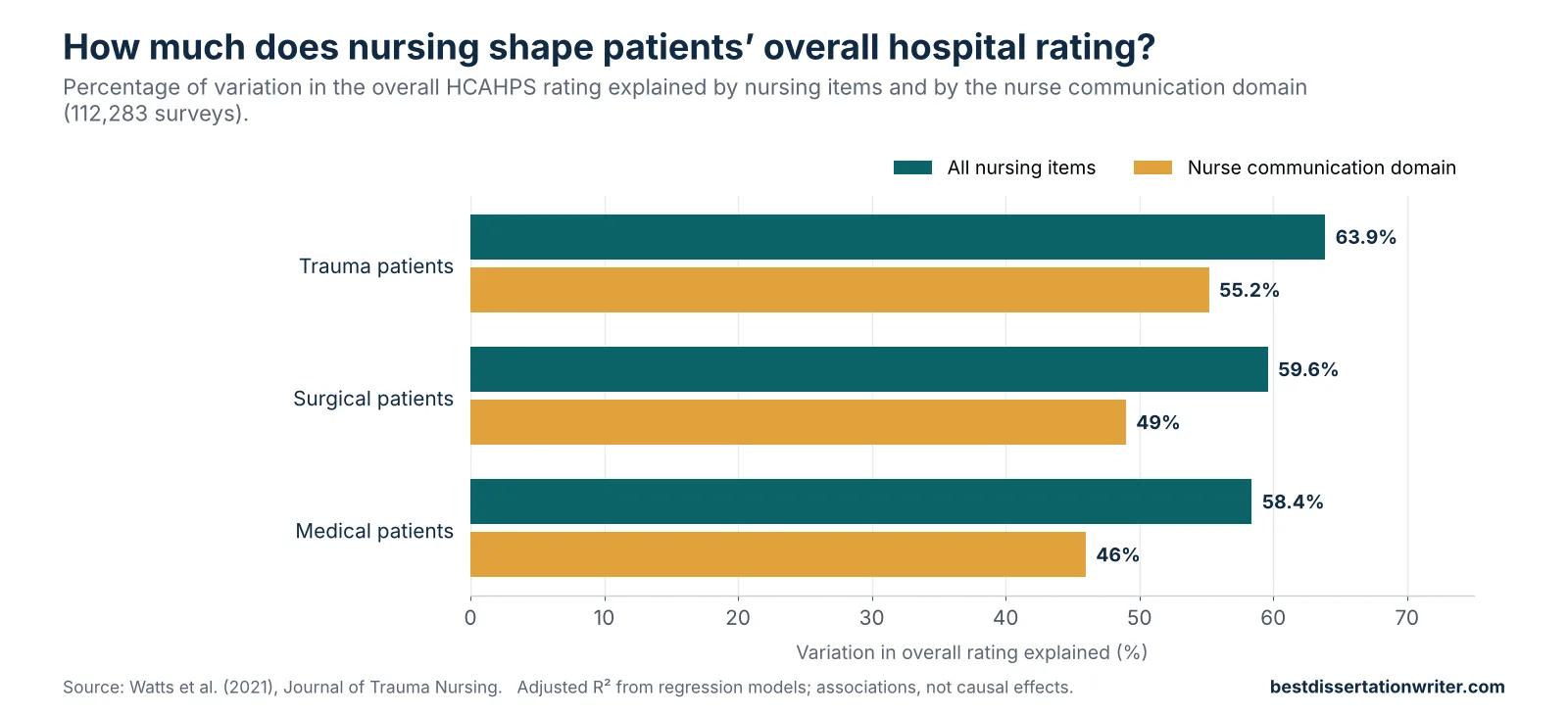
These findings suggest that, from the patient’s perspective, how nurses communicate is central to the overall experience of hospital care. Listening carefully, explaining things clearly and treating patients with courtesy and respect are core therapeutic communication skills, and they appear to matter more to patients’ overall judgement than many other aspects of care. However, the analysis was correlational, so it cannot show that better communication caused higher ratings.
The finding that listening was the most influential single item is important for practice. Listening is often treated as a passive activity, yet patients appear to notice whether nurses give them full attention, allow them to finish speaking and respond to what they have said. In busy wards, small behaviours such as sitting down, making eye contact and summarising what the patient has said may signal that the nurse has listened, even when time is short. These behaviours lie at the core of therapeutic communication skills and of a trusting nurse-patient relationship.
Evidence from randomised trials supports a link between the patient-clinician relationship and outcomes beyond satisfaction. In a meta-analysis of 13 randomised trials in which the relationship was deliberately enhanced, Kelley et al. (2014) found a small but statistically significant effect on health outcomes (effect size d = 0.11). The authors noted that few trials met their criteria and that most were not designed to test this question, so the true size of the effect remains uncertain.
Theme 2: Can Communication Skills Be Taught?
If communication matters, an important question is whether training can improve it. A Cochrane review by Moore et al. (2018) examined 17 randomised trials of communication skills training for doctors and nurses working with people with cancer, involving 532 nurses among 1,240 professionals. Training probably improved professionals’ empathy and may have increased their use of open questions. However, there was no clear evidence that training improved patient satisfaction, patients’ anxiety or professionals’ burnout.
Evidence from nursing education shows similar results. In a systematic review of 19 studies of educational interventions for nursing students, Gutiérrez-Puertas et al. (2020) found that most interventions, especially simulation with standardised patients, improved students’ communication skills, confidence or attitudes. Thirteen of the 19 studies reported significant improvements. However, most studies measured students’ self-reported skills rather than patients’ experiences, and the authors concluded that it was not yet clear which teaching method was most effective.
Taken together, these reviews suggest that therapeutic communication skills can be improved through structured training, particularly approaches that include practice and feedback, but that the benefits for patients are harder to demonstrate. One explanation is that patient satisfaction is already high in many settings, leaving little room for measurable improvement; another is that training effects may fade without ongoing support in practice.
Theme 3: Barriers and Facilitators in Practice
Even skilled nurses may find it difficult to communicate therapeutically in busy clinical environments. In a literature-based study, Kwame and Petrucka (2021) identified four groups of barriers to patient-centred communication in nurse-patient interactions: institutional factors such as staffing shortages and workload, communication factors such as language differences, environmental factors such as noise and lack of privacy, and personal or behavioural factors affecting both nurses and patients. They proposed a model to help nurses identify which practices and contexts support or hinder person-centred communication.
These barriers help to explain the gap between training and practice. Nurses who have learned therapeutic communication skills may have little time to use them when wards are understaffed, and patients who are in pain, anxious or speak a different language may find it hard to engage. Facilitators include continuity of care, private spaces for conversations, access to interpreters and a ward culture that values time spent talking with patients.
Electronic records and task-focused routines can also shape communication. Nurses may spend considerable time at computers or completing documentation, and conversations with patients can become organised around tasks such as medicine rounds and observations rather than the patient’s concerns. Using these routine contacts as opportunities for brief therapeutic conversations, for example by asking how the patient is feeling while recording observations, may help nurses to maintain connection even when time is limited.
Discussion
This review suggests that nurse communication is one of the most important influences on how patients judge their hospital care, and that the patient-clinician relationship has a small but real effect on health outcomes. Large survey data show that listening carefully and explaining clearly are strongly associated with overall ratings, which supports the emphasis placed on therapeutic communication skills in nursing education and professional standards.
At the same time, the evidence that training directly improves patient satisfaction is weak. Training improves nurses’ empathy and skills, but trials have not consistently shown changes in patients’ experiences. This may reflect limitations of satisfaction as an outcome measure, which can be influenced by many factors outside the nurse’s control, as well as the difficulty of sustaining new skills in pressured environments. Measures that capture specific aspects of communication, such as whether patients felt listened to, may be more sensitive to change.
It is also worth considering the effect of communication on nurses themselves. Difficult conversations, such as responding to anger, breaking bad news or supporting distressed relatives, can be emotionally demanding. Training that builds confidence in these situations, combined with supervision and peer support, may help nurses to sustain compassionate communication without becoming exhausted.
The barriers identified by Kwame and Petrucka (2021) highlight that communication is not only an individual skill but also a product of the care environment. Staffing levels, workload, noise and lack of privacy all limit the time and space for therapeutic conversations. Improving patient experience therefore requires attention to the conditions in which nurses work, not just to training in therapeutic communication skills.
Cultural and linguistic diversity adds another dimension. Patients from different backgrounds may have different expectations about how nurses should communicate, how much information they want and who should be involved in decisions. Nurses need cultural humility, the willingness to ask rather than assume, as well as practical access to interpreters and translated materials. Without these, therapeutic communication skills may be applied in ways that do not meet the needs of all patients, widening inequalities in patient satisfaction and outcomes.
The evidence base has limitations. The survey analysis was correlational and set in United States trauma centres, the Cochrane review focused on cancer care and the nursing education review relied mainly on self-reported outcomes. Few studies measured long-term effects or included patients from diverse cultural and linguistic backgrounds. This review relied on openly accessible, English-language sources. Future research should test communication interventions on general adult wards using patient-reported outcomes and follow-up over time. Studies should also include patients with communication difficulties, such as those with hearing loss, cognitive impairment or limited proficiency in the local language.
Implications of Therapeutic Communication Skills Evidence for Practice
For adult nurses, the evidence supports making active listening and clear explanation a routine part of every interaction. Nurses should introduce themselves, sit at the patient’s level where possible, use open questions, check understanding using teach-back and acknowledge emotions before moving to information. Where language is a barrier, professional interpreters should be used. Ward managers should protect time for conversations, provide private spaces and offer communication training that includes practice and feedback, reinforced through supervision and reflective practice.
Good communication underpins many other aspects of safe care. Explaining treatment clearly supports medication adherence, while listening carefully to patients and families can reveal early signs of deterioration that should be acted on alongside early warning scores. Talking with patients about repositioning and skin care supports the prevention of hospital-acquired pressure ulcers, and believing patients’ reports is central to assessing acute and chronic pain.
Conclusion
This narrative review examined the influence of nurses’ therapeutic communication skills on patient satisfaction and outcomes in adult care. Nurse communication is strongly associated with how patients rate their hospital care, and the patient-clinician relationship has a small but significant effect on health outcomes. Training improves nurses’ skills and empathy, although its effect on patient satisfaction is less certain.
Strengthening therapeutic communication skills requires both individual and organisational effort. Nurses can listen carefully, explain clearly and respond with empathy, but they also need the time, staffing, privacy and support that make meaningful conversations possible on busy wards.
References
Gutiérrez-Puertas, L., Márquez-Hernández, V. V., Gutiérrez-Puertas, V., Granados-Gámez, G., & Aguilera-Manrique, G. (2020). Educational interventions for nursing students to develop communication skills with patients: A systematic review. International Journal of Environmental Research and Public Health, 17(7), 2241. https://doi.org/10.3390/ijerph17072241
Kelley, J. M., Kraft-Todd, G., Schapira, L., Kossowsky, J., & Riess, H. (2014). The influence of the patient-clinician relationship on healthcare outcomes: A systematic review and meta-analysis of randomized controlled trials. PLoS ONE, 9(4), e94207. https://doi.org/10.1371/journal.pone.0094207
Kwame, A., & Petrucka, P. M. (2021). A literature-based study of patient-centered care and communication in nurse-patient interactions: Barriers, facilitators, and the way forward. BMC Nursing, 20, 158. https://doi.org/10.1186/s12912-021-00684-2
Moore, P. M., Rivera, S., Bravo-Soto, G. A., Olivares, C., & Lawrie, T. A. (2018). Communication skills training for healthcare professionals working with people who have cancer. Cochrane Database of Systematic Reviews, (7), CD003751. https://doi.org/10.1002/14651858.CD003751.pub4
Watts, D. D., Slivinski, A., Garland, J. M., Kerley, D. R., Wilson, N. Y., Cooper, T., Howard, K., Dunne, J., Lieser, M. J., Berg, G. M., Wyse, R. J., Carrick, M. M., & Fakhry, S. M. (2021). The impact of nursing on trauma patient satisfaction: An analysis of HCAHPS from 112,283 patients. Journal of Trauma Nursing, 28(4), 219–227. https://doi.org/10.1097/JTN.0000000000000589
Cite this example
Best Dissertation Writers (2026) The Influence of Therapeutic Communication Skills on Patient Satisfaction in Adult Nursing Care: A Narrative Review. Available at: https://bestdissertationwriter.com/therapeutic-communication-skills-review/
Best Dissertation Writers
Get expert help with your nursing literature review
Share your topic and deadline with Best Dissertation Writers and get support tailored to your module brief.