

Early Recognition and Management of Sepsis by Nurses Using the Sepsis Six Care Bundle: A Systematic Review
 By Dr. Robertson Prime, Research Fellow
Updated October 12, 2026
15 min read
About 3,100 words
By Dr. Robertson Prime, Research Fellow
Updated October 12, 2026
15 min read
About 3,100 words
In this review
Abstract
Background: The Sepsis Six is a simple care bundle of three diagnostic and three therapeutic steps designed to be delivered within one hour of sepsis being recognised. Sepsis can progress from mild illness to septic shock within hours, and many patients first show signs of it on a general ward, where nurses are often the first professionals to notice that something is wrong.
Aim: This systematic review aimed to examine the evidence that early recognition and delivery of the bundle by nurses improves outcomes for adults with sepsis, and what helps or hinders nurses in carrying it out.
Methods: Evidence was identified through targeted searches of openly accessible bibliographic records, publisher websites and the reference lists of key reviews. Seven sources published between 2011 and 2020 were included: two large observational cohort studies, one before-and-after intervention study, one qualitative study, one international consensus statement, one global burden-of-disease analysis and one national guideline, appraised with CASP checklists and synthesised narratively.
Findings: In the original evaluation, patients who received the bundle had a hospital mortality of 20.0%, compared with 44.1% among those who did not, although the design was observational. In 49,331 patients, each hour of delay in completing the three-hour bundle was associated with a 4% increase in the odds of in-hospital death, with delayed antibiotics also linked to higher mortality. Training ward nurses in early recognition was followed by better 30-day survival, but emergency nurses reported gaps in knowledge and confidence and depended on organisational support.
Conclusion: Nurses should record complete observations, escalate promptly and start the bundle within one hour of suspected sepsis. Training, equipment and nurse-initiated protocols with clear governance may help to reduce delays.
Keywords: Sepsis Six, care bundle, early recognition
Introduction
This systematic review critically examines recent evidence on Sepsis Six and its implications for adult nursing practice.
Sepsis is a medical emergency in which the body’s response to infection damages its own tissues and organs. It can develop from a chest infection, a urinary tract infection, a wound or almost any other source, and it can progress from mild illness to septic shock within hours. Many patients first show signs of sepsis while on a general ward, where nurses are often the first professionals to notice that something is wrong.
The Sepsis Six is a simple care bundle of three diagnostic and three therapeutic steps designed to be delivered within one hour of sepsis being recognised. Because it can be started by any trained member of the ward team, it has become a central part of nursing practice in the United Kingdom and many other countries. Nurses record the observations that trigger suspicion of sepsis, escalate to medical staff and frequently carry out or coordinate the elements of the bundle themselves.
A systematic approach was chosen so that the strongest available evidence, including large cohort studies, intervention studies and international consensus statements, could be identified and appraised. Understanding the evidence behind the Sepsis Six matters because the bundle is now embedded in national guidance and ward protocols.
Review question
What is the evidence that early recognition and delivery of the Sepsis Six by nurses improves outcomes for adults with sepsis, and what helps or hinders nurses in carrying it out?
Background to Sepsis Six
Definitions of sepsis have changed over time. The Third International Consensus Definitions (Sepsis-3) describe sepsis as life-threatening organ dysfunction caused by a dysregulated host response to infection, and septic shock as a subset in which circulatory and metabolic abnormalities substantially increase the risk of death (Singer et al., 2016). This definition shifted attention from inflammation alone to organ dysfunction, which nurses often detect first through changes in breathing, blood pressure, consciousness and urine output.
Sepsis is a major global cause of death. Using data from the Global Burden of Disease Study, Rudd et al. (2020) estimated that there were 48.9 million cases of sepsis and 11 million sepsis-related deaths worldwide in 2017, accounting for almost one in five deaths globally. Although age-standardised mortality has fallen since 1990, sepsis remains common among older adults and people with long-term conditions, who make up a large proportion of patients on adult wards. Survivors may also experience long-term problems, including fatigue, muscle weakness, anxiety and difficulty returning to work, which means that the effects of sepsis extend well beyond the hospital stay. Preventing progression to severe illness therefore benefits patients, families and health services alike.
The Sepsis Six was developed in the United Kingdom as a practical way of delivering the early elements of international sepsis guidance. It consists of giving high-flow oxygen if needed, taking blood cultures, giving intravenous antibiotics, giving intravenous fluids, measuring serum lactate and haemoglobin, and monitoring urine output accurately (Daniels et al., 2011). The National Institute for Health and Care Excellence (NICE, 2016) recommends structured assessment of people with suspected sepsis and timely treatment according to their level of risk, and many hospitals use the Sepsis Six as their care bundle for the first hour.
Search Strategy and Methods
Evidence for this example was identified through targeted searches of openly accessible bibliographic records, publisher websites and the reference lists of key reviews. Search terms combined keywords for the intervention (“Sepsis Six”, “sepsis bundle”, “care bundle”, “time to antibiotics”) with terms for recognition and nursing (“early recognition”, “screening”, “nurs*”, “ward”, “emergency department”), joined with the Boolean operators AND and OR. A full systematic review for assessment would run the same strategy in CINAHL, PubMed/MEDLINE, the Cochrane Library and Embase and report the number of records screened in a PRISMA flow diagram.
Sources were eligible if they examined the recognition or early management of sepsis in adults in hospital and reported outcomes or nursing perspectives relevant to the Sepsis Six. Cohort studies, intervention studies, qualitative studies, international consensus statements, burden-of-disease analyses and national guidance were included. Studies confined to children, neonates or intensive care alone were excluded, as were laboratory studies of biomarkers.
Seven sources published between 2011 and 2020 were included: two large observational cohort studies of bundle delivery, one before-and-after intervention study of ward nurses, one qualitative study of emergency nurses, one international consensus statement, one global burden-of-disease analysis and one national guideline (Table 1). Each source was appraised using the Critical Appraisal Skills Programme (CASP) checklist appropriate to its design, and findings relevant to the Sepsis Six were synthesised narratively and grouped into themes.
Key Findings on Sepsis Six
Three themes were identified: the association between timely bundle delivery and survival, the role of ward nurses in early recognition, and the knowledge and organisational factors that affect nursing practice. Table 1 summarises the included sources, and Figure 1 shows the mortality data reported in the original evaluation of the bundle.
| Author, year | Design | Setting and sample | Key finding |
|---|---|---|---|
| Daniels et al. (2011) | Prospective cohort study | 567 patients with severe sepsis; one English hospital | Mortality 20.0% with the Sepsis Six vs 44.1% without; bundle linked to completion of later resuscitation steps. |
| NICE (2016) | National guideline (NG51) | People with suspected sepsis; England | Structured risk assessment and treatment within time frames set by level of risk. |
| Singer et al. (2016) | International consensus statement (Sepsis-3) | Task force of international experts | Sepsis defined as life-threatening organ dysfunction caused by a dysregulated response to infection. |
| Torsvik et al. (2016) | Before-and-after intervention study | 881 patients with bloodstream infection; Norway | Ward nurse early recognition programme: higher 30-day survival (OR 2.7), less organ failure, stays 3.7 days shorter. |
| Seymour et al. (2017) | Retrospective cohort study | 49,331 patients; 149 New York hospitals | Each hour of delay in completing the bundle raised odds of death by 4%; delayed antibiotics also harmful. |
| Harley et al. (2019) | Qualitative interview study | 14 emergency nurses; Australia | Gaps in knowledge and confidence; reliance on seniors; call for a nurse-inclusive sepsis pathway. |
| Rudd et al. (2020) | Global burden-of-disease analysis | Worldwide data, 1990–2017 | 48.9 million sepsis cases and 11 million deaths in 2017, almost one in five global deaths. |
Theme 1: Timely Delivery of the Sepsis Six and Survival
The first evaluation of the bundle was a prospective cohort study of 567 patients with severe sepsis in a large English hospital (Daniels et al., 2011). Patients who received the Sepsis Six had a hospital mortality of 20.0%, compared with 44.1% among those who did not. Patients who received the bundle were also far more likely to go on to complete the wider resuscitation bundle, which was itself associated with markedly lower mortality (5.9% compared with 51%). The authors concluded that the bundle offered a practical route to delivering evidence-based care at the bedside.
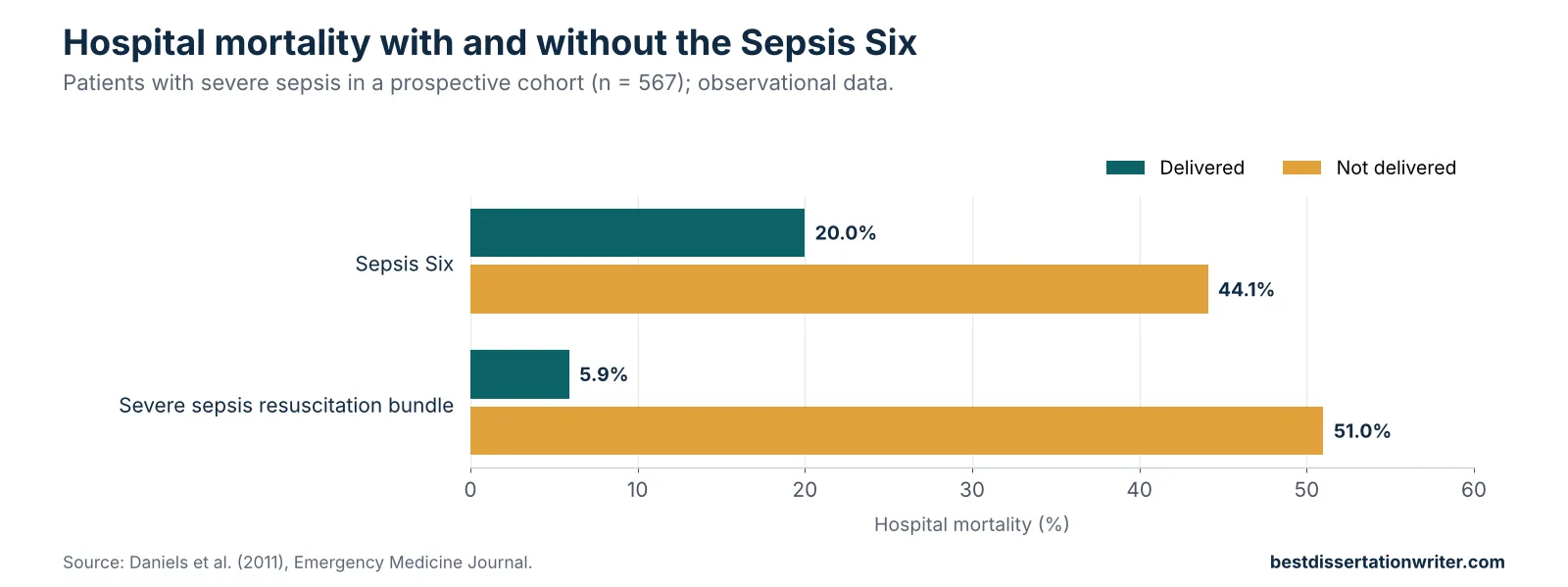
These differences are striking, but the study was observational, so patients who received the bundle may have differed from those who did not. Sicker patients or those with atypical presentations might have been less likely to be recognised and treated promptly, which could exaggerate the apparent benefit. Even so, the scale of the difference supports the view that early delivery of this care bundle is associated with better survival.
Stronger evidence about timing comes from New York State, where hospitals were required to follow sepsis protocols. In a study of 49,331 patients in 149 hospitals, Seymour et al. (2017) found that each hour of delay in completing the three-hour bundle was associated with a 4% increase in the odds of in-hospital death. Delay in giving antibiotics was also associated with higher mortality, whereas the timing of the initial fluid bolus was not. These findings support the emphasis on rapid antibiotics within the Sepsis Six, while suggesting that not every element contributes equally.
The New York data also show why delay matters at ward level. Each step of the bundle takes time, from recognising the problem and calling a doctor to obtaining intravenous access, taking blood cultures and receiving antibiotics from the pharmacy. Small delays at each step can add up to hours, particularly at night or when wards are busy. Seymour et al. (2017) found that most patients did have the bundle completed within three hours, but the minority with longer delays had worse outcomes, which suggests that reducing the slowest cases may be as important as improving average performance.
Theme 2: The Role of Ward Nurses in Early Recognition
Delivering the bundle depends on recognising sepsis in the first place. In a before-and-after study in a Norwegian hospital, Torsvik et al. (2016) evaluated an intervention that trained ward nurses to identify sepsis early and to observe at-risk patients more closely. After the intervention, patients with bloodstream infection had 2.7 times higher odds of surviving to 30 days, were less likely to develop severe organ failure and stayed in hospital for an average of 3.7 fewer days. The authors concluded that early recognition by ward nurses may have reduced disease progression.
This study shows that the nursing contribution begins before the Sepsis Six is started. Regular observation, accurate recording of vital signs and prompt escalation allow sepsis to be identified while it can still be treated effectively. Since the definition of sepsis centres on organ dysfunction (Singer et al., 2016), the signs nurses monitor, including respiratory rate, blood pressure, confusion and urine output, are central to early recognition.
Theme 3: Knowledge, Confidence and Organisational Support
Nurses’ ability to recognise sepsis varies. In a qualitative study of 14 emergency department nurses in Australia, Harley et al. (2019) found gaps in nurses’ knowledge and confidence in recognising and responding to sepsis. Nurses relied heavily on experience and on seeking advice from senior colleagues, and their practice was shaped by the support and systems provided by the organisation. The authors noted that existing guidelines did not clearly define the nursing role and argued for a nurse-inclusive sepsis pathway.
Organisational factors also influence whether the Sepsis Six is delivered on time. Access to blood culture bottles, prompt prescribing of antibiotics, availability of intravenous access and clear escalation routes all affect how quickly the bundle can be completed. National guidance encourages hospitals to use structured risk assessment and clear time frames for treatment (NICE, 2016), but these tools are effective only if nurses are trained and empowered to act on them.
Handover and communication between shifts are further points of vulnerability. A patient whose observations begin to change late in a shift may not be reviewed until the next team arrives, and information about pending blood results or a planned antibiotic dose can be lost. Structured handover tools and clear documentation of the time sepsis was first suspected help to ensure that treatment continues without interruption, and they also provide the data needed to audit how quickly the care bundle is completed.
Discussion
This review suggests that early recognition of sepsis and timely delivery of the Sepsis Six are associated with lower mortality, and that ward nurses play a central role in both. The evidence for timing is particularly strong for antibiotics, with large cohort data showing a rising risk of death with each hour of delay (Seymour et al., 2017). The striking mortality differences reported in the original evaluation of the bundle support its use, although they should be interpreted cautiously because of the observational design.
A key insight is that the Sepsis Six cannot work without early recognition. Interventions that improve nurses’ observation and escalation, such as the Norwegian programme evaluated by Torsvik et al. (2016), appear to improve survival and reduce organ failure. This positions nurses not simply as people who carry out tasks once a doctor has diagnosed sepsis, but as the professionals most likely to notice the first signs of deterioration and to start the Sepsis Six.
The evidence also reveals gaps in knowledge and role clarity. Harley et al. (2019) found that nurses lacked confidence and relied on senior colleagues, reflecting guidance that has historically focused on medical decision-making. Nurse-initiated protocols, which allow trained nurses to take blood cultures, measure lactate and start fluids or antibiotics according to agreed criteria, may help to reduce delays, but they require organisational support, clear governance and regular training.
There is also a risk of over-treatment. Encouraging rapid antibiotics for every patient who might have sepsis can lead to unnecessary antibiotic use, contributing to antimicrobial resistance and side effects. Structured risk assessment, as recommended by NICE (2016), helps to target the bundle at those who need it most, while ensuring that patients at high risk are treated without delay. Nurses can contribute to antimicrobial stewardship by ensuring that blood cultures are taken before antibiotics where possible, so that treatment can later be narrowed or stopped once results are available.
The evidence base has limitations. Most studies were observational or before-and-after designs, which cannot prove that the bundle caused better outcomes. Several sources came from emergency departments rather than wards, and the qualitative study was small and set in a single country. This review relied on openly accessible, English-language sources and did not involve independent double screening. Future research should test nurse-initiated Sepsis Six protocols on general wards using controlled designs. Studies should also report patient-centred outcomes, such as recovery of function after discharge, and examine whether training effects are sustained over time.
Implications of Sepsis Six Evidence for Practice
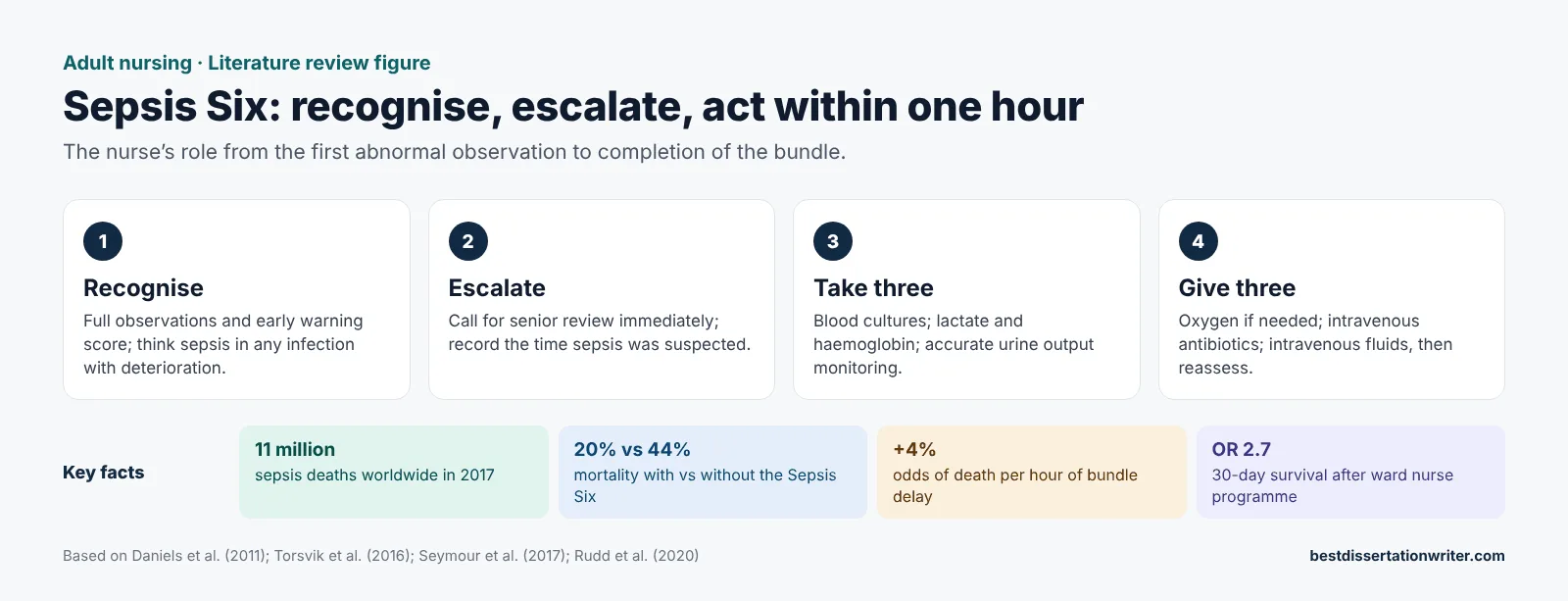
For adult nurses, the evidence supports recording complete sets of observations, calculating early warning scores accurately and considering sepsis in any patient with signs of infection and deterioration. When sepsis is suspected, nurses should escalate immediately, start the Sepsis Six within one hour, record the time each element is completed and reassess the patient frequently. Urine output and intravenous fluids should be recorded carefully, making accurate fluid balance monitoring an essential part of sepsis care.
Managers and educators should provide regular sepsis training, ensure that equipment such as blood culture bottles and lactate testing is readily available and support nurse-initiated protocols where appropriate. Patients with long-term conditions such as chronic obstructive pulmonary disease are at particular risk of sepsis from chest infections, and early recognition should be included in discharge planning advice so that patients know when to seek help.
Conclusion
This systematic review examined the evidence on early recognition of sepsis and delivery of the Sepsis Six by nurses. Timely completion of sepsis bundles, especially early antibiotics, is associated with lower mortality, and interventions that strengthen ward nurses’ observation and escalation appear to improve survival.
Nurses are often the first to recognise sepsis and are central to delivering the Sepsis Six within the first hour. Strengthening their knowledge, confidence and authority to act, supported by clear protocols and organisational commitment, offers a practical way to reduce deaths from sepsis on adult wards.
References
Daniels, R., Nutbeam, T., McNamara, G., & Galvin, C. (2011). The sepsis six and the severe sepsis resuscitation bundle: A prospective observational cohort study. Emergency Medicine Journal, 28(6), 507–512. https://doi.org/10.1136/emj.2010.095067
Harley, A., Johnston, A. N. B., Denny, K. J., Keijzers, G., Crilly, J., & Massey, D. (2019). Emergency nurses’ knowledge and understanding of their role in recognising and responding to patients with sepsis: A qualitative study. International Emergency Nursing, 43, 106–112. https://doi.org/10.1016/j.ienj.2019.01.005
National Institute for Health and Care Excellence. (2016). Suspected sepsis: Recognition, diagnosis and early management (NICE guideline NG51; updated 2024). https://www.nice.org.uk/guidance/ng51
Rudd, K. E., Johnson, S. C., Agesa, K. M., Shackelford, K. A., Tsoi, D., Kievlan, D. R., Colombara, D. V., Ikuta, K. S., Kissoon, N., Finfer, S., Fleischmann-Struzek, C., Machado, F. R., Reinhart, K. K., Rowan, K., Seymour, C. W., Watson, R. S., West, T. E., Marinho, F., Hay, S. I., … Naghavi, M. (2020). Global, regional, and national sepsis incidence and mortality, 1990–2017: Analysis for the Global Burden of Disease Study. The Lancet, 395(10219), 200–211. https://doi.org/10.1016/S0140-6736(19)32989-7
Seymour, C. W., Gesten, F., Prescott, H. C., Friedrich, M. E., Iwashyna, T. J., Phillips, G. S., Lemeshow, S., Osborn, T., Terry, K. M., & Levy, M. M. (2017). Time to treatment and mortality during mandated emergency care for sepsis. New England Journal of Medicine, 376(23), 2235–2244. https://doi.org/10.1056/NEJMoa1703058
Singer, M., Deutschman, C. S., Seymour, C. W., Shankar-Hari, M., Annane, D., Bauer, M., Bellomo, R., Bernard, G. R., Chiche, J.-D., Coopersmith, C. M., Hotchkiss, R. S., Levy, M. M., Marshall, J. C., Martin, G. S., Opal, S. M., Rubenfeld, G. D., van der Poll, T., Vincent, J.-L., & Angus, D. C. (2016). The Third International Consensus Definitions for Sepsis and Septic Shock (Sepsis-3). JAMA, 315(8), 801–810. https://doi.org/10.1001/jama.2016.0287
Torsvik, M., Gustad, L. T., Mehl, A., Bangstad, I. L., Vinje, L. J., Damås, J. K., & Solligård, E. (2016). Early identification of sepsis in hospital inpatients by ward nurses increases 30-day survival. Critical Care, 20, 244. https://doi.org/10.1186/s13054-016-1423-1
Cite this example
Best Dissertation Writers (2026) Early Recognition and Management of Sepsis by Nurses Using the Sepsis Six Care Bundle: A Systematic Review. Available at: https://bestdissertationwriter.com/sepsis-six-literature-review/
Best Dissertation Writers
Get expert help with your nursing literature review
Share your topic and deadline with Best Dissertation Writers and get support tailored to your module brief.


