
Systematic review writing services from expert review writers
Order systematic review writing services today and let our expert writers deliver a PRISMA-guided, plagiarism-free systematic literature review or manuscript.
From$12per page
We deliver rigorous, well-documented systematic reviews. Our systematic review writing services cover the protocol, search, screening, synthesis and manuscript, with every step recorded so your methods are reproducible.
Meet our systematic review writers & literature review experts you can trust
Get expert systematic review writing services, from screening and synthesis to manuscript support, delivered by experienced academic writers.
Showing 1–8 of 32 writers · best rated first

Urban Planning and Geography is my PhD field, built on a Master's degree in Real Estate and Urban Development and a Bachelor's degree in Transport Studies. Thirteen year…

My PhD in Pharmaceutical Sciences came after a Bachelor's degree in Chemistry and was followed by a Master's degree in Public Health, a route that links the molecule to …

Sixteen years of university teaching and applied research cover two fields that do not often share a CV: engineering and agriculture. I hold a PhD in Engineering, a Mast…

Ten years of university teaching and applied research have kept me close to the lab bench and the data. My PhD is in Biological Sciences, my Master's degree is in Bioinf…

Social work practice and criminological theory meet in my nine years of university teaching and applied research. My PhD is in Social Work, my Master's degree is in Crim…

Anthropology is my doctoral field, reached through a Bachelor's degree in Criminology and a Master's degree in Social Work, which says a lot about where my curiosity lie…

I came to computing through study first and teaching second: a Bachelor's degree in Cybersecurity, a Master's degree in Artificial Intelligence and Robotics and then a P…

Business strategy, operations and organisational analysis sit next to macroeconomic policy and econometrics in my sixteen years of university work. I hold a PhD in Econo…

Eighteen years of teaching and applied research have gone into understanding why people think and act as they do, and how societies are organised around them. I hold a P…

Data has been my working language for fifteen years. After a Bachelor's degree in Engineering and a Master's degree in Information Systems, I completed a PhD in Data Sci…

Fifteen years in the university classroom have given me a steady way of explaining difficult ideas. My PhD is in Physics, my Master's degree is in Mathematics and Statis…

Network defence, cryptography and risk management have occupied much of my fourteen years of teaching and applied research. I hold a PhD in Cybersecurity, a Master's deg…

Marketing is my PhD discipline and supply chain management my Master's field, with a Bachelor's degree in Quality Assurance behind both. Thirteen years of university tea…

Nineteen years is a long time in university teaching, and I have used them to go deep into procurement, inventory control and global logistics, and into quality manageme…

Hotels and balance sheets are not often found in one teaching portfolio, but they are in mine. With a PhD in Hospitality and Tourism Management, a Master's degree in Acc…

Policy is both my subject and my method. After a Bachelor's degree in Communication and Media Studies and a Master's degree in Public Policy, I completed a PhD in Politi…

I started in architecture, moved into sustainability studies and finished with a PhD in Environmental Science. Nine years of university teaching and applied research hav…

My route to a PhD in Educational Technology ran through a Bachelor's degree in Law and a Master's degree in Education, and eleven years of teaching and applied research …

History taught me to read slowly and literature taught me to write carefully, and I have used both for thirteen years in university teaching and applied research. My PhD…

Corporate finance, valuation and investment analysis form the first half of my eleven years in teaching and applied research; macroeconomic policy, microeconomic theory …

People are the common thread in my twelve years of teaching and applied research. I began with a Bachelor's degree in Marketing, added a Master's degree in Human Resourc…

Seventeen years in the humanities have given me a wide view of how cultures remember and express themselves. I hold a PhD in Theology and Religious Studies, a Master's d…

Language, ideas and belief have been my subjects for twenty-one years. I hold a PhD in Literature and Linguistics, a Master's degree in Philosophy and a Bachelor's degre…

Moving people and welcoming them are the two subjects I have taught for most of sixteen years. My PhD is in Transport Studies, my Master's degree is in Hospitality and T…

Chemistry is my doctorate, physics my Master's degree and mathematics and statistics my first degree, which is an unusual mix that makes me a careful problem solver. Fou…

Cities and the systems that keep them running are what I have studied for sixteen years. My Bachelor's degree is in Urban Planning and Geography, my Master's degree is i…

Twenty years of teaching in the creative fields have given me a settled approach: look carefully, explain clearly and support every claim. My PhD is in Fashion and Merch…

Law is my field, and I bring eight years of university teaching, supervision support and applied research to it. My PhD is in Law, my Master's degree is in Environmental…

Biotechnology is where my doctorate sits, and eleven years of teaching, supervision support and applied research have grown around it. I added a Master's degree in Medic…

Music and Performing Arts is my doctoral field, reached through a Bachelor's degree in Art and Design and a Master's degree in Fashion and Merchandising. Thirteen years …

Twenty-two years of university teaching have mostly gone on how people communicate and learn. I hold a PhD in Communication and Media Studies, a Master's degree in Educa…

Clinical medicine, pathophysiology and evidence-based practice make up the core of my eleven years in university teaching and applied research. I trained through a Bache…
No writers match these filters.
What researchers say about our systematic review writing services
Real reviews from clients who ordered systematic reviews, meta-analyses and literature reviews from our writers.
- ★★★★★
Excellent work on my systematic literature review. Truly impressed!
- ★★★★★
I was particularly impressed with the meta-analysis. Highly professional service!
- ★★★★★
My literature review was comprehensive, well-organised, and supported by credible academic sources. The thematic synthesis was particularly impressive.
- ★★★★★
Outstanding systematic review! The search strategy, inclusion criteria, and critical appraisal of the selected studies were handled exceptionally well.
- ★★★★★
Very satisfied with the quality of my research synthesis. A few additional recent publications would have made it even better.
- ★★★★★
Professional, detailed, and well-referenced work. The writer successfully identified research gaps and brought together findings from different studies to develop a compelling discussion.
Why researchers choose our systematic review writing services
Our systematic review writing services give you expert writers, a documented method and a clear plan, so your review is transparent, reproducible and ready for peer review.
Without our support
Writing a systematic review alone
- Building search strings and a protocol without a librarian or an information specialist to guide you.
- Screening hundreds of records by hand, with no clear record of why each study was included or excluded.
- Risk of bias, data extraction and synthesis mistakes that weaken the conclusions of your review.
- Missing PRISMA items, flow diagrams and journal formatting rules that delay your submission.
With our systematic review writers
Methodical support from research question to manuscript
- Systematic review writers matched to your field, your review type and your scope.
- Unlimited revisions until your systematic review meets your instructions.
- PRISMA 2020 reporting, checklist and flow diagram handled with you at each stage.
- Dedicated support team keeps your systematic review writing services on schedule.
4,604 dissertations and research papers completed
4.7 average writers’ rating
from 438 client ratingsNo commitment to start. Share your research question and see the difference in your next draft.
Get systematic review helpMain features of our systematic review writing services
Everything included in our systematic review writing services, with no hidden extras.
Subject-matched review writers
We match you with experienced academic writers who know your field and your type of review.
PRISMA 2020 reporting
Your review follows the PRISMA 2020 checklist and includes a flow diagram of how studies were found and selected.
Search strategies built with care
Boolean search strings for PubMed, Scopus, Web of Science and grey literature, documented so they can be repeated.
Screening workflow
Title, abstract and full-text screening set up in Covidence or Rayyan, with every decision recorded.
Risk of bias appraisal
Quality checks with the tools that fit your studies, such as Cochrane risk of bias, JBI, CASP or AMSTAR.
Data extraction and synthesis
Structured extraction tables, then narrative synthesis or meta-analysis where your data allow it.
Manuscript and journal formatting
A publication-ready manuscript formatted to your journal author guidelines or your university rules.
Thorough citation checks
We verify that every source traces back to a credible database and matches your required citation style.
Systematic review writing services we offer for publication-ready results
Every order of our systematic review writing services includes expert writing, careful review and unlimited revisions.
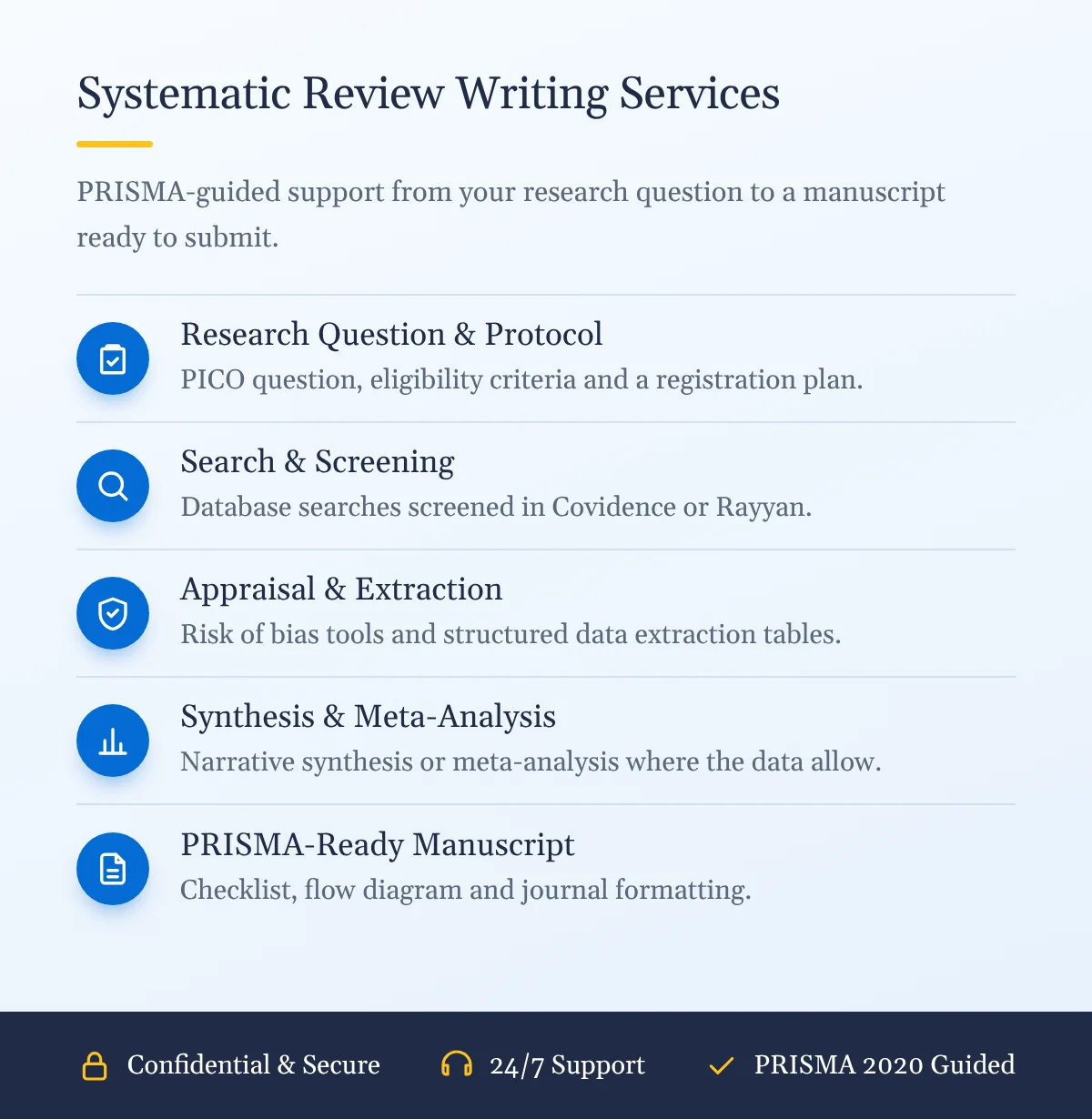
- Unlimited revisions
- PRISMA 2020 reporting
- Deadlines you set
End-to-end systematic review
A complete review built on PRISMA 2020, from research question and protocol to the final manuscript.
Get a full reviewLiterature searches
Boolean search strings and database searches in PubMed, Scopus and Web of Science, with librarian-style support.
Get search helpScreening workflow
Covidence or Rayyan set-up, title and abstract screening, and full-text decisions recorded for your flow diagram.
Get screening helpData extraction and synthesis
Extraction tables, narrative synthesis and meta-analysis, when your included studies are suitable.
Get synthesis helpRisk of bias and quality appraisal
Cochrane, JBI, CASP and AMSTAR tools applied to your included studies, with clear reasoning.
Get appraisal helpManuscript writing and formatting
Journal formatting, a cover letter and revision support for your systematic review manuscript.
Get manuscript helpNot sure which of our systematic review writing services you need? Ask for a free quote first.
Get a free quoteOrder systematic review writing services in 4 easy steps
Ordering our systematic review writing services takes just a few minutes. Here is exactly how it works.
Submit your review details
Share your research question, the type of review, your target journal or university guidelines, and your deadline.
Get matched with a review writer
We pair you with a writer experienced in systematic reviews in your field, and you will get a quote before anything starts.
Review the completed work
Your writer returns the review with the search, screening and synthesis documented. Request revisions any time until you are satisfied.
Download your finished review
Once you approve the work, download your finished systematic review with its supporting files, such as the PRISMA checklist and flow diagram.
Everything about our systematic review writing services
A full breakdown of how our writers work, what is included and how to get started.
Our systematic review writing services and review writing process explained
Our systematic review writing services are built for students, researchers and clinicians who need a rigorous review without losing months to searching, screening and formatting. Whether you are writing a systematic review for a dissertation, a clinical research project or a medical journal, our experienced writers follow a structured review process: research question, protocol, search, screening, appraisal, synthesis and manuscript. Every step is recorded, so your methods are transparent and reproducible.
Your order starts with a short brief. You share your research question, the type of review, the scope, your deadline and any university or journal requirements. We match your project with a writer who knows your field, and you receive a quote before any work begins. Our systematic review writing services then plan the work backwards from your deadline, so the finished systematic review is delivered on time.
Throughout the research process you can message your writer and request unlimited revisions. Our systematic review writing services include editing, citation and formatting support, so the final document meets your formatting requirements without extra effort. These support services run alongside the writing itself. Unlike a general essay service, our review writing solutions focus on complex research that has to stand up to peer reviewers and examiners.
Because every project is different, our systematic review writing services adapt to the support you need. Some clients ask us to write the whole review. Others want help with one stage, such as the search strategy, the screening, the risk of bias tables or the final manuscript. Either way, you stay in control of the research process, and our writers explain each methodological decision so you can defend it to your supervisor, examiners and peer reviewers. Whether you need one stage or the whole project, our systematic review service works to the same standard.
Systematic review writing service or literature review writing: which do you need?
A traditional literature review summarises and critiques existing research to give your study context. A systematic literature review is stricter: it answers a focused question with a pre-defined protocol, a comprehensive database search, explicit inclusion and exclusion criteria and a documented appraisal of every included study. Our literature review writing and our systematic review writing service cover both, and we will tell you honestly which one your assignment needs.
If your instructions mention PRISMA, a protocol, a flow diagram or a risk of bias assessment, you almost certainly need a full systematic review. If you need a themed discussion of sources for a dissertation chapter, a narrative literature review is usually enough. For a feel of clear structure, strong synthesis and careful citation, you can browse our nursing literature review examples.
Not sure which one fits? Send your assignment brief and your research objectives. Our systematic review writing services start with advice on the right type of review, a realistic scope and a sensible timeline, before you commit to anything.
The right choice also depends on your goals. A systematic review writing service is the better fit when you want to publish, or when your assignment expects a protocol and PRISMA reporting. Literature review writing is the better fit for a dissertation chapter that builds the background to your own study. Whichever you choose, our systematic review writing services keep the same standard of clear, evidence-based academic writing.
PRISMA 2020 guidelines and the reporting standards we follow
PRISMA is the main reporting guideline for systematic reviews, and the PRISMA 2020 statement replaced the earlier 2009 version. It provides a 27-item checklist and a flow diagram template that show how many records were found, screened, excluded and included. Following the PRISMA guidelines makes your review easier for peer reviewers to assess and easier for readers to reproduce.
Within our systematic review writing services, our writers complete the PRISMA checklist alongside your manuscript, prepare the PRISMA flow diagram from your screening records and make sure the methods section reports every item clearly. Where your topic calls for another standard, such as an extension for scoping reviews, we follow the reporting standards your journal or university requires.
For reviews of interventions we also work from the Cochrane Handbook for Systematic Reviews of Interventions. We advise on protocol development and registration too, for example on PROSPERO when your review falls within its scope.
Reporting standards are not only about ticking boxes. A review that follows PRISMA 2020 shows readers exactly what was done, which makes your findings more credible and easier to appraise. Our writers keep the checklist, the flow diagram and the text consistent, so the numbers in your PRISMA flow always match the results you report. That consistency is one of the first things peer reviewers check in a systematic review manuscript.
Protocol development and registration for your systematic review
A protocol is the plan for your review, written before you start searching. It states the research question, the scope, the inclusion and exclusion criteria, the databases, the screening method and how you will appraise and synthesize the evidence. Agreeing these decisions in advance reduces bias and shows examiners that your systematic review writing was planned, not improvised.
Our systematic review writing services include protocol development, step by step. We turn your idea into a clear PICO question, define your eligibility criteria and choose methods that match the type of review. When your topic falls within its scope, we also help you prepare a registration on PROSPERO, so your review is visible and your plans are time-stamped.
A good protocol makes every later stage faster. The search, the screening and the write-up all follow the same document, and any change is recorded and explained.
Search strategies, databases and grey literature
A systematic review is only as good as its literature search. In our systematic review writing services, writers build search strategies around your PICO elements or another framework, combining keywords and subject headings with Boolean operators. Each database search runs in the databases that suit your topic, such as PubMed, Scopus and Web of Science, with librarian-style support for complex strings.
We record every search, the date it was run, the exact string and the number of results, so it can be repeated later. Where relevant we add grey literature, such as theses, reports and conference papers, and we chase citations to reduce the risk of missing key research articles.
You receive the full search appendix with your review, which examiners and peer reviewers often ask to see. That makes a thorough literature search easy to defend and simple to update when new evidence appears.
Good search strategies also protect you from bias. Searching only one database, or only for English-language articles, can skew the evidence base. Our systematic review writers explain the limits of each source, document any restriction and justify it in the methods section, so your literature sources look deliberate rather than accidental. If your institution requires a protocol, we write the search section of it with you.
Screening, data extraction and risk of bias assessment
After the search, records are de-duplicated and screened against your inclusion and exclusion criteria. We set up the screening workflow in Covidence or Rayyan, move from title and abstract screening to full-text screening, and record the reason for every exclusion so it can feed your PRISMA flow diagram.
Next comes data extraction. We design extraction tables for study characteristics, outcomes and key findings, so the evidence is easy to compare. Each included study is then appraised for methodological quality with a suitable tool, such as Cochrane risk of bias, JBI checklists, CASP or AMSTAR, depending on the type of studies in your review.
Working this way keeps every decision in our systematic review writing services consistent and auditable.
Clear tables are what make a long review readable. Our extraction sheets and risk of bias summaries use consistent labels, so the same study is described the same way everywhere. This is especially valuable in a clinical systematic review, where readers compare populations, interventions, comparators and outcomes across many trials. You can reuse the tables in your results section, your appendices or a presentation.
Evidence synthesis, meta-analysis and summary of findings tables
Evidence synthesis is where a systematic review earns its value. Depending on your data, our systematic review writing services synthesize results with a narrative synthesis, a thematic synthesis or, when the studies are similar enough, a meta-analysis. We explain each methodological choice in your methods section so readers can follow the logic.
Results are presented in clear summary of findings tables, with forest plots where appropriate and a discussion of heterogeneity and the certainty of the evidence. If you need advanced statistics for a meta-analysis, our dissertation statistics help team can support the analysis.
The discussion links your key findings back to the research question, states limitations honestly and points to research gaps and future research. This keeps your conclusions evidence-based rather than overstated.
When a meta-analysis is not suitable because the studies differ too much, we say so and use a structured narrative synthesis instead. This honest approach protects the credibility of your review and of our systematic review writing services. We follow the Cochrane Handbook for decisions about pooling data and describe every choice clearly, so your evidence synthesis is easy to defend in a viva, a committee meeting or a peer review report.
Tables and figures do much of the work in this section. A clear summary of findings table lets readers see the effect, the certainty of the evidence and the number of studies at a glance. We label every outcome consistently, so your results, your abstract and your discussion all report the same numbers, and a reader can trace each claim back to the studies behind it. This also makes the review easier to update when new studies are published.
Systematic review manuscript writing and journal formatting
If you plan to publish, our systematic review writing services prepare your manuscript for a peer-reviewed journal. We write the abstract, introduction, methods, results and discussion in the structure the journal expects, and we follow its author guidelines for word limits, headings, tables and figures. We work with medical and scientific journals as well as university submissions.
We format citations in APA, Vancouver or the style your target medical journal requires, check every reference against its source and prepare a cover letter on request. Our editing services can also polish a draft you have already written.
The aim is a publication-ready manuscript that meets current publication standards. We cannot promise acceptance, because that decision belongs to the peer reviewers, but we can make sure your review is clear, complete and well reported.
Revisions are a normal part of publishing, so we support them too. If peer reviewers ask for changes, our writers can help you respond point by point, update the search, adjust the synthesis and refresh the PRISMA flow diagram. Keeping the same writer for the revision saves time, because they already know your data, your methods and your reporting choices. That is why many authors return to our systematic review writing services.
Types of reviews we write: scoping, rapid, umbrella and more
Different questions need a different type of review. Alongside the full systematic review, our systematic review writing services produce a scoping review to map a field, rapid reviews when time is short, umbrella reviews that synthesise existing reviews, and integrative or narrative reviews for dissertation chapters.
We also provide clinical systematic review writing, including reviews of interventions, diagnostic accuracy and qualitative evidence, as well as reviews in education, psychology, business and the social sciences. Each uses the same evidence-based research approach, adapted to the scope and to the reporting standard that applies.
Tell us your research needs and we will recommend the type of review that fits your question, your timeline and your institution’s rules. That advice is part of all our systematic review writing services.
Many first-time authors are unsure how to choose a review type. A short conversation about your research gaps, your timeline and your target readers usually settles it. A scoping review suits a broad, emerging topic. A full systematic review suits a narrow, answerable question. Rapid reviews suit urgent decisions, and umbrella reviews suit fields where many reviews already exist. We help you pick before work begins.
Choosing between these types is easier when you start from the question. Ask whether you want to map what exists, answer a narrow question, update an older review or compare several reviews. Our systematic review writing services use your answer to recommend the type of review, the reporting guideline and a realistic timeline, so you do not spend weeks on the wrong design.
Systematic review writing services for dissertations and research papers
Many students need a systematic review as one chapter of a larger project. Our systematic review writing services fit inside a dissertation, a thesis or a stand-alone research paper, and our writers keep your review consistent with the rest of your work, from research objectives to methodology.
If you also need help with the surrounding chapters, our research paper writing service and our wider dissertation writing services cover proposals, methodology, results and discussion. You can combine services in one order, so one team handles the full academic writing process.
This helps when your supervisor expects the findings of the review to shape your own study design, because the same writers on our systematic review writing services understand both sides of the work.
Our systematic review writing services are staffed by writers who also know how a dissertation committee reads a review. They check that the research objectives, the inclusion criteria and the discussion all point the same way, and that your methodology chapter describes the review process accurately. If your department follows APA, we format the whole document to match, including tables, figures and the reference list.
Quality, originality and confidentiality in every review
Every review we write is created from scratch for your project and checked for originality before delivery. Citations are verified against the original research articles, and the reference list follows the format you request. Our systematic review writing services are confidential, and your files and instructions are kept private.
We also encourage you to treat the finished review as academic research and to use it responsibly. Many universities and journals have policies on writing support and on AI tools, so please check yours and disclose help wherever it is required. Our writers explain their choices clearly, which helps you understand, edit and stand behind the finished work.
Revisions are included in our systematic review writing services. If anything in the finished review does not match your instructions, you can request a revision and we will work on it with you until the document meets your requirements.
Systematic reviews work with published studies, so you should never need to share patient-identifiable information with anyone. If your project involves sensitive material, such as unpublished results, tell us before you upload anything and we will agree how to handle it.
How to get started with our review writing service
Getting started with our systematic review writing services is simple. Tell us your topic, the type of review, your deadline and any requirements from your university or journal. You can upload your rubric, protocol or existing literature, and we will confirm the scope and send a quote.
Your writer then begins with a protocol and a search plan, shares progress as the work develops and delivers the finished systematic review with its supporting files: the search appendix, the PRISMA checklist, the flow diagram and the extraction tables.
For another view of how systematic literature reviews are organised, you can also read about systematic literature reviews. When you are ready, place your order and our team will take it from there.
Throughout our systematic review writing services, you can reach our support team around the clock, share files securely and follow progress with your writer. If you want to see how our writers are rated before you order, you can read what clients say in our client reviews. We aim to make the whole experience simple, private and predictable, so you can focus on your studies, your clinical work or your next paper.
Frequently asked questions about systematic review writing services
Straight answers about our systematic review writing services, plus steps, tools, structure, tense and what to avoid.
What are the 5 steps of systematic literature review?
A widely cited framework (Khan et al., 2003) describes five steps. First, frame the question, often with PICO. Second, identify relevant work through a documented search of several databases, such as PubMed, Scopus and Web of Science. Third, assess the quality of the included studies, for example with risk of bias tools. Fourth, summarise the evidence in tables and a synthesis, narrative or meta-analysis. Fifth, interpret the findings, including limitations and implications for practice and future research. Many teams also register a protocol before the search and report with PRISMA at the end. Our systematic review writing services follow all five steps.
Can ChatGPT be used for systematic literature reviews?
It can help with small tasks, such as brainstorming search terms, explaining a method or tidying your own wording, but it cannot replace the review itself. A systematic review must be transparent and reproducible. A chatbot can invent references, cannot run a documented database search and cannot make defensible screening or risk of bias decisions. The ICMJE says AI tools cannot be authors and that their use must be disclosed. Check your institution’s rules, verify every source yourself and keep a record of exactly how any tool was used. With our systematic review writing services, your writer works from sources you can check.
What are the 5 C's of a literature review?
One common model lists Cite, Compare, Contrast, Critique and Connect. Cite credits the authors and checks that sources are current. Compare and contrast look for similarities and differences in findings, methods and questions across studies. Critique asks how well each study answered its own question. Connect links what you found to your own research objectives. Our systematic review writing services apply the same thinking, but inside a documented protocol with explicit criteria.
What are the four types of literature reviews?
There is no single official list, and sources group them differently. A common grouping names four: narrative reviews, which summarise and discuss a topic; systematic reviews, which follow a protocol with explicit search and inclusion criteria; scoping reviews, which map the extent of a field and its gaps; and integrative reviews, which combine different kinds of evidence. Meta-analyses, rapid reviews and umbrella reviews are further types. Choose the type of review that fits your research question, your timeline and your institution’s rules. Our systematic review writing services cover all of these types.
What are the key differences between a literature review and a systematic review?
A literature review summarises and critiques existing research to give context, and the author chooses sources more freely. A systematic review answers a focused question using a pre-defined protocol, a comprehensive and reproducible search, explicit inclusion and exclusion criteria, quality appraisal and transparent reporting, usually with PRISMA. It takes longer and may include a meta-analysis. Journals and examiners expect that extra rigour to be visible in the methods section. Our systematic review writing services are built around it.
How do I structure my literature review?
Start with an introduction that states the scope and purpose. Organise the body by theme, chronology or methodology rather than source by source, and end with a conclusion that synthesises the key findings and points out research gaps. For a systematic review, follow the PRISMA structure: abstract, introduction with objectives, methods (eligibility criteria, sources, search strategy, selection, data collection, risk of bias, synthesis), results with the flow diagram and tables, discussion, and registration and other information. Our systematic review writing services can set up this structure for you.
What tense should a literature review be written in?
APA style generally uses the past tense or the present perfect for other researchers’ work, for example "Smith (2019) found" or "Jones (2015) has shown". Use the present tense for established facts and for your own claims about what the literature shows, such as "the evidence suggests". In a systematic review, write the methods and results in the past tense because the work is complete. Stay consistent within each section and follow your style guide or journal. Our systematic review writing services follow your style guide for tense.
What should be avoided when writing a literature review?
Avoid listing one study after another instead of synthesising them. Avoid relying on a few outdated or non-peer-reviewed sources, quoting heavily instead of paraphrasing with citations, including studies that do not match your scope, and hiding limitations or contradictory findings. Do not let your own opinion replace evidence. In a systematic review, skipping a documented search or failing to record decisions are serious weaknesses. Check every citation, follow the required format and proofread. Our systematic review writing services are designed to avoid these problems.
Ready to Get Your Systematic Review Written?
Tell us your research question, review type and deadline, and our systematic review writing services will match you with the right writer.
- Expert review writers
- Original, plagiarism-checked
- Free revisions
- 24/7 support