Nursing Interventions for the Prevention of Hospital-Acquired Pressure Ulcers in Adult Inpatients: A Literature Review
 By Dr. Robertson Prime, Research Fellow
Updated October 12, 2026
16 min read
About 3,200 words
By Dr. Robertson Prime, Research Fellow
Updated October 12, 2026
16 min read
About 3,200 words
In this review
Abstract
Background: Hospital-acquired pressure ulcers develop after admission, usually in patients whose mobility, sensation or nutrition is compromised by acute illness, surgery or frailty. In a meta-analysis of more than 1.8 million hospitalised adults, 8.4% developed a hospital-acquired pressure injury, and nurses carry most of the responsibility for prevention.
Aim: This systematic review aimed to identify which nursing interventions are effective in preventing pressure ulcers in adult inpatients and how strong the evidence behind them is.
Methods: Evidence was identified through targeted searches of openly accessible bibliographic records, publisher websites and the reference lists of key reviews. Nine sources published between 2014 and 2026 were included: four Cochrane or network meta-analyses, two further systematic reviews and meta-analyses, one cluster randomised trial and two clinical guidelines, appraised with CASP checklists and synthesised thematically.
Findings: Using a structured risk assessment scale made little or no clear difference to pressure ulcer incidence compared with clinical judgement, and nurses answered only about half of knowledge questions correctly. Comparisons of repositioning frequencies were inconclusive, but a network meta-analysis of 65 randomised trials found that powered active air surfaces probably reduce incidence compared with standard hospital mattresses. Nutritional supplements may make little or no difference, and a patient participation bundle was associated with a 42% lower hazard that was not statistically significant.
Conclusion: Prevention should combine prompt risk and skin assessment linked to a documented care plan, appropriate support surfaces, reliable repositioning and attention to nutrition, delivered as a coordinated bundle. Nurses should make sure that every assessment leads to action.
Keywords: hospital-acquired pressure ulcers, pressure injury, repositioning, risk assessment
Introduction
This systematic review critically examines recent evidence on hospital-acquired pressure ulcers and its implications for adult nursing practice.
Pressure ulcers, also called pressure injuries, are localised areas of damage to the skin and underlying tissue caused by sustained pressure, often combined with shear. They are painful, slow to heal and associated with infection, longer hospital stays and reduced quality of life. Because most are considered preventable, their occurrence in hospital is widely used as an indicator of the quality of nursing care.
Hospital-acquired pressure ulcers develop after admission, usually in patients whose mobility, sensation or nutrition is compromised by acute illness, surgery or frailty. Nurses carry most of the responsibility for prevention, from assessing risk on admission to repositioning patients, protecting their skin and choosing appropriate equipment. Despite decades of guidance, rates remain stubbornly high in many countries, which raises questions about which preventive interventions really work.
Using the PICO framework, the population is adults admitted to hospital, the interventions are nurse-delivered preventive measures, the comparison is usual care or an alternative measure, and the outcome is the incidence of new pressure ulcers.
Review question
Which nursing interventions are effective in preventing hospital-acquired pressure ulcers in adult inpatients, and how strong is the evidence behind them?
Background to Hospital-Acquired Pressure Ulcers
Pressure damage occurs when soft tissue is compressed between a bony prominence and an external surface for long enough to reduce blood flow. Shear and friction, moisture from incontinence or sweating, poor nutrition and reduced perfusion all increase vulnerability. The sacrum, heels and hips are the most commonly affected sites because they bear weight when patients lie or sit for long periods.
Damage is classified by depth. Category or stage 1 describes intact skin with non-blanching redness, stage 2 involves partial-thickness skin loss, and stages 3 and 4 extend into fat, muscle or bone. Early stages can be missed, particularly in darker skin tones, where redness is harder to see. Medical devices such as oxygen masks and catheters can also cause device-related injuries at any site. Recognising damage at stage 1 gives nurses the best chance to relieve pressure before the skin breaks down.
The burden is substantial. In a meta-analysis of studies involving more than 1.8 million hospitalised adults, Li et al. (2020) estimated that 8.4% developed a hospital-acquired pressure injury, with most at stage 1 or 2. Even early damage matters, because it signals that preventive care has broken down and may progress if the cause is not removed. For these reasons, preventing hospital-acquired pressure ulcers is a national patient safety priority and a key responsibility for every ward nurse.
In England, the NICE guideline on pressure ulcers (CG179) sets out expectations for risk assessment, skin inspection, repositioning, equipment and nutrition (National Institute for Health and Care Excellence [NICE], 2014). Internationally, the joint guideline from the European Pressure Ulcer Advisory Panel, the National Pressure Injury Advisory Panel and the Pan Pacific Pressure Injury Alliance (EPUAP et al., 2019) provides similar, more detailed recommendations.
Search Strategy and Methods
Evidence for this example was identified through targeted searches of openly accessible bibliographic records, publisher websites and the reference lists of key reviews. Search terms combined keywords for the condition (“pressure ulcer*”, “pressure injur*”, “bed sore*”, “decubitus”) with terms for prevention (“repositioning”, “turning”, “risk assessment”, “support surface”, “mattress”, “nutrition”) and for the hospital setting, joined with the Boolean operators AND and OR. A full systematic review for assessment would run the same strategy in CINAHL, PubMed/MEDLINE, the Cochrane Library and Embase and report the number of records screened in a PRISMA flow diagram.
Sources were eligible if they examined interventions to prevent hospital-acquired pressure ulcers in adults aged 18 or over, or reported their incidence or nurses’ preventive knowledge. Systematic reviews, randomised trials and large observational studies were prioritised. Studies conducted only in community or care home settings, studies of pressure ulcer treatment rather than prevention, and opinion pieces were excluded. National and international guidelines were included to describe the expected standard of care. Studies of hospital-acquired pressure ulcers in critical care were included where their findings were relevant to general wards.
Nine sources published between 2014 and 2026 were included: four Cochrane or network meta-analyses of interventions, two further systematic reviews and meta-analyses, one cluster randomised trial and two clinical guidelines (Table 1). Each source was appraised with the relevant Critical Appraisal Skills Programme (CASP) checklist, and the certainty ratings reported by review authors were recorded.
Findings were synthesised thematically by comparing how the evidence addressed risk assessment, repositioning and support surfaces, and nutrition and patient participation. Because the sources used different designs and outcome measures, statistical pooling was not appropriate. The aim was to judge which measures against hospital-acquired pressure ulcers rest on strong evidence and which rely mainly on expert consensus.
Key Findings on Hospital-Acquired Pressure Ulcers
Three themes emerged: the value of structured risk and skin assessment, the effectiveness of repositioning and support surfaces, and the role of nutrition and patient participation. Table 1 summarises the included sources.
| Author, year | Design | Setting and sample | Key finding |
|---|---|---|---|
| Li et al. (2020) | Systematic review and meta-analysis | Studies of more than 1.8 million hospitalised adults | 8.4% of hospitalised adults developed a hospital-acquired pressure injury; most were stage 1 or 2. |
| Latimer et al. (2026) | Cochrane systematic review | 11 randomised trials; 4,462 adults | Repositioning frequency and 30° tilt comparisons inconclusive (very low certainty); turning reminders promising. |
| Moore and Patton (2019) | Cochrane systematic review | 2 randomised trials; 1,487 acute care patients | Risk assessment tools made little or no clear difference to incidence compared with clinical judgement. |
| Shi et al. (2018) | Network meta-analysis | 65 randomised trials | Powered active and hybrid air surfaces probably reduce incidence compared with standard hospital mattresses. |
| Langer et al. (2024) | Cochrane systematic review | 11 prevention studies | Mixed nutritional supplements may make little or no difference to incidence (low certainty). |
| Chaboyer et al. (2016) | Cluster randomised trial (INTACT) | 1,600 at-risk patients; eight Australian hospitals | Patient participation bundle: hazard ratio 0.58, imprecise and not statistically significant. |
| Wu et al. (2022) | Systematic review and meta-analysis | 20 studies of nurses and nursing students | Nurses scored about 51% on prevention knowledge; weakest on reducing pressure and shear. |
| NICE (2014) | National guideline | Adults in all NHS settings | Assess risk on admission; reposition at least every 6 h (at risk) or 4 h (high risk); high-specification foam mattress. |
| EPUAP et al. (2019) | International guideline | Adults and children in all care settings | Detailed evidence-graded recommendations for assessment, repositioning, support surfaces and nutrition. |
Theme 1: Risk Assessment and Skin Inspection
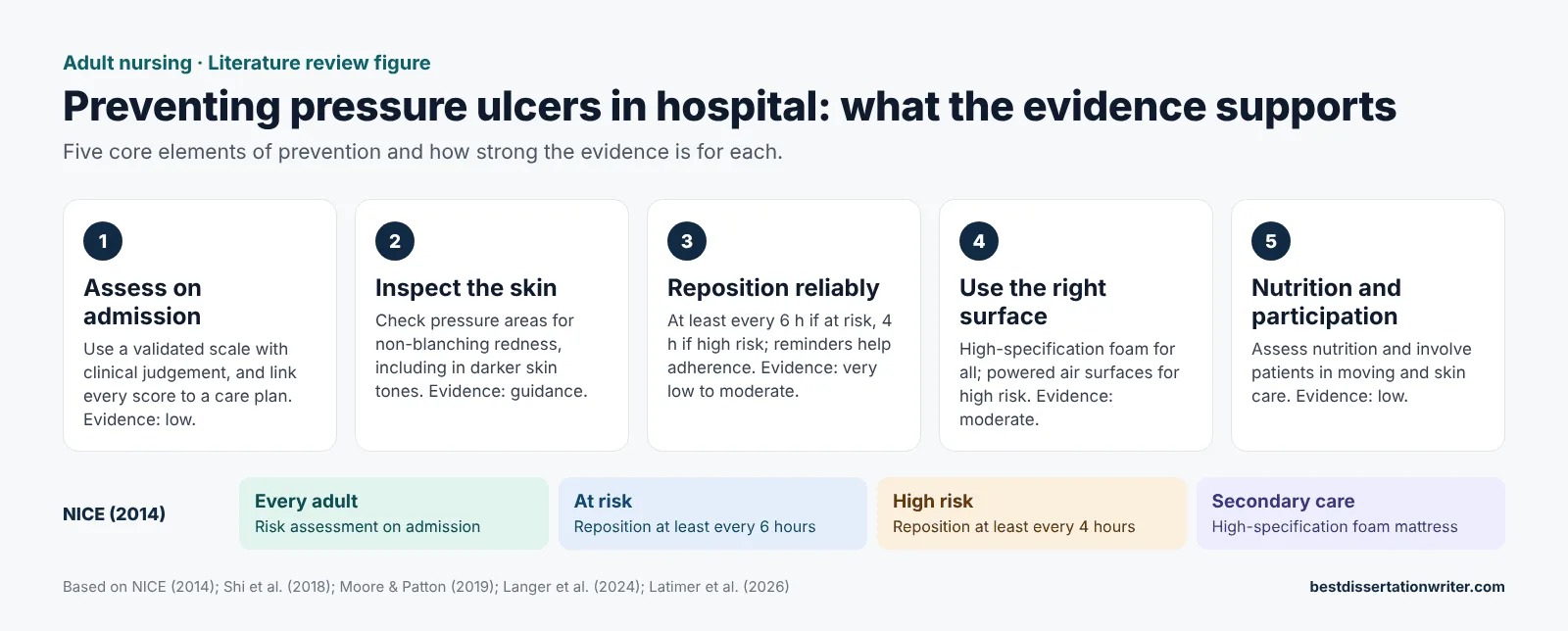
Structured risk assessment scales such as the Braden, Waterlow and Norton scales are used in almost every hospital, and NICE (2014) recommends assessing all adults on admission using a validated scale alongside clinical judgement. However, the evidence that using a scale prevents pressure ulcers is weak. In a Cochrane review of two randomised trials involving 1,487 acute care patients, Moore and Patton (2019) found that using the Braden, Waterlow or Ramstadius tools made little or no clear difference to pressure ulcer incidence compared with clinical judgement, with the certainty of evidence rated low or very low.
These findings do not mean that risk assessment is pointless. A scale gives structure to an assessment, prompts nurses to consider factors such as mobility, nutrition and moisture, and creates a record that supports communication. What matters is that the assessment leads to action. A high score that is documented but not linked to a care plan, equipment or repositioning schedule is unlikely to change outcomes, which may help to explain the trial findings. Assessment is the first step in preventing hospital-acquired pressure ulcers, not an end in itself.
Skin inspection is the other half of assessment. NICE (2014) recommends that adults at high risk have their skin checked by a trained professional, using finger palpation or diascopy to identify non-blanching redness, which is harder to detect in darker skin. The ability to recognise early damage depends on nurses’ knowledge. In a meta-analysis of 20 studies using the Pressure Ulcer Knowledge Assessment Tool, Wu et al. (2022) found that nurses answered only about half of the questions correctly, below the 60% threshold the authors considered sufficient, with the weakest scores on measures to reduce pressure and shear.
Theme 2: Repositioning and Support Surfaces
Repositioning is the most familiar preventive measure, and NICE (2014) recommends changing the position of adults at risk at least every six hours and those at high risk at least every four hours. The 2026 update of the Cochrane review on repositioning, which included 11 randomised trials with 4,462 adults, found that comparisons of different repositioning frequencies, such as two-hourly against four-hourly turning, were inconclusive and supported by very low-certainty evidence (Latimer et al., 2026). The comparison of a 30-degree tilt with a 90-degree position was similarly uncertain.
One trial in the same review offered a more promising signal: wearable sensors that reminded staff when patients were due to be turned were associated with fewer pressure injuries, with moderate-certainty evidence. This suggests that the reliability of repositioning, rather than the exact interval chosen, may be what protects patients. Nurses know that planned turns are often delayed or missed when wards are busy, and technology that supports adherence may address this gap and reduce hospital-acquired pressure ulcers on busy wards.
For nurses, these findings have practical consequences. Because the evidence does not identify a single correct interval, repositioning should be planned around each patient’s skin response, comfort and clinical condition, and reviewed regularly rather than applied as a fixed routine. Skin that remains red after a set interval suggests that turning needs to be more frequent, whereas a patient who can move independently may need encouragement rather than scheduled turns. Clear documentation of each position change also allows teams to check that planned care is actually delivered.
The evidence for support surfaces is stronger. In a network meta-analysis of 65 randomised trials, Shi et al. (2018) found that powered active air surfaces and powered hybrid air surfaces probably reduce the incidence of pressure ulcers compared with standard hospital mattresses, with moderate-certainty evidence for active air surfaces. Patients found these surfaces slightly less comfortable, which may affect sleep and willingness to use them. NICE (2014) recommends a high-specification foam mattress for all adults admitted to secondary care, with more advanced surfaces for those at higher risk.
Theme 3: Nutrition and Patient Participation
Poor nutrition is a recognised risk factor, so supplements have often been used for prevention. However, a 2024 Cochrane review of 11 prevention studies found that mixed energy, protein and micronutrient supplements may make little or no difference to the proportion of patients who develop pressure ulcers compared with a standard diet, with low-certainty evidence (Langer et al., 2024). In line with this, NICE (2014) advises against giving supplements solely to prevent pressure ulcers when a patient’s intake is adequate, while recommending nutritional assessment for those at risk of malnutrition.
Patient participation is a newer approach. In the INTACT cluster randomised trial across eight Australian hospitals, Chaboyer et al. (2016) tested a care bundle that encouraged 1,600 at-risk patients to keep moving, look after their skin and eat well, supported by nurses trained to work in partnership with them. The bundle was associated with a 42% lower hazard of hospital-acquired pressure ulcers, but the estimate was imprecise and not statistically significant. The authors concluded that the approach may be effective but that a larger trial was needed. Involving patients is nonetheless consistent with person-centred care and may strengthen other measures against hospital-acquired pressure ulcers.
Taken together, the findings show that the strongest evidence for preventing hospital-acquired pressure ulcers supports advanced support surfaces, while evidence for risk scales, specific repositioning intervals, nutritional supplements and patient participation remains uncertain. Much routine practice therefore rests on consensus guidance rather than high-certainty trial evidence.
Discussion
The most striking feature of this evidence base is the gap between how firmly preventive measures are embedded in practice and how weak the trial evidence behind them is. Risk scales, regular repositioning and nutritional support are recommended in every major guideline, yet Cochrane reviews rate most of the supporting evidence as low or very low certainty. This does not show that these measures are ineffective. Rather, it reflects small trials, inconsistent outcome measures and the difficulty of testing individual parts of what is, in reality, a combined package of care.
Several findings point to implementation as the key issue. Risk assessment appears to help only when it leads to action, repositioning seems to work best when adherence is supported, and the effect of patient participation depends on nurses having the time and skills to involve patients. The low knowledge scores reported by Wu et al. (2022), particularly about reducing pressure and shear, suggest that education remains a weak link. Prevention of hospital-acquired pressure ulcers is therefore as much about reliable systems and skilled staff as about any single intervention.
The evidence base has important limitations. Many trials were small, conducted in single countries and judged at high risk of bias, and incidence was measured in different ways. The INTACT trial was underpowered, and the knowledge meta-analysis drew mainly on surveys from a limited number of countries. This review relied on openly accessible sources and English-language publications and did not include community or care home settings, so its conclusions about hospital-acquired pressure ulcers apply to adult hospital inpatients.
The findings also have implications for how prevention is measured. Because stage 1 damage is easily missed and incidence is recorded in different ways, a ward with high reported rates may simply be better at detecting early damage. Audits should therefore check whether preventive care was delivered, such as timely assessment, appropriate mattresses and documented repositioning, as well as counting new ulcers. Combining process and outcome measures gives a fairer and more useful picture of the quality of nursing care.
Despite these limitations, the findings are consistent enough to guide practice. Prevention of hospital-acquired pressure ulcers should combine prompt assessment, appropriate support surfaces, reliable repositioning and attention to skin, moisture and nutrition, delivered as a coordinated bundle rather than isolated tasks. Future research should test bundles in adequately powered trials, use standardised outcome measures, and evaluate technologies that support repositioning and the early detection of skin damage, including in patients with darker skin tones.
Implications of Hospital-Acquired Pressure Ulcers Evidence for Practice
For adult nurses, the evidence on hospital-acquired pressure ulcers supports assessing every patient on admission and whenever their condition changes, and making sure that each assessment leads to a documented care plan. Patients at risk should be placed on a high-specification foam mattress, with powered air surfaces considered for those at high risk. Repositioning schedules should be realistic, recorded and reviewed at handover, and patients who are able should be encouraged to move and to report discomfort.
Ward managers should treat prevention as a team responsibility, support staff with equipment and reminders, and provide regular education on skin inspection, including in darker skin tones. The same principles of systematic assessment and reliable follow-through underpin other ward safety priorities, such as recognising deterioration with early warning scores, preventing falls and managing acute and chronic pain, which can limit mobility and increase pressure risk.
Conclusion
This review examined nursing interventions for preventing hospital-acquired pressure ulcers in adult inpatients. Powered air support surfaces have the strongest evidence of benefit, while risk scales, specific repositioning intervals, nutritional supplements and patient participation are supported mainly by low-certainty evidence and expert consensus. The findings suggest that the success of prevention depends less on any single measure than on reliable, coordinated care delivered by knowledgeable staff.
Nurses can reduce hospital-acquired pressure ulcers by assessing risk promptly, linking every assessment to action, protecting vulnerable skin and making sure that repositioning and equipment are consistently in place. Stronger trials of combined prevention bundles are needed to build a firmer evidence base for this important area of practice, and to show which elements matter most for different groups of patients.
References
Chaboyer, W., Bucknall, T., Webster, J., McInnes, E., Gillespie, B. M., Banks, M., Whitty, J. A., Thalib, L., Roberts, S., Tallott, M., Cullum, N., & Wallis, M. (2016). The effect of a patient centred care bundle intervention on pressure ulcer incidence (INTACT): A cluster randomised trial. International Journal of Nursing Studies, 64, 63–71. https://doi.org/10.1016/j.ijnurstu.2016.09.015
European Pressure Ulcer Advisory Panel, National Pressure Injury Advisory Panel, & Pan Pacific Pressure Injury Alliance. (2019). Prevention and treatment of pressure ulcers/injuries: Clinical practice guideline. The international guideline (3rd ed.). EPUAP/NPIAP/PPPIA. https://internationalguideline.com
Langer, G., Wan, C. S., Fink, A., Schwingshackl, L., & Schoberer, D. (2024). Nutritional interventions for preventing and treating pressure ulcers. Cochrane Database of Systematic Reviews, 2024(2), CD003216. https://doi.org/10.1002/14651858.CD003216.pub3
Latimer, S. L., Chaboyer, W. P., Probst, S., Thalib, L., Palipana, D., Lapkin, S., McInnes, E., Downes, M. J., & Gillespie, B. M. (2026). Repositioning for pressure injury prevention in adults. Cochrane Database of Systematic Reviews, 2026(6), CD009958. https://doi.org/10.1002/14651858.CD009958.pub4
Li, Z., Lin, F., Thalib, L., & Chaboyer, W. (2020). Global prevalence and incidence of pressure injuries in hospitalised adult patients: A systematic review and meta-analysis. International Journal of Nursing Studies, 105, Article 103546. https://doi.org/10.1016/j.ijnurstu.2020.103546
Moore, Z. E. H., & Patton, D. (2019). Risk assessment tools for the prevention of pressure ulcers. Cochrane Database of Systematic Reviews, 2019(1), CD006471. https://doi.org/10.1002/14651858.CD006471.pub4
National Institute for Health and Care Excellence. (2014). Pressure ulcers: Prevention and management (Clinical guideline CG179). NICE. https://www.nice.org.uk/guidance/cg179
Shi, C., Dumville, J. C., & Cullum, N. (2018). Support surfaces for pressure ulcer prevention: A network meta-analysis. PLoS ONE, 13(2), Article e0192707. https://doi.org/10.1371/journal.pone.0192707
Wu, J., Wang, B., Zhu, L., & Jia, X. (2022). Nurses’ knowledge on pressure ulcer prevention: An updated systematic review and meta-analysis based on the Pressure Ulcer Knowledge Assessment Tool. Frontiers in Public Health, 10, Article 964680. https://doi.org/10.3389/fpubh.2022.964680
Cite this example
Best Dissertation Writers (2026) Nursing Interventions for the Prevention of Hospital-Acquired Pressure Ulcers in Adult Inpatients: A Literature Review. Available at: https://bestdissertationwriter.com/hospital-acquired-pressure-ulcers/
Best Dissertation Writers
Get expert help with your nursing literature review
Share your topic and deadline with Best Dissertation Writers and get support tailored to your module brief.