
Psychosocial Support Needs of People Living with Cancer and the Nursing Response: An Integrative Review
 By Dr. Robertson Prime, Research Fellow
Updated October 28, 2026
14 min read
About 2,900 words
In this review
Abstract
Background: A cancer diagnosis affects emotional, social, practical and spiritual wellbeing as well as the body, and many people have psychosocial support needs that are not met. Nurses see patients across the pathway and are often the first to notice distress, so evidence on needs, interventions and barriers to psychosocial care is central to cancer nursing.
Aim: This integrative review aimed to bring together evidence on the psychosocial support needs of people living with cancer, the effectiveness of psychological interventions and the barriers nurses face in providing psychosocial care.
Methods: Evidence was identified through targeted searches of openly accessible bibliographic records, publisher websites and professional guidance. Five sources published between 2009 and 2023 were included: three systematic reviews, a literature review and a clinical practice guideline. The research sources were appraised using CASP checklists and integrated narratively.
Findings: A systematic review of 94 reports found that the prevalence of unmet needs varied widely, from 12% to 85% for psychological needs and 6% to 93% for information needs. A scoping review of 81 studies found that distress, depression and anxiety were associated with higher unmet needs in people with advanced cancer and their caregivers. A Cochrane review of 30 trials found small or no effects on quality of life but a possible benefit of nurse-delivered interventions on mood. A guideline recommends a stepped-care model. A literature review identified lack of skills, time and privacy as barriers for nurses.
Conclusion: Psychosocial support needs are common, variable and often unmet. Nurses can screen, provide first-line support and refer using stepped care, but training, time and organisational guidance are needed.
Keywords: psychosocial support needs, emotional needs, oncology nurse
Introduction
This integrative review critically examines recent evidence on psychosocial support needs and its implications for cancer nursing practice.
People who are diagnosed with cancer face uncertainty about the future, changes in their body and daily life, and demands from treatment and from family and work. Many experience anxiety or low mood, some develop depression and others struggle with practical matters such as money, childcare or transport. These difficulties are described as psychosocial support needs, and they range from a need for information and reassurance to a need for specialist psychological treatment.
Psychosocial support needs are not always visible. Patients may not mention worries because they do not want to burden busy staff, because they think distress is expected or because they do not know that help is available. Clinicians may focus on physical treatment and miss the emotional effects. When needs go unmet, patients can feel isolated, may find it hard to follow treatment and may experience a lower quality of life.
Oncology nurses have long contact with patients who have psychosocial support needs, they are often present at difficult moments and they are trusted. This makes them well placed to ask about emotional needs and to give first-line support. An integrative review was chosen because the question needs surveys, trials and guidelines to be considered together.
Review question
What does the evidence show about the psychosocial support needs of people with cancer, which psychological interventions help, and what prevents nurses from providing psychosocial care?
Background to Psychosocial Support Needs
Supportive care needs are commonly grouped into domains, including physical, psychological, psychosocial, information, communication, spiritual, sexual and practical needs. A need is described as unmet when a person wants help in a domain and does not receive it. Measuring psychosocial support needs allows services to see where support is missing, and it is different from measuring distress, although the two are often related.
Support for psychosocial support needs is usually organised in levels. Many people need good information and empathy from the care team, some need structured counselling, and a smaller number need specialist mental health care. The idea of stepped care follows from this: the least intensive effective treatment is offered first, and care is stepped up if symptoms do not improve.
Cancer care has increasingly recognised that carers also have needs, and some of the sources reviewed here include them. The experiences of carers are described in the review of cancer carers, and the needs of people near the end of life are considered in the review of integration of palliative care.
Emotional needs deserve particular attention because they can be missed. A patient who is quiet and polite in clinic may be anxious about scan results, afraid of recurrence or low in mood. Nurses can learn to notice cues, such as a patient who repeatedly asks the same question, who seems to have lost interest in treatment or who says that they are fine without making eye contact, and can respond by inviting the patient to say more.
Search Strategy and Methods
Evidence for this example was identified through targeted searches of openly accessible bibliographic records, publisher websites and professional guidance. Search terms combined keywords for the need (“psychosocial support needs”, “unmet needs”, “emotional needs”, “distress”) with terms for the intervention and provider (“psychosocial intervention”, “stepped care”, “oncology nurse”, “nurse-delivered”), joined with the Boolean operators AND and OR. A full integrative review for assessment would run the same strategy in CINAHL, PubMed/MEDLINE, PsycINFO and Embase and report the records screened in a PRISMA flow diagram.
Sources were eligible if they were systematic reviews, Cochrane reviews, literature reviews or clinical practice guidelines on the needs of adults with cancer, the effects of psychosocial interventions, or the delivery of psychosocial care by nurses. Studies of children and of single psychotherapy techniques in specific cancers were excluded.
Five sources published between 2009 and 2023 were included (Table 1). The quality of each research source was considered using the Critical Appraisal Skills Programme (CASP) checklists, and findings were integrated narratively under themes.
Key Findings on Psychosocial Support Needs
Three themes were identified: the prevalence and range of unmet needs, the effectiveness of interventions and guidelines, and the barriers to nurses providing psychosocial care. Table 1 summarises the included sources, and Figure 1 shows the range of reported prevalence of unmet needs by domain.
| Author, year | Design | Setting and sample | Key finding |
|---|---|---|---|
| Andersen et al. (2023) | Clinical practice guideline | Adult survivors of cancer | Stepped-care model; psychological treatment before medication; regular mental health assessment. |
| Galway et al. (2012) | Cochrane review | 30 randomised trials | Small or no effect on quality of life; possible benefit of nurse-delivered support on mood. |
| Harrison et al. (2009) | Systematic review | 94 reports; 57 quantified prevalence | Unmet need varied widely by domain, for example 12% to 85% for psychological needs. |
| Hart et al. (2022) | Systematic scoping review | 85 papers; 81 studies | Distress, depression and anxiety associated with higher unmet needs in advanced cancer. |
| White (2021) | Literature review | Adult cancer services | Barriers include lack of skills, time, privacy and organisational guidance. |
Theme 1: The Prevalence and Range of Unmet Needs
Harrison et al. (2009) carried out a systematic review of the unmet supportive care needs of people with cancer. They identified 94 articles or reports, of which 57 quantified the prevalence of unmet need. Prevalence varied widely between studies and domains. Unmet needs with activities of daily living were the most frequently reported (1% to 73%), followed by psychological needs (12% to 85%), information needs (6% to 93%), psychosocial needs (1% to 89%) and physical needs (7% to 89%). Spiritual, communication and sexuality needs were the least investigated.
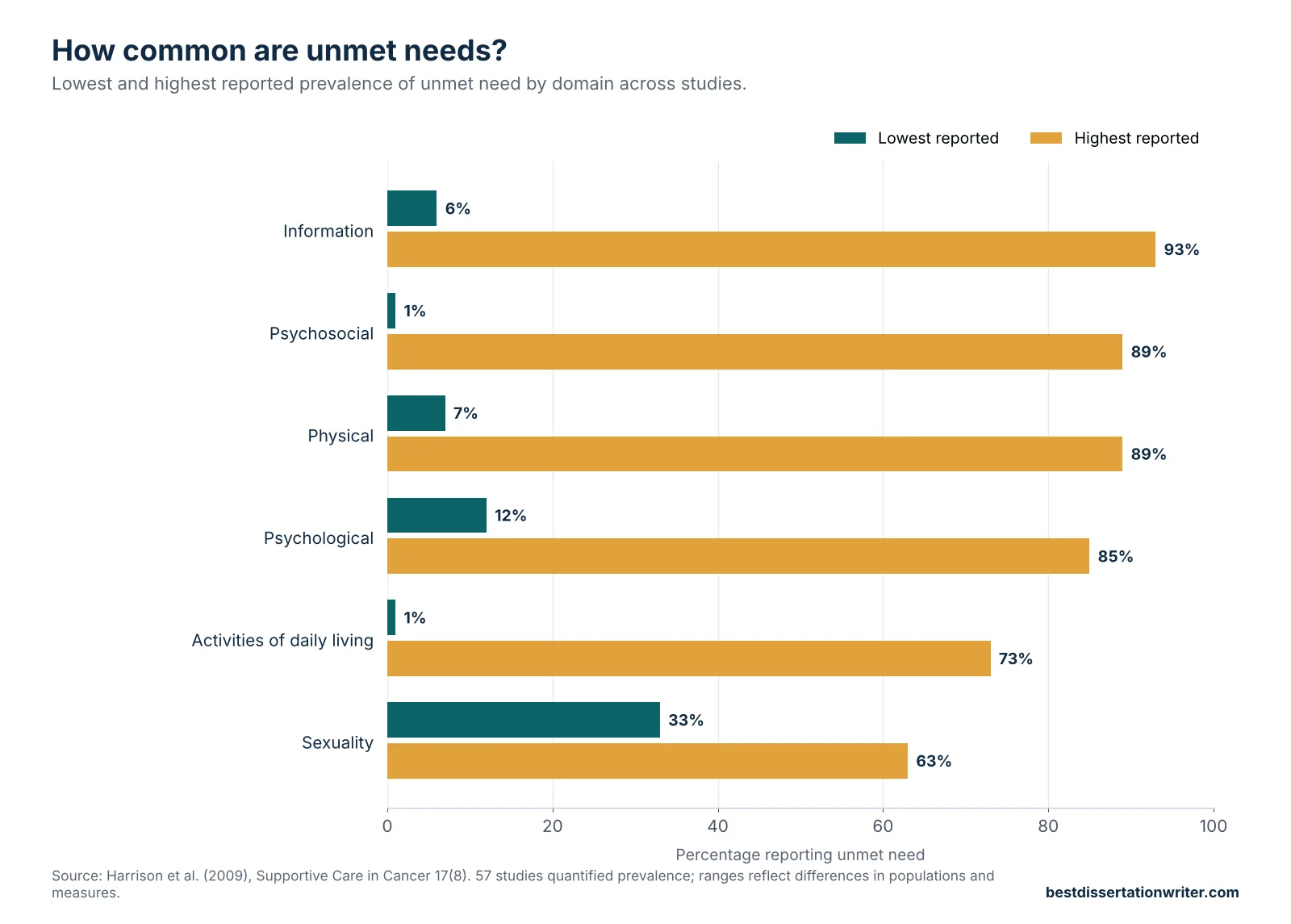
The review reported that unmet needs were highest and most varied during treatment, but that more people reported unmet needs after treatment than at any other time. The authors noted that differences in how need was classified and reported, and differences in the populations studied, limit comparison between studies, and they called for prospective, validated and standardised research. The width of the ranges is itself an important finding, because it shows that needs depend on the person and the setting and cannot be assumed.
Hart et al. (2022) carried out a systematic scoping review of unmet supportive care needs of people with advanced cancer and their caregivers, searching PubMed, CINAHL and EMBASE and including 85 papers representing 81 studies. People with advanced cancer reported the highest unmet needs in financial, health system and information, psychological, and physical and daily living domains, while caregivers reported the highest unmet needs in psychological and patient care and support domains. Distress, depression and anxiety were associated with higher unmet needs across all domains for both patients and caregivers, and the authors noted substantial heterogeneity in study populations and methods.
Theme 2: Interventions and Guidelines
Galway et al. (2012) carried out a Cochrane review of psychosocial interventions to improve quality of life and emotional wellbeing for recently diagnosed cancer patients. It included 30 randomised trials of one-to-one psychosocial interventions delivered by a trained helper, from 3,309 records screened. There was no significant effect on overall quality of life at six months (9 studies, standardised mean difference 0.11, 95% confidence interval −0.00 to 0.22), and a small improvement when cancer-specific measures were used (6 studies, 0.16, 0.02 to 0.30). General psychological distress improved on mood measures (8 studies, −0.81, −1.44 to −0.18), but there was no significant effect on depression or anxiety scores.
Within these results, psychoeducational and nurse-delivered interventions, given face to face and by telephone, had small positive effects on quality of life in breast cancer (2 studies, 0.23, 0.04 to 0.43). The authors said that variation in participants, delivery modes, helper disciplines and content made firm conclusions difficult, and tentatively suggested that nurse-delivered interventions that combine information with supportive attention may benefit mood in newly diagnosed patients.
The 2023 ASCO guideline update on anxiety and depression in adult survivors of cancer (Andersen et al., 2023) provides more practical guidance. It retained the 2014 recommendations on screening and assessment and calls for regular mental health assessment after diagnosis. It recommends a stepped-care model, choosing the most effective and least resource-intensive option for the severity of symptoms, with a clear referral plan and tracking of response at set intervals. For moderate symptoms of depression or anxiety it advises individual or group therapy, such as cognitive behavioural therapy, behavioural activation, structured exercise or mindfulness-based stress reduction, and for severe symptoms individual therapy. Medication is not first line, which it describes as a weak recommendation based on low-quality evidence.
Theme 3: Barriers to Nurses Providing Psychosocial Care
White (2021) reviewed the literature on barriers to the delivery and uptake of psychosocial care in adult cancer services. The barriers identified included that patients may be reluctant to accept psychosocial care from mental health professionals and tend to prefer nurses, that nurses often lack the skills and training to deliver psychosocial interventions during routine appointments, that time and privacy are limited, that organisational guidance is insufficient, and that nursing culture places little emphasis on self-care.
These findings link psychosocial support needs to the response. Patients prefer to talk to nurses, but nurses report that they are not equipped, do not have the time and do not always have a private place to talk. The result is a gap between what patients want and what services provide. The review is a narrative literature review, and the number of included studies was not stated in the available abstract, so its conclusions should be read with some caution.
Taken together, the themes describe a pathway that starts with recognising psychosocial support needs, continues with an appropriate response and depends on a workforce that is able to provide it. A failure at the first step, for example when needs are not assessed, means that later steps are not reached. A failure at the last step, when nurses lack time or skills, means that needs are found but not met, which can be as discouraging for patients and staff as not asking at all.
The sources also suggest that needs change over time. Harrison et al. found that unmet needs were highest and most varied during treatment but that more people reported them after treatment than at any other time. This pattern fits the experience of many patients, who feel supported while in treatment and then find that contact falls away when it ends. Psychosocial assessment should therefore be repeated at transitions, such as the end of treatment, recurrence and the move to palliative care.
Finally, the findings invite caution about the choice of outcome in research. A trial that measures quality of life may miss improvements in mood or in confidence, and a trial that measures distress may miss the relief that comes from being listened to. Future studies should combine several outcomes, including the experience of the patient, and should describe the content and the professional delivering the intervention so that nursing contributions can be identified.
Discussion
This review shows that psychosocial support needs are common, variable and often unmet, and that they continue after treatment ends. The figures vary so much between studies that no single number can be quoted for the proportion of patients who need help, which means that each service needs to assess its own population. Needs are also linked to distress, and both increase in advanced cancer.
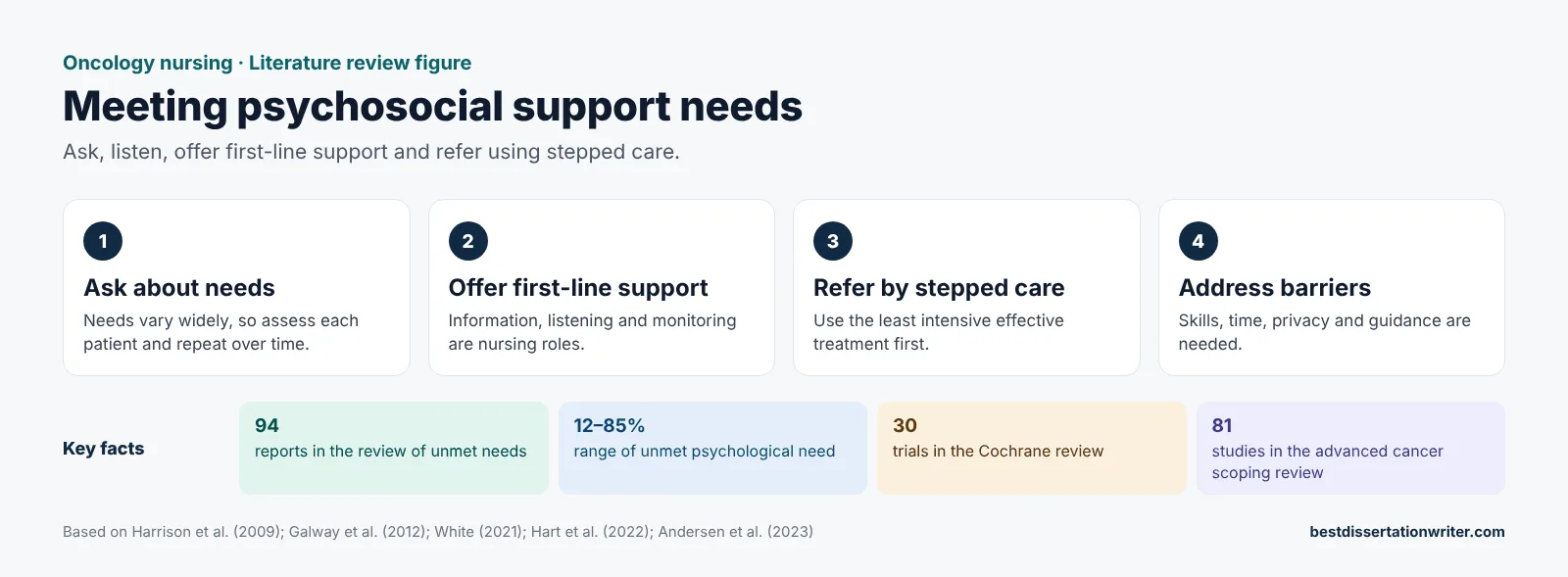
The evidence on interventions is mixed. The Cochrane review found small or no effects on quality of life, although the authors suggested that nurse-delivered interventions may help mood. Guidelines are more definite about the structure of care, and the recommended approach of stepped care, with psychological treatment before medication, gives nurses a practical framework. Nurses can offer first-line support, such as information, listening and monitoring, and refer patients with moderate or severe symptoms.
The barriers show what is needed to put this into practice. Training in communication and psychosocial skills, time and a private space for conversations, and organisational guidance on screening and referral are all required. Without these, even the best-evidenced approach will be difficult to deliver. Psychosocial care also needs to take account of other symptoms such as pain and fatigue, described in the reviews of cancer pain and cancer-related fatigue, because physical and emotional distress influence each other.
There are limitations. The sources are of different types, and some are older, so recent developments may be missed. The Cochrane review concerned one-to-one interventions in recently diagnosed patients and does not cover group or family therapy. The review of barriers is a literature review with limited detail. Evidence on the experience of specific groups, such as younger people or those from minority backgrounds, is limited in the sources. This review relied on openly accessible, English-language sources.
Practical steps are available even where resources are limited. A brief question at each visit about how the patient is coping, with a note of the answer, costs little and creates an opening for conversation. A list of local services, including counselling, peer support groups and financial advice, allows nurses to signpost quickly. Where a patient seems to be at risk, a nurse can follow local procedures to arrange urgent assessment, and should seek supervision or debriefing after distressing conversations.
Implications of Psychosocial Support Needs Evidence for Practice
For practice, the evidence supports asking every patient about psychosocial support needs at key points, using a validated screening tool where available, offering information and first-line support, and referring according to a stepped-care model. Patients and families can find information and support from Macmillan Cancer Support and Cancer Research UK.
Managers should provide training in psychosocial care, protected time and private space, and clear referral routes. Services should audit whether psychosocial support needs are assessed and recorded, and whether patients who need more help receive it.
Future research should test nurse-delivered psychosocial interventions in routine care, compare stepped-care models with usual practice and include groups who are under-represented, such as younger people, people from minority backgrounds and those in rural areas. Studies should also report the training that nurses receive and the time that the interventions take, so that services can judge whether they are feasible. Better evidence on how to meet psychosocial support needs in advanced cancer, where unmet needs are high, is especially needed.
Conclusion
This integrative review found that psychosocial support needs are common but vary widely and are often unmet, that nurse-delivered support may help, and that guidelines recommend stepped care with psychological treatment first.
Nurses can meet these needs by asking, listening and referring, but they need training, time and organisational support to do so reliably.
References
Andersen, B. L., Lacchetti, C., Ashing, K., Berek, J. S., Berman, B. S., Bolte, S., Dizon, D. S., Given, B., Nekhlyudov, L., Pirl, W., Stanton, A. L., & Rowland, J. H. (2023). Management of anxiety and depression in adult survivors of cancer: ASCO guideline update. Journal of Clinical Oncology, 41(18), 3426–3453. https://doi.org/10.1200/JCO.23.00293
Galway, K., Black, A., Cantwell, M., Cardwell, C. R., Mills, M., & Donnelly, M. (2012). Psychosocial interventions to improve quality of life and emotional wellbeing for recently diagnosed cancer patients. Cochrane Database of Systematic Reviews, (11), Article CD007064. https://doi.org/10.1002/14651858.CD007064.pub2
Harrison, J. D., Young, J. M., Price, M. A., Butow, P. N., & Solomon, M. J. (2009). What are the unmet supportive care needs of people with cancer? A systematic review. Supportive Care in Cancer, 17(8), 1117–1128. https://doi.org/10.1007/s00520-009-0615-5
Hart, N. H., Crawford-Williams, F., Crichton, M., Yee, J., Smith, T. J., Koczwara, B., Fitch, M. I., Crawford, G. B., Mukhopadhyay, S., Mahony, J., Cheah, C., Townsend, J., Cook, O., Agar, M. R., & Chan, R. J. (2022). Unmet supportive care needs of people with advanced cancer and their caregivers: A systematic scoping review. Critical Reviews in Oncology/Hematology, 176, Article 103728. https://doi.org/10.1016/j.critrevonc.2022.103728
White, S. (2021). Barriers to the delivery and uptake of psychosocial care in adult cancer services: A literature review. Cancer Nursing Practice, 20(4), 29–34. https://doi.org/10.7748/cnp.2021.e1760
Cite this example
Best Dissertation Writers (2026) Psychosocial Support Needs of People Living with Cancer and the Nursing Response: An Integrative Review. Available at: https://bestdissertationwriter.com/psychosocial-support-needs-review/
Best Dissertation Writers
Get expert help with your nursing literature review
Share your topic and deadline with Best Dissertation Writers and get support tailored to your module brief.