Non-Pharmacological Interventions for Cancer-Related Fatigue: A Systematic Review
 By Dr. Robertson Prime, Research Fellow
Updated October 28, 2026
14 min read
About 2,900 words
In this review
Abstract
Background: Cancer-related fatigue is among the most common and distressing effects of cancer and its treatment, and it is not relieved by rest. Drug treatments have limited support, so nurses often rely on non-pharmacological interventions such as exercise, psychological therapies and mind-body approaches, and need to know which are best supported by the evidence.
Aim: This systematic review aimed to examine the evidence on non-pharmacological interventions for cancer-related fatigue and its implications for cancer nursing practice.
Methods: Evidence was identified through targeted searches of openly accessible bibliographic records, publisher websites and professional guidance. Five sources published between 2012 and 2024 were included: four systematic reviews or meta-analyses and a clinical practice guideline. The research sources were appraised using CASP checklists and synthesised narratively.
Findings: A meta-analysis of 113 studies with 11,525 adults found that exercise (effect size 0.30) and psychological interventions (0.27) reduced cancer-related fatigue more than pharmaceutical interventions (0.09). A Cochrane review of 56 studies found that aerobic exercise was beneficial, particularly in solid tumours. A network meta-analysis of 245 studies ranked relaxation and massage highest during treatment and yoga highest after treatment. A guideline recommends screening for fatigue and about 150 minutes of moderate aerobic activity weekly, unless contraindicated.
Conclusion: Exercise and psychological interventions are the best-supported ways to reduce cancer-related fatigue. Nurses can screen, educate, address contributing factors and support patients to be active, although the quality of the evidence varies.
Keywords: cancer-related fatigue, non-pharmacological, cancer fatigue
Introduction
This systematic review critically examines recent evidence on cancer-related fatigue and its implications for cancer nursing practice.
Fatigue is one of the most common symptoms in people with cancer. Unlike the tiredness that follows a busy day, cancer-related fatigue is persistent, disproportionate to activity and not relieved by rest. It can begin at diagnosis, worsen during chemotherapy or radiotherapy and continue for months or years after treatment has finished. Patients describe it as affecting work, relationships, mood and the ability to carry out everyday tasks.
Cancer-related fatigue has many causes, including the cancer itself, treatment, anaemia, poor sleep, pain, low mood, poor nutrition and reduced activity. Because the causes are many, there is no single treatment. Medicines have been tested, but the evidence for them is limited, and many patients prefer approaches they can control themselves. For this reason, non-pharmacological interventions are central to nursing care for fatigue.
Nurses are often the first to hear that a patient is exhausted, and they are well placed to screen, explain, advise and refer. The answers are considered for their implications for nursing.
Review question
What does the evidence show about the effectiveness of non-pharmacological interventions for cancer-related fatigue, and what do guidelines recommend for practice?
Background to Cancer-Related Fatigue
Cancer-related fatigue is often under-recognised. Patients may not mention it because they think it is expected, and clinicians may not ask. The American Society of Clinical Oncology (ASCO) guideline on fatigue in adult survivors advises that clinicians should screen for fatigue from diagnosis onward, including after treatment ends, at least once a year and more often when clinically indicated, using a quantitative or semiquantitative tool and documenting the result (Bower et al., 2014).
Assessment then looks for contributing factors that can be treated. The guideline lists pain, depression, anxiety, emotional distress, sleep problems, poor nutrition, low activity, anaemia, medication side effects and other conditions. Nurses can contribute to this assessment by taking a focused history and arranging referral when needed.
Interventions that do not involve drugs include exercise, psychological therapies such as cognitive behavioural therapy, education, relaxation, yoga, massage and acupuncture. They are attractive because they have few side effects and can be started by patients themselves. Their evidence, however, comes from trials that vary in design, so the question for this review is how strong it is.
Timing matters because the experience of fatigue changes across the cancer pathway. It can arise during treatment and, as the guideline notes, can persist after treatment ends, when patients and families may mistake it for a failure to recover. Nurses who understand these patterns can set realistic expectations, which is itself an intervention, since patients who know that cancer-related fatigue is common are less likely to blame themselves.
Search Strategy and Methods
Evidence for this example was identified through targeted searches of openly accessible bibliographic records, publisher websites and professional guidance. Search terms combined keywords for the problem (“cancer-related fatigue”, “cancer fatigue”) with terms for the intervention and provider (“exercise”, “psychological”, “non-pharmacological”, “yoga”, “nurse”), joined with the Boolean operators AND and OR. A full systematic review for assessment would run the same strategy in CINAHL, PubMed/MEDLINE, Embase and the Cochrane Library and report the records screened in a PRISMA flow diagram.
Sources were eligible if they were systematic reviews, meta-analyses or clinical practice guidelines on interventions for cancer-related fatigue in adults. Studies of a single drug and of paediatric populations were excluded.
Five sources published between 2012 and 2024 were included (Table 1). The quality of each research source was considered using the Critical Appraisal Skills Programme (CASP) checklists, and findings were synthesised narratively.
Key Findings on Cancer-Related Fatigue
Three themes were identified: the comparative effect of exercise, psychological and drug interventions, the evidence for specific types of intervention, and what guidelines advise for practice. Table 1 summarises the included sources, and Figure 1 shows the effect sizes in the largest meta-analysis.
| Author, year | Design | Setting and sample | Key finding |
|---|---|---|---|
| Bower et al. (2014) | Clinical practice guideline | Adult survivors of cancer | Screen annually; about 150 minutes of aerobic activity weekly; cognitive behavioural therapy and psychoeducation can help. |
| Cramp & Byron-Daniel (2012) | Cochrane review | 56 studies; 4,068 participants | Aerobic exercise beneficial, particularly in solid tumours. |
| Hilfiker et al. (2018) | Systematic review with network meta-analysis | 245 studies | Relaxation ranked highest during treatment; yoga highest after treatment. |
| Li et al. (2024) | Systematic review with network meta-analysis | 77 studies in breast cancer | Six interventions reduced fatigue, led by cognitive behavioural therapy. |
| Mustian et al. (2017) | Meta-analysis | 113 studies; 11,525 adults | Exercise (0.30) and psychological interventions (0.27) outperformed drugs (0.09). |
Theme 1: Comparing Exercise, Psychological and Drug Interventions
Mustian et al. (2017) carried out a meta-analysis comparing pharmaceutical, psychological and exercise treatments for cancer-related fatigue. They analysed 113 unique studies with 11,525 adults with cancer, published between 1999 and 2016. The weighted effect size for reducing the severity of fatigue was 0.30 for exercise, 0.27 for psychological interventions and 0.26 for combined exercise and psychological interventions, all statistically significant. Pharmaceutical interventions had a smaller effect of 0.09.
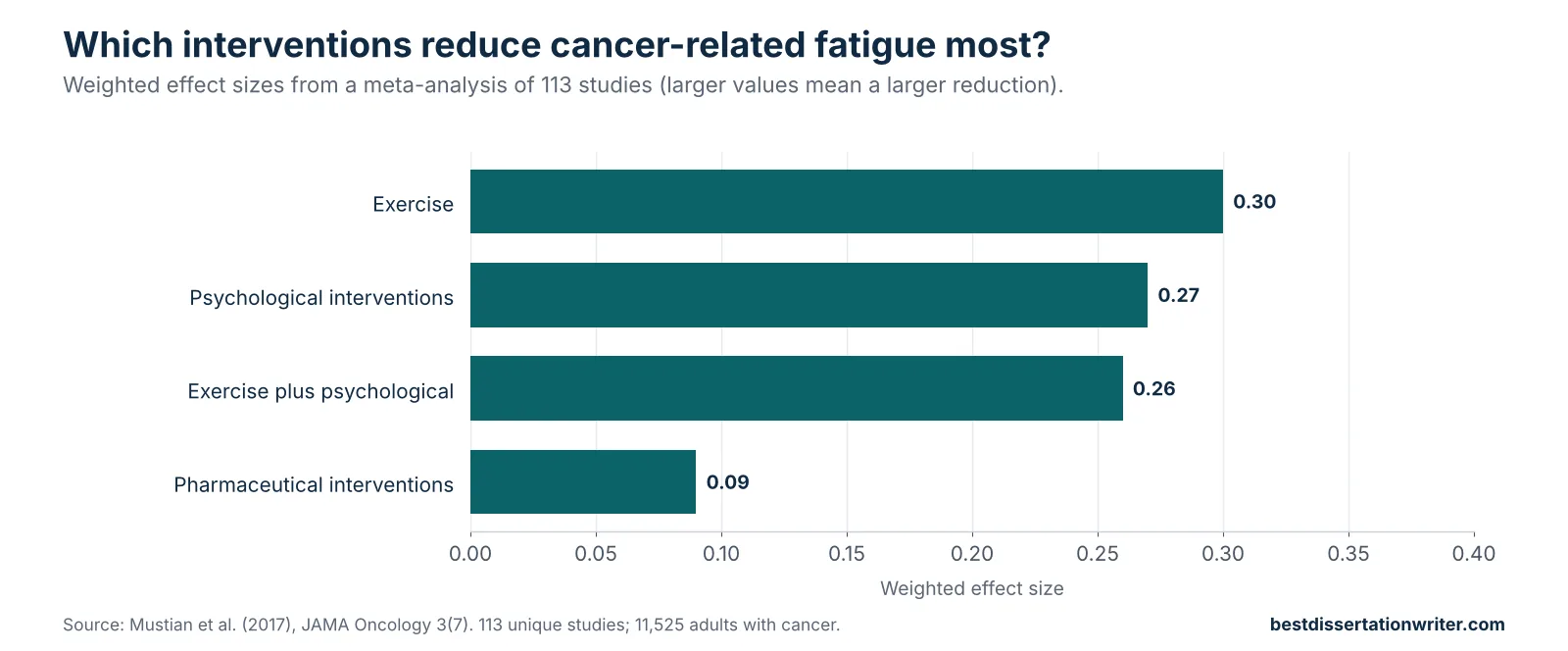
These results suggest that approaches which engage patients actively, rather than drugs, offer the best prospects for most people. The comparison is indirect in that the trials differed in design and population, and the effect sizes are small to moderate, so they should be read as a general pattern. The review nevertheless supports a first-line role for exercise and psychological interventions in nursing care.
Theme 2: Evidence for Specific Interventions
Cramp and Byron-Daniel (2012) reported a Cochrane review of exercise for cancer-related fatigue in adults. It included 56 studies with 4,068 participants, searched to March 2011. In the meta-analysis of 38 comparisons, exercise was statistically more effective than control at the end of the intervention (standardised mean difference −0.27, 95% confidence interval −0.37 to −0.17). Benefits were seen for breast and prostate cancer but not for haematological malignancies, and aerobic exercise significantly reduced fatigue whereas resistance training and other forms did not reach significance. The authors concluded that aerobic exercise is beneficial during and after treatment, particularly for solid tumours.
Hilfiker et al. (2018) carried out a systematic review with a network meta-analysis of 245 randomised or quasi-randomised studies published up to January 2017, of which 112 were during treatment and 133 after treatment. During treatment, relaxation ranked highest (standardised mean difference −0.77), followed by massage, combined cognitive behavioural therapy with physical activity, and exercise. After treatment, yoga ranked highest (−0.68), with smaller effects for combined aerobic and resistance training, cognitive behavioural therapy and tai chi. The authors noted moderate to high risk of bias and considerable heterogeneity, and cautioned that the rankings were not conclusive.
Li et al. (2024) focused on breast cancer in a systematic review and network meta-analysis of 77 studies comparing 12 interventions, with seven databases searched to June 2023. Six interventions significantly reduced fatigue compared with control: cognitive behavioural therapy, Chinese traditional exercises, aerobic exercise, multimodal exercise, music interventions and yoga. Together, the reviews suggest that several types of activity and psychological approaches can help, and that patients may choose among them according to preference and ability.
Theme 3: What Guidelines Advise for Practice
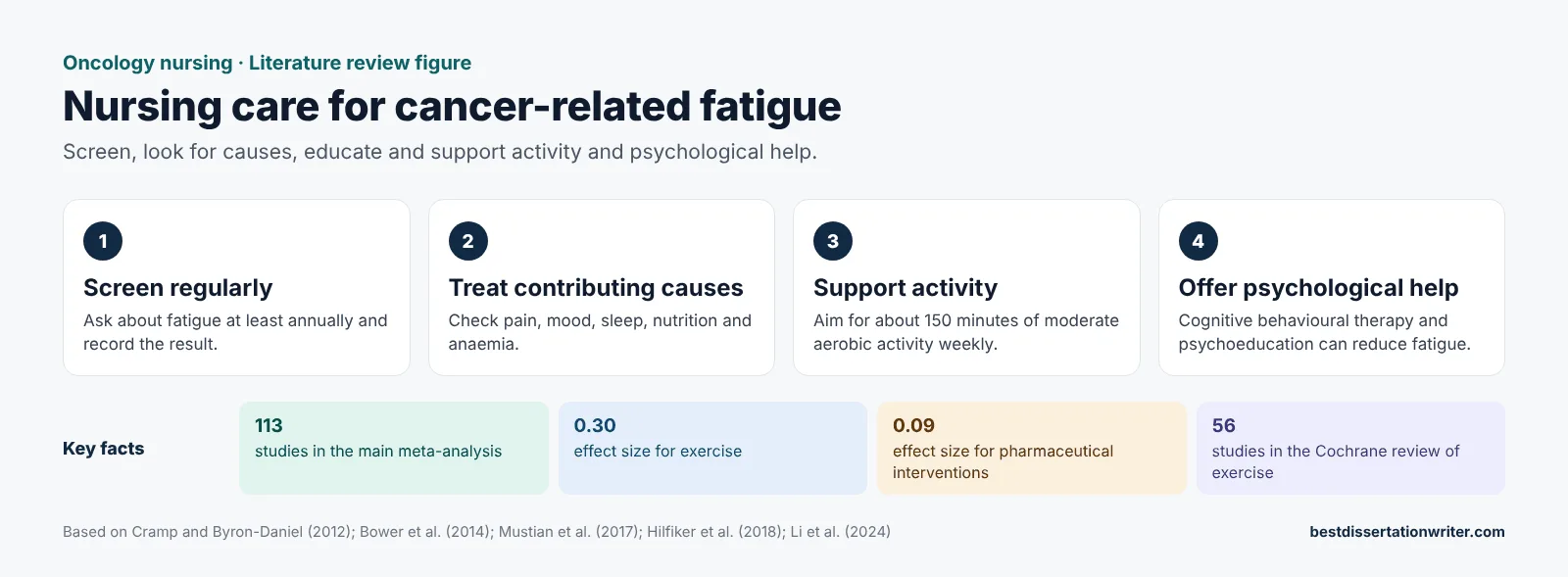
The ASCO guideline adaptation (Bower et al., 2014) turns this evidence into practice advice for adults who have completed treatment with curative intent. It advises education about how cancer-related fatigue differs from normal tiredness, how long it can last and what causes it, together with self-management strategies, and regular reassessment of response.
For exercise, it encourages about 150 minutes of moderate aerobic activity each week, such as brisk walking, cycling or swimming, plus two to three strength training sessions weekly, unless contraindicated. Walking programmes are typically safe for most survivors, but those at higher risk of injury, for example from neuropathy or heart problems, or with severe fatigue should be referred to a physical therapist or exercise specialist. The guideline also states that cognitive behavioural therapy and psychoeducational therapy can reduce fatigue, that mindfulness, yoga and acupuncture show some evidence of benefit, and that evidence for psychostimulant drugs is limited in disease-free survivors.
These recommendations apply to survivors after treatment, whereas patients receiving chemotherapy or radiotherapy may need adapted advice. The guideline is a US adaptation that is a decade old, so nurses should also check current local guidance. It remains a useful statement of the principles of screening, assessment of contributing causes and individualised self-management.
Taken together, the three themes support a stepped approach. All patients can be screened and educated. Those with fatigue can be helped to find a form of activity that suits their treatment phase and fitness, and those with severe or persistent fatigue can be offered a psychological therapy or referred to an exercise specialist. This approach fits the guideline’s advice and uses the evidence on relaxation, yoga and cognitive behavioural therapy for patients who find exercise difficult.
The evidence also shows what is not yet known. The network meta-analyses compared many interventions indirectly, and the authors cautioned against treating the rankings as conclusive. Few trials directly compared one non-pharmacological approach with another, and the optimal type, intensity and timing of exercise remain uncertain, as the Cochrane authors noted. Nurses should therefore describe the evidence honestly to patients, saying that these approaches help many people but not everyone.
Safety needs consideration. The guideline recommends referral to an exercise specialist for patients at higher risk of injury, for example because of neuropathy or heart problems, and for those whose fatigue is severe, and advises that breast cancer survivors with lymphoedema should see a specialist before starting upper-body strength training. Nurses should also be alert to symptoms such as breathlessness, chest pain or dizziness that need medical review before activity is increased.
Discussion
This review shows reasonable agreement that exercise and psychological interventions are the best-supported non-pharmacological treatments for cancer-related fatigue. Four independent sources, using different methods, reached the same general conclusion, and the guideline reflects it. The size of the benefit is modest, but fatigue is common, so even modest benefits matter for many patients.
The evidence is less clear about which type of intervention is best. The Cochrane review found benefit for aerobic exercise but not for resistance training, while the network meta-analyses ranked relaxation, massage, yoga and cognitive behavioural therapy highly, and the rankings differed between sources. Differences in populations, timing and comparators probably explain part of this. In practice, the best intervention is likely to be one that the patient will carry on with.
Nurses have several roles. They can screen at each contact, explain that cancer-related fatigue is common and expected, help patients to plan activity and rest, check for treatable causes such as anaemia and sleep problems, and signpost to exercise programmes and psychological support. Fatigue also interacts with other symptoms described in this series, including those in the reviews of chemotherapy-induced side effects and psychosocial support needs, so assessment should be wide.
There are limitations. The sources include trials of varying quality, and the network meta-analyses acknowledged moderate to high risk of bias and heterogeneity. Exercise dose was often poorly described. The Cochrane review was searched to 2011 and the guideline was published in 2014, so newer trials are not covered. Many trials had small samples and short follow-up, and benefit was not consistent across cancer types. This review relied on openly accessible, English-language sources.
Patients’ views were not the main focus of the sources, but practice suggests that people value being believed. A nurse who asks about fatigue, listens to how it affects daily life and agrees a small, achievable plan is likely to be more effective than one who gives general advice to rest. Plans might include short walks, scheduling demanding tasks for times of day when energy is higher, and asking family or friends for practical help. These suggestions fit the self-management advice in the guideline, although they were not tested separately in the reviews.
Documentation is a further practical point. Recording a fatigue score at each screen allows nurses to see whether the symptom is improving, and the guideline specifically asks for results to be documented. Repeating the measure after an intervention also helps patients to see progress and shows services whether their programmes are working.
The scope of the evidence should be kept in view when advising patients. Trials are conducted in research conditions, and the support given to participants may not be available to every patient in routine care. The meta-analyses combined many different programmes, so a general recommendation to be active does not tell a nurse how often, how hard or for how long a particular patient should exercise. Guidelines and local exercise specialists can fill that gap.
Implications of Cancer-Related Fatigue Evidence for Practice
For practice, the evidence supports routine screening for cancer-related fatigue, assessment of contributing factors, education and self-management advice, encouragement of regular physical activity within a person’s capacity, and referral for psychological therapy where needed. Patients with severe fatigue, neuropathy or heart problems should be referred to an exercise specialist. Guidance is available from Macmillan Cancer Support and Cancer Research UK.
Fatigue also matters at the end of life, when goals of care change, as discussed in the review of integration of palliative care. Managers should provide training in fatigue assessment, access to exercise and psychological services and documentation of screening.
Future research should compare non-pharmacological interventions directly, describe exercise dose clearly and include patients who are undergoing treatment as well as survivors. Studies in which nurses deliver or coordinate the intervention would show whether nursing-led programmes for cancer-related fatigue are effective and affordable. Outcomes should include patients’ own priorities, such as the ability to work, care for family and take part in social life, and not only fatigue scores.
Services should also consider access. Group exercise programmes, psychological therapy and yoga classes are not equally available, and patients with low income, limited mobility, caring duties or no transport may find it hard to take part. Offering home-based and telephone-supported options, where evidence supports them, may reduce inequality in the management of cancer-related fatigue.
Conclusion
This systematic review found that exercise and psychological interventions are the best-supported non-pharmacological treatments for cancer-related fatigue, with smaller effects for drugs, although the quality of the evidence and the best choice of intervention vary.
Nurses can use this evidence by screening regularly, treating contributing factors and helping patients to find activity and support that suit them, so that fatigue is recognised and managed as a central part of cancer care.
References
Bower, J. E., Bak, K., Berger, A., Breitbart, W., Escalante, C. P., Ganz, P. A., Schnipper, H. H., Lacchetti, C., Ligibel, J. A., Lyman, G. H., Ogaily, M. S., Pirl, W. F., & Jacobsen, P. B. (2014). Screening, assessment, and management of fatigue in adult survivors of cancer: An American Society of Clinical Oncology clinical practice guideline adaptation. Journal of Clinical Oncology, 32(17), 1840–1850. https://doi.org/10.1200/JCO.2013.53.4495
Cramp, F., & Byron-Daniel, J. (2012). Exercise for the management of cancer-related fatigue in adults. Cochrane Database of Systematic Reviews, (11), Article CD006145. https://doi.org/10.1002/14651858.CD006145.pub3
Hilfiker, R., Meichtry, A., Eicher, M., Nilsson Balfe, L., Knols, R. H., Verra, M. L., & Taeymans, J. (2018). Exercise and other non-pharmaceutical interventions for cancer-related fatigue in patients during or after cancer treatment: A systematic review incorporating an indirect-comparisons meta-analysis. British Journal of Sports Medicine, 52(10), 651–658. https://doi.org/10.1136/bjsports-2016-096422
Li, Y., Gao, L., Chao, Y., Lan, T., Zhang, J., Li, R., Zhang, Z., Li, S., Lian, J., Wang, Z., & Chen, X. (2024). Various interventions for cancer-related fatigue in patients with breast cancer: A systematic review and network meta-analysis. Frontiers in Oncology, 14, Article 1341927. https://doi.org/10.3389/fonc.2024.1341927
Mustian, K. M., Alfano, C. M., Heckler, C., Kleckner, A. S., Kleckner, I. R., Leach, C. R., Mohr, D., Palesh, O. G., Peppone, L. J., Piper, B. F., Scarpato, J., Smith, T., Sprod, L. K., & Miller, S. M. (2017). Comparison of pharmaceutical, psychological, and exercise treatments for cancer-related fatigue: A meta-analysis. JAMA Oncology, 3(7), 961. https://doi.org/10.1001/jamaoncol.2016.6914
Cite this example
Best Dissertation Writers (2026) Non-Pharmacological Interventions for Cancer-Related Fatigue: A Systematic Review. Available at: https://bestdissertationwriter.com/cancer-related-fatigue-review-review/
Best Dissertation Writers
Get expert help with your nursing literature review
Share your topic and deadline with Best Dissertation Writers and get support tailored to your module brief.