Survivorship Care Plans and Nurse-Led Follow-Up for Cancer Survivors: A Systematic Review
 By Dr. Robertson Prime, Research Fellow
Updated October 28, 2026
14 min read
About 2,900 words
In this review
Abstract
Background: Survivorship care plans are written summaries of a person’s cancer treatment and a plan for follow-up and health needs, and they are widely recommended. Nurses often prepare them, lead follow-up clinics and support survivors, so evidence on whether care plans and nurse-led or patient-initiated follow-up improve outcomes is important for cancer nursing.
Aim: This systematic review aimed to examine the evidence on the effectiveness of survivorship care plans and of nurse-led and patient-initiated models of follow-up for adults after cancer treatment.
Methods: Evidence was identified through targeted searches of openly accessible bibliographic records, publisher websites and the reference lists of key reviews. Five sources published between 2018 and 2025 were included: four systematic reviews and an interview study. The research sources were appraised using CASP checklists and synthesised narratively.
Findings: A review of 24 studies found little evidence that survivorship care plans improve health outcomes and health care delivery, with more positive results for proximal outcomes, especially when plans were accompanied by counselling. A meta-analysis of nurse-led survivorship care (15 trials, 3,278 survivors) found benefits for some quality-of-life domains. A Cochrane review of 19 trials found that intensive follow-up for colorectal cancer made little or no difference to overall survival. A review of 10 trials found that patient-initiated follow-up may be viable for breast cancer. An interview study identified barriers to delivering survivorship information in rural areas.
Conclusion: Survivorship care plans alone have limited evidence of effect, but nurse-led care and patient-initiated follow-up show promise. Nurses can strengthen survivorship care by combining plans with counselling and by ensuring recommendations are acted on.
Keywords: survivorship care plans, cancer survivorship, survivorship care
Introduction
This systematic review critically examines recent evidence on survivorship care plans and its implications for cancer nursing practice.
As more people survive cancer, health services have had to think about what happens after treatment ends. Survivors may live with physical effects such as fatigue, pain and neuropathy, with fear of recurrence, with changes in work and relationships, and with an increased need for health checks. They may also be unsure who is responsible for their care, as contact with the hospital team reduces and care is passed to primary care.
Survivorship care plans were introduced to address this gap. A plan is a document, given to the survivor and often shared with the family doctor, that summarises the diagnosis and treatment received, describes possible late effects, sets out the schedule of follow-up and screening, and gives advice about healthy living and support. Nurses are frequently responsible for preparing and discussing these plans and for leading follow-up clinics.
Alongside care plans, new models of follow-up have appeared. Traditional follow-up involves scheduled visits to the hospital for a fixed period, whereas nurse-led models place a specialist nurse in charge, and patient-initiated models invite the survivor to contact the service when they have symptoms or concerns.
Review question
What does the evidence show about the effectiveness of survivorship care plans and of nurse-led and patient-initiated models of follow-up, and what are the implications for nursing practice?
Background to Survivorship Care Plans
Survivorship care plans have been recommended in many guidelines, based on the belief that survivors benefit from clear information and from coordination between hospital and primary care. The expected benefits include better knowledge, better adherence to follow-up and screening, better communication between professionals and improved wellbeing. These are the outcomes examined in the reviews below.
Follow-up after cancer treatment has several purposes. It aims to detect recurrence early, to manage the late effects of treatment, to provide psychological support and to promote health. Whether routine scheduled visits achieve these purposes is a matter of continuing debate, which is why the evidence on alternative models is considered here.
Nurses have a distinct view of this issue. They meet survivors in clinics and in the community and hear about concerns that do not fit into the schedule of visits. Their experience may help to explain why some plans are used and others are not, and the review of cancer nurse navigators describes a related role in coordinating care.
Some late and acute problems also need to be written into the plan. Survivors who have had chemotherapy may need advice on when to seek urgent help for fever or infection, a topic described in the review of neutropenic sepsis, and survivors of cancers treated with drugs or radiotherapy may need long-term monitoring for specific effects. Nurses who prepare plans can use the treatment summary to highlight these points so that the survivor and primary care team know what to look for.
Search Strategy and Methods
Evidence for this example was identified through targeted searches of openly accessible bibliographic records, publisher websites and the reference lists of key reviews. Search terms combined keywords for the intervention (“survivorship care plans”, “cancer survivorship”, “nurse-led follow-up”, “patient-initiated follow-up”) with terms for the population and outcome (“cancer survivors”, “quality of life”, “follow-up strategies”, “satisfaction”), joined with the Boolean operators AND and OR. A full systematic review for assessment would run the same strategy in CINAHL, PubMed/MEDLINE, Embase and the Cochrane Library and report the records screened in a PRISMA flow diagram.
Sources were eligible if they were systematic reviews or Cochrane reviews of survivorship care plans or models of follow-up for adults after cancer treatment, or studies of the delivery of survivorship information. Studies of children and of palliative follow-up were excluded.
Five sources published between 2018 and 2025 were included (Table 1). The quality of each research source was considered using the Critical Appraisal Skills Programme (CASP) checklists, and findings were synthesised narratively.
Key Findings on Survivorship Care Plans
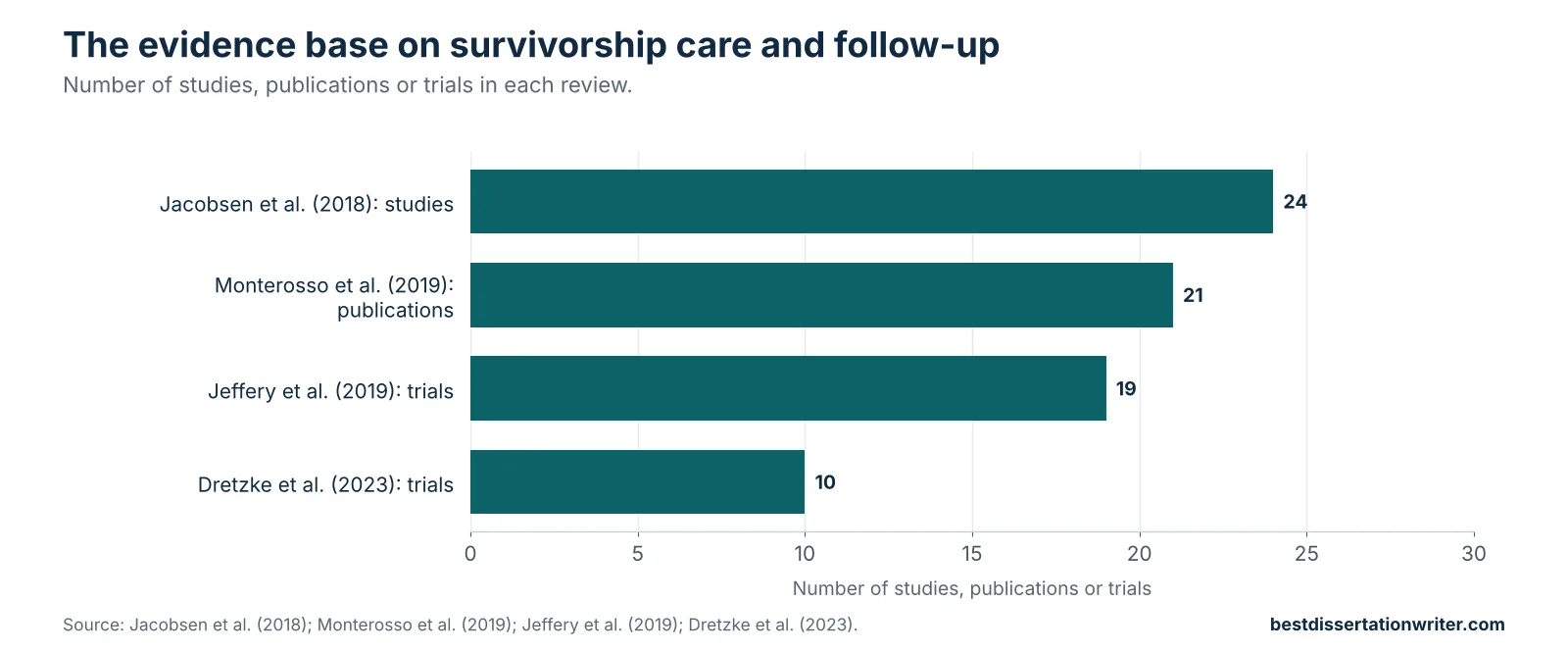
Three themes were identified: the effectiveness of survivorship care plans, the evidence on nurse-led and intensive follow-up, and the evidence on patient-initiated follow-up and delivery. Table 1 summarises the included sources, and Figure 1 shows the size of the evidence base in each review.
| Author, year | Design | Setting and sample | Key finding |
|---|---|---|---|
| Dretzke et al. (2023) | Systematic review | 10 randomised trials; 1,754 participants | Patient-initiated follow-up may be viable for breast cancer; limited evidence for other cancers. |
| Jacobsen et al. (2018) | Systematic review | 24 studies (13 randomised) | Little evidence that survivorship care plans improve outcomes; more positive when combined with counselling. |
| Jeffery et al. (2019) | Cochrane review | 19 trials; 13,216 participants (colorectal cancer) | Intensive follow-up made little or no difference to overall survival. |
| Johnston et al. (2025) | Qualitative interview study | 31 health care professionals | Barriers of policy and funding in rural areas; facilitators of perceived value and need. |
| Monterosso et al. (2019) | Systematic review and meta-analysis | 21 publications; 15 trials; 3,278 survivors | Nurse-led care beneficial for some quality-of-life domains. |
Theme 1: Effectiveness of Survivorship Care Plans
Jacobsen et al. (2018) carried out a systematic review of the impact of cancer survivorship care plans on health outcomes and health care delivery. They included 24 studies, of which 13 were randomised and 11 were not. The non-randomised studies provided descriptive information on satisfaction with care and on reactions to the plans. The randomised studies were mostly negative for the most commonly assessed outcomes: physical, functional and psychological wellbeing. Single studies reported positive results for the information received, satisfaction with care and physicians’ implementation of recommended care.
The authors concluded that existing research provides little evidence that survivorship care plans improve health outcomes and health care delivery. They suggested reasons, including heterogeneity between studies and the low likelihood that delivering a plan alone would influence distant outcomes such as wellbeing. Results were more positive for proximal outcomes and for care delivery, especially when plans were accompanied by counselling, and they recommended research on ensuring that recommendations in the plan are acted on within ongoing care.
Theme 2: Nurse-Led and Intensive Follow-Up
Monterosso et al. (2019) carried out a systematic review and meta-analysis of patient-reported outcomes for nurse-led models of survivorship care for adult cancer patients less than two years after treatment. They included 21 publications describing 15 trials with 3,278 survivors, with studies of breast, gynaecological, head and neck, colorectal, upper gastrointestinal and prostate cancers, published between 2007 and 2017. Seven trials measured quality of life with the EORTC QLQ-C30.
At four to six months, nurse-led care was associated with better cognitive functioning (4 trials, 463 participants, mean difference 4.04, 95% confidence interval 0.59 to 7.50) and better social functioning (3.06, 0.14 to 5.97), while appetite loss was worse in the nurse-led group (4.43, 0.08 to 8.78). After the intervention, fatigue was reduced (−4.45, −7.93 to −0.97; 4 trials, 647 participants). The authors concluded that nurse-led care appears beneficial for some quality-of-life domains, but that evidence was limited by risk of bias, in particular blinding of personnel and assessors.
Jeffery et al. (2019) reviewed follow-up strategies in a Cochrane review of 19 randomised trials with 13,216 participants treated with curative intent for non-metastatic colorectal cancer. Intensive follow-up made little or no difference to overall survival (hazard ratio 0.91, 95% confidence interval 0.80 to 1.04; high certainty) or relapse-free survival, and probably made little or no difference to quality of life, anxiety or depression. More patients had salvage surgery with curative intent in the intensive group (risk ratio 1.98), but this did not translate into better survival, and harms were poorly reported.
Theme 3: Patient-Initiated Follow-Up and Delivery of Information
Dretzke et al. (2023) carried out a systematic review of the effectiveness of patient-initiated follow-up after cancer, in which the survivor contacts the service when needed rather than attending scheduled visits. They included 10 randomised trials with 1,754 participants, of which six concerned breast cancer, two colorectal, one endometrial and one melanoma. In breast cancer, quality of life and satisfaction were generally similar between arms, and patient-initiated follow-up may reduce clinician consultations. The colorectal trial reported higher satisfaction and patient involvement. The melanoma trial found more recurrence or new melanoma diagnoses with patient-led surveillance, although the difference was not statistically significant overall.
The authors concluded that patient-initiated follow-up may be a viable model for breast cancer, that evidence for other cancers is too limited for firm conclusions, and that research on long-term outcomes is needed. All included studies had concerns about risk of bias. This model depends on survivors knowing when and how to make contact, which is a task for nurses who teach and support them.
Johnston et al. (2025) studied the delivery of survivorship information in a rural setting. In semi-structured interviews with 31 health care professionals, including cancer specialists, general practitioners, nurses, care coordinators and allied health practitioners, they mapped barriers and facilitators to an implementation framework. Facilitators included the view that improving information was important and valuable, a perception that current practice was unsustainable and alignment with organisational goals. Barriers included local policies and financing, including difficulty accessing support services in rural areas and limited funding for post-treatment care. This is a single qualitative study, not a review, so it illustrates the problems of implementation rather than the effectiveness of care.
Taken together, the themes suggest that the question is not whether survivors should have a plan but how it is delivered and followed up. The weak results of the randomised studies in the review of Jacobsen et al. may reflect outcomes that are too distant from the intervention, as the authors suggested, or a mismatch between what plans contain and what survivors need. Studies of proximal outcomes, such as knowledge of late effects, confidence in seeking help and communication with primary care, may be more suitable measures of benefit.
The models of follow-up raise a second question about resources. If nurse-led or patient-initiated follow-up gives similar outcomes to scheduled hospital visits, services may be able to release clinic time for those with greater need. This is attractive to services under pressure, but the reviews caution that most trials had risk of bias and that evidence outside breast cancer is limited. Any change should therefore be accompanied by monitoring of outcomes and of survivors’ experience.
Equity is a further concern. Patient-initiated follow-up depends on survivors who can recognise symptoms, who have access to telephone or digital contact and who feel able to use the service. People with limited health literacy, language barriers or those living far from services may be at a disadvantage, as the rural interview study suggests. Nurses can help by checking understanding, offering interpreters and keeping routes of contact simple.
Discussion
This review shows that survivorship care plans, delivered alone, have little evidence of benefit for wellbeing, but that the picture is better for information, satisfaction and, when counselling accompanies the plan, for care delivery. This suggests that the content of the plan matters less than how it is used. A document that is handed over and not discussed, or not acted on by primary care, is unlikely to change outcomes.
The evidence on models of follow-up is more positive. Nurse-led care shows benefits for some domains of quality of life, patient-initiated follow-up appears acceptable in breast cancer, and more intensive scheduled follow-up in colorectal cancer did not improve survival. Together, these findings support the view that follow-up can be organised in ways that are less resource-intensive without obvious loss of outcomes in some groups, although the evidence is limited by risk of bias.
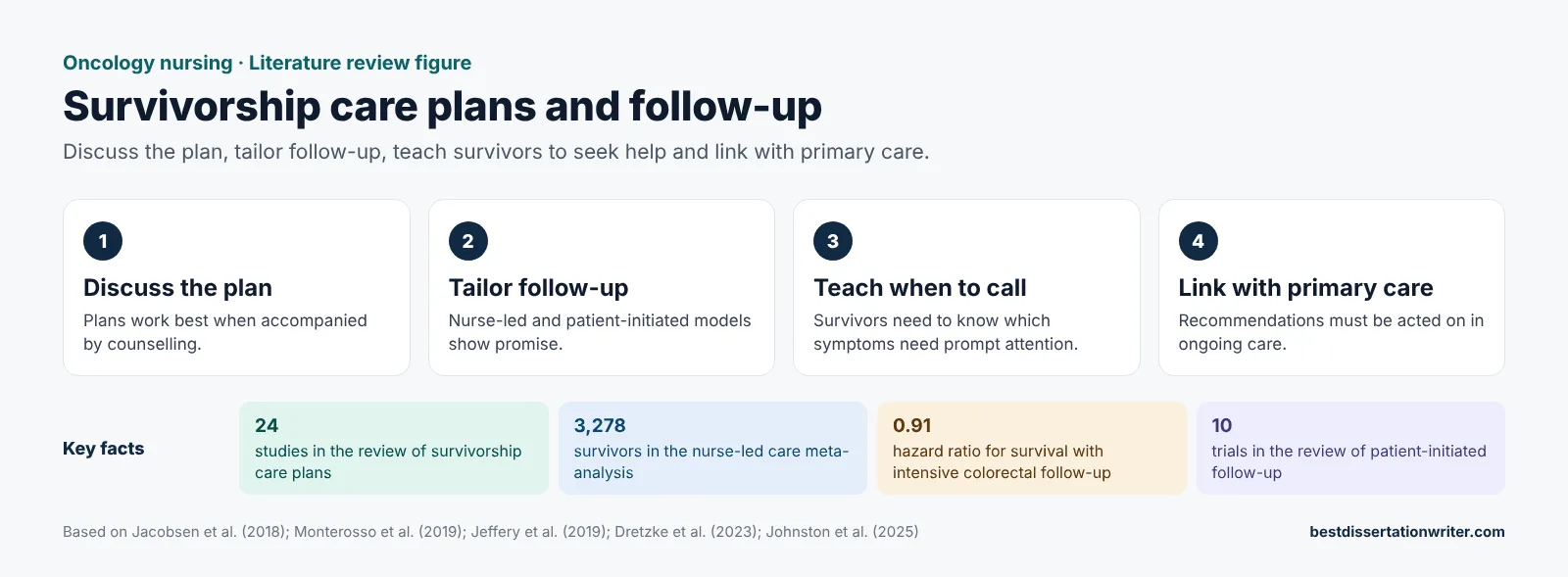
For nurses, the key message is to make survivorship care plans a conversation and not only a document. Discussing the plan with the survivor, giving contact details, explaining which symptoms need prompt attention and communicating clearly with primary care are practical ways to put the findings into action. Survivors also need help with problems such as fatigue and distress, which are discussed in the reviews of cancer-related fatigue and psychosocial support needs, and the skills for difficult conversations are described in the review of communicating bad news.
There are limitations. The sources include reviews with risk of bias concerns, and the Cochrane review concerned colorectal cancer only. Care plans were studied in varied formats, and most trials were conducted in specific health systems, so findings may not transfer. Evidence on long-term outcomes and costs was limited. The interview study is a single rural study. This review relied on openly accessible, English-language sources.
Survivors’ own views are not the main focus of the sources included here, although they are central to good practice. People may value a plan because it gives them a clear record and a sense of control, or they may find that it adds little to what they already know. Asking survivors what information they want, when they want it and in what form, and revising plans in response, allows services to tailor the content. Such feedback also offers a way to measure whether the plan has achieved its purpose.
Implications of Survivorship Care Plans Evidence for Practice
For practice, the evidence supports delivering survivorship care plans with a discussion, tailoring follow-up to individual need, teaching survivors how to seek help when symptoms occur, and working with primary care so that recommendations are acted on. Support and information for survivors are available from Macmillan Cancer Support and Cancer Research UK.
Managers should ensure that nurses have time to discuss plans, that primary care teams receive them and that patient-initiated systems have clear and responsive contact routes. Services should also audit survivorship care plans to check that they are being offered to all eligible survivors, including those in rural areas.
Future research should test whether combining care plans with counselling improves outcomes that matter to survivors, compare nurse-led, patient-initiated and scheduled follow-up in cancers other than breast and colorectal, and measure long-term outcomes and costs. Studies should describe how plans are used by primary care and include survivors from under-served groups. Such evidence would show nurses and services how best to deliver survivorship care.
Conclusion
This systematic review found limited evidence that survivorship care plans alone improve health outcomes, but promising evidence for nurse-led care and, in breast cancer, for patient-initiated follow-up, with more intensive follow-up not improving survival in colorectal cancer.
By combining plans with counselling, supporting survivors to seek help and working with primary care, nurses can strengthen the care that people receive after cancer treatment.
References
Dretzke, J., Chaudri, T., Balaji, R., Mehanna, H., Nankivell, P., Moore, D. J., & on behalf of the PETNECK2 Research Team. (2023). A systematic review of the effectiveness of patient-initiated follow-up after cancer. Cancer Medicine, 12(18), 19057–19071. https://doi.org/10.1002/cam4.6462
Jacobsen, P. B., DeRosa, A. P., Henderson, T. O., Mayer, D. K., Moskowitz, C. S., Paskett, E. D., & Rowland, J. H. (2018). Systematic review of the impact of cancer survivorship care plans on health outcomes and health care delivery. Journal of Clinical Oncology, 36(20), 2088–2100. https://doi.org/10.1200/JCO.2018.77.7482
Jeffery, M., Hickey, B. E., & Hider, P. N. (2019). Follow-up strategies for patients treated for non-metastatic colorectal cancer. Cochrane Database of Systematic Reviews, 2019(9), Article CD002200. https://doi.org/10.1002/14651858.CD002200.pub4
Johnston, E. A., Bourdaniotis, X. E., Ayre, S. K., Fung, H., Craig, N., Crawford-Williams, F., Bergin, R. J., Emery, J. D., Chan, R. J., & Goodwin, B. C. (2025). What are the facilitators and barriers to improving the delivery of survivorship care information to rural cancer survivors? A qualitative study using an implementation science framework. Australian Journal of Rural Health, 33(6), Article e70125. https://doi.org/10.1111/ajr.70125
Monterosso, L., Platt, V., Bulsara, M., & Berg, M. (2019). Systematic review and meta-analysis of patient reported outcomes for nurse-led models of survivorship care for adult cancer patients. Cancer Treatment Reviews, 73, 62–72. https://doi.org/10.1016/j.ctrv.2018.12.007
Cite this example
Best Dissertation Writers (2026) Survivorship Care Plans and Nurse-Led Follow-Up for Cancer Survivors: A Systematic Review. Available at: https://bestdissertationwriter.com/survivorship-care-plans-review-review/
Best Dissertation Writers
Get expert help with your nursing literature review
Share your topic and deadline with Best Dissertation Writers and get support tailored to your module brief.