Recognition and Management of Neutropenic Sepsis by Oncology Nurses: A Literature Review
 By Dr. Robertson Prime, Research Fellow
Updated October 28, 2026
14 min read
About 2,900 words
In this review
Abstract
Background: Neutropenic sepsis is a life-threatening complication of cancer treatment in which a person with a very low neutrophil count develops a serious infection, often with few early signs. Oncology nurses are usually the first to hear about fever from patients and to carry out triage, so their recognition and response strongly influence outcomes.
Aim: This narrative review aimed to examine recent evidence on the recognition and management of neutropenic sepsis, including risk assessment, speed of antibiotic treatment and outpatient care, and the implications for oncology nursing.
Methods: Evidence was identified through targeted searches of openly accessible bibliographic records, publisher websites and the reference lists of key guidelines. Five sources published between 2000 and 2020 were included: a risk index study, a cohort study, a Cochrane review, a clinical practice guideline and a national guideline. The relevance and quality of each source was considered critically, and findings were synthesised narratively.
Findings: A prospective cohort of 307 episodes of febrile neutropenia found that each additional hour before antibiotics raised the risk of 28-day mortality by about 18%, and recommended a 30-minute target. A Cochrane review of 22 trials found oral antibiotics an acceptable alternative to intravenous treatment for stable, low-risk patients (mortality risk ratio 0.95). The MASCC risk index, with a score of 21 or higher indicating low risk, had a positive predictive value of 91% on validation. The ASCO and IDSA guideline recommends initial empirical antibiotics within 1 hour of triage.
Conclusion: Rapid recognition, risk assessment and treatment save lives, and some low-risk patients can be treated safely at home. Oncology nurses should treat fever in a person receiving chemotherapy as an emergency and use structured triage.
Keywords: neutropenic sepsis, febrile neutropenia, urgent care
Introduction
This narrative review critically examines recent evidence on neutropenic sepsis and its implications for cancer nursing practice.
Chemotherapy and some other cancer treatments lower the number of neutrophils, the white blood cells that fight bacterial infection. When neutrophil counts are very low, a minor infection can spread rapidly through the body. Neutropenic sepsis describes the serious illness that results, and it can progress to septic shock and death within hours. Fever is the usual trigger for urgent assessment.
The National Institute for Health and Care Excellence (NICE) guideline on neutropenic sepsis covers the prevention, identification and management of the condition in children, young people and adults receiving cancer treatment. It was first published in 2012 and was updated in January 2020 for restrictions on fluoroquinolone antibiotics. The existence of a national guideline reflects the seriousness of the problem and the importance of consistent practice.
Nurses are central to the response. Patients are advised to contact the oncology service if they develop a fever or feel unwell, and the nurse who takes the call, or who sees the patient on arrival, must decide how urgent the situation is and start the pathway. A narrative review design was chosen because the evidence includes cohort studies, trials and guidelines, and a critical synthesis was more suitable than a pooled estimate.
Review question
What does the evidence show about the recognition, risk assessment and treatment of neutropenic sepsis, and what does it mean for nursing practice?
Background to Neutropenic Sepsis
The terms neutropenic sepsis and febrile neutropenia are used for the same clinical problem, though the second emphasises the combination of fever and a low neutrophil count. Definitions combine a temperature threshold with a neutrophil count threshold, and the exact values are set out in the guideline in use locally. The key practical point is that suspected neutropenic sepsis is treated as an emergency and that treatment should not wait for a result that might delay it.
Prevention and early recognition are the two pillars of nursing care. Prevention includes teaching patients about hygiene and recognising early warning signs, and the use of prophylactic antibiotics in some patients, which the ASCO and IDSA guideline recognises. Early recognition depends on patients knowing when to call, services being accessible, and staff acting on every call without delay.
Risk assessment determines where and how a patient is treated. The Multinational Association for Supportive Care in Cancer (MASCC) developed a risk index to identify low-risk patients, and the American Society of Clinical Oncology (ASCO) and the Infectious Diseases Society of America (IDSA) recommend that clinical judgement or a validated tool be used to decide who can be managed as an outpatient. This distinction matters, because treating every episode as high risk uses inpatient beds, while treating a high-risk episode as low risk can be fatal.
Antibiotic timing is a further question. The speed with which antibiotics are given is a central question, and the sources reviewed here give slightly different targets. The evidence on timing, outpatient treatment and risk scoring is considered in the sections that follow.
Search Strategy and Methods
Evidence for this example was identified through targeted searches of openly accessible bibliographic records, publisher websites and the reference lists of key guidelines. Search terms combined keywords for the problem (“neutropenic sepsis”, “febrile neutropenia”, “chemotherapy”) with terms for the intervention and outcome (“time to antibiotics”, “risk index”, “outpatient management”, “nursing”, “mortality”), joined with the Boolean operators AND and OR. A full review for assessment would search CINAHL, PubMed/MEDLINE, Embase and the Cochrane Library and report the records screened.
Few studies label their subject as neutropenic sepsis, since many refer to febrile neutropenia, so both terms were searched. Evidence on neutropenic sepsis was sought for adults, because the available trials and cohort studies in the sources concern adults, and paediatric guidance was not examined.
Sources were included if they examined risk assessment, the timing or route of antibiotic treatment, or guidance for the management of fever in neutropenic cancer patients. Studies of prophylaxis alone, paediatric haematology and single-centre audits without outcome data were excluded.
Five sources published between 2000 and 2020 were included (Table 1): a risk index study, a cohort study, a Cochrane review, a clinical practice guideline and a national guideline. The relevance and quality of each source was considered critically, and findings were synthesised narratively.
Key Findings on Neutropenic Sepsis
Three themes were identified: speed of antibiotic treatment, risk assessment, and the route and setting of care. Table 1 summarises the included sources, and Figure 1 shows 28-day mortality in the cohort study according to the time taken to give antibiotics.
| Author, year | Design | Setting and sample | Key finding |
|---|---|---|---|
| Klastersky et al. (2000) | Risk index study | 756 patients (derivation) | Score of 21 or more identified low-risk patients; positive predictive value 91% on validation. |
| National Institute for Health and Care Excellence (2020) | National guideline | Adults, young people and children | Covers prevention, identification and management of neutropenic sepsis; updated January 2020. |
| Rosa & Goldani (2014) | Prospective cohort study | 307 episodes; 169 adult patients | Each extra hour to antibiotics raised 28-day mortality risk by about 18%. |
| Taplitz et al. (2018) | Clinical practice guideline | Adults treated for malignancy | Antibiotics within 1 hour of triage; risk assessment for outpatient care. |
| Vidal et al. (2013) | Cochrane systematic review | 22 trials; 2,372 patients | Oral antibiotics an acceptable alternative for stable, low-risk patients. |
Theme 1: Speed of Antibiotic Treatment
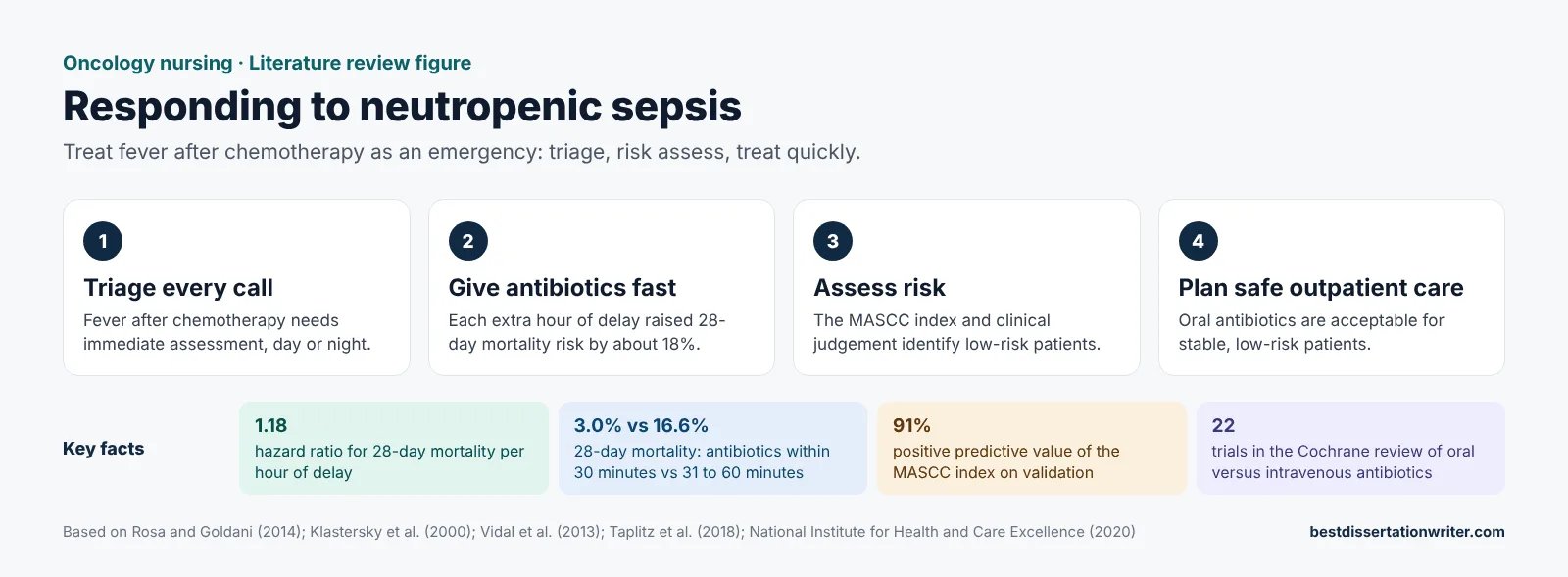
Rosa and Goldani (2014) carried out a prospective cohort study of all consecutive episodes of febrile neutropenia at a tertiary referral hospital in southern Brazil between October 2009 and August 2011. The study included 307 episodes in 169 adult cancer patients, with 29 deaths during the study period. In Cox regression, time to antibiotics was independently associated with 28-day mortality (hazard ratio 1.18; 95% confidence interval 1.10 to 1.26), meaning that each additional hour of delay raised the risk of death within 28 days by about 18%.
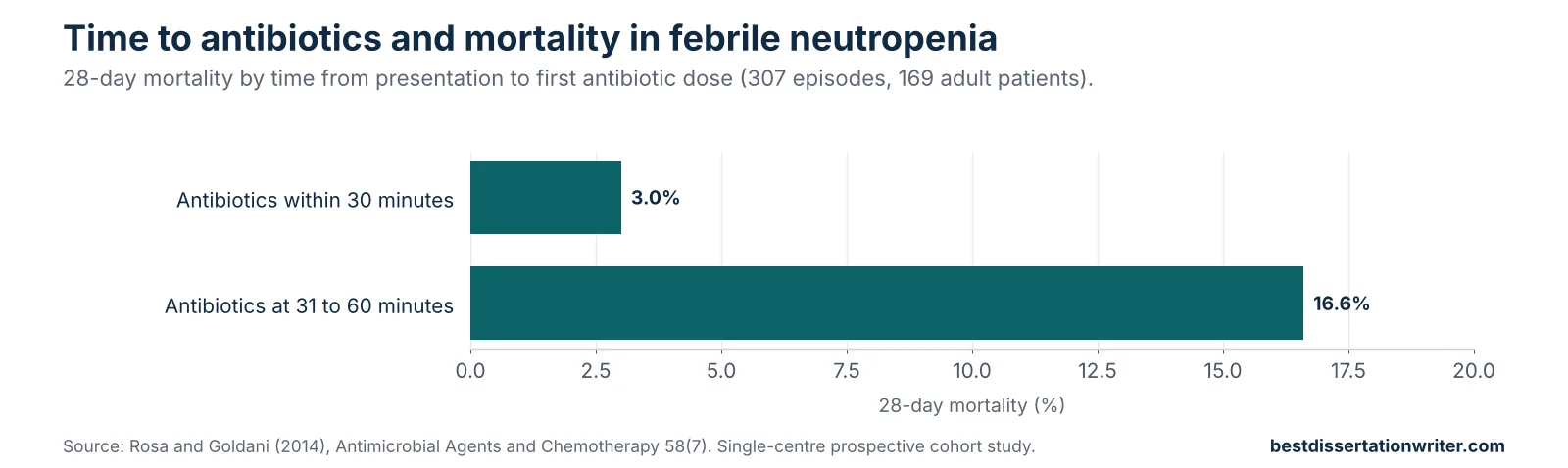
Episodes in which antibiotics were given within 30 minutes had a 28-day mortality of 3.0%, compared with 16.6% for those given between 31 and 60 minutes (log-rank P=0.0002). The authors concluded that earlier antibiotic administration was linked to better survival and recommended a target of 30 minutes to antibiotics for adult cancer patients with febrile neutropenia.
This was a single-centre observational study, so the association may be partly explained by differences between patients, for example sicker patients being recognised and treated faster. Even so, the finding is consistent with the principle of immediate treatment, and the ASCO and IDSA guideline recommends that patients with febrile neutropenia receive initial doses of empirical antibacterial therapy within 1 hour of triage. For nurses, the practical lesson is that every minute of delay in triage, assessment or access to a prescriber counts.
For oncology nursing, the central message of this theme is that neutropenic sepsis rewards speed. Each stage of the pathway, from the patient’s call, through triage and clinical assessment, to prescription and administration, adds time. Nurses can shorten the pathway by using pre-agreed protocols, keeping the first dose of antibiotic available in the clinical area and making sure that the prescriber is alerted at once. Audit of the time to antibiotics for every episode of neutropenic sepsis shows where delays occur.
Theme 2: Risk Assessment
Klastersky et al. (2000) described the MASCC risk index, a scoring system for identifying low-risk febrile neutropenic cancer patients. Developed in a derivation set of 756 patients, it uses clinical features to produce a score, and a score of 21 or higher identifies patients at low risk of complications. On a validation set the index had a positive predictive value of 91%, with specificity of 68% and sensitivity of 71%.
These figures show both the value and the limits of the tool. A positive predictive value of 91% means that most people identified as low risk did well, but a sensitivity of 71% means that some people who would have been safe at home were not identified, and the 9% of low-risk predictions that were wrong remind us that clinical judgement is still needed. The ASCO and IDSA guideline recommends that clinical judgement is used when deciding which patients are candidates for outpatient management, and that clinicians may use clinical criteria or a validated tool such as the MASCC risk index.
Risk assessment also helps with communication. A patient who is told that their risk is low, and why, may feel more confident about being treated at home, while a patient at high risk needs to understand why admission is necessary. Whichever route is chosen, neutropenic sepsis should be explained clearly, so that patients and carers know what the condition is, what treatment involves and what to do if the situation changes.
Theme 3: Route and Setting of Care
Vidal et al. (2013) compared oral and intravenous antibiotic treatment for febrile neutropenia in a Cochrane review of 22 trials, including 3,142 episodes in 2,372 patients. Mortality was similar between groups (risk ratio 0.95; 95% CI 0.54 to 1.68; 9 trials, 1,392 patients), as was treatment failure (risk ratio 0.96; 95% CI 0.86 to 1.06). Adverse events were mostly gastrointestinal and more common with oral antibiotics.
The authors concluded that oral treatment is an acceptable alternative to intravenous treatment in febrile neutropenic cancer patients who are haemodynamically stable, have no organ failure and lack pneumonia, central line infection or severe soft-tissue infection, and noted that patients with acute leukaemia were excluded. They added that the wide confidence interval for mortality supports oral use only in groups with an expected low mortality risk.
The ASCO and IDSA guideline builds on this evidence. For patients who qualify for outpatient management, it recommends an oral fluoroquinolone plus amoxicillin and clavulanate, with clindamycin substituted if the patient is allergic to penicillin, unless fluoroquinolone prophylaxis was used before fever developed. Patients should be monitored for at least 4 hours before discharge, and those who do not defervesce after 2 to 3 days of initial broad-spectrum therapy should be reassessed and considered for inpatient treatment.
Discussion
This narrative review shows that neutropenic sepsis is time-critical, that risk can be assessed, and that some patients can be treated with oral antibiotics, including at home. The evidence on timing is observational and the evidence on risk scoring has limitations, but the direction is consistent: speed and structured assessment improve outcomes.
Taken as a whole, the sources describe a pathway in which neutropenic sepsis is recognised early, risk is assessed, antibiotics are given at once, and the route and setting of care are matched to the patient. Each step is supported by evidence of different strength, and the weakest link is the evidence on how nurses can best deliver the pathway. Research on nurse-led triage, patient education and telephone follow-up for neutropenic sepsis would be valuable.
The 30-minute and 1-hour targets in the sources are not identical, and the difference should be recognised. The cohort study suggested that a 30-minute target would give better survival, while the guideline recommends antibiotics within 1 hour of triage. Local policy should follow the guideline in use, but nurses should understand that the aim is to give treatment as quickly as possible, and that the target is the longest acceptable time rather than a goal to be approached slowly.
Outpatient care brings benefits to patients, who can recover at home, and to services, but it carries risks. It requires reliable communication, a carer who can bring the patient back, a safe home environment and a clear plan for review. Nurses coordinate these arrangements, give instructions and make telephone contact, so their role in safe outpatient care is substantial.
Consistency is another concern. A target is only useful if it is met for every patient, so services should audit performance across the whole week, including nights and weekends, and share the results with the team so that learning is shared.
Equity and access should be considered. People who live far from the hospital, who have no transport or who find it difficult to use a telephone may be at greater risk of delay, and the benefit of fast pathways depends on every patient being able to reach them. Services should check that information is understood and that patients know whom to call.
There are limitations. This review relied on openly accessible, English-language sources and did not involve formal systematic screening. The cohort study was from one centre in Brazil, the MASCC index was developed more than two decades ago, and the Cochrane review excluded patients with acute leukaemia. The NICE guideline was used for its scope and update history because its detailed recommendations could not be accessed. Few studies examine nursing interventions directly.
Implications of Neutropenic Sepsis Evidence for Practice
For practice, the evidence supports treating fever in a person receiving cancer treatment as an emergency, using a structured triage tool, ensuring that antibiotics are given within the time set by local policy and applying a validated risk tool or clinical judgement to decide who may go home. These principles link with the care of other treatment complications, as described in the reviews of fertility preservation counselling and of patient-reported outcome measures, which can help to detect problems early, and with symptom control in the review of cancer pain. Guidance is available from NICE guidance on neutropenic sepsis.
Employers should provide 24-hour access to advice, training in triage, and audit of time to antibiotics. Patient information should be clear and repeated, and it should reach carers as well as patients.
Conclusion
This narrative review examined evidence on neutropenic sepsis. Delay in giving antibiotics is associated with higher mortality, risk tools help to identify patients who can be managed safely as outpatients, and oral antibiotics are an acceptable alternative for stable, low-risk patients.
Neutropenic sepsis is a reminder that cancer treatment carries risks that can be reduced by good nursing. The evidence summarised here is not perfect, but it is consistent enough to guide practice, and it shows that rapid recognition and appropriate treatment of neutropenic sepsis can make the difference between recovery and death.
Oncology nurses are at the front line of this emergency. By taking every report of fever seriously, using structured triage and coordinating safe treatment, they can save lives and reduce unnecessary admissions.
References
Klastersky, J., Paesmans, M., Rubenstein, E. B., Boyer, M., Elting, L., Feld, R., Gallagher, J., Herrstedt, J., Rapoport, B., Rolston, K., Talcott, J., & Study Section on Infections of the Multinational Association for Supportive Care in Cancer. (2000). The Multinational Association for Supportive Care in Cancer risk index: A multinational scoring system for identifying low-risk febrile neutropenic cancer patients. Journal of Clinical Oncology, 18(16), 3038–3051. https://doi.org/10.1200/JCO.2000.18.16.3038
National Institute for Health and Care Excellence. (2020). Neutropenic sepsis: Prevention and management in people with cancer (Clinical guideline CG151). https://www.nice.org.uk/guidance/cg151
Rosa, R. G., & Goldani, L. Z. (2014). Cohort study of the impact of time to antibiotic administration on mortality in patients with febrile neutropenia. Antimicrobial Agents and Chemotherapy, 58(7), 3799–3803. https://doi.org/10.1128/AAC.02561-14
Taplitz, R. A., Kennedy, E. B., Bow, E. J., Crews, J., Gleason, C., Hawley, D. K., Langston, A. A., Nastoupil, L. J., Rajotte, M., Rolston, K., Strasfeld, L., & Flowers, C. R. (2018). Outpatient management of fever and neutropenia in adults treated for malignancy: American Society of Clinical Oncology and Infectious Diseases Society of America clinical practice guideline update. Journal of Clinical Oncology, 36(14), 1443–1453. https://doi.org/10.1200/JCO.2017.77.6211
Vidal, L., Ben dor, I., Paul, M., Eliakim-Raz, N., Pokroy, E., Soares-Weiser, K., & Leibovici, L. (2013). Oral versus intravenous antibiotic treatment for febrile neutropenia in cancer patients. Cochrane Database of Systematic Reviews, (10), CD003992. https://doi.org/10.1002/14651858.CD003992.pub3
Cite this example
Best Dissertation Writers (2026) Recognition and Management of Neutropenic Sepsis by Oncology Nurses: A Literature Review. Available at: https://bestdissertationwriter.com/neutropenic-sepsis-literature-review/
Best Dissertation Writers
Get expert help with your nursing literature review
Share your topic and deadline with Best Dissertation Writers and get support tailored to your module brief.