Communicating Bad News in Oncology: Nurses’ Roles and Skills: A Narrative Review
 By Dr. Robertson Prime, Research Fellow
Updated October 28, 2026
14 min read
About 2,900 words
In this review
Abstract
Background: Communicating bad news, such as a diagnosis of cancer, recurrence or the end of curative treatment, is one of the most difficult tasks in oncology. Nurses are often present before, during and after these conversations, but their role, training and confidence vary, so evidence on structured approaches and on training is important for cancer nursing.
Aim: This narrative review aimed to examine the evidence on communicating bad news in oncology, including the SPIKES protocol, communication skills training and the role of nurses.
Methods: Evidence was identified through targeted searches of openly accessible bibliographic records, publisher websites and the reference lists of key reviews. Five sources published between 2000 and 2023 were included: the original SPIKES paper, an integrative review of the nursing literature, an evidence-based review of models for oncology nurses, a Cochrane review and a systematic review of SPIKES. The relevance and quality of each source was considered critically, and findings were synthesised narratively.
Findings: SPIKES is a six-step protocol designed for oncology. A systematic review of 37 publications found that SPIKES training was associated with improved learner satisfaction, knowledge and performance, but no study examined system outcomes. A Cochrane review of 17 trials found that communication skills training improved empathy and reduced fact-only responses, with no evidence of benefit for patient satisfaction. An integrative review of nine articles found that nurses in some countries felt unauthorised to deliver bad news, while others had greater autonomy. Nurses often report inadequate training.
Conclusion: Structured approaches and communication skills training can improve how bad news is delivered, but evidence on patient outcomes and on nurses specifically is limited. Nurses need training, rehearsal and clear roles to support conversations before and after the news is given.
Keywords: communicating bad news, breaking bad news, SPIKES, patient experience
Introduction
This narrative review critically examines recent evidence on communicating bad news and its implications for cancer nursing practice.
In oncology, bad news takes many forms. It may be a diagnosis of cancer, a result showing that treatment has not worked, a recurrence or a change from treatment intended to cure to treatment intended to control symptoms. In each case the information changes the way a person sees the future. How it is given influences not only the immediate reaction but also the person’s trust in the team, understanding of the illness and ability to take part in decisions.
For many years, the task of communicating bad news was seen as the responsibility of doctors. In practice, nurses are closely involved in communicating bad news. They may be present in the consultation, they often meet the patient and family soon afterwards, and they are asked to explain, clarify and offer support. Some work in settings in which nurses give information themselves. For this reason, the skills of communicating bad news are part of cancer nursing.
Structured approaches have been developed to help clinicians. The best known is SPIKES, a six-step protocol described for oncology in 2000. Training courses based on such protocols are now widely used. A narrative review was chosen because the sources include a protocol, reviews of different kinds and studies of nursing practice that cannot be pooled.
Review question
What does the evidence show about structured approaches and training, and what do we know about the role and experience of nurses?
Background to Communicating Bad News
Patients receiving bad news generally want honest and clear information, delivered with sensitivity, although individuals differ in how much they want to know and how quickly. Clinicians may find the task stressful. They may fear causing distress, worry about taking away hope or lack confidence in their skills, and these concerns can lead to delay or to the use of technical language.
A good conversation does not consist only of the moment at which the news is given. It involves preparation, which includes choosing a private place and checking what the patient already knows, the delivery of information in manageable amounts, attention to emotions and a clear plan for what happens next. It continues afterwards, when patients often need information repeated and explained.
The need for such conversations occurs across the cancer pathway. They are relevant in urgent situations such as those described in the review of neutropenic sepsis, in decisions at diagnosis such as those described in the review of fertility preservation counselling, and in follow-up, as discussed in the review of survivorship care plans.
Words matter in these conversations. Technical terms, euphemisms and false reassurance can leave patients confused, while a plain statement that the news is serious, followed by a pause, allows the person to react. Nurses who are present can notice when a patient looks bewildered and can offer to go through what was said afterwards, an important part of communicating bad news that is not always recognised.
Search Strategy and Methods
Evidence for this example was identified through targeted searches of openly accessible bibliographic records, publisher websites and the reference lists of key reviews. Search terms combined keywords for the topic (“communicating bad news”, “breaking bad news”, “SPIKES”, “communication skills training”) with terms for the setting and provider (“oncology”, “cancer”, “nurses”, “protocol”), joined with the Boolean operators AND and OR. A full review for assessment would run the same strategy in CINAHL, PubMed/MEDLINE, PsycINFO and Embase and report the records screened.
Sources were included if they described a protocol for communicating bad news in cancer, reviewed evidence on training or on the nursing role, or reviewed the nursing literature. Studies of non-cancer settings only and studies of single training courses were excluded.
Five sources published between 2000 and 2023 were included (Table 1). The relevance and quality of each source was considered critically, and findings were synthesised narratively under themes.
Key Findings on Communicating Bad News
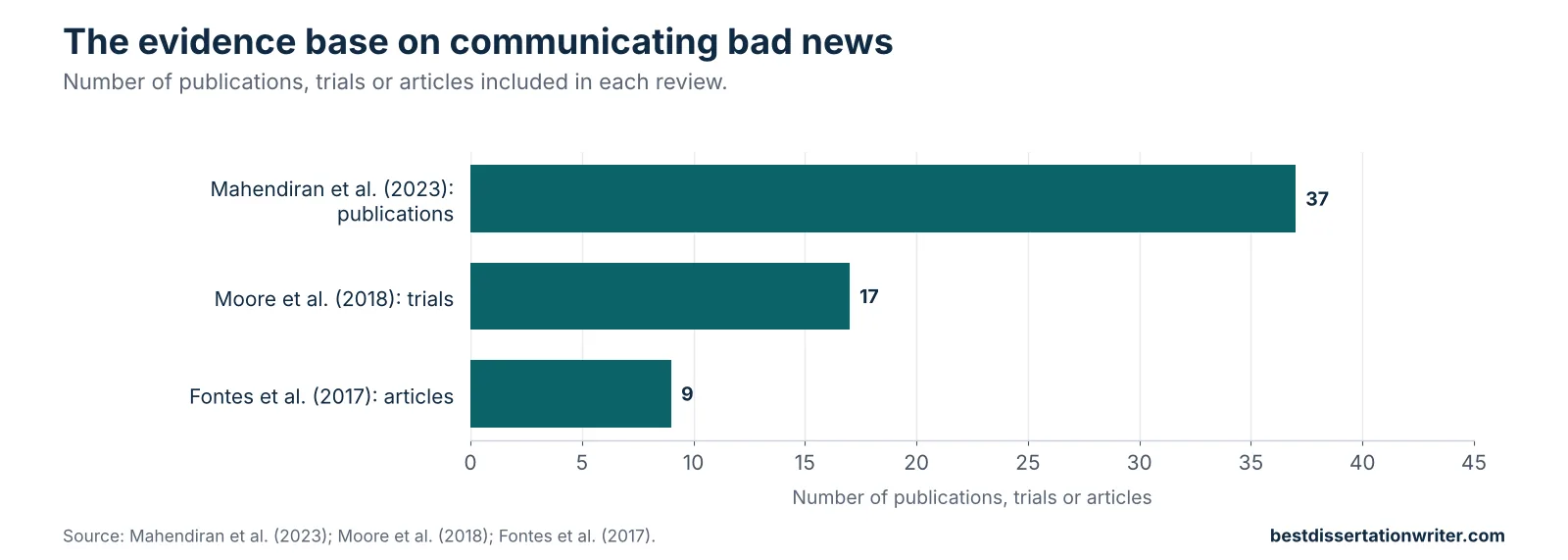
Three themes were identified: structured protocols for communicating bad news, the evidence for training, and the role and experience of nurses. Table 1 summarises the included sources, and Figure 1 shows the size of the evidence base in the three reviews of research.
| Author, year | Design | Setting and sample | Key finding |
|---|---|---|---|
| Baile et al. (2000) | Protocol description | Patients with cancer | SPIKES: a six-step protocol for delivering bad news in oncology. |
| Bumb et al. (2017) | Evidence-based review | Models of communication for oncology nurses | No single model best; nurses report inadequate training; preparation and rehearsal help. |
| Fontes et al. (2017) | Integrative review | 9 articles from 99 identified | Nurse role varies by country; honesty and hope must be balanced. |
| Mahendiran et al. (2023) | Systematic review | 37 publications | SPIKES training associated with improved satisfaction, knowledge and performance; no system outcomes studied. |
| Moore et al. (2018) | Cochrane review | 17 trials; 1,240 health professionals | Training improved empathy and reduced fact-only responses; no evidence of patient benefit. |
Theme 1: Structured Protocols
Baile et al. (2000) described SPIKES as a six-step protocol for delivering bad news, applied to the patient with cancer. It was developed for oncology and covers situations such as recurrence and the move to palliative care. The protocol gives clinicians a six-step sequence to follow when communicating bad news, so that the conversation is prepared, the patient’s understanding and wishes are explored, information is given and emotions are addressed.
Bumb et al. (2017) reviewed the evidence on models of communication for oncology nurses. They described SPIKES and a second model, PEWTER, which was created for school counsellors but has been used in clinical settings and emphasises preparation, assessing what the patient already knows and offering hope where realistic. The article did not identify any model as the best, and suggested that nurses may use either or combine them. It reported that many nurses describe inadequate training in delivering bad news, although training does not always correlate with comfort, and that confidence and experience are critical, so preparation and rehearsal can help.
Theme 2: The Evidence for Training
Mahendiran et al. (2023) carried out a systematic review of the effectiveness of the SPIKES model. They searched four databases and included 37 publications from 622 screened, covering interventions that included lectures, role play with standardised patients, video, debriefing and computer simulation. The authors concluded that SPIKES training is associated with improved learner satisfaction, knowledge and performance. They noted that none of the studies examined system outcomes, and that patient outcomes, the best components of training and the ideal length of training need more study. Meta-analysis was not possible because of differences between studies.
Moore et al. (2018) carried out a Cochrane review of communication skills training for health care professionals working with people who have cancer. It included 17 randomised trials with 1,240 health care professionals, of whom 532 were nurses, searched to May 2018. Training improved empathy (standardised mean difference 0.18, 95% confidence interval 0.05 to 0.32; moderate certainty), and professionals were less likely to give only facts after training (−0.26, −0.51 to −0.01; low certainty). Open questions may have increased (very low certainty), and there was no difference in eliciting concerns or giving appropriate information. Outcomes did not differ between doctors and nurses.
The Cochrane review found no evidence of benefit for patient satisfaction or perception of communication (very low certainty), and effects on patient anxiety were very uncertain. The authors concluded that courses appear effective for improving supportive communication skills, but that it is unclear whether effects last, whether follow-up sessions are needed, or which type of training is best. There was no evidence of benefit for professional burnout or for patients’ mental or physical health.
Theme 3: The Role and Experience of Nurses
Fontes et al. (2017) carried out an integrative review of the nursing literature on communicating bad news. Searching literature from 1993 to 2014 across six databases, they identified 99 articles and included nine, of which six were primary studies, mostly qualitative, and three were reviews, from several countries. Communicating bad news was most common in oncology and palliative care and was strongly shaped by cultural norms.
In Greece and China, nurses often felt unprepared or unauthorised to deliver bad news and believed that doctors should do so, whereas studies from Sweden, the Netherlands, the United States and Brazil reported greater nurse autonomy. Honesty was seen as essential to quality care, and nurses described the need to balance truthfulness with preserving hope. In one Brazilian neonatal study, families valued clear, detailed and honest information delivered with emotional support and noticed the nurse’s posture and expressions. The authors concluded that the nurse’s approach and communication skills affect how patients react, and that the topic is scarce in the literature.
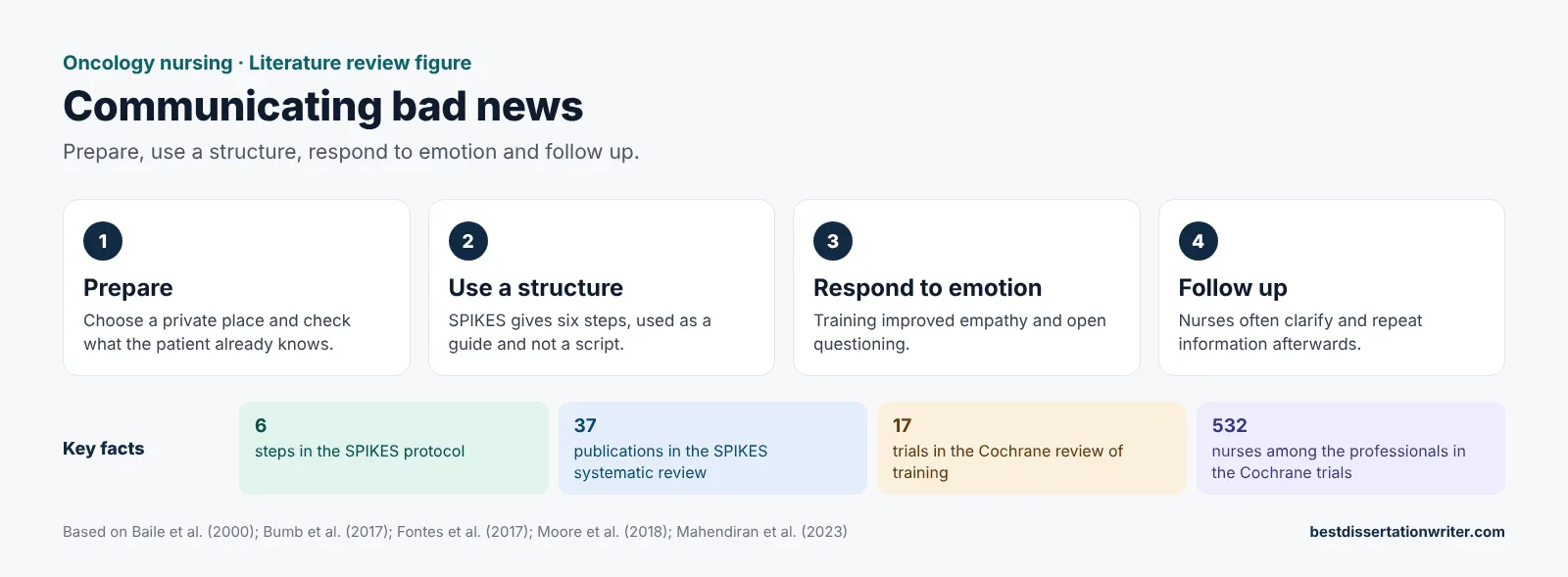
Bumb et al. (2017) added that nurses often provide ongoing support, clarification and repeated explanation after the initial disclosure, and that clinicians often rate encounters more negatively than patients and families do. They also noted that nurses may experience burnout and compassion fatigue, and that stress responses may persist after the conversation. This points to a need for support for staff as well as patients.
Taken together, the three themes show a progression from structure to training to practice. SPIKES provides the structure, training shows that skills can be taught, and the nursing literature shows how conversations are shaped by role, culture and relationships. The findings of the Cochrane review that training did not change patient satisfaction suggest that skills measured in training may not be the aspects of the conversation that patients value most, or that existing measures are not sensitive enough.
Cultural context deserves particular attention. In the integrative review, nurses in some countries believed that doctors should deliver bad news, and families in some settings may prefer to receive information on behalf of the patient. Communicating bad news in a multicultural service therefore requires awareness of different expectations, use of interpreters where needed and willingness to ask patients how much they wish to know and who should be present.
The sources also draw attention to the emotional cost for staff. Nurses who repeatedly share patients’ distress may experience compassion fatigue, and the review of models noted that stress responses can persist after a conversation. Debriefing, peer support and supervision are therefore not optional extras but part of the infrastructure that allows nurses to carry on communicating bad news with care.
Discussion
This review shows that structured approaches and training for communicating bad news have some support but limited evidence of effect on patients. SPIKES training is associated with improved learner satisfaction, knowledge and performance, and communication skills training improves some skills, particularly empathy and the avoidance of fact-only responses. However, the sources found no evidence that this training improves patient satisfaction or wellbeing, and none examined system outcomes.
This gap matters because training is time-consuming and expensive. It suggests that research should look more directly at what patients value and at how conversations affect their understanding and decisions. It also suggests that training should be evaluated in practice settings and not only through simulated exercises, and that follow-up sessions might help to maintain skills.
The evidence on nurses shows variation in role according to culture and setting. Where nurses are not authorised to give bad news, they still have a role in preparing patients, being present, clarifying information and supporting patients afterwards. Where they are authorised, they need training and clear protocols. In both cases, they need support for their own wellbeing, since repeated difficult conversations can lead to compassion fatigue.
There are limitations. As a narrative review it did not pool results, and the quality of sources varies: the SPIKES paper is a protocol and not a trial, the review of models for oncology nurses did not report a systematic search, and the integrative review included few studies, some of them old. Most evidence concerns doctors, and there is little evidence on nurses specifically. Findings from other cultural settings may not apply in the United Kingdom. This review relied on openly accessible, English-language sources.
Practical steps for individual nurses follow from the sources. Before a planned consultation, a nurse can agree with the team who will say what, check that a private room is available and consider what the patient has already been told. During the consultation, a nurse who is present can note the patient’s reactions, questions and non-verbal cues. Afterwards, the nurse can return to ask what the patient remembers and understands, correct misunderstandings and make sure that the next steps are clear. These actions are consistent with the descriptions in the sources, although few have been tested individually.
Implications of Communicating Bad News Evidence for Practice
For practice, the evidence supports using a structured approach such as SPIKES as a guide and not a script, preparing for the conversation, using open questions and empathic responses, checking understanding and following up after the news is given. Information for patients about what to expect after a diagnosis is available from Macmillan Cancer Support and Cancer Research UK.
Managers should provide training in communicating bad news that includes practice and feedback, protect time for debriefing and ensure that roles are clear, so that nurses know when to lead and when to support. Services should seek the views of patients on how conversations were handled.
Future research should evaluate communication training for nurses specifically, measure outcomes that matter to patients such as understanding, trust and decisional regret, test whether follow-up sessions help skills to last, and explore communicating bad news in diverse cultural and health system settings. Studies in the United Kingdom, and studies that include patients’ and families’ own accounts of what helped, would make the evidence more relevant to practice.
Patients and families should also be involved in shaping local approaches. Asking people who have received difficult news what helped and what did not, and using their answers in training, would keep the focus on what matters to them. Such feedback can be collected simply, for example through a short conversation or a brief questionnaire after a consultation.
Conclusion
This narrative review found that structured protocols and training can improve how professionals communicate bad news, but evidence of benefit for patients is lacking and evidence on the role of nurses is limited and varies by setting.
By preparing for conversations, communicating with empathy, supporting patients afterwards and looking after their own wellbeing, nurses can make communicating bad news a more supportive part of cancer care.
References
Baile, W. F., Buckman, R., Lenzi, R., Glober, G., Beale, E. A., & Kudelka, A. P. (2000). SPIKES—A six-step protocol for delivering bad news: Application to the patient with cancer. The Oncologist, 5(4), 302–311. https://doi.org/10.1634/theoncologist.5-4-302
Bumb, M., Keefe, J., Miller, L., & Overcash, J. (2017). Breaking bad news: An evidence-based review of communication models for oncology nurses. Clinical Journal of Oncology Nursing, 21(5), 573–580. https://doi.org/10.1188/17.CJON.573-580
Fontes, C. M. B., Menezes, D. V., Borgato, M. H., & Luiz, M. R. (2017). Communicating bad news: An integrative review of the nursing literature. Revista Brasileira de Enfermagem, 70(5), 1089–1095. https://doi.org/10.1590/0034-7167-2016-0143
Mahendiran, M., Yeung, H., Rossi, S., Khosravani, H., & Perri, G.-A. (2023). Evaluating the effectiveness of the SPIKES model to break bad news – A systematic review. American Journal of Hospice and Palliative Medicine, 40(11), 1231–1260. https://doi.org/10.1177/10499091221146296
Moore, P. M., Rivera, S., Bravo-Soto, G. A., Olivares, C., & Lawrie, T. A. (2018). Communication skills training for healthcare professionals working with people who have cancer. Cochrane Database of Systematic Reviews, 2018(7), Article CD003751. https://doi.org/10.1002/14651858.CD003751.pub4
Cite this example
Best Dissertation Writers (2026) Communicating Bad News in Oncology: Nurses’ Roles and Skills: A Narrative Review. Available at: https://bestdissertationwriter.com/communicating-bad-news-review-review/
Best Dissertation Writers
Get expert help with your nursing literature review
Share your topic and deadline with Best Dissertation Writers and get support tailored to your module brief.