Fertility Preservation Counselling for Patients with Cancer: The Nursing Role: A Scoping Review
 By Dr. Robertson Prime, Research Fellow
Updated October 28, 2026
15 min read
About 2,900 words
In this review
Abstract
Background: Cancer and its treatment can threaten fertility, and for many young people the possibility of having children matters as much as survival. Fertility preservation counselling needs to take place before treatment starts, but nurses, who are often best placed to raise the subject, report limited training, time and pathways.
Aim: This scoping review aimed to map the evidence on fertility preservation counselling for patients with cancer, including clinical guidance, patient distress, barriers faced by nurses and the nursing role.
Methods: Evidence was identified through targeted searches of openly accessible bibliographic records, publisher websites and professional guidance. Five sources published between 2018 and 2026 were included: a clinical practice guideline, a systematic review of psychological distress, an integrative review of the nursing role, a qualitative study and a joint nursing position statement. Data were charted and summarised descriptively.
Findings: The ASCO guideline states that health care providers should initiate the discussion on the possibility of infertility, document it and refer patients to reproductive specialists as early as possible. A review of 47 papers found that fertility-related distress lasts from diagnosis through survivorship. An integrative review of 11 appraised studies found that nurses are well placed to improve fertility preservation care but currently have a minimal role, with barriers including gaps in knowledge, limited time and late timing. An interview study found that nurses reported little training and no standard pathways.
Conclusion: Fertility preservation counselling is an essential part of cancer care, and nurses are well placed to deliver it. Training, documentation, clear pathways and referral partnerships are needed to enable them to do so.
Keywords: fertility preservation counselling, oncofertility, fertility preservation
Introduction
This scoping review critically examines recent evidence on fertility preservation counselling and its implications for cancer nursing practice.
Some cancer treatments, including certain chemotherapy drugs, radiotherapy to the pelvis and surgery to reproductive organs, can reduce or remove the ability to have children. For people who are diagnosed in childhood, adolescence or early adulthood, the prospect of future parenthood may be an important part of how they think about recovery. Fertility preservation refers to methods of protecting the ability to have biological children, such as sperm, oocyte or embryo cryopreservation, and the term oncofertility is used for the field that brings together oncology and reproductive medicine.
The timing of fertility preservation counselling is critical. Most options need to be considered before treatment starts, when the person may be shocked, anxious about the diagnosis and under pressure to begin treatment quickly. The American Society of Clinical Oncology (ASCO) guideline states that health care providers should initiate the discussion on the possibility of infertility, and that the information should be provided as early as possible in the treatment process.
Nurses have a central part in this process. They often have the longest and most continuous contact with patients and families, they are present when consent is discussed, and they can help patients to ask questions and to understand what they are told. A scoping review design was chosen because the evidence is varied in design and the aim was to map it, rather than to pool effects.
Review question
What does the evidence show about fertility preservation counselling, the experience of patients, and the contribution and challenges of nurses?
Background to Fertility Preservation Counselling
Fertility preservation counselling is a conversation in which the clinician explains the risk to fertility from treatment, describes options for preserving it, outlines their benefits, limits and costs, and supports the patient to make a decision. It is not a single event, because patients may need time to absorb information, and wishes may change as health, relationships and circumstances change.
The ASCO guideline states that sperm, oocyte and embryo cryopreservation are considered standard practice and are widely available. It states that there is conflicting evidence to recommend gonadotropin-releasing hormone agonists, which may be offered to young women with breast cancer when proven methods are not feasible, but that they should not be used in place of proven fertility preservation methods. For children, discussion should start with parents or guardians as early as possible, and the guideline notes that ovarian tissue cryopreservation may evolve to become standard therapy in the future.
Fertility preservation counselling involves a team. Oncologists describe the risks of treatment, reproductive specialists explain the procedures, and nurses support the process, provide information, coordinate referrals and help patients to weigh options. Because the window for fertility preservation can be short, the team needs to work quickly and to communicate clearly.
The professional nursing organisations take the view that nurses have a duty in this area. A joint position statement from the Association of Pediatric Hematology/Oncology Nurses, the Canadian Association of Nurses in Oncology and the Oncology Nursing Society was approved in December 2023 and updated in June 2026. It is considered later in this review.
Search Strategy and Methods
Evidence for this example was identified through targeted searches of openly accessible bibliographic records, publisher websites and professional guidance. Search terms combined keywords for the topic (“fertility preservation”, “oncofertility”, “fertility counselling”, “infertility”) with terms for the population and provider (“cancer”, “nurses”, “adolescents and young adults”, “shared decision-making”), joined with the Boolean operators AND and OR. A full scoping review for assessment would follow the PRISMA extension for scoping reviews, search CINAHL, PubMed/MEDLINE, PsycINFO and Embase, and report the records screened.
Sources were included if they gave authoritative guidance on fertility preservation in cancer, synthesised evidence on patient distress, or examined the role and experience of nurses. Studies of the technical success of individual procedures were excluded.
Five sources published between 2018 and 2026 were included (Table 1). In line with scoping review methods, no formal quality appraisal was undertaken. Data were charted and summarised descriptively under themes.
Key Findings on Fertility Preservation Counselling
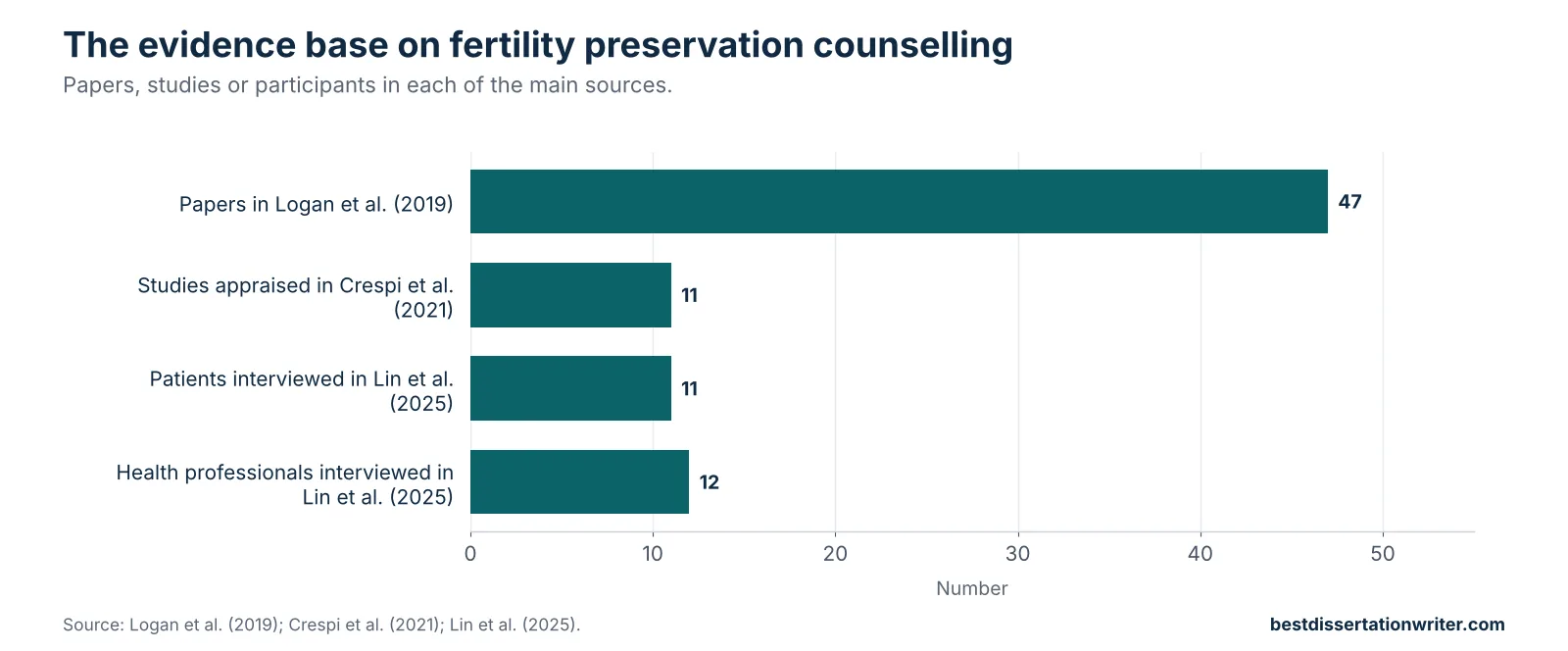
Three themes were identified: the guidance on what fertility preservation counselling should include, the psychological importance of fertility to patients, and the role and challenges of nurses. Table 1 summarises the included sources, and Figure 1 shows the size of the evidence base in the main studies.
| Author, year | Design | Setting and sample | Key finding |
|---|---|---|---|
| Association of Pediatric Hematology/Oncology Nurses, Canadian Association of Nurses in Oncology, & Oncology Nursing Society (2026) | Joint position statement | Nurses and advanced practice providers | Nurses share responsibility for advocating for fertility preservation, education, documentation and referral. |
| Crespi et al. (2021) | Integrative review | 11 appraised studies from 85 articles | Nurses well placed but have a minimal role; barriers at provider, institutional and patient levels. |
| Lin et al. (2025) | Qualitative interview study | 11 patients; 12 health care professionals | Late or missed information; nurses had little training and no standard pathways. |
| Logan et al. (2019) | Systematic review | 47 papers | Fertility-related distress lasts from diagnosis through survivorship. |
| Oktay et al. (2018) | Clinical practice guideline | Adults and children with cancer | Providers should initiate the discussion early, document it and refer to reproductive specialists. |
Theme 1: What Fertility Preservation Counselling Should Include
The ASCO guideline update (Oktay et al., 2018) sets out the main expectations. It recommends that providers initiate the discussion on the possibility of infertility, that they do so as early as possible in the treatment process, that they discuss preservation options or refer all potential patients to appropriate reproductive specialists, and that the discussion of threats to fertility and of preservation options is documented. The guideline covers adults and children with cancer.
These recommendations place responsibility on the whole team and not only on doctors. The expectation that every eligible patient is told, and that the discussion is recorded, is a standard that can be audited, and nurses often hold the records and the contact with patients that make audit possible. The guideline itself addresses health care providers in general and does not single out nurses.
Theme 2: The Psychological Importance of Fertility
Logan et al. (2019) carried out a systematic review of fertility-related psychological distress in cancer patients. They included 47 papers from 708 potentially relevant studies identified in a search of five databases in January 2018, covering male and female cancer patients under 45. The review found that fertility-related distress lasts from diagnosis through survivorship, and that patients described a range of negative emotions linked to the threat of infertility.
In survivors, reproductive concerns, an unmet desire for children, never having given birth and early menopause were associated with higher rates of mental health disorders and psychological distress. The authors concluded that distress related to fertility is common and long-lasting among cancer patients and survivors, and argued that fertility-related psychological support should be part of standard care from diagnosis onward. They proposed a revised model of care.
These findings show why fertility preservation counselling cannot be limited to a single conversation about procedures. Patients may need emotional support at the time of diagnosis, when choices are made, and later, when they consider parenthood after treatment. Nurses are present throughout this pathway and are well placed to notice distress and to offer or arrange support.
Theme 3: The Role and Challenges of Nurses
Crespi et al. (2021) carried out an integrative review of the role of nurses in fertility preservation for adolescents and young adults with cancer. Searching literature through 2020, they identified 85 articles, of which 11 met the inclusion criteria and were critically appraised. They concluded that nurses are well positioned to improve fertility preservation care but currently have a minimal role.
Barriers were described at three levels. Provider-related barriers included gaps in knowledge of guidelines, low comfort, role confusion and ethical concerns, such as parents acting as gatekeepers. Institutional barriers included limited time, late timing relative to treatment start, lack of educational materials, poor access to fertility centres, and cost or insurance gaps. Patient-related barriers included poor prognosis, treatment urgency, age or maturity, distress, gender, and LGBTQ or HIV-related factors. Facilitators included access to resources and education materials, and patients initiating the fertility conversation.
Lin et al. (2025) added a qualitative perspective in an interview study in China of 11 women with gynaecological cancer and 12 health care professionals, including 7 physicians and 5 nurses. Patients often learned about fertility preservation late or not at all, deferred to physicians or others, and faced fear, cost concerns, time pressure and social stigma, while professionals cited heavy workloads and weak referral systems. Nurses reported little training in fertility preservation and no standardised tools or pathways, were less involved in fertility discussions than physicians, and usually shared information only when patients asked. Facilitators included coordinated multidisciplinary clinics, structured decision aids and supportive policies and institutional leadership.
The joint position statement of the nursing organisations (APHON, CANO/ACIO and ONS) describes what nurses should do. It states that nurses and advanced practice providers share responsibility for advocating for fertility preservation, for identifying infertility risk, educating patients and confirming understanding during informed consent. Nurses are described as uniquely poised to assess the complexity of the individual and family experience and to guide patients through fertility preservation across the cancer care trajectory, to advocate for equitable access, to ensure the patient’s wishes are discussed, documented and revisited over time, and to establish community partnerships for prompt referral when a facility lacks fertility services.
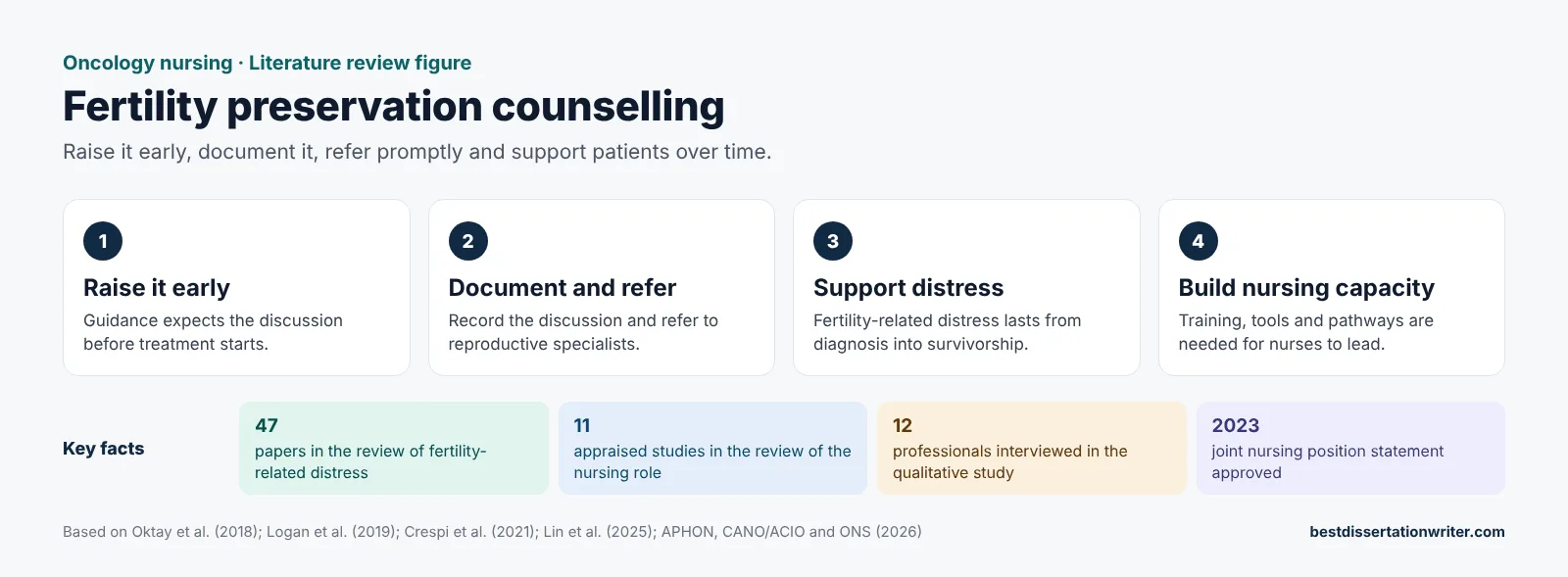
Taken together, the themes show how the sources complement one another. The guideline says what should happen, the review of distress explains why it matters to patients, and the nursing literature explains why it often does not happen. None of the sources provides trial evidence that a particular nursing intervention improves outcomes, so recommendations for nursing practice rest on guidance, professional consensus and descriptive findings.
The sources also differ in the populations they describe. The guideline covers adults and children, the review of distress covers patients under 45 of both sexes, the integrative review concerns adolescents and young adults, and the interview study concerns women with gynaecological cancer. Readers should therefore take care before applying any single finding to a different group, such as older adults or men with testicular cancer, who may have different needs.
Communication skill is a further consideration. Patients in the interview study often deferred to physicians and learned about options late, which suggests that information given in a rushed consultation may not be understood or remembered. Nurses can check understanding, give written material, offer a second conversation and make sure that the patient knows whom to contact with questions, which is consistent with the position statement’s emphasis on confirming understanding during informed consent.
Future research should test whether training programmes, structured decision aids and standard documentation improve the delivery of fertility preservation counselling, and should measure outcomes that matter to patients, such as decisional regret, distress and the proportion who receive a timely referral. Studies set in the United Kingdom would be particularly useful for readers working in the National Health Service, where the sources reviewed here provide little direct evidence. Involving patients and survivors in designing such studies would help to ensure that they address real concerns.
Discussion
This scoping review maps a clear gap between what guidance expects and what nurses are currently able to provide. The guideline and the position statement set out an active role in fertility preservation counselling, yet the integrative review describes a minimal role, and the qualitative study found that nurses share information only when patients ask. The gap appears to be caused less by a lack of willingness than by lack of training, time, tools and pathways.
The evidence on distress shows what is at stake. Fertility-related distress can last for years, and it is associated with mental health problems. A missed or hurried conversation before treatment may be difficult to repair later, so the quality of fertility preservation counselling has long-term consequences for the person’s wellbeing.
Several practical steps follow from the barriers identified. Education can address gaps in knowledge and comfort. Standard documentation in the electronic record, a recommendation also made by Crespi et al., can prompt the conversation and show whether it has happened. Clear pathways to fertility services, and partnerships with community providers where local services are lacking, can shorten the time between diagnosis and referral. Decision aids can support patients who are anxious and short of time.
Equity is an important theme. The position statement calls for equitable access, and the barriers described include cost, insurance, gender and sexual identity. Services should check whether some groups are less likely to be offered fertility preservation counselling, including young men, people from minority backgrounds and those with a poor prognosis, and should address any differences.
There are limitations. As a scoping review it did not appraise study quality or pool results. The included sources vary from a guideline to a small single-site interview study, and several are from North America or China, so they may not describe practice elsewhere. The ASCO guideline summary was read from a news report of the recommendations, and the nursing literature on this topic is small. This review relied on openly accessible, English-language sources and did not involve a formal search of all databases.
Implications of Fertility Preservation Counselling Evidence for Practice
For practice, the evidence supports raising the possibility of infertility with every eligible patient before treatment, documenting the discussion, referring early, offering emotional support and revisiting the topic over time. These principles are consistent with the work on symptoms and treatment effects described in the reviews of patient-reported outcome measures and of body image disturbance, and with the urgent pathways discussed in the review of neutropenic sepsis. Professional guidance is available from the joint position statement on fertility preservation.
Employers should provide training in fertility preservation counselling, accessible educational materials for patients, clear referral pathways and time for the conversation. Managers should audit whether fertility discussions are offered and recorded, and should support nurses to take part.
Conclusion
This scoping review mapped the evidence on fertility preservation counselling. Guidance expects every eligible patient to be told of the risk to fertility and offered options before treatment, fertility-related distress is common and long-lasting, and nurses are well placed to help but face barriers of knowledge, time and pathways.
By building their knowledge, documenting conversations and developing referral partnerships, nurses can make fertility preservation counselling a reliable part of cancer care, and help people to keep open the possibility of a family after treatment.
References
Association of Pediatric Hematology/Oncology Nurses, Canadian Association of Nurses in Oncology, & Oncology Nursing Society. (2026). Fertility preservation in individuals with cancer [Joint position statement]. Oncology Nursing Society. https://www.ons.org/network-advocacy/position-statements/fertility-preservation-individuals-cancer
Crespi, C., Adams, L., Gray, T. F., & Azizoddin, D. R. (2021). An integrative review of the role of nurses in fertility preservation for adolescents and young adults with cancer. Oncology Nursing Forum, 48(5), 491–505. https://doi.org/10.1188/21.ONF.491-505
Lin, Y., Ma, Q., Wang, X., Li, X., Jin, M., Wei, Q., & Jiang, L. (2025). Shared decision-making on fertility preservation in reproductive-aged women with gynecological cancer: A qualitative study of patients’ and health care professionals’ perspectives. International Journal of Women’s Health, 17, 5155–5168. https://doi.org/10.2147/IJWH.S563769
Logan, S., Perz, J., Ussher, J. M., Peate, M., & Anazodo, A. (2019). Systematic review of fertility-related psychological distress in cancer patients: Informing on an improved model of care. Psycho-Oncology, 28(1), 22–30. https://doi.org/10.1002/pon.4927
Oktay, K., Harvey, B. E., Partridge, A. H., Quinn, G. P., Reinecke, J., Taylor, H. S., Wallace, W. H., Wang, E. T., & Loren, A. W. (2018). Fertility preservation in patients with cancer: ASCO clinical practice guideline update. Journal of Clinical Oncology, 36(19), 1994–2001. https://doi.org/10.1200/JCO.2018.78.1914
Cite this example
Best Dissertation Writers (2026) Fertility Preservation Counselling for Patients with Cancer: The Nursing Role: A Scoping Review. Available at: https://bestdissertationwriter.com/fertility-preservation-counselling/
Best Dissertation Writers
Get expert help with your nursing literature review
Share your topic and deadline with Best Dissertation Writers and get support tailored to your module brief.