Assessment and Management of Cancer Pain by Nurses: A Systematic Review
 By Dr. Robertson Prime, Research Fellow
Updated October 28, 2026
14 min read
About 2,800 words
In this review
Abstract
Background: Cancer pain is one of the most feared and most common consequences of cancer and its treatment, and it can usually be relieved. Nurses assess pain, give analgesia, teach patients and families and coordinate care, but undertreatment remains widespread and the evidence on which nursing actions make a difference needs to be drawn together.
Aim: This systematic review aimed to examine the evidence on the prevalence of cancer pain, the effectiveness of opioids and patient education, and the implications for nursing assessment and management.
Methods: Evidence was identified through targeted searches of openly accessible bibliographic records, publisher websites and the reference lists of key reviews. Five sources published between 2008 and 2019 were included: four systematic reviews and a World Health Organization guideline. The research sources were appraised using CASP checklists and synthesised narratively.
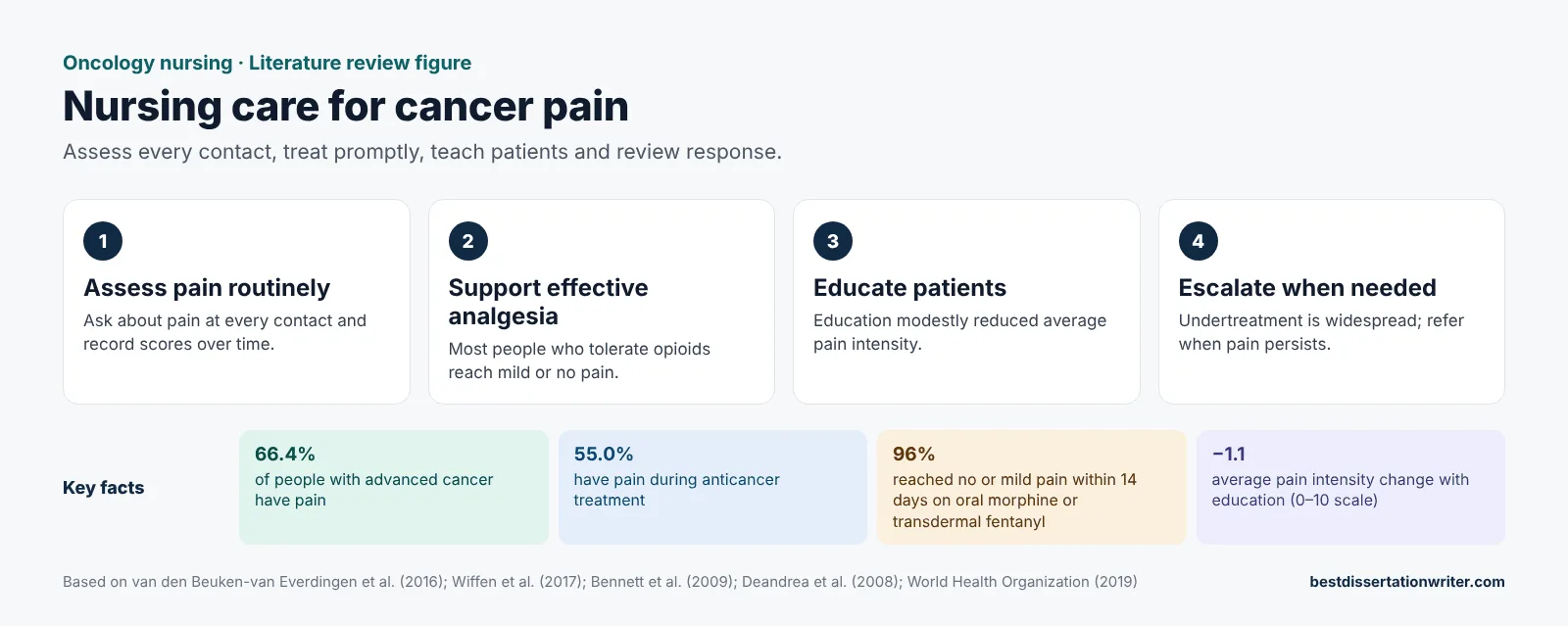
Findings: A meta-analysis of 122 studies found that pain affected 39.3% of patients after curative treatment, 55.0% during anticancer treatment and 66.4% of those with advanced disease. An overview of nine Cochrane reviews found that 96% of 850 people given oral morphine or transdermal fentanyl reached no or mild pain within 14 days, although the certainty of the evidence was very low. A meta-analysis of patient education trials found modest reductions in average pain intensity (weighted mean difference -1.1 on a 0 to 10 scale). A review of the literature concluded that undertreatment of cancer pain is widespread.
Conclusion: Cancer pain is common but can usually be relieved with opioids and other treatments. Nurses can improve outcomes by assessing pain systematically, supporting safe opioid use and educating patients, but better-quality evidence is needed.
Keywords: cancer pain, pain assessment, opioids
Introduction
This systematic review critically examines recent evidence on cancer pain and its implications for cancer nursing practice.
Pain is among the most common symptoms in people with cancer, and among the most feared. The World Health Organization (WHO) reports that pain affects 55% of patients on anti-cancer treatment and 66% of those with advanced, metastatic or terminal disease, and that it can usually be relieved with medicines and other treatments. Uncontrolled pain reduces sleep, appetite, mood and the ability to carry out daily activities.
Cancer pain has many causes. It may result from the tumour itself, for example through pressure on nerves or invasion of bone, or from treatment, such as surgery, radiotherapy or chemotherapy. It can also arise from other conditions that the patient has. Because the causes differ, a careful assessment is needed to decide how to treat it, and the treatment often combines several approaches.
Nurses have a central part in managing cancer pain. They are often the people who ask about pain, record scores, administer and review analgesia, watch for side effects, teach patients and families and refer to specialists. A systematic review was chosen because the question concerns the effectiveness of interventions, and several robust syntheses exist.
Review question
What does the evidence show about how common cancer pain is, which treatments and nursing interventions relieve it, and how reliable is that evidence?
Background to Cancer Pain Assessment and Management
Pain assessment is the starting point. It includes the site, severity, quality, timing and effect of pain, the patient’s own beliefs about it and the response to previous treatment. Simple tools, such as a numerical rating scale from 0 to 10, allow severity to be recorded and compared over time. Because pain is a personal experience, the patient’s own report is the most reliable guide.
The WHO guideline on the pharmacological and radiotherapeutic management of cancer pain in adults and adolescents, published in 2019, was developed to give evidence-based guidance to clinicians, nurses, pharmacists and caregivers, and to help policymakers balance opioid policies and prescribing rules. Its goal is to relieve pain to a level that supports an acceptable quality of life. It covers the choice of initial analgesic, maintenance opioid, rescue medication, route of administration, opioid rotation and when to stop, as well as adjuvant medicines such as steroids, antidepressants and anticonvulsants, and treatment of bone metastases with bisphosphonates and radiotherapy.
Opioids are the main treatment for moderate to severe cancer pain. They are effective but can cause constipation, nausea, vomiting and drowsiness, and concerns about addiction or tolerance can lead patients and professionals to avoid them. Nurses therefore play an important role in explaining the purpose of opioids, anticipating side effects and monitoring safe use.
Patient education is a further approach. It aims to improve patients’ knowledge and beliefs about pain and its treatment, and to help them to report pain and use medicines as prescribed. Such interventions are low in cost and well suited to nurse delivery, so their effectiveness is of practical importance.
Search Strategy and Methods
Evidence for this example was identified through targeted searches of openly accessible bibliographic records, publisher websites and the reference lists of key reviews. Search terms combined keywords for the problem (“cancer pain”, “pain assessment”, “opioids”, “undertreatment”) with terms for the intervention and provider (“nurse”, “education”, “analgesia”, “guideline”), joined with the Boolean operators AND and OR. A full systematic review for assessment would run the same strategy in CINAHL, PubMed/MEDLINE, Embase and the Cochrane Library and report the records screened in a PRISMA flow diagram.
Sources were eligible if they were systematic reviews or guidelines on the prevalence, treatment or undertreatment of cancer pain, or on educational interventions for it. Studies of single drugs in specific conditions and of paediatric cancer pain were excluded.
Five sources published between 2008 and 2019 were included (Table 1). The quality of each research source was considered using the Critical Appraisal Skills Programme (CASP) checklists, and findings were synthesised narratively.
Key Findings on Cancer Pain
Three themes were identified: how common cancer pain is and whether it is adequately treated, how effective opioids are, and what patient education adds. Table 1 summarises the included sources, and Figure 1 shows the prevalence of pain at different stages of the disease.
| Author, year | Design | Setting and sample | Key finding |
|---|---|---|---|
| Bennett et al. (2009) | Systematic review and meta-analysis | 21 trials; 3,501 adults | Education modestly reduced average pain intensity (WMD −1.1 on 0–10). |
| Deandrea et al. (2008) | Systematic review | Published literature | Undertreatment of cancer pain is widespread despite guidelines. |
| van den Beuken-van Everdingen et al. (2016) | Systematic review and meta-analysis | 122 studies; 63,533 patients (prevalence) | Pain in 39.3% after curative treatment, 55.0% during treatment and 66.4% in advanced disease. |
| Wiffen et al. (2017) | Overview of Cochrane reviews | 9 reviews; 152 studies; 13,524 participants | 96% reached no or mild pain within 14 days with oral morphine or transdermal fentanyl; very low certainty. |
| World Health Organization (2019) | Guideline | Adults and adolescents | Evidence-based guidance on analgesia, adjuvant medicines and bone metastases. |
Theme 1: The Prevalence and Undertreatment of Cancer Pain
Van den Beuken-van Everdingen et al. (2016) updated a systematic review and meta-analysis of the prevalence of pain in patients with cancer. They selected 122 studies, of which 117 (63,533 patients) contributed to the analysis of prevalence and 52 (32,261 patients) to the analysis of severity. Pain was present in 39.3% of patients after curative treatment, 55.0% during anticancer treatment and 66.4% in advanced, metastatic or terminal disease. Moderate to severe pain, defined as a numerical rating scale score of 5 or more, affected 38.0% of all patients.
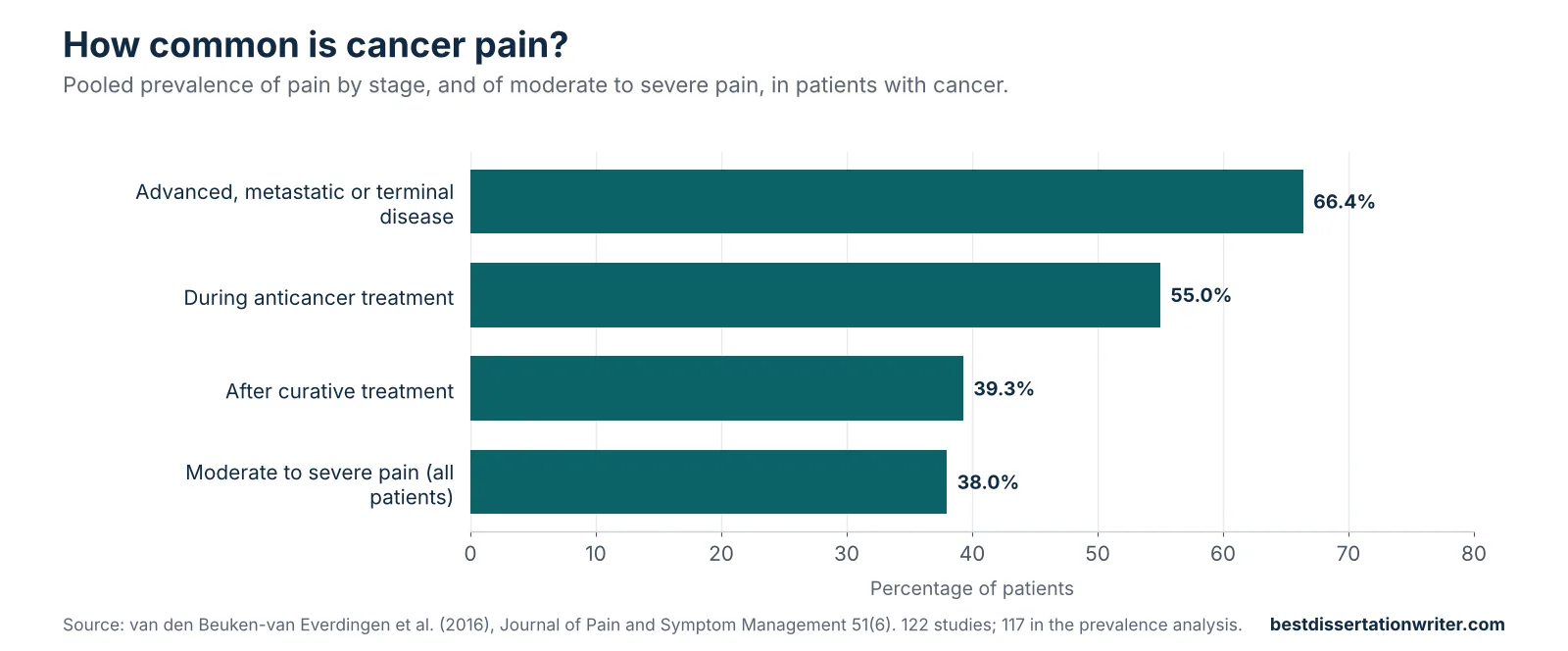
The authors concluded that pain remains common in people with cancer despite greater attention to its assessment and management, and that future work should address barriers to effective treatment and develop interventions for better pain management. These figures confirm that pain is a problem that nurses will meet in all settings, not only in palliative care.
Deandrea et al. (2008) reviewed the published literature on the prevalence of undertreatment of pain in people with cancer. They explain that Pain Management Indexes compare reported pain with the intensity of analgesic therapy, and that negative scores indicate inadequate prescribing. Their conclusion was that, despite the existence of guidelines for cancer pain management, undertreatment is a widespread problem. This gap between guidance and practice is where nursing assessment and advocacy can make the greatest difference.
Theme 2: The Effectiveness of Opioids
Wiffen et al. (2017) produced an overview of nine Cochrane reviews of opioids for cancer pain, covering 152 included studies and 13,524 participants, although some studies appeared in more than one review. For oral morphine and transdermal fentanyl, 96% of 850 participants reached no or mild pain within 14 days. Most other opioids lacked data on this outcome, and the oxycodone review indicated that average pain scores were in the mild-or-no-pain range.
Adverse events were common. Three reviews reported that 11% to 77% of participants had at least one adverse event, and five reported withdrawal due to adverse events at 6% to 19%. Common effects were constipation and nausea or vomiting. The certainty of the evidence was rated very low for all outcomes, because studies were often small, at high risk of bias and poorly reported.
The authors concluded that the evidence is disappointingly low, but that roughly 19 in 20 people with moderate to severe pain who tolerate opioids should reach mild or no pain within 14 days. They noted that this somewhat overstates the effectiveness suggested by the WHO pain ladder, that most people experience adverse events, and that roughly 1 to 2 in 10 may need to change treatment because of them. For nurses, this means that opioids are usually effective, but that side effects must be anticipated and managed, with prompt review when treatment is not tolerated.
The nursing contribution to opioid use is practical. Nurses check that the dose is appropriate, make sure that rescue medication is available, ask about constipation, nausea and drowsiness at each review, and teach patients when and how to take medicines. Because constipation was among the commonest adverse effects in the Cochrane overview, nurses can raise it proactively when an opioid is started instead of waiting for the problem to appear.
Theme 3: Patient Education and Self-Management
Bennett, Bagnall and Closs (2009) carried out a systematic review and meta-analysis of patient-based educational interventions in the management of cancer pain. Twenty-one trials, 19 of them randomised, with 3,501 adult patients met the inclusion criteria, and 15 were included in the meta-analysis. Education improved knowledge and attitude scores by about half a point on a 0 to 5 scale (weighted mean difference 0.52; 95% confidence interval 0.04 to 1.0).
Average pain intensity fell by just over one point on a 0 to 10 scale (weighted mean difference −1.1; 95% CI −1.8 to −0.41), and worst pain intensity fell by just under one point (−0.78; −1.21 to −0.35). The evidence on self-efficacy was equivocal, and there was no significant effect on medication adherence or on interference with daily activities. The authors described the benefits as modest but significant and suggested that such interventions are probably underused alongside traditional analgesic approaches.
Discussion
This systematic review shows that cancer pain is common at every stage, that it can usually be relieved, and that it is often undertreated. The evidence supports both medicines and education, but the effects of education are modest, and the evidence on opioids is of low certainty even though the clinical response is generally good.
Taken together, the sources show that the management of cancer pain depends on three linked elements: recognising that pain is present, treating it effectively and supporting the patient to take part in their own care. A failure at any one point can leave pain uncontrolled, and nurses are often the only professionals who see all three elements in the course of a shift.
The apparent contradiction between very low certainty and a high rate of pain relief is explained by the nature of the evidence. Opioid studies were small and short, and many lacked comparison groups, so their results cannot be used to estimate exact benefits and harms. Yet the consistency of the response in those studies, and decades of clinical use, support the view that opioids are effective for most people.
Undertreatment suggests that the main problem is not lack of effective drugs but their use. Barriers can include inadequate assessment, concerns about side effects or addiction, fear among patients of reporting pain, and difficulties with access. Nurses can address several of these by asking about pain at every contact, giving clear information about opioids and their side effects, and escalating when pain is not controlled.
Education deserves particular mention because it can be delivered by any nurse at little cost. The reduction in pain intensity of about one point is modest, but for a person whose pain is severe a one-point change can be meaningful, and it was obtained alongside conventional analgesia. Education can also correct beliefs that lead patients to under-report pain, such as the idea that pain is inevitable or that complaining distracts staff from treatment.
Equity should be considered. The WHO guideline emphasises safe opioid stewardship, which balances relief of pain with the policies and prescribing rules that govern opioids. Nurses should be alert to patients who may be less likely to be asked about pain or less likely to be believed.
There are limitations. This review relied on openly accessible, English-language sources and did not involve formal systematic screening. Some included reviews are more than ten years old, the evidence on opioids is of very low certainty, and the education trials measured outcomes over differing periods. The reviews did not examine nursing-led pain services directly, so the nurse-specific evidence is indirect.
Research priorities follow from these gaps. Trials of nurse-led pain assessment and review, with outcomes such as pain scores, side effects, hospital admissions and patient satisfaction, would show whether structured nursing input improves control. Studies should include people who are older, who have communication difficulties or who live in deprived areas, since these groups are often under-represented and may be at greater risk of inadequate treatment.
Implications of Cancer Pain Evidence for Practice
For practice, the evidence supports routine, structured pain assessment, timely and appropriate opioid use, anticipation of side effects, patient education and early referral for specialist support. Cancer pain also interacts with other symptoms, as described in the reviews of cancer nurse navigators and survivorship care plans, and with the side effects discussed in the review of chemotherapy-induced side effects. The WHO guideline on cancer pain gives detailed guidance.
Documentation matters as much as the conversation. A clear record of pain scores, treatment given and the response allows the next nurse to see whether the plan is working and prompts review when it is not. Where scores stay high despite treatment, the record provides the evidence needed to request a specialist opinion without delay.
Teams should also consider how to involve family members, who often help to give medicines at home and are well placed to notice changes in pain. Written information, clear contact numbers and a plan for what to do if pain increases at night or at weekends help to prevent avoidable distress, and nurses can build these into discharge planning so that people leave hospital with the knowledge and supplies they need.
Employers should ensure that nurses are trained in pain assessment and opioid management, that tools for recording pain are in use, and that pathways to specialist teams are clear. Audit of pain scores and response times can show whether cancer pain is being treated effectively.
Finally, the findings are a reminder that treatment of pain is a matter of dignity as well as symptom control. People who are comfortable can sleep, eat, spend time with their families and take part in decisions about their care. Nurses who take pain seriously, believe what patients tell them and act promptly on it help to preserve these things at a time when much else is uncertain.
Conclusion
This systematic review examined evidence on cancer pain. Pain affects many people with cancer, particularly during treatment and in advanced disease, opioids relieve it in most people who tolerate them, patient education gives modest additional benefit, and undertreatment remains widespread.
Nurses can improve the care of people with cancer pain by assessing it systematically, supporting safe and effective use of analgesia, teaching patients and advocating when pain is not controlled. Higher-quality research on nursing interventions will strengthen this contribution.
References
Bennett, M. I., Bagnall, A.-M., & Closs, S. J. (2009). How effective are patient-based educational interventions in the management of cancer pain? Systematic review and meta-analysis. Pain, 143(3), 192–199. https://doi.org/10.1016/j.pain.2009.01.016
Deandrea, S., Montanari, M., Moja, L., & Apolone, G. (2008). Prevalence of undertreatment in cancer pain: A review of published literature. Annals of Oncology, 19(12), 1985–1991. https://doi.org/10.1093/annonc/mdn419
van den Beuken-van Everdingen, M. H. J., Hochstenbach, L. M. J., Joosten, E. A. J., Tjan-Heijnen, V. C. G., & Janssen, D. J. A. (2016). Update on prevalence of pain in patients with cancer: Systematic review and meta-analysis. Journal of Pain and Symptom Management, 51(6), 1070–1090.e9. https://doi.org/10.1016/j.jpainsymman.2015.12.340
Wiffen, P. J., Wee, B., Derry, S., Bell, R. F., & Moore, R. A. (2017). Opioids for cancer pain: An overview of Cochrane reviews. Cochrane Database of Systematic Reviews, (7), CD012592. https://doi.org/10.1002/14651858.CD012592.pub2
World Health Organization. (2019). WHO guidelines for the pharmacological and radiotherapeutic management of cancer pain in adults and adolescents. https://www.who.int/publications/i/item/9789241550390
Cite this example
Best Dissertation Writers (2026) Assessment and Management of Cancer Pain by Nurses: A Systematic Review. Available at: https://bestdissertationwriter.com/cancer-pain-literature-review/
Best Dissertation Writers
Get expert help with your nursing literature review
Share your topic and deadline with Best Dissertation Writers and get support tailored to your module brief.