Electronic Patient-Reported Outcome Measures for Symptom Monitoring in Cancer Care: A Systematic Review
 By Dr. Robertson Prime, Research Fellow
Updated October 28, 2026
14 min read
About 2,900 words
In this review
Abstract
Background: Patient-reported outcome measures collect information on symptoms and quality of life directly from patients, and electronic versions allow this to be done routinely during cancer treatment. Nurses often prompt, review and respond to the reports, so the evidence on whether routine use improves care, and on what helps or hinders its adoption, matters for cancer nursing practice.
Aim: This systematic review aimed to examine the evidence on the effectiveness of the routine use of patient-reported outcome measures in cancer care and the barriers and facilitators reported by health care professionals.
Methods: Evidence was identified through targeted searches of openly accessible bibliographic records, publisher websites and the reference lists of key reviews. Five sources published between 2014 and 2023 were included: three systematic reviews, a Cochrane review and a randomised trial analysis. The research sources were appraised using CASP checklists and synthesised narratively.
Findings: A Cochrane review of 116 randomised trials found that feeding back questionnaire responses probably produces a small improvement in quality of life (standardised mean difference 0.15) and a moderate improvement in patient-provider communication (0.36). In a trial of 766 patients with metastatic cancer, median overall survival was 31.2 months with electronic symptom monitoring and 26.0 months with usual care. A review of 24 controlled trials found that routine use increased discussion of patient outcomes, although few results were statistically significant. A mapping study of 17 papers identified lack of integration with electronic health records as a barrier.
Conclusion: Routine use of patient-reported outcome measures improves communication and may improve quality of life and survival, but the evidence is varied and often uncertain. Nurses can help by supporting patients to report, acting on the results and contributing to integration with clinical systems.
Keywords: patient-reported outcome measures, patient-reported outcomes, symptom monitoring
Introduction
This systematic review critically examines recent evidence on patient-reported outcome measures and its implications for cancer nursing practice.
People with cancer experience symptoms such as pain, fatigue, nausea and anxiety that may change quickly between clinic visits. Clinicians who rely on conversation alone can miss or underestimate these problems, and patients may not mention them. Patient-reported outcome measures (PROMs) are standardised questionnaires that ask patients to report on their own symptoms, function and quality of life, without interpretation by a clinician. When they are completed electronically, the answers can be reviewed straight away, and alerts can be sent to the care team when a symptom is severe.
Nurses are closely involved in this process. They may introduce the questionnaires, help patients who find technology difficult, review the responses, telephone patients when an alert is raised and adjust care. For this reason, any evidence on the value of routine symptom monitoring has direct meaning for oncology nursing, and nurses are also well placed to explain why some systems succeed and others do not.
Early studies focused on whether patient-reported outcome measures could be collected reliably. More recent work asks whether using them in routine care changes outcomes such as survival, quality of life, communication and emergency admissions. The review is framed around the definition of patient-reported outcomes used by the studies included, rather than any single questionnaire.
Review question
What does the evidence show about the effects of routine use of PROMs in cancer care, and what do health care professionals report as barriers and facilitators to patient-reported outcome measures?
Background to Patient-Reported Outcome Measures
Patient-reported outcome measures cover a wide range of instruments. Some are general measures of quality of life, others are checklists of symptoms, and some are designed for specific cancers or treatments. They can be completed in clinic, at home on a tablet or phone, or between visits, and the results may be displayed as scores or graphs for the clinician and the patient.
The Cochrane review by Gibbons et al. (2021) defines patient-reported outcome measures as measures that assess a patient’s subjective appraisal of health outcomes, and considered feeding back the information to patients, health care workers or both, compared with not providing such feedback. The idea behind the approach is that giving clinicians structured information leads to better recognition of problems, better conversations and earlier action.
Electronic systems add further possibilities. They can prompt patients to report at regular intervals, trigger alerts for severe symptoms, link the answers to the medical record and allow remote monitoring. They also bring new demands, including access to devices, digital skills and staff time to review the data. These practical issues shape whether systems are adopted in everyday cancer care and are explored in the findings below.
Search Strategy and Methods
Evidence for this example was identified through targeted searches of openly accessible bibliographic records, publisher websites and the reference lists of key reviews. Search terms combined keywords for the intervention (“patient-reported outcome measures”, “PROMs”, “symptom monitoring”, “electronic patient-reported outcomes”) with terms for the population and setting (“cancer”, “oncology”, “nurses”, “routine care”), joined with the Boolean operators AND and OR. A full systematic review for assessment would run the same strategy in CINAHL, PubMed/MEDLINE, Embase and the Cochrane Library and report the records screened in a PRISMA flow diagram.
Sources were eligible if they were systematic reviews or trials that examined the routine use of PROMs or symptom monitoring in cancer care, or that synthesised health care professionals’ views on electronic systems. Studies that only tested the psychometric properties of a single questionnaire were excluded.
Five sources published between 2014 and 2023 were included (Table 1). The quality of each research source was considered using the Critical Appraisal Skills Programme (CASP) checklists, and findings were synthesised narratively.
Key Findings on Patient-Reported Outcome Measures
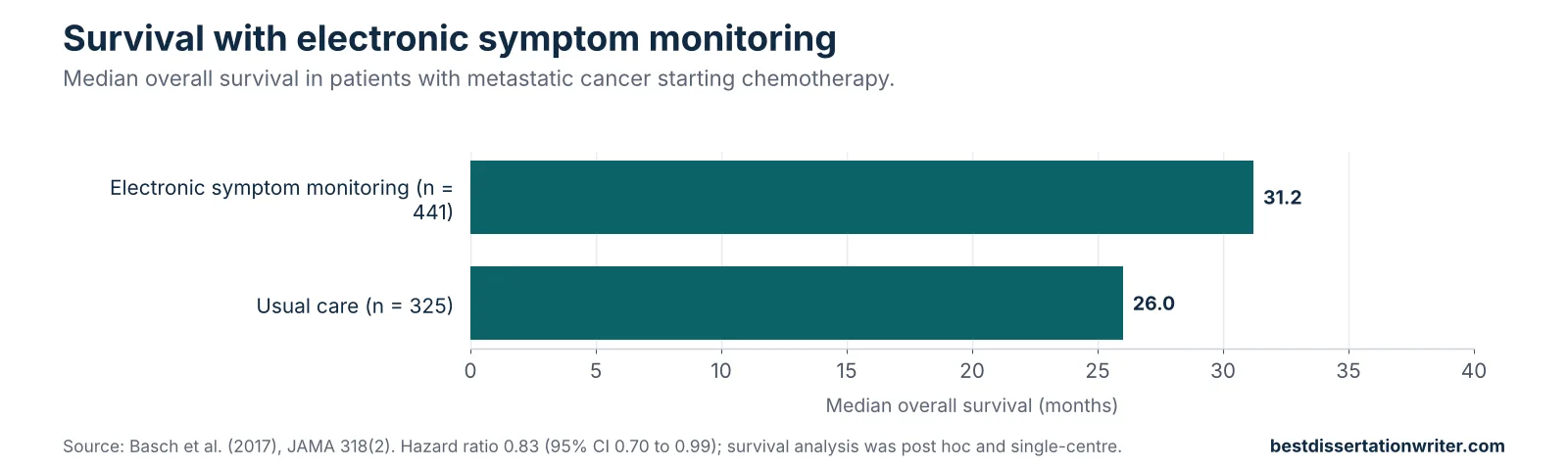
Three themes were identified: the effect of routine use on communication and quality of life, the evidence on survival and use of services, and the barriers and facilitators to implementation. Table 1 summarises the included sources, and Figure 1 shows the median survival in the trial that reported it.
| Author, year | Design | Setting and sample | Key finding |
|---|---|---|---|
| Basch et al. (2017) | Randomised trial (survival analysis) | 766 patients with metastatic cancer | Median overall survival 31.2 months with monitoring vs 26.0 months with usual care. |
| Gibbons et al. (2021) | Cochrane review | 116 trials; 49,785 participants | Small improvement in quality of life; moderate improvement in communication. |
| Kotronoulas et al. (2014) | Systematic review of controlled trials | 26 articles; 24 trials | Routine use increased discussion of patient outcomes; few significant results. |
| Laitio et al. (2023) | Systematic mapping study | 17 papers | Lack of record integration a barrier; improved communication a facilitator. |
| Lizán et al. (2021) | Systematic review | Studies of symptom monitoring | Links to survival, fewer admissions and cost-effectiveness; mixed quality of life. |
Theme 1: Effects on Communication and Quality of Life
Kotronoulas et al. (2014) carried out a systematic review of controlled trials of the routine use of PROMs in cancer care, including 26 articles that reported on 24 unique trials. The trials differed widely in design, intervention, outcomes and clinical context, and health service outcomes were rarely used as endpoints. Few results were statistically significant, and effect sizes were mostly small to moderate. However, the review concluded that routine use of patient-reported outcome measures increases the frequency of discussion of patient outcomes during consultations, and some studies linked it to better symptom control, more supportive care and higher patient satisfaction.
The Cochrane review by Gibbons et al. (2021) covers a wider field. It included 116 randomised trials with 49,785 participants across disciplines including psychiatry, primary care and oncology, with databases searched in October 2020. Feeding back questionnaire responses probably produces a small improvement in quality of life (standardised mean difference 0.15, 95% confidence interval 0.05 to 0.26; 11 studies, 2,687 participants) and probably improves communication between patients and providers to a moderate degree (0.36, 0.21 to 0.52; 5 studies, 658 participants). Both findings were of moderate certainty.
Effects on individual symptoms were less clear. The Cochrane review found that feedback probably makes little or no difference to pain, and that effects on fatigue, physical functioning and mental functioning were uncertain because certainty was very low. Many trials were at risk of performance and detection bias, and there were few trials for each outcome. The authors noted that it is unclear whether the gains are clinically meaningful or sustainable.
Theme 2: Survival and Use of Services
The strongest claim for symptom monitoring comes from a trial at Memorial Sloan Kettering Cancer Center. Basch et al. (2017) reported an overall survival analysis for 766 patients with metastatic solid tumours who began routine chemotherapy between 2007 and 2011, of whom 441 were assigned to electronic patient-reported symptom monitoring and 325 to usual care. Median overall survival was 31.2 months (95% confidence interval 24.5 to 39.6) in the monitoring group and 26.0 months (22.1 to 30.9) in the usual care group, a difference of 5 months. The hazard ratio was 0.83 (0.70 to 0.99) in the multivariable model.
The authors suggested that earlier responses to symptoms and longer tolerance of chemotherapy may explain the finding, and that electronic symptom monitoring may be considered for implementation as part of high-quality cancer care. They also acknowledged limitations: the trial was conducted at a single centre, and the survival analysis was not prespecified. The result is therefore promising but needs confirmation.
Lizán et al. (2021) reviewed the added value of patient-reported symptom monitoring in cancer care. Their evidence table brings together studies reporting that monitoring was linked to longer survival in a retrospective cohort and in two randomised trials, and that a nurse-led protocolised approach reduced fatigue. Several studies reported fewer emergency visits or hospitalisations and high patient satisfaction, and two economic evaluations judged monitoring cost-effective. Results for quality of life were mixed, with some studies reporting improvements and one finding no effect. The authors’ summary pointed to heterogeneity across outcomes, so the pattern is encouraging rather than conclusive.
Theme 3: Barriers and Facilitators to Implementation
Laitio et al. (2023) carried out a systematic mapping study of health care professionals’ perspectives on electronic patient-reported outcome systems in cancer care. Searching three databases in August and September 2021, they imported 152 papers and included 17 published between 2010 and 2021. A thematic meta-synthesis produced seven themes in three categories: work environment, value to users and suggested features.
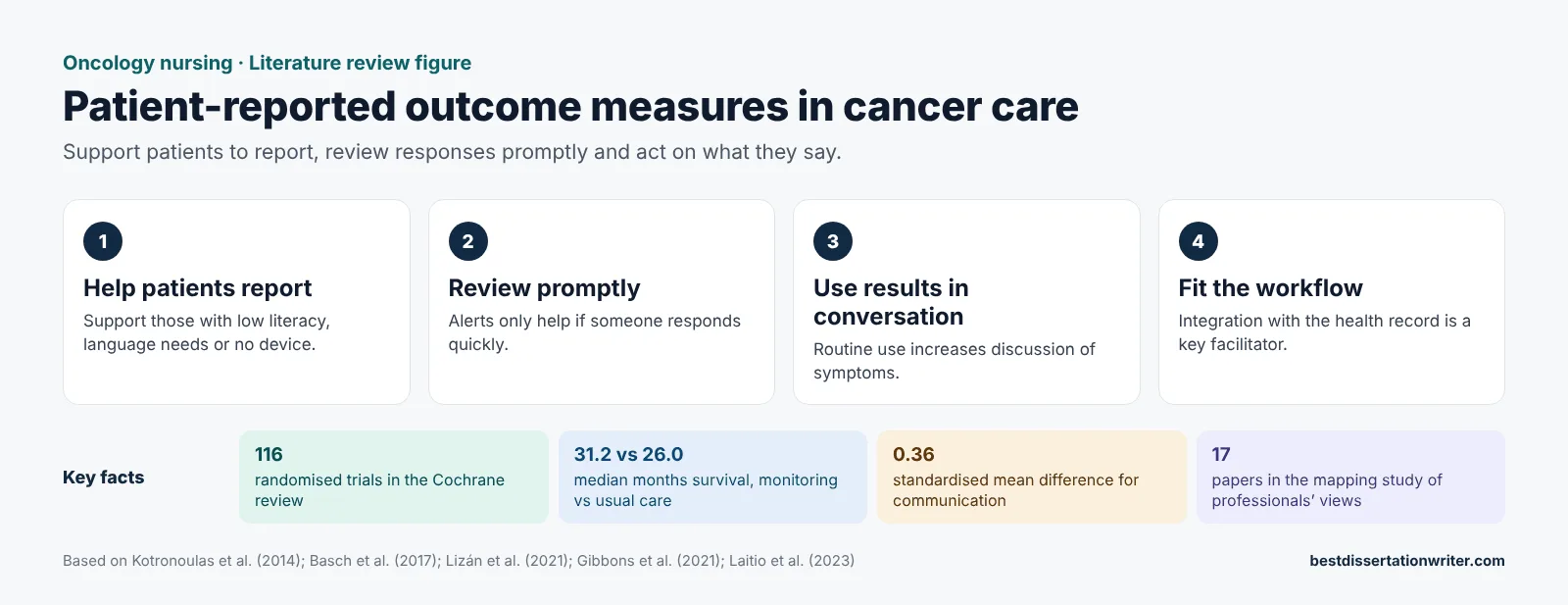
Lack of integration with the electronic health record was a barrier in seven papers, and the authors concluded that electronic systems should be interoperable with hospital records. Professionals reported that the systems improved communication and the efficiency of consultations, although some papers reported that they lengthened visits. Barriers for patients included literacy, language and limited access at home, and barriers for staff included limited technical support, uncertainty about which questionnaire to choose and difficulty interpreting the displays. Graphs were preferred to tables.
Kotronoulas et al. (2014) reached related conclusions much earlier. They noted that patient adherence needs more effort, that clinicians need support in responding to the concerns that patients report, and that clear system guidelines are needed. Taken with the later mapping study, the evidence suggests that the technology matters less than the workflow around it: who reviews the data, how quickly, and what they are expected to do about it.
Taken together, the three themes suggest that the value of patient-reported outcome measures depends on what happens after the form is completed. The trials with the clearest benefits paired the questionnaire with a response, such as a nurse reviewing an alert and contacting the patient, whereas studies in which the information was simply collected tended to show smaller effects. The evidence reviewed here does not allow this explanation to be tested directly, so it should be treated as a reasonable interpretation rather than a proven mechanism.
The sources also differ in what they count as an outcome. Some report scores on questionnaires, some report survival, and some report the use of services or cost. Combining these into a single judgement about patient-reported outcome measures is difficult, and readers should look at the outcome that matters most to their own setting, whether that is symptom control, communication, avoidable admissions or the experience of care.
Patients’ own views are underrepresented in the sources reviewed. The mapping study of Laitio et al. concerned the perspectives of health care professionals, and the trials measured the effects on patients rather than asking them about the burden of reporting. Future research should explore how often patients need to be asked, how long questionnaires should be, and how patient-reported outcome measures can be used in ways that patients find meaningful and not repetitive.
Discussion
This review shows a consistent but cautious picture. The routine use of patient-reported outcome measures reliably improves the amount and quality of discussion about symptoms. It probably gives a small improvement in quality of life. A promising trial suggests a survival benefit in metastatic cancer, but that finding has limits, and the broader evidence on symptoms, service use and costs is mixed and often of low certainty.
The findings fit the nursing role, and nurses are central to using patient-reported outcome measures well. Improved communication is a process that nurses influence directly, since they discuss symptoms with patients at nearly every contact. A nurse-led protocol reduced fatigue in one study reported by Lizán et al., which suggests that nursing action on the results, and not the questionnaire alone, may be what produces benefit. Reporting without a response risks frustrating patients and adding to the burden of care.
Implementation is a major challenge. Electronic systems need to fit into the clinical workflow and link to the patient record, staff need time and training to review alerts, and patients need support if they have low literacy, limited English or no reliable device. Services should check that digital monitoring does not widen inequality by favouring patients who are already confident with technology, and should offer paper or telephone alternatives.
There are limitations. The included sources differ widely, the Cochrane review covered all specialties and not only oncology, and the survival finding comes from one centre and was a post hoc analysis. Apart from the trial, the sources are reviews, so some primary studies were not read in full. Most evidence comes from high-income countries. This review relied on openly accessible, English-language sources and was not a complete search of the databases.
Equity deserves particular attention. Patients with lower literacy, limited English, no home internet or an older device may be less able to take part in electronic monitoring, and these are often the people with the greatest need. The mapping study identified these barriers directly. Services can reduce the risk by offering assistance in clinic, telephone reporting and translated questionnaires, and by checking who is and is not completing the forms. Without such checks, an apparently universal system can quietly leave some groups out of the benefit.
Implications of Patient-Reported Outcome Measures Evidence for Practice
For practice, the evidence supports the routine use of patient-reported outcome measures for symptom monitoring, provided there is a clear plan for who reviews the responses and how quickly they are acted on. Nurses can help patients to complete questionnaires, check that alerts reach the right person, and use the results to structure conversations. The same approach can support the identification of body image concerns, described in the review of body image disturbance, and of fertility worries, described in the review of fertility preservation counselling.
Systems that record symptoms can also help services to understand who takes part in other parts of the cancer pathway, such as the screening discussed in the review of cancer screening uptake. National information is available from Macmillan Cancer Support and Cancer Research UK. Managers should invest in training, integration with the electronic record and support for patients who find technology difficult.
Conclusion
This systematic review found that the routine use of patient-reported outcome measures improves communication and may improve quality of life and survival in cancer care, although the evidence is mixed and often of moderate to very low certainty.
Barriers of integration, workflow and digital access remain. By supporting patients to report and by acting promptly on what they say, nurses can turn routine symptom monitoring into a reliable part of care.
References
Basch, E., Deal, A. M., Dueck, A. C., Scher, H. I., Kris, M. G., Hudis, C., & Schrag, D. (2017). Overall survival results of a trial assessing patient-reported outcomes for symptom monitoring during routine cancer treatment. JAMA, 318(2), 197. https://doi.org/10.1001/jama.2017.7156
Gibbons, C., Porter, I., Gonçalves-Bradley, D. C., Stoilov, S., Ricci-Cabello, I., Tsangaris, E., Gangannagaripalli, J., Davey, A., Gibbons, E. J., Kotzeva, A., Evans, J., van der Wees, P. J., Kontopantelis, E., Greenhalgh, J., Bower, P., Alonso, J., & Valderas, J. M. (2021). Routine provision of feedback from patient-reported outcome measurements to healthcare providers and patients in clinical practice. Cochrane Database of Systematic Reviews, 2021(10), Article CD011589. https://doi.org/10.1002/14651858.CD011589.pub2
Kotronoulas, G., Kearney, N., Maguire, R., Harrow, A., Di Domenico, D., Croy, S., & MacGillivray, S. (2014). What is the value of the routine use of patient-reported outcome measures toward improvement of patient outcomes, processes of care, and health service outcomes in cancer care? A systematic review of controlled trials. Journal of Clinical Oncology, 32(14), 1480–1501. https://doi.org/10.1200/JCO.2013.53.5948
Laitio, A. M., Giunti, G., & Halonen, R. (2023). Perceived barriers and facilitators in using patient-reported outcome systems for cancer care: Systematic mapping study. JMIR Cancer, 9, Article e40875. https://doi.org/10.2196/40875
Lizán, L., Pérez-Carbonell, L., & Comellas, M. (2021). Additional value of patient-reported symptom monitoring in cancer care: A systematic review of the literature. Cancers, 13(18), Article 4615. https://doi.org/10.3390/cancers13184615
Cite this example
Best Dissertation Writers (2026) Electronic Patient-Reported Outcome Measures for Symptom Monitoring in Cancer Care: A Systematic Review. Available at: https://bestdissertationwriter.com/patient-reported-outcome-measures/
Best Dissertation Writers
Get expert help with your nursing literature review
Share your topic and deadline with Best Dissertation Writers and get support tailored to your module brief.