
Phenomenology Example in Nursing: Nurses’ Experience of Caring for COVID-19 Patients
 By Dr. Robertson Prime, Research Fellow
Updated October 12, 2026
14 min read
On this page
This phenomenology example in nursing is based on a published study by Jang, Yang and Shin (2022) in the International Journal of Environmental Research and Public Health. The researchers wanted to understand what it meant for nurses to care directly for patients with COVID-19 during the third wave of the pandemic in South Korea. That is a question about lived experience, so a descriptive phenomenological design was chosen.
This phenomenology example walks through the study in the order a dissertation would: the question, the reasons for the design, how participants were chosen, how interviews were run, how Colaizzi’s seven steps were applied, what was found and how rigour was demonstrated. It ends with guidance on using the same design in your own nursing dissertation.
A Phenomenological Study of Nurses’ Experience in Caring for COVID-19 Patients
Jang, H.-Y., Yang, J.-E. and Shin, Y.-S. (2022). International Journal of Environmental Research and Public Health, 19(5), 2924. doi.org/10.3390/ijerph19052924
This phenomenology example at a glance
- Aim
- To understand and describe the experiences of nurses who cared for patients with COVID-19
- Design
- Descriptive phenomenology grounded in Husserl’s philosophy, analysed with Colaizzi’s method; reported using COREQ
- Setting
- A government-designated COVID-19 infectious disease hospital in Seoul and Gyeonggi Province, South Korea
- Data collection
- 20 October 2020 to 15 January 2021, during the third wave
- Participants
- 14 nurses who had given direct care in an isolation ward for at least one month
- Sampling
- Purposive (12 nurses) and snowball (2 nurses)
- Interviews
- Individual in-depth interviews, online or face to face, about 60 to 120 minutes
- Analysis
- Colaizzi’s seven steps, by two researchers with doctoral degrees
The research question in this phenomenology example
What is the meaning and essence of the care experience of nurses who directly cared for COVID-19 patients?
Why it suits phenomenology: it asks for meaning and essence, it focuses on people who lived the experience, and it does not ask how often, how much or what predicts.
In this phenomenology example, notice the two key words, “meaning” and “essence”. They signal that the answer will be a description of what the experience was like and what was common to everyone who lived it. A survey could have measured anxiety levels or burnout scores, but it could not have captured how the nurses themselves made sense of wearing protective equipment for hours, being avoided by others or watching patients die without family present.
Why descriptive phenomenology was chosen
- A new and intense experience. Caring for patients with a new infectious disease was something few nurses had faced, so there was little existing theory to test.
- The aim was description, not interpretation. The researchers wanted to describe the essential structure of the experience as the nurses lived it, which fits Husserl’s descriptive approach.
- Bracketing was possible and planned. The researchers wrote down their own assumptions before data collection so they could set them aside during analysis.
- Colaizzi’s method gives a clear path. Its seven steps move from participants’ statements to an exhaustive description and a final essential structure that can be checked with participants.
Choosing participants who had lived the experience
Every phenomenology example depends on participants who can describe the phenomenon from the inside. The inclusion and exclusion criteria were written to make sure every nurse interviewed had meaningful, direct experience of caring for patients with COVID-19.
| Include | Exclude |
|---|---|
| Nurses who gave direct care to confirmed or suspected COVID-19 patients in an isolation ward for at least one month | Nurses with less than one month of COVID-19 care |
| Able to communicate and understand the study | Nurses who did not give direct care |
| Gave voluntary written consent | Nurses who had not yet been released from isolation |
Twelve nurses were recruited purposively and two more were introduced by participants (snowball sampling). Recruitment and analysis ran at the same time, and two researchers judged that no new themes were emerging after the fourteenth interview, which is how saturation was decided. A sample of fourteen is typical for phenomenology, where depth of description matters more than numbers.
How the interviews in this phenomenology example were carried out
- One trained interviewerAll interviews were conducted by one trained researcher, which keeps the style of questioning consistent.
- Participant’s choice of formatNurses could choose an online or face-to-face interview. This mattered during the pandemic, when meeting in person carried risks.
- An open opening questionEach interview began with “Tell me about your experience of caring for patients with COVID-19”, leaving the nurse free to start wherever the experience mattered most to them.
- Time for depthInterviews lasted about 60 to 120 minutes, giving room for detailed accounts and follow-up questions.
- Prompt transcriptionRecordings were transcribed verbatim within 24 hours, while the interview was still fresh, so that analysis could begin before the next interview.
Bracketing in this phenomenology example
In a Husserlian phenomenology example such as this, the researcher tries to set aside what they already believe about the phenomenon. In this study, the researcher’s assumptions were written down before the interviews began. During analysis, the researchers could check whether a theme came from the nurses’ words or from their own expectations. For a nursing dissertation, a short reflexive account of your prior beliefs, placed in the methods chapter or an appendix, is the practical equivalent.
Colaizzi’s seven steps as applied in the study
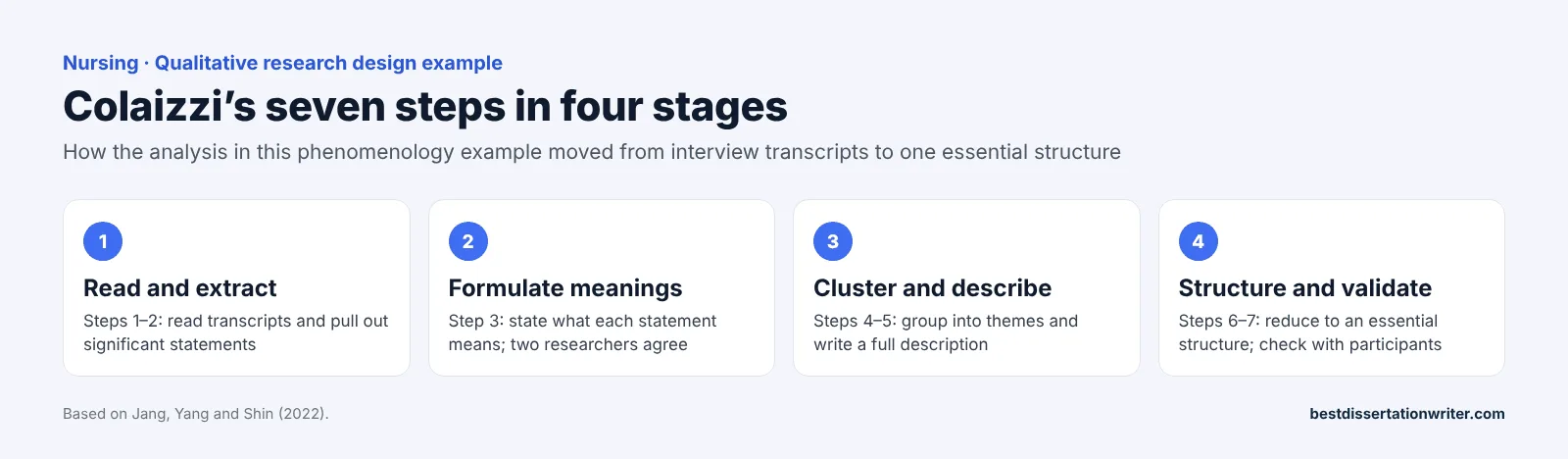
The table below shows each step of Colaizzi’s method alongside what it involved in this phenomenology example. Two researchers analysed the data independently and then discussed their results, which adds a check on each interpretation.
| Step | What it involves | In this study |
|---|---|---|
| 1. Read the transcripts | Read each account several times to get a sense of the whole | Verbatim transcripts of all 14 interviews |
| 2. Extract significant statements | Pull out phrases that relate directly to the experience | Done independently by two researchers |
| 3. Formulate meanings | State what each significant statement means | Meanings discussed until agreed |
| 4. Cluster into themes | Group meanings into themes and theme clusters | 12 themes in 5 theme clusters |
| 5. Exhaustive description | Write a full description of the experience using the themes | Description built from all clusters |
| 6. Essential structure | Reduce the description to its fundamental structure | “Going beyond the double suffering tunnel of taking charge of infected patients into the future” |
| 7. Return to participants | Check that the description matches their experience | Findings checked with two participants |
Findings of the phenomenology example: five clusters, twelve themes
The study reported five theme clusters made up of twelve themes. They are listed below with short summaries in our own words; the original article gives the participants’ quotations behind each theme.
Anxiety and fear accompanying patient care; patients’ dignity ignored because of fear of infection.
The burden of wearing protective equipment for everyone’s safety; work loaded solely on nurses; confusing and uncertain working conditions.
Self-isolation turning anxiety into reality; being seen both as heroes of society and as people to avoid.
Companionship and shared difficulties; support and appreciation from patients and the public; a sense of satisfaction and self-esteem.
Restoring everyday life; preparing for the future.
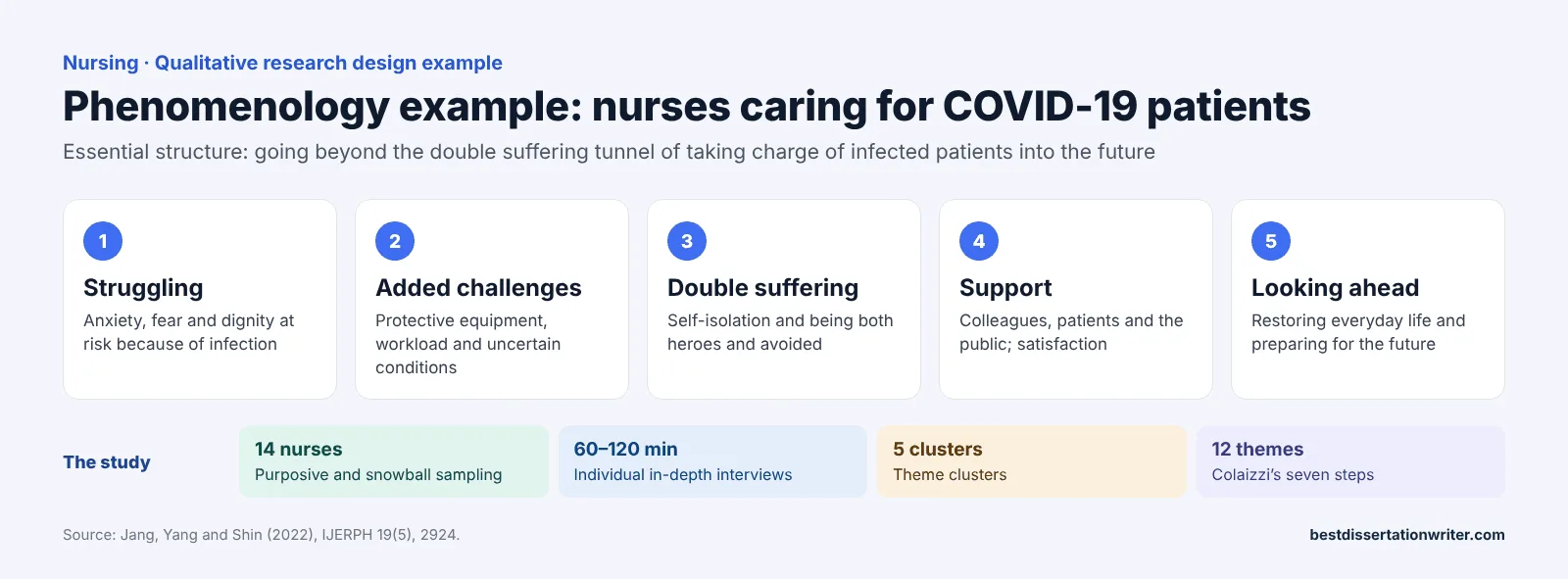
The essential structure, “going beyond the double suffering tunnel of taking charge of infected patients into the future”, draws these clusters together. It describes nurses who carried both the strain of the work and the social burden of being associated with infection, but who also found support and looked ahead to recovery. This is what the finding of a phenomenology example looks like: one integrated description of the experience rather than a list of separate variables.
How rigour was demonstrated in this phenomenology example
The authors used Lincoln and Guba’s criteria and described specific actions for each one. This is a useful model for the trustworthiness section of a dissertation, because each criterion is matched to something the researchers actually did.
| Criterion | What the researchers did |
|---|---|
| Truth value (credibility) | Rich data from long interviews in a comfortable setting; findings checked with two participants |
| Applicability (transferability) | Participant characteristics reported; thick description of the findings |
| Consistency (dependability) | Colaizzi’s method followed step by step; process documented; original quotations used; a second researcher reviewed the analysis |
| Neutrality (confirmability) | Bracketing, with the researcher’s assumptions written down before data collection |
Ethical approval came from the Hanyang University Institutional Review Board. Participants gave written informed consent, could withdraw without any disadvantage and received a small reward for taking part.
Ethics when interviewing about distressing experiences
Phenomenological interviews often ask people to revisit difficult events, and this study interviewed nurses while the pandemic was still under way. Its safeguards, written consent, the right to withdraw without disadvantage and a choice of interview format, are the minimum a dissertation should offer. In your own study, also plan what you will do if a participant becomes distressed: pause or stop the interview, check how they are, and give details of staff support or counselling services. Agree in advance how you will protect anonymity in quotations, especially in small units where colleagues might recognise each other’s stories, and store recordings securely until transcription is checked.
Limitations of this phenomenology example
- Assigned, not volunteer, nurses. Only nurses who had been assigned to COVID-19 care took part, so the experiences of volunteers may differ.
- Online interviews. Some interviews were online, which may have reduced non-verbal cues and depth.
- A vulnerable moment. Nurses were interviewed while facing infection risk, covering for colleagues and coping with protective equipment.
- Before vaccination. Data were collected before vaccines were available, which may explain why negative emotions dominate the findings.
What the findings meant for practice
The authors drew several practical implications. They suggested developing and testing mental health recovery programmes for nurses, improving working environments through practice environment management and incentives, setting clear protocols and standard operating procedures for future outbreaks, monitoring the use of protective equipment and the length of shifts, and finding ways to balance infection control with dignified death, for example by allowing family members in protective clothing to take part in end-of-life care. They also cautioned against social expectations that nurses should sacrifice themselves.
These implications come directly from the themes. That link between lived experience and practical recommendation is what makes this phenomenology example, and any phenomenological dissertation, useful to practice, rather than only descriptive.
Using this phenomenology example in your own dissertation
The design in this phenomenology example can be used for many nursing topics where the experience itself is the focus. The examples below keep the same structure as the published study.
| Topic | Phenomenological research question | Who to interview |
|---|---|---|
| Night shift work | What is the lived experience of newly qualified nurses working permanent night shifts? | Nurses in their first two years working nights |
| Moral distress | What does it mean for intensive care nurses to care for patients when treatment is withdrawn? | ICU nurses involved in withdrawal of treatment |
| Student placements | How do student nurses experience their first death of a patient on placement? | Students who have been present at a patient’s death |
| Long-term conditions | What is the lived experience of adults managing a new stoma at home? | Adults within a year of stoma formation |
“A descriptive phenomenological design informed by Husserl was used, because the study aimed to describe the essence of nurses’ experience. Participants were recruited purposively and had direct experience of the phenomenon for at least one month. Individual in-depth interviews began with an open question and were transcribed verbatim. Data were analysed using Colaizzi’s seven-step method, and the researcher’s prior assumptions were recorded before data collection to support bracketing. Trustworthiness was addressed using Lincoln and Guba’s criteria.”
Questions an examiner might ask, and how this study answers them
A useful way to test any phenomenology example in nursing is to ask the questions an examiner would ask in a viva or marking meeting. The answers below come from what the published study reports.
- Why phenomenology and not a survey?
- The question asked for the meaning and essence of an experience, which a questionnaire cannot capture.
- Why only 14 nurses?
- Depth matters more than numbers; two researchers judged that no new themes emerged after the fourteenth interview.
- How were your own views kept out?
- The researcher’s assumptions were written down before data collection (bracketing), and a second researcher reviewed the analysis.
- How do we know the themes are accurate?
- Findings were returned to two participants in the final step of Colaizzi’s method, and original quotations support each theme.
- Can the findings be generalised?
- Not statistically. Transferability is supported by reporting participant characteristics and a thick description so readers can judge fit with their own setting.
- What would you do differently?
- The authors suggest including volunteer nurses and vaccinated staff in future studies.
Writing up phenomenological findings
The way this phenomenology example presents its findings is a good model for a dissertation findings chapter. It works from the largest unit to the smallest: first the essential structure, then the five theme clusters, then the twelve themes within them, each illustrated with participants’ own words. This order lets the reader see the whole experience before the detail.
In your own write-up, give each theme a short heading that reflects the participants’ language, follow it with a paragraph explaining what the theme captures, and support it with two or three short quotations attributed to participant codes rather than names. Keep interpretation for the discussion chapter, where the themes can be compared with earlier research. Avoid counting how many participants mentioned something; in phenomenology the aim is to describe a shared structure, not to measure frequency.
Planning your own phenomenological study: a checklist
- Name the phenomenon precisely“Caring for COVID-19 patients in an isolation ward” is clearer than “working in the pandemic”.
- Choose your phenomenological traditionDecide between descriptive (Husserl, often with Colaizzi or Giorgi) and interpretive (Heidegger, often with interpretative phenomenological analysis), and keep your analysis consistent with that choice.
- Set inclusion criteria around the experienceSpecify how much and what kind of experience participants must have, as this study did with its one-month rule.
- Write one open opening questionPrepare a few gentle prompts, but let participants lead.
- Record your assumptionsWrite a short reflexive statement before the first interview and revisit it during analysis.
- Analyse as you goTranscribe promptly and analyse alongside data collection so you can judge when no new themes are appearing.
- Plan the return to participantsAsk at consent whether participants are willing to review the findings.
How to describe this phenomenology example in your literature review
“Using descriptive phenomenology and Colaizzi’s method, Jang, Yang and Shin (2022) interviewed 14 nurses who had cared for COVID-19 patients in a designated infectious disease hospital in South Korea. The essential structure of their experience was described as going beyond a ‘double suffering tunnel’: nurses carried the physical and emotional burden of care while also being avoided by others, yet found support from colleagues and patients. The study was conducted before vaccination and included only nurses assigned to COVID-19 care, which may limit transferability.”
Related examples and reviews
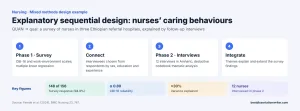
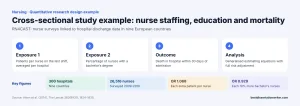
Nurses’ wellbeing under pressure is a theme across our library. Our literature review on burnout and staff wellbeing summarises the wider evidence, and the review on hospital-acquired infections covers the infection-control side of the same work. To see how experience data can be combined with survey data, read the explanatory sequential design example, and for a large quantitative study of the nursing workforce see the cross-sectional study example.
Common mistakes this phenomenology example avoids
- A question that is not about experience. The question asks for meaning and essence, not frequency or causes.
- Participants without the experience. The one-month inclusion criterion ensured every nurse had lived the phenomenon.
- Naming a method without showing it. Each of Colaizzi’s steps can be traced in the study, including the return to participants.
- Vague rigour statements. Each trustworthiness criterion is linked to a concrete action.
- Themes without a structure. The findings end in one essential structure, which is the distinctive result of descriptive phenomenology.
Use this phenomenology example in nursing as a checklist when you plan your own study: every element below can be traced in the published article.
- Phrase the question around meaning or experience.
- Set inclusion criteria that guarantee participants have lived the phenomenon.
- Start interviews with one open question and allow time for depth.
- Show every step of your chosen analytic method in a table.
- Link each trustworthiness criterion to something you actually did.
This phenomenology example summarises a published study in our own words to show how phenomenology is used in practice. Read the original open-access article for participant details, quotations and the full discussion.
References
- Tong, A., Sainsbury, P. and Craig, J. (2007) Consolidated criteria for reporting qualitative research (COREQ): a 32-item checklist for interviews and focus groups. International Journal for Quality in Health Care, 19(6), pp. 349–357. https://doi.org/10.1093/intqhc/mzm042
- Jang, H.-Y., Yang, J.-E. and Shin, Y.-S. (2022) A phenomenological study of nurses’ experience in caring for COVID-19 patients. International Journal of Environmental Research and Public Health, 19(5), 2924. https://doi.org/10.3390/ijerph19052924
Cite this example
Best Dissertation Writers (2026) Phenomenology Example in Nursing: Nurses’ Experience of Caring for COVID-19 Patients. Available at: https://bestdissertationwriter.com/phenomenology-example-nursing-covid-19-care/
Best Dissertation Writers
Need a Phenomenology example for your own project?
Share your topic and deadline with Best Dissertation Writers and get expert support tailored to your brief.