
PICO Example in Nursing: Preventing Delirium After Hip Fracture Surgery
 By Dr. Robertson Prime, Research Fellow
Updated October 12, 2026
14 min read
On this page
This PICO example in nursing follows one clinical question all the way from a ward observation to a searchable, answerable question and a plan for reviewing the evidence. The topic is delirium in older adults after hip fracture surgery: a common, distressing and costly complication that ward nurses are well placed to notice, prevent and measure.
This PICO example is written the way a student or staff nurse would actually work: starting with a messy problem, drafting a question that is too vague, and tightening it element by element until every word can be searched and every outcome can be measured. Each decision is explained so that you can repeat the same reasoning for your own topic.
On a 28-bed orthopaedic trauma ward, nurses notice that many patients aged over 65 become acutely confused in the first days after surgery for a fractured hip. Some pull out cannulas and catheters, some try to climb out of bed at night, and several stop eating and drinking well. Confused patients are slower to mobilise and tend to stay in hospital longer, and families often ask whether the confusion will last.
At a team meeting the ward manager asks a staff nurse to find out whether a structured, nurse-led prevention programme would make a difference before the team changes its routine. The nurse is also completing a top-up degree and decides to use the same question for a literature-based dissertation.
How the PICO example starts: from ward concern to draft question
The nurse’s first attempt was written quickly after the meeting: “Can nurses stop patients getting confused after hip operations?” It captures the concern, but it cannot guide a search. It does not say which patients, what nurses would actually do, what the alternative is, or how confusion would be measured. “Confused” also mixes up delirium, which is acute and often preventable, with dementia, which is long-standing.
Working through the elements of the PICO example one at a time turned the concern into a question that a database can answer. The table below shows how the wording changed over three drafts.
| Draft | Wording | What was still missing |
|---|---|---|
| 1 | Can nurses stop patients getting confused after hip operations? | No defined population, intervention, comparison or measurable outcome |
| 2 | Do delirium prevention measures reduce delirium in older hip fracture patients? | “Measures” is vague; no comparison; who delivers the care is unclear |
| 3 | In adults aged 65 and over having surgery for a hip fracture, does a nurse-led multicomponent delirium prevention programme, compared with usual postoperative nursing care, reduce the incidence of postoperative delirium? | Complete: every element is named and measurable |
The four elements of this PICO example
In this PICO example, each element is written for one ward and one patient group so that the question can be searched now and measured later. Vague elements such as “elderly patients” or “better care” would return thousands of irrelevant studies and would make screening impossible.
P: why “adults aged 65 and over having surgery for a hip fracture”
The nurse considered simply writing “older patients”, but databases and trials define age in years, so a cut-off makes screening consistent. Sixty-five was chosen because it matches the ward’s own admission profile and is a common threshold in hip fracture research. “Having surgery for a hip fracture” excludes planned hip replacements, whose patients are usually fitter and have their operation on a planned list, so their delirium risk differs. The nurse decided to include people with dementia, because they are a large part of the ward’s population and are at higher risk; excluding them would make any answer less useful in practice.
I: why “nurse-led multicomponent programme”
Delirium rarely has a single cause, so single actions such as a sleep leaflet are unlikely to be enough. The intervention element therefore names a bundle of actions and, importantly, who leads it. This matters because the ward manager’s decision is about nursing practice. A programme led by a geriatrician or a pharmacist may work, but it would need different staff and funding. Writing “nurse-led” keeps the question tied to what the team can actually change.
C: why “usual postoperative nursing care”
A comparison is sometimes left out of PICO questions, but here it does real work. No patient receives “no care”, so the honest comparison is the care the ward already gives. Stating it reminds the reader that any benefit found is the extra benefit of the programme. When the nurse later extracts data, she will record what “usual care” meant in each study, because it can differ a great deal between hospitals and countries.
O: why “incidence of postoperative delirium”
The outcome is the proportion of patients who develop delirium after surgery, measured with a validated tool rather than taken from notes. Delirium is easily missed, especially the quiet, hypoactive form, so studies that relied on case-note recording are likely to under-count it. Secondary outcomes, such as severity of delirium, length of stay, falls and discharge destination, are recorded but do not drive the search.
The finished question in this PICO example
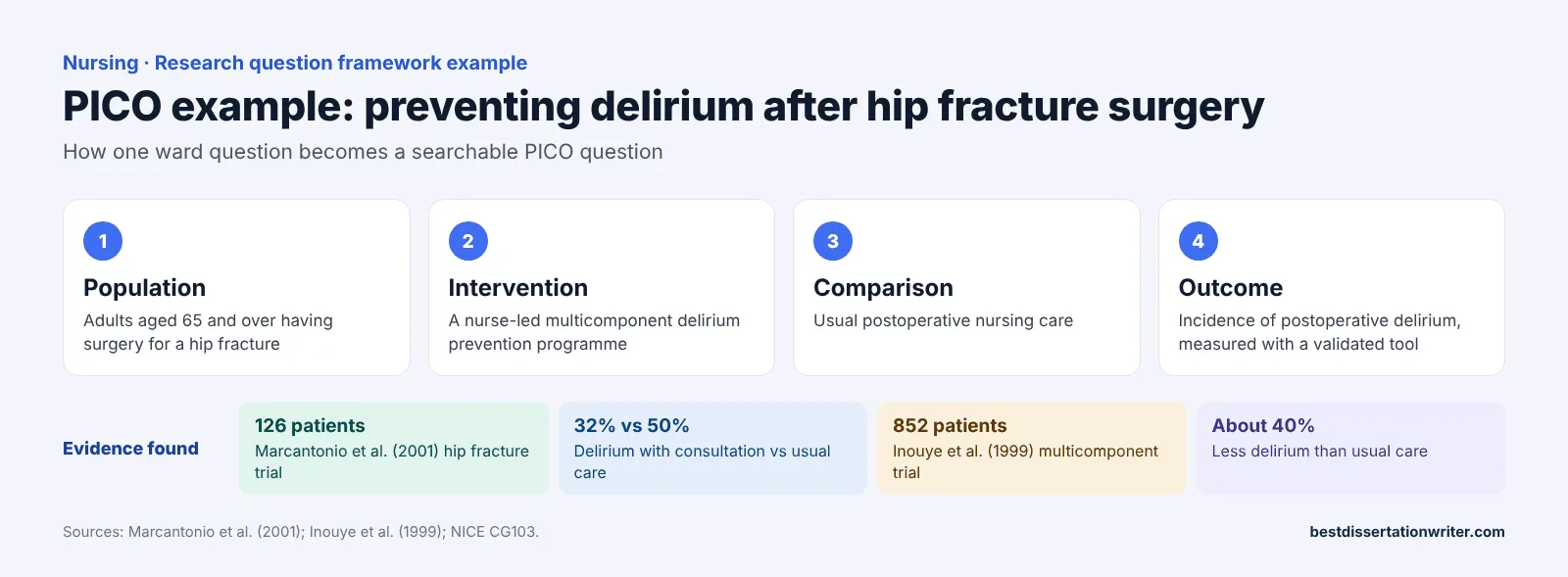
In adults aged 65 and over having surgery for a hip fracture (P), does a nurse-led multicomponent delirium prevention programme (I), compared with usual postoperative nursing care (C), reduce the incidence of postoperative delirium (O)?
Question type: intervention (effectiveness). Best evidence to look for: randomised controlled trials and systematic reviews of trials, supported by controlled before-and-after studies if trials are scarce.
Turning the PICO example into PICOT
If the ward wants a fixed follow-up period, a time element can be added: “…reduce the incidence of postoperative delirium within the first five days after surgery (T)?” Five days was chosen because most hip fracture patients on this ward are transferred to rehabilitation soon afterwards, so later outcomes would be hard to compare. Adding T narrows the evidence, so the nurse kept the PICO version for the search and used the time point as a data-extraction field.
Turning the PICO into search terms
In this PICO example, the four elements become the concept groups of the search. Synonyms within a group are joined with OR, and the groups are joined with AND. The comparison is usually left out of the search, because “usual care” is rarely described in titles and abstracts, and searching for it would wrongly exclude relevant trials.
| Element | Main term | Synonyms and related terms |
|---|---|---|
| P | Hip fracture | hip fracture*, femoral neck fracture*, proximal femoral fracture*, intertrochanteric fracture*, hip surgery; aged, older adult*, elderly, geriatric |
| I | Delirium prevention | prevent*, multicomponent, multi-component, nurse-led, nurse led, non-pharmacological, intervention program*, care bundle* |
| O | Delirium | delirium, acute confusion*, postoperative confusion, postoperative cognitive |
Free-text words catch recent articles that have not yet been indexed, while subject headings catch articles that use unexpected wording. A good search uses both. The headings below exist in both MEDLINE (MeSH) and CINAHL, although the exact tree structure differs between the two databases.
| Concept | MEDLINE (MeSH) | CINAHL Headings |
|---|---|---|
| Population | Hip Fractures; Aged | Hip Fractures; Aged |
| Outcome | Delirium | Delirium |
| Intervention | No exact heading: rely on free text such as prevent*, multicomponent and nurse-led | No exact heading: rely on free text |
("hip fracture*" OR "femoral neck fracture*" OR "proximal femoral fracture*" OR "intertrochanteric fracture*" OR "hip surgery")
AND (aged OR elderly OR "older adult*" OR geriatric)
AND (delirium OR "acute confusion*" OR "postoperative confusion")
AND (prevent* OR multicomponent OR "multi-component" OR "nurse-led" OR "non-pharmacological" OR "care bundle*")
Run in CINAHL, MEDLINE, Embase and the Cochrane Library, then combine with subject headings (for example MeSH “Delirium” and “Hip Fractures”).
Choosing databases and limits
For this PICO example, CINAHL is essential for a nurse-led intervention, because nursing trials and quality improvement reports are well indexed there. MEDLINE and Embase capture the medical and geriatric literature where most hip fracture trials are published, and the Cochrane Library identifies existing systematic reviews and trials. The nurse limited results to English because she could not translate other languages, and recorded this as a limitation. She did not apply a date limit at first, because a landmark trial from 2001 is directly relevant; instead she sorted by date during screening.
Every search was saved in a search log with the database, date, exact string and number of results. This log later becomes an appendix and allows the PRISMA flow diagram to be completed accurately.
Testing the search before running it in full
Before running the final search, the nurse tested the PICO example search against two articles she already knew to be relevant, including the Marcantonio trial. If a known relevant article is not retrieved, a synonym or subject heading is missing. She also looked at the first fifty results: if most were about elective joint replacement or dementia care, the population terms needed tightening. Small adjustments at this stage save many hours of screening later.
Inclusion and exclusion criteria from the PICO
This PICO example reuses the same elements as eligibility criteria, which is one of the main advantages of a well-built PICO question: the screening decisions follow directly from the question rather than being invented later.
| Element | Include | Exclude |
|---|---|---|
| Population | Patients aged 65+ having surgery for hip fracture, with or without dementia | Elective hip replacement; patients with delirium before surgery; mixed surgical samples where hip fracture data cannot be separated |
| Intervention | Multicomponent, non-drug prevention delivered or led by nurses | Single-component or drug-only interventions |
| Comparison | Usual care | No comparison group |
| Outcome | Delirium measured with a validated tool | Delirium recorded only from case notes |
| Study design | Randomised and controlled trials; controlled before-and-after studies; systematic reviews | Case reports, editorials, opinion pieces |
Screening, appraisal and data extraction plan
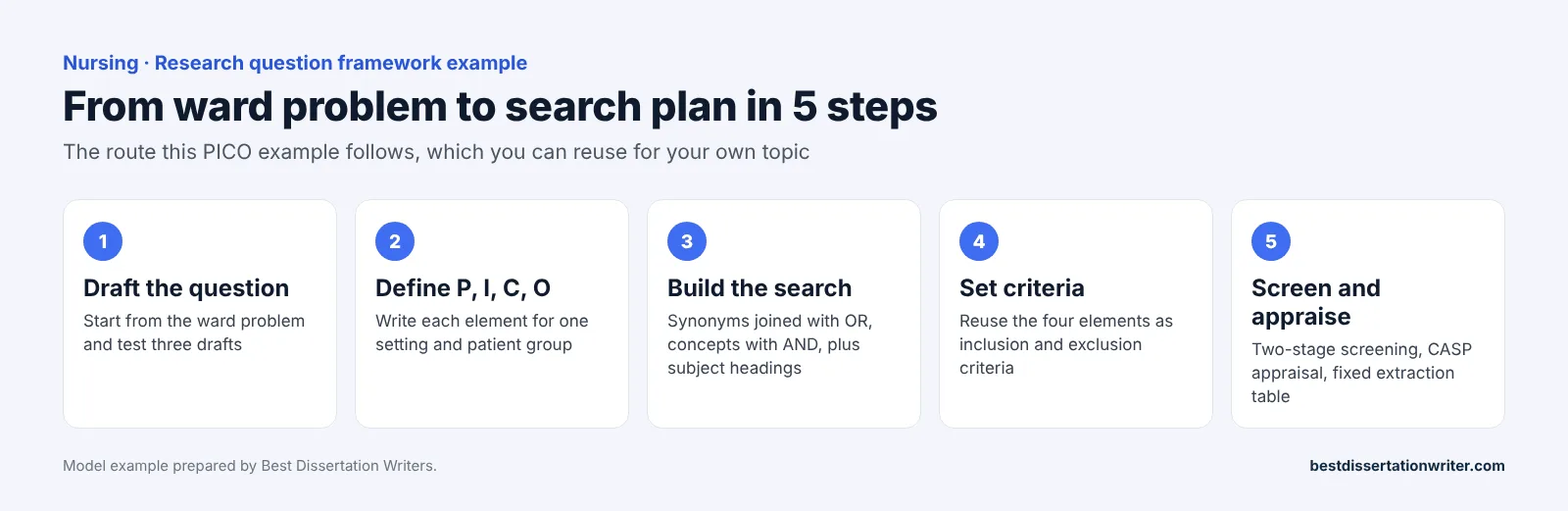
The question in this PICO example also shapes how the evidence will be handled after the search. The plan below is the one written into the dissertation methodology chapter.
- Remove duplicatesExport all results to a reference manager and remove duplicate records before screening.
- Screen titles and abstractsCheck each record against the five criteria above. Where the abstract is unclear, keep the record for full-text review.
- Screen full textsRead the full article and record one main reason for each exclusion, for example “intervention led by geriatrician” or “delirium not measured with a validated tool”.
- Appraise qualityUse the CASP randomised controlled trial checklist for trials and the CASP systematic review checklist for reviews, so that every study is judged on the same questions.
- Extract dataUse one table with fixed columns: author and year, country and setting, sample size, intervention components, who delivered it, usual-care description, delirium tool, follow-up period, and delirium incidence in each group.
- SynthesiseIf studies are similar enough, compare incidence across groups; if they are not, describe the pattern of findings narratively, organised by intervention component.
What the first search for this PICO example finds
A first search quickly finds a landmark trial by Marcantonio and colleagues (2001). In 126 patients having emergency surgery for hip fracture, proactive geriatrics consultation reduced delirium from 50% with usual care to 32%. The trial supports the outcome chosen in this PICO, but its intervention was led by a geriatrician rather than by nurses.
The search also finds the Hospital Elder Life Program trial by Inouye and colleagues (1999). In 852 hospitalised patients aged 70 and over, an intervention targeting six risk factors (cognitive impairment, sleep deprivation, immobility, vision loss, hearing impairment and dehydration) was associated with substantially less delirium than usual care, roughly 40% less. It shows that the components chosen for this PICO are well established, but it was delivered by an interdisciplinary team with trained volunteers, and the population was general hospital patients rather than people having hip fracture surgery.
This is exactly where a precise PICO example pays off. Because the population and intervention elements are specific, the nurse can see straight away that both studies answer neighbouring questions. She keeps them as background evidence in the introduction and, if few nurse-led trials in hip fracture patients exist, she can justify widening one element at a time, for example to “multidisciplinary” programmes, and record why. National guidance on delirium from NICE also recommends a tailored multicomponent prevention package for people at risk, which supports the intervention chosen here.
Weak and strong versions of the PICO example
Does nursing care help confused patients after hip operations?
No age group, no defined intervention, no comparison and no measurable outcome. “Confused” also mixes dementia with delirium.
In adults aged 65+ having hip fracture surgery, does a nurse-led multicomponent prevention programme, compared with usual care, reduce postoperative delirium?
Every PICO element is named, so the question can be searched, screened and measured.
How this PICO example shapes the dissertation
Once the question in this PICO example is fixed, much of the dissertation structure follows from it. The aim restates the question, the objectives break it into tasks, and the methodology chapter explains how each element was searched and screened.
- Aim
- To evaluate the evidence on whether nurse-led multicomponent programmes reduce postoperative delirium in adults aged 65 and over having hip fracture surgery.
- Objective 1
- To identify trials and controlled studies of nurse-led delirium prevention in this population.
- Objective 2
- To appraise the quality of the included studies using CASP checklists.
- Objective 3
- To compare delirium incidence between intervention and usual-care groups and identify which components were most often used.
- Objective 4
- To make recommendations for delirium prevention on orthopaedic trauma wards.
“The review question was developed using the PICO framework. The population was adults aged 65 years and over undergoing surgery for hip fracture; the intervention was a nurse-led multicomponent delirium prevention programme; the comparison was usual postoperative nursing care; and the outcome was the incidence of postoperative delirium measured with a validated tool. Each element formed a concept group in the search strategy, and the same elements defined the inclusion and exclusion criteria.”
Related examples and reviews
The same ward could ask other kinds of question about delirium and safety. A survey of staffing and omitted care would need a correlational research question, and large workforce studies use a cross-sectional design. For finished reviews on closely related topics, see our literature reviews on preventing falls and enhanced recovery pathways, both of which draw on the same kind of focused question.
Common mistakes this PICO example avoids
- Searching the comparison. In a PICO example like this one, adding “usual care” to the search string would have excluded trials that never use that phrase in the abstract.
- Using one word for two conditions. Writing “delirium” rather than “confusion” separates an acute, preventable problem from dementia.
- Leaving the intervention vague. Naming the components and who leads them makes screening decisions clear and repeatable.
- Measuring the outcome loosely. Requiring a validated tool avoids comparing studies that simply recorded “confusion” in notes.
- Changing the question after reading results. Any widening of an element is made deliberately, one element at a time, and recorded with a reason.
Use this PICO example in nursing as a template: replace the population, intervention, comparison and outcome with your own, and follow the same steps from draft question to search plan.
- Start from a real practice problem and write each element for that setting.
- Draft, test and refine the question; keep a record of each version.
- Turn each element into a concept group of free-text terms and subject headings.
- Reuse the same elements as your inclusion and exclusion criteria and extraction fields.
- If the first results show a gap, adjust one element and record why.
Model example. This PICO example and its ward scenario were written by our team to show how PICO is applied. The studies and guidance cited are real and are listed below.
References
- Inouye, S.K., Bogardus, S.T., Charpentier, P.A., Leo-Summers, L., Acampora, D., Holford, T.R. and Cooney, L.M. (1999) A multicomponent intervention to prevent delirium in hospitalized older patients. New England Journal of Medicine, 340(9), pp. 669–676.
- Marcantonio, E.R., Flacker, J.M., Wright, R.J. and Resnick, N.M. (2001) Reducing delirium after hip fracture: a randomized trial. Journal of the American Geriatrics Society, 49(5), pp. 516–522.
- National Institute for Health and Care Excellence (2010, updated 2023) Delirium: prevention, diagnosis and management in hospital and long-term care (CG103). London: NICE. https://www.nice.org.uk/guidance/cg103
Cite this example
Best Dissertation Writers (2026) PICO Example in Nursing: Preventing Delirium After Hip Fracture Surgery. Available at: https://bestdissertationwriter.com/pico-example-nursing-hip-surgery/
Best Dissertation Writers
Need a PICO example for your own project?
Share your topic and deadline with Best Dissertation Writers and get expert support tailored to your brief.