The Impact of Enhanced Recovery Pathways on Post-Operative Outcomes in Adult Surgical Patients: A Review of Nursing Evidence
 By Dr. Robertson Prime, Research Fellow
Updated October 12, 2026
15 min read
About 2,900 words
By Dr. Robertson Prime, Research Fellow
Updated October 12, 2026
15 min read
About 2,900 words
In this review
Abstract
Background: Enhanced recovery pathways, often known as ERAS, bring together evidence-based measures delivered before, during and after surgery to reduce its physiological impact and support an early return to normal function. Many of these measures, including preoperative education, early mobilisation and early eating and drinking, depend on nurses.
Aim: This systematic review aimed to examine the impact of enhanced recovery on post-operative outcomes in adult surgical patients and the nursing contribution to its success.
Methods: Evidence was identified through targeted searches of openly accessible bibliographic records, publisher websites and the reference lists of key reviews. Six sources published between 2014 and 2019 were included: one meta-analysis of randomised controlled trials, one international registry study, one international guideline, one narrative review and two qualitative systematic reviews, appraised with CASP checklists and synthesised narratively into themes.
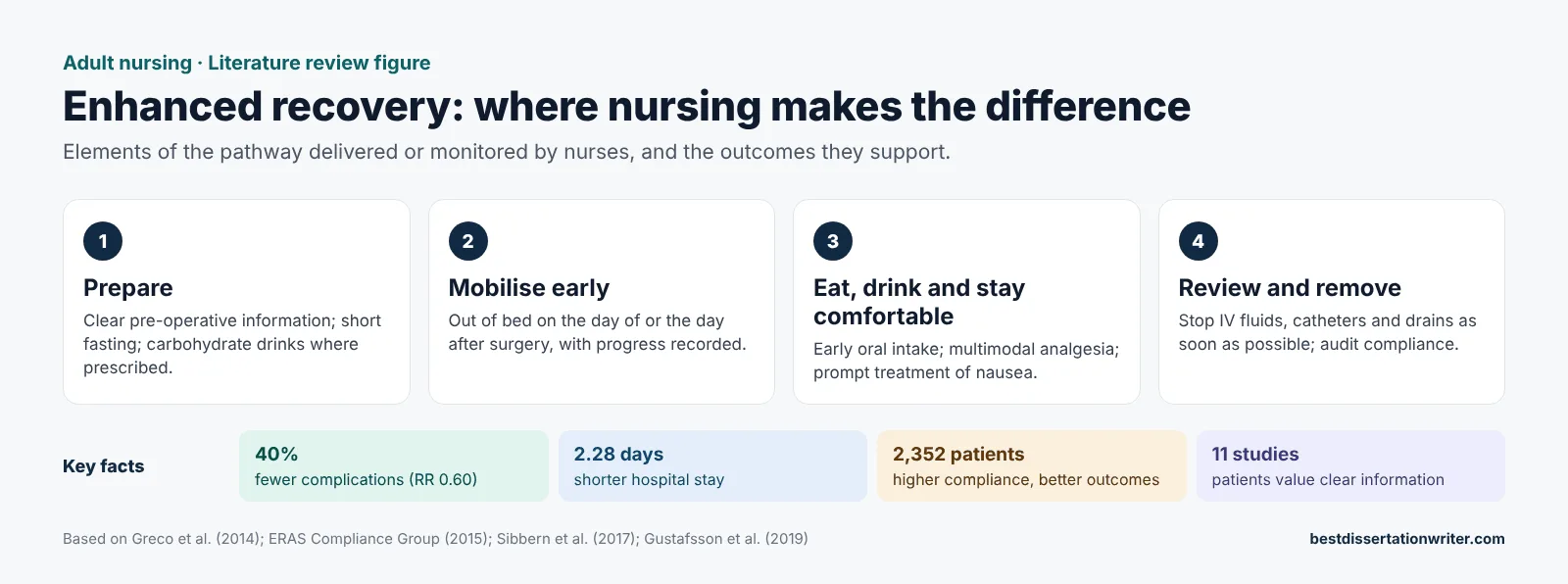
Findings: In colorectal surgery, a meta-analysis of 16 randomised trials found that enhanced recovery reduced overall complications by around 40% and length of stay by an average of 2.28 days, without an increase in readmissions. Higher compliance with ERAS elements was independently associated with fewer complications and shorter stays, and many of the elements most closely linked to outcomes are carried out or monitored by nurses on the ward. Patients and staff valued the approach but described tension between standardised targets and individual needs.
Conclusion: Nurses should provide consistent preoperative information, support early mobilisation and eating, manage pain and nausea promptly and record each element for audit, while adapting post-operative care for older and frail patients.
Keywords: enhanced recovery pathways, ERAS, post-operative care, length of stay
Introduction
This systematic review critically examines recent evidence on enhanced recovery pathways and its implications for adult nursing practice.
Major surgery places considerable stress on the body. Traditional perioperative care often added to that stress through long periods of fasting, routine bowel preparation, heavy use of opioids, prolonged bed rest and the slow reintroduction of food and drink. Over the past two decades, these traditions have been challenged by evidence showing that patients recover faster and with fewer complications when care is designed to reduce the physiological impact of surgery and support an early return to normal function.
Enhanced recovery pathways, often known by the abbreviation ERAS (Enhanced Recovery After Surgery), bring together a series of evidence-based measures delivered before, during and after surgery. Many of these measures, including preoperative education, early mobilisation, early eating and drinking and the timely removal of drains and catheters, depend on nurses. As a result, the success of enhanced recovery pathways is closely linked to the quality of nursing care on surgical wards.
A systematic approach was chosen to identify and appraise the strongest available evidence, including meta-analyses of randomised trials, international guidelines, registry data and qualitative reviews of patients’ and staff experiences.
Review question
What is the impact of enhanced recovery pathways on post-operative outcomes in adult surgical patients, and what does the evidence reveal about the nursing contribution to their success?
Background to Enhanced Recovery Pathways
The enhanced recovery approach emerged in the late 1990s, when surgical teams in Denmark and northern Europe began to combine several evidence-based changes into a single “fast-track” programme for colorectal surgery. The ERAS Society was later formed to develop procedure-specific guidelines and to support audit. In a review of the field, Ljungqvist et al. (2017) described enhanced recovery as a multimodal, multidisciplinary approach in which surgeons, anaesthetists, nurses, physiotherapists and dietitians all contribute, and in which the elements work together rather than in isolation.
The colorectal guidelines of the ERAS Society set out more than twenty recommended elements, each graded according to the strength of the evidence (Gustafsson et al., 2019). Before surgery, these include patient counselling, avoiding prolonged fasting and offering carbohydrate drinks. During surgery, they include minimally invasive techniques, careful fluid management and anaesthesia that limits the use of opioids. After surgery, they emphasise multimodal analgesia, early eating and drinking, early mobilisation and the prompt removal of urinary catheters and drains. Enhanced recovery pathways have since been adapted for orthopaedic, gynaecological, urological and many other types of surgery.
Although shorter length of stay was an early focus, Ljungqvist et al. (2017) noted that the main benefits now recognised are fewer complications and a faster return to function, with reduced hospital costs as a consequence. Because the elements are spread across the whole surgical journey, enhanced recovery pathways require coordination between professional groups and consistent delivery on the ward, which is where much of the nursing contribution lies.
Search Strategy and Methods
Evidence for this example was identified through targeted searches of openly accessible bibliographic records, publisher websites and the reference lists of key reviews. Search terms combined keywords for the intervention (“enhanced recovery pathways”, “enhanced recovery after surgery”, “ERAS”, “fast-track surgery”) with terms for outcomes and nursing (“post-operative care”, “complications”, “length of stay”, “compliance”, “nurs*”, “experience*”), joined with the Boolean operators AND and OR. A full systematic review for assessment would run the same strategy in CINAHL, PubMed/MEDLINE, the Cochrane Library and Embase and report the number of records screened in a PRISMA flow diagram.
Sources were eligible if they evaluated enhanced recovery pathways in adult surgical patients or explored the experiences of patients and staff involved in them. Meta-analyses, international guidelines, registry studies and qualitative systematic reviews were included. Studies of single perioperative interventions outside an enhanced recovery programme, studies in children and conference abstracts were excluded.
Six sources published between 2014 and 2019 were included: one meta-analysis of randomised controlled trials, one international registry study, one international guideline, one narrative review by the founders of the approach and two qualitative systematic reviews (Table 1). The quality of each source was appraised using the Critical Appraisal Skills Programme (CASP) checklist appropriate to its design. Quantitative and qualitative findings were synthesised narratively and grouped into themes, as recommended for reviews combining different types of evidence about enhanced recovery pathways.
Key Findings on Enhanced Recovery Pathways
Three themes were identified: the effect of enhanced recovery on complications and length of stay, the importance of compliance with the pathway, and the experiences of patients and staff, including nurses. Table 1 summarises the included sources.
| Author, year | Design | Setting and sample | Key finding |
|---|---|---|---|
| Greco et al. (2014) | Meta-analysis of RCTs | 16 trials, 2,376 colorectal surgery patients | Complications reduced by 40% (RR 0.60); length of stay 2.28 days shorter; no rise in readmissions. |
| ERAS Compliance Group (2015) | International registry study | 2,352 patients; 13 centres in 6 countries | Higher compliance linked to fewer complications and shorter stays; restrictive fluids strongly protective. |
| Ljungqvist et al. (2017) | Narrative review | Enhanced recovery across specialties | Multimodal, multidisciplinary approach; benefits include fewer complications and lower costs. |
| Sibbern et al. (2017) | Qualitative systematic review | 11 studies of patients | Patients valued clear information; symptoms sometimes conflicted with recovery goals. |
| Cohen and Gooberman-Hill (2019) | Qualitative systematic review | 8 studies of health professionals | Teamwork and champions support success; nurses torn between targets and individual care. |
| Gustafsson et al. (2019) | International guideline (ERAS Society) | Elective colorectal surgery | Graded recommendations for each element before, during and after surgery. |
Theme 1: Effects of Enhanced Recovery Pathways on Complications and Length of Stay
The strongest evidence of benefit comes from colorectal surgery. In a meta-analysis of 16 randomised controlled trials involving 2,376 patients, Greco et al. (2014) found that enhanced recovery pathways reduced overall complications by around 40% compared with traditional care (risk ratio 0.60). The reduction was driven mainly by fewer non-surgical complications, such as chest and urinary infections and cardiovascular problems, which fell by 60%. Surgical complications such as wound infection and anastomotic leak were not significantly reduced.
The same meta-analysis found that patients on enhanced recovery pathways stayed in hospital for an average of 2.28 fewer days than those receiving conventional care, without an increase in readmissions (Greco et al., 2014). This is important because shorter stays achieved by sending patients home too early could simply shift complications into the community. The fall in non-surgical complications suggests that the benefits are linked to measures such as early mobilisation, early feeding and careful fluid management, all of which nurses help to deliver.
The trials included in this meta-analysis varied in size and quality, and most were conducted in specialist centres. Blinding was not possible because patients and staff knew which type of care was being delivered. Nevertheless, the consistency of the reduction in non-surgical complications across trials provides reasonably strong evidence that well-implemented enhanced recovery pathways improve post-operative care for adults having colorectal surgery.
Theme 2: Compliance and Consistent Delivery
The benefits of enhanced recovery appear to depend on how fully the pathway is followed. In an international registry of 2,352 patients having colorectal cancer surgery in 13 centres across six countries, the ERAS Compliance Group (2015) found that higher compliance with ERAS elements was independently associated with fewer complications and a shorter hospital stay. Restrictive intravenous fluid management was particularly strongly linked to fewer complications, and preoperative carbohydrate loading was associated with shorter stays.
These findings suggest that partial implementation may deliver only part of the benefit. Many of the elements most closely linked to outcomes, including early oral intake, mobilisation and fluid management, are carried out or monitored by nurses on the ward. If patients are not helped out of bed on the day after surgery, are kept nil by mouth for longer than necessary or remain on intravenous fluids unnecessarily, compliance falls and the advantages of enhanced recovery pathways may be lost.
Audit is therefore central to the approach. Ljungqvist et al. (2017) emphasised that enhanced recovery depends on continuous audit of both compliance and outcomes, so that teams can identify which elements are being missed and why. For nurses, this means accurate documentation of mobilisation, eating and drinking, pain and nausea, which provides the data needed to improve the pathway.
Compliance may also be harder to sustain in the days after surgery, when care moves from the operating theatre to the ward. Elements delivered during the operation involve a small team at a single point in time, whereas ward-based elements such as mobilisation and early feeding depend on many staff across several shifts. Clear daily goals, shared at handover and visible to patients, may help to maintain progress once the patient returns to the ward.
Theme 3: Experiences of Patients and Staff
Qualitative evidence offers insight into how enhanced recovery feels to those involved. In a review of 11 qualitative studies, Sibbern et al. (2017) identified four themes in patients’ experiences: the value of clear information, tension between standardised care and individual needs, the challenge of balancing burdensome symptoms such as pain, nausea and fatigue against expectations of rapid recovery, and the importance of feeling secure at discharge. Patients were generally motivated to recover quickly, but symptoms sometimes made the goals of the pathway difficult to achieve.
Staff experiences show similar tensions. In a review of eight qualitative studies, Cohen and Gooberman-Hill (2019) found that staff generally supported enhanced recovery but found implementation complex. Communication, teamwork and a dedicated champion supported success, while resistance to change and rigid protocols created difficulties. Nurses described feeling torn between meeting pathway targets and responding to individual patients, particularly those who were frail or complex, and relied on experience and tacit knowledge to judge when to depart from the protocol.
Discharge was a particular point of concern for patients. Sibbern et al. (2017) found that patients felt more secure leaving hospital when they had received clear advice, knew whom to contact and felt that professionals were available if problems arose. Some older patients felt discharged before they were ready. The authors suggested that follow-up telephone calls or visits, which nurses are well placed to provide, could help patients to manage symptoms at home and to sustain the progress made in hospital.
Discussion
This review confirms that enhanced recovery pathways improve outcomes after colorectal surgery, reducing complications and shortening hospital stays without increasing readmissions. The evidence also shows that these benefits are not automatic. They depend on consistent delivery of many separate elements, and higher compliance is associated with better outcomes. Since many of these elements take place on the ward, the nursing contribution is central to whether patients receive the full benefit of enhanced recovery.
The qualitative evidence adds an important perspective. Both patients and nurses described tension between standardised targets and individual needs (Sibbern et al., 2017; Cohen & Gooberman-Hill, 2019). This suggests that pathways should be applied with clinical judgement rather than rigidly. Nurses are well placed to recognise when a patient is not ready to progress, to manage the symptoms that hold recovery back and to explain the reasons for each step, which may strengthen patients’ motivation and confidence.
Information and preparation emerged as particularly important. Patients who understood what to expect felt more secure, while inconsistent information between pre-operative and post-operative stages caused anxiety (Sibbern et al., 2017). Preoperative education, often delivered by nurses, is a recommended element of the ERAS guidelines (Gustafsson et al., 2019) and may support compliance with later elements such as early mobilisation and eating.
The findings also raise questions about how enhanced recovery pathways work for patients who do not fit the typical profile. Older, frail or malnourished patients, and those with cognitive impairment, may find early mobilisation and eating harder to achieve, and nurses in the review by Cohen and Gooberman-Hill (2019) were uncertain how far to adapt the protocol for them. Rather than excluding these patients, pathways may need flexible targets and additional support, such as physiotherapy, dietetic input and closer monitoring, so that the benefits of enhanced recovery reach those at greatest risk of complications.
Workforce factors are another consideration. Delivering early mobilisation, frequent observation and timely symptom control requires adequate nurse staffing on surgical wards, particularly in the first twenty-four hours after surgery. When wards are short-staffed, these elements are among the first to be delayed, which may help to explain why compliance falls outside specialist centres. Successful enhanced recovery pathways therefore depend not only on agreed protocols but also on the resources that allow nurses to deliver them reliably.
The evidence base has limitations. Much of it concerns colorectal surgery, and applying the findings to other specialties involves some extrapolation. The randomised trials were generally small and unblinded, and the registry data are observational, so the association between compliance and outcomes may partly reflect other differences between hospitals. This review relied on openly accessible, English-language sources and did not involve independent double screening. Future research should examine nurse-led interventions to improve compliance and evaluate outcomes for frail and older patients.
Implications of Enhanced Recovery Pathways Evidence for Practice
For adult surgical nurses, the evidence on enhanced recovery pathways supports a clear set of priorities. Nurses should provide consistent pre-operative information, help patients out of bed on the day of or the day after surgery, encourage early eating and drinking, manage pain and nausea promptly using multimodal approaches, review intravenous fluids and urinary catheters daily and record each element accurately for audit. Patients who are not progressing as expected should be escalated rather than pushed to meet targets, and post-operative care plans should be adapted for older and frail patients.
Managers should support nurse champions, regular audit of compliance and joint training with other professions. Enhanced recovery is closely linked to discharge planning, since shorter stays require early and well-coordinated preparation for home, and to nutritional screening, because poorly nourished patients may struggle with early feeding. Effective pain control also draws on evidence about acute and chronic pain, while early catheter removal helps to prevent hospital-acquired infections.
Conclusion
This systematic review examined the impact of enhanced recovery pathways on post-operative outcomes in adult surgical patients. The evidence shows that these pathways reduce complications and length of stay after colorectal surgery, particularly by reducing non-surgical complications, and that better compliance is associated with better outcomes. Patients and staff value the approach but experience tension between standard targets and individual needs.
Nurses deliver many of the elements on which enhanced recovery depends, from pre-operative education to early mobilisation, feeding and symptom control. Strengthening this contribution through training, audit, teamwork and space for clinical judgement offers a practical route to faster and safer recovery for adults having major surgery, and ensures that enhanced recovery pathways deliver their full benefit in everyday practice.
References
Cohen, R., & Gooberman-Hill, R. (2019). Staff experiences of enhanced recovery after surgery: Systematic review of qualitative studies. BMJ Open, 9(2), e022259. https://doi.org/10.1136/bmjopen-2018-022259
ERAS Compliance Group. (2015). The impact of enhanced recovery protocol compliance on elective colorectal cancer resection: Results from an international registry. Annals of Surgery, 261(6), 1153–1159. https://doi.org/10.1097/SLA.0000000000001029
Greco, M., Capretti, G., Beretta, L., Gemma, M., Pecorelli, N., & Braga, M. (2014). Enhanced recovery program in colorectal surgery: A meta-analysis of randomized controlled trials. World Journal of Surgery, 38(6), 1531–1541. https://doi.org/10.1007/s00268-013-2416-8
Gustafsson, U. O., Scott, M. J., Hubner, M., Nygren, J., Demartines, N., Francis, N., Rockall, T. A., Young-Fadok, T. M., Hill, A. G., Soop, M., de Boer, H. D., Urman, R. D., Chang, G. J., Fichera, A., Kessler, H., Grass, F., Whang, E. E., Fawcett, W. J., Carli, F., … Ljungqvist, O. (2019). Guidelines for perioperative care in elective colorectal surgery: Enhanced Recovery After Surgery (ERAS®) Society recommendations: 2018. World Journal of Surgery, 43(3), 659–695. https://doi.org/10.1007/s00268-018-4844-y
Ljungqvist, O., Scott, M., & Fearon, K. C. (2017). Enhanced recovery after surgery: A review. JAMA Surgery, 152(3), 292–298. https://doi.org/10.1001/jamasurg.2016.4952
Sibbern, T., Bull Sellevold, V., Steindal, S. A., Dale, C., Watt-Watson, J., & Dihle, A. (2017). Patients’ experiences of enhanced recovery after surgery: A systematic review of qualitative studies. Journal of Clinical Nursing, 26(9–10), 1172–1188. https://doi.org/10.1111/jocn.13456
Cite this example
Best Dissertation Writers (2026) The Impact of Enhanced Recovery Pathways on Post-Operative Outcomes in Adult Surgical Patients: A Review of Nursing Evidence. Available at: https://bestdissertationwriter.com/enhanced-recovery-pathways-review/
Best Dissertation Writers
Get expert help with your nursing literature review
Share your topic and deadline with Best Dissertation Writers and get support tailored to your module brief.