Prevention of Necrotising Enterocolitis in Preterm Infants: A Review of Nursing Practice
 By Dr. Robertson Prime, Research Fellow
Updated October 25, 2026
14 min read
About 2,800 words
In this review
Abstract
Background: Necrotising enterocolitis is one of the most serious gastrointestinal emergencies of preterm babies, in which inflammation and injury to the bowel can lead to surgery, long-term complications or death. Because nurses prepare feeds, support breast milk provision and are often first to notice early signs, prevention is closely tied to everyday nursing practice.
Aim: This narrative review aimed to examine the evidence on strategies to prevent this condition in preterm infants and the nursing practices that support them.
Methods: Evidence was identified through targeted searches of openly accessible bibliographic records, publisher websites and the reference lists of key reviews. Five sources published between 2017 and 2024 were included: a stakeholder-engaged scoping review, a meta-analysis of human milk feeding and three Cochrane reviews, appraised with CASP checklists and synthesised narratively.
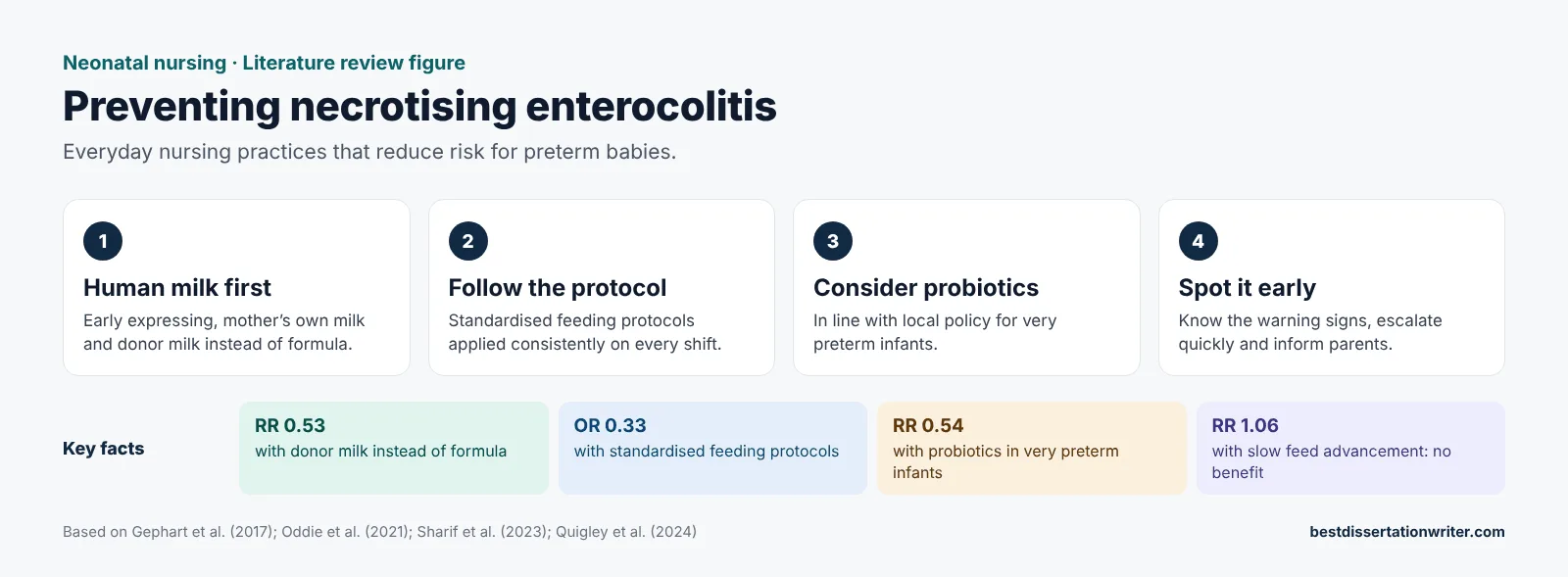
Findings: Donor milk instead of formula roughly halved the risk (risk ratio 0.53), and any human milk was associated with a similar reduction (0.51). Probiotics may reduce the risk in very preterm infants (risk ratio 0.54) and probably reduce mortality slightly, although effects in extremely preterm infants were uncertain. Standardised feeding protocols were associated with 67% lower odds (odds ratio 0.33), whereas slow advancement of feed volumes probably made little or no difference (risk ratio 1.06).
Conclusion: Prevention rests on prioritising human milk, using standardised feeding protocols and considering probiotics, supported by timely recognition of early signs. Neonatal nurses are central to each of these strategies.
Keywords: necrotising enterocolitis, feeding protocols, probiotics
Introduction
This narrative review critically examines recent evidence on necrotising enterocolitis and its implications for neonatal nursing practice.
Necrotising enterocolitis is an inflammatory disease of the bowel that mainly affects preterm babies, particularly those born very early or at very low birth weight. In its severe forms, parts of the bowel wall become damaged or die, leading to perforation, sepsis and the need for emergency surgery. Babies who survive may face long-term problems such as short bowel syndrome, poor growth and neurodevelopmental impairment, and the condition remains a leading cause of death among preterm infants after the first weeks of life.
The causes of necrotising enterocolitis are not fully understood, but immaturity of the gut and immune system, abnormal colonisation by bacteria, feeding practices and reduced blood flow to the bowel are all thought to contribute. Because there is no single cause, prevention depends on reducing several risk factors at once. Many of these factors, including the type of milk a baby receives and the way feeds are introduced and advanced, are directly influenced by nursing care.
A narrative review was chosen because the evidence combines Cochrane reviews of specific interventions, a meta-analysis of observational studies and a scoping review that produced practice recommendations with parents and clinicians, and a narrative approach allows these different sources to be interpreted together.
The question matters for neonatal nurses, feeding specialists and unit leaders who develop feeding guidelines and support families. Prevention strategies only work if they are implemented consistently across shifts and staff groups, so understanding the strength of evidence behind each strategy helps nurses to advocate for and sustain them.
Review question
What does the evidence show about strategies to prevent necrotising enterocolitis in preterm infants, and what are the implications for neonatal nursing practice?
Background to Necrotising Enterocolitis
Necrotising enterocolitis typically presents in the second to fourth week of life in preterm babies, often after feeds have been established. Early signs can be subtle and non-specific, such as feed intolerance, increased gastric residuals, abdominal distension, bilious aspirates, blood in the stool, apnoea or temperature instability. Diagnosis is supported by abdominal X-rays showing gas in the bowel wall, and staging systems describe severity from suspected disease to advanced disease with perforation.
Treatment usually involves stopping milk feeds, decompressing the stomach, giving intravenous antibiotics and fluids, and monitoring closely, with surgery for perforation or deterioration. Because treatment is largely supportive, prevention is particularly important. Prevention strategies include feeding human milk, standardising how feeds are started and increased, giving probiotics and avoiding medications that may increase risk, such as acid-suppressing drugs and prolonged antibiotics.
Nurses are central to both prevention and early recognition. They support mothers to provide breast milk, administer feeds, measure abdominal girth and gastric aspirates, observe stools and behaviour and escalate concerns. They also communicate with parents, who may notice changes in their baby and who need information about the risks and signs of necrotising enterocolitis. Nursing practice is therefore at the centre of efforts to reduce its incidence, and nurses are well placed to lead change on their units.
Rates vary considerably between countries and units, reflecting differences in populations, feeding practices and definitions. This variation suggests that unit-level practices can make a difference, and it has encouraged quality improvement programmes that combine several evidence-based strategies into a single bundle of care.
Search Strategy and Methods
Evidence for this example was identified through targeted searches of openly accessible bibliographic records, publisher websites and the reference lists of key reviews. Search terms combined keywords for the condition (“necrotising enterocolitis”, “necrotizing enterocolitis”, “NEC”) with terms for population and prevention (“preterm”, “very low birth weight”, “human milk”, “donor milk”, “probiotics”, “feeding protocols”, “feed advancement”), joined with the Boolean operators AND and OR. A full narrative review for assessment would run the same strategy in CINAHL, PubMed/MEDLINE, the Cochrane Library and Embase and report the number of records screened in a PRISMA flow diagram.
Sources were eligible if they evaluated strategies to prevent necrotising enterocolitis in preterm or very low birth weight infants, or synthesised evidence into practice recommendations relevant to nursing. Systematic reviews and Cochrane reviews were prioritised. Studies of treatment after diagnosis, and of term infants, were excluded.
Five sources published between 2017 and 2024 were included: one stakeholder-engaged scoping review with meta-analyses, one systematic review and meta-analysis of human milk feeding, and three Cochrane reviews of probiotics, slow advancement of feed volumes and donor milk (Table 1). The quality of each source was appraised using the Critical Appraisal Skills Programme (CASP) checklist for systematic reviews, and findings were synthesised narratively.
Key Findings on Necrotising Enterocolitis
Three themes were identified: human milk as the foundation of prevention, feeding protocols and feed advancement, and probiotics and wider prevention bundles. Table 1 summarises the included sources, and Figure 1 compares the effects of different prevention strategies on the risk of necrotising enterocolitis.
| Author, year | Design | Setting and sample | Key finding |
|---|---|---|---|
| Gephart et al. (2017) | Stakeholder-engaged scoping review with meta-analyses | 71 research reports and 11 position statements | Feeding protocols OR 0.33; strong recommendations for human milk and protocols; avoid antacids. |
| Miller et al. (2018) | Systematic review and meta-analysis | 49 studies of very low birth weight infants | Any human milk vs formula associated with RR 0.51 for NEC. |
| Oddie et al. (2021) | Cochrane systematic review | 14 trials, 4,033 very preterm or VLBW infants | Slow feed advancement: RR 1.06; little or no effect on NEC or death. |
| Sharif et al. (2023) | Cochrane systematic review | 60 trials, 11,156 infants | Probiotics may reduce NEC (RR 0.54) and mortality (RR 0.77) in very preterm infants. |
| Quigley et al. (2024) | Cochrane systematic review | 12 trials, 2,296 very preterm or VLBW infants | Donor milk vs formula: RR 0.53 (high certainty). |
Theme 1: Human Milk and Necrotising Enterocolitis
Quigley et al. (2024) reviewed 12 randomised trials involving 2,296 very preterm or very low birth weight infants. Donor milk instead of formula reduced the risk of the disease by about half (risk ratio 0.53, 95% confidence interval 0.37 to 0.76), with high-certainty evidence, while having little or no effect on mortality before discharge. Miller et al. (2018), drawing mainly on observational studies, found a similar association for any human milk compared with exclusive preterm formula (risk ratio 0.51).
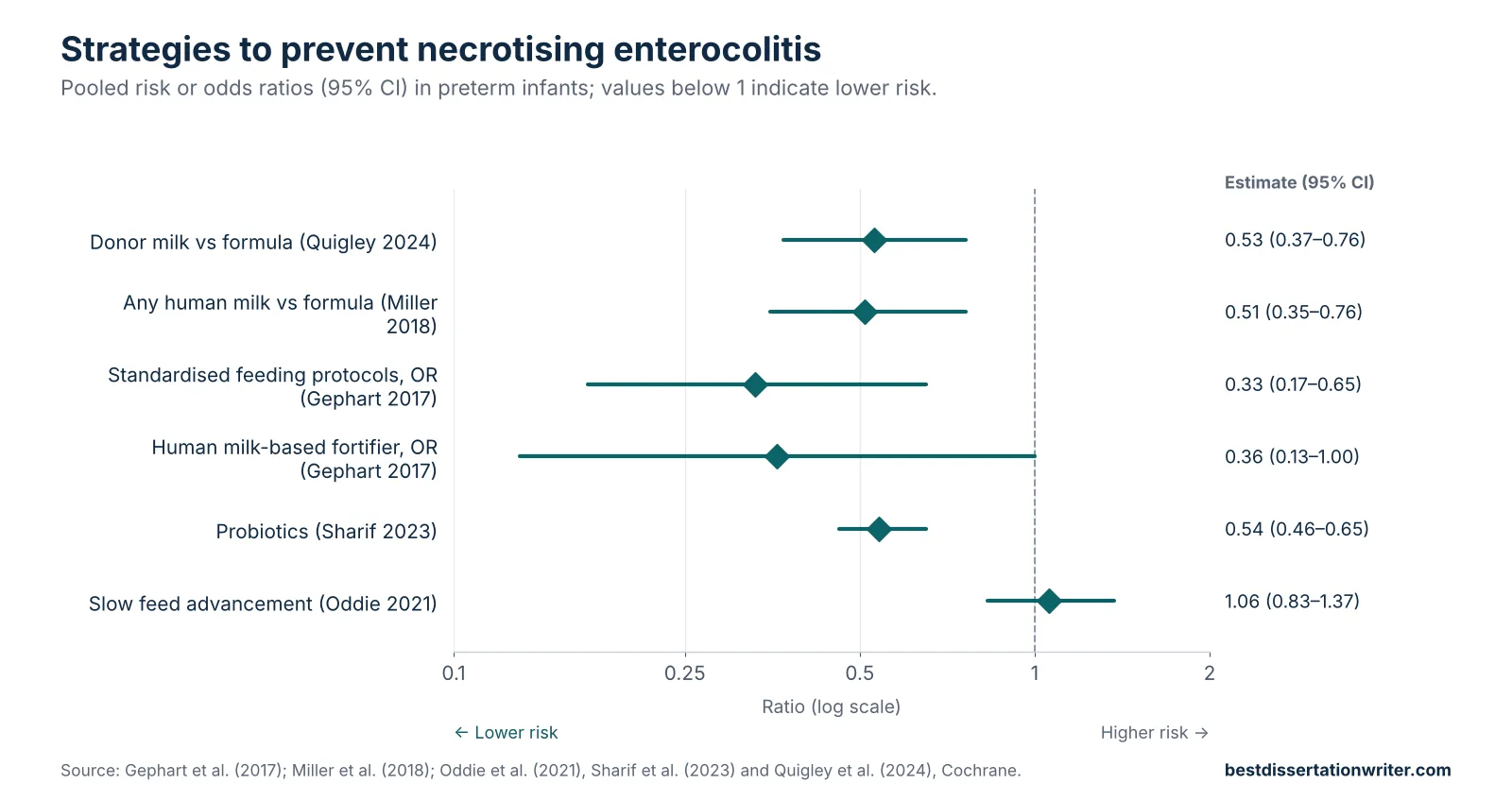
Gephart et al. (2017) developed the NEC-Zero recommendations through a scoping review of 71 research reports and 11 position statements, involving clinicians and parents. Prioritising human milk received a strong recommendation, and in infants under 1,250 g, a human milk-based fortifier was associated with lower odds of the disease than a cow’s milk-based fortifier (odds ratio 0.36, 95% confidence interval 0.13 to 1.00), although this result was at the margin of statistical significance.
These findings make human milk the single most important element of prevention. For nurses, the implication is that supporting mothers to express and provide milk from the first hours after birth, and using donor milk when mother’s own milk is not available, is a core preventive intervention rather than simply a feeding preference.
The practical details matter. Mothers of very preterm babies may need help to begin expressing within hours of birth, to express frequently, including at night, and to use colostrum for oral care while their baby is not yet fed. Nurses can make expressing easier by providing pumps at the cot side, encouraging skin-to-skin contact before expressing and recording volumes so that problems with supply are noticed early. Where donor milk is used, safe storage, labelling and checking procedures are essential, and parents should understand why it is offered and that it does not replace their own milk.
Theme 2: Feeding Protocols and Feed Advancement
Gephart et al. (2017) meta-analysed nine studies involving 4,755 infants under 1,500 g and found that standardised feeding protocols were associated with 67% lower odds of necrotising enterocolitis (odds ratio 0.33, 0.17 to 0.65). Feeding protocols received a strong recommendation. These protocols set out when to start feeds, how quickly to increase them and how to respond to signs of intolerance, reducing variation between clinicians and shifts.
In contrast, the speed of feed advancement itself appeared less important. Oddie et al. (2021) reviewed 14 trials involving 4,033 very preterm or very low birth weight infants and found that slow advancement, up to 24 mL/kg/day, probably had little or no effect on the condition (risk ratio 1.06, 0.83 to 1.37) or mortality, and may slightly increase invasive infection. One large trial contributed most of the infants, strengthening confidence in the result.
Together, these findings suggest that consistency matters more than caution. Following an agreed protocol, rather than advancing feeds very slowly, appears to be the key. For nurses, this means applying feeding protocols consistently, recognising and documenting feed intolerance accurately, and avoiding unnecessary interruptions to feeds that may prolong reliance on intravenous nutrition.
Assessment of feed tolerance is an area where practice varies. Routine measurement of gastric residuals, for example, has been questioned because small residuals are common and may lead to feeds being withheld without benefit. Feeding protocols that specify which signs should prompt review, and which should not, help nurses to respond consistently. Clear documentation of abdominal examination, stools, vomiting and behaviour also allows trends to be recognised over several shifts rather than judged in isolation.
Theme 3: Probiotics and Prevention Bundles
Sharif et al. (2023) reviewed 60 trials involving 11,156 infants. In very preterm or very low birth weight infants, probiotics may reduce the risk of necrotising enterocolitis (risk ratio 0.54, 0.46 to 0.65; low certainty) and probably reduce mortality slightly (0.77, 0.66 to 0.90), with numbers needed to treat of 33 and 50 respectively. In extremely preterm or extremely low birth weight infants, effects were small and uncertain. The authors called for further large, high-quality trials.
Gephart et al. (2017) also recommended avoiding acid-suppressing medications, limiting antibiotic exposure and using a standard approach to timely recognition, and emphasised that parents wanted information about necrotising enterocolitis early in the admission. The authors concluded that the evidence was strong enough to implement and that system-level interventions involving the whole team, including parents, were likely to have the greatest impact.
Discussion
This review suggests that the prevention of necrotising enterocolitis rests on three main strategies: prioritising human milk, using standardised feeding protocols and considering probiotics for very preterm infants. The evidence for human milk, and particularly for donor milk compared with formula, is the strongest, while the evidence for feeding protocols is largely observational and that for probiotics is of low certainty for the main outcome.
Probiotics illustrate the challenge of translating evidence into practice. Although pooled trials suggest a substantial reduction in necrotising enterocolitis and mortality, the certainty of evidence is low, products and strains vary, and effects in the most vulnerable extremely preterm babies are uncertain. Concerns about product quality and rare infections have also been raised. Units therefore differ in their use of probiotics, and decisions should be guided by local policy, product availability and careful monitoring.
The contrast between feeding protocols and the speed of advancement is instructive. Large trials show that advancing feeds slowly does not prevent necrotising enterocolitis, yet observational data suggest that standardising feeding reduces it. One explanation is that protocols reduce variation, avoid unnecessary interruptions and ensure that early signs are acted upon consistently. Nurses, as the staff who deliver and monitor feeds around the clock, are essential to making protocols work.
Prevention bundles that combine several strategies reflect the multifactorial nature of the disease. However, bundles are hard to evaluate because their components interact and they are often introduced alongside other changes. Units adopting bundles should measure both their implementation, such as the proportion of babies receiving human milk, and their outcomes, so that they can learn which elements are delivered reliably and where improvement is needed.
Families have an important place in prevention. Parents who understand the value of their milk may be more motivated to express, and parents who know the warning signs can share observations with nurses. The parents involved in developing the NEC-Zero recommendations asked for information early in the admission, during changes to feeding and when problems arose, using written and video materials as well as conversation. Providing such information in a calm, balanced way, without causing unnecessary alarm, is a nursing skill that deserves attention in training.
The evidence base has limitations. Evidence for feeding protocols and some human milk comparisons came from observational studies, definitions and staging of necrotising enterocolitis varied, and few studies reported long-term outcomes. This review relied on openly accessible, English-language sources and, as a narrative review, did not use formal systematic screening. Future research should test prevention bundles in multicentre studies, clarify the role of probiotics in extremely preterm infants and evaluate nurse-led early recognition tools.
Implications of Necrotising Enterocolitis Evidence for Practice
For neonatal nurses, the evidence supports helping mothers to express early and often, using donor milk when mother’s own milk is unavailable, following standardised feeding protocols consistently and documenting signs of intolerance clearly. Nurses should know the early signs of necrotising enterocolitis, escalate concerns promptly and give parents information about the condition and its warning signs. Units should consider probiotics in line with local policy and audit their prevention practices, for example the proportion of very preterm babies receiving any human milk in the first week, adherence to the feeding protocol and the time from first warning signs to medical review. Sharing these results with the nursing team helps to sustain improvement. The NEC-Zero recommendations provide a practical framework.
Supporting mothers to provide milk depends on reducing parental stress and on family-integrated care, in which parents are active partners in feeding. Good nutrition for preterm infants is the foundation of prevention, and the same attention to infection prevention that reduces late-onset sepsis supports careful antibiotic and medication stewardship.
Conclusion
This narrative review examined strategies to prevent necrotising enterocolitis in preterm infants. Human milk, and donor milk when mother’s own milk is unavailable, roughly halves the risk compared with formula, standardised feeding protocols are associated with substantially lower risk, probiotics may reduce risk in very preterm infants, and slow advancement of feeds does not appear to help.
Neonatal nurses are central to prevention. By supporting breast milk provision, applying feeding protocols consistently, recognising early signs and involving parents, nurses can make a direct contribution to reducing necrotising enterocolitis and its devastating consequences for babies and families.
References
Gephart, S. M., Hanson, C., Wetzel, C. M., Fleiner, M., Umberger, E., Martin, L., Rao, S., Agrawal, A., Marin, T., Kirmani, K., Quinn, M., Quinn, J., Dudding, K. M., Clay, T., Sauberan, J., Eskenazi, Y., Porter, C., Msowoya, A. L., Wyles, C., … Duchon, J. (2017). NEC-zero recommendations from scoping review of evidence to prevent and foster timely recognition of necrotizing enterocolitis. Maternal Health, Neonatology and Perinatology, 3, 23. https://doi.org/10.1186/s40748-017-0062-0
Miller, J., Tonkin, E., Damarell, R. A., McPhee, A. J., Suganuma, M., Suganuma, H., Middleton, P. F., Makrides, M., & Collins, C. T. (2018). A systematic review and meta-analysis of human milk feeding and morbidity in very low birth weight infants. Nutrients, 10(6), 707. https://doi.org/10.3390/nu10060707
Oddie, S. J., Young, L., & McGuire, W. (2021). Slow advancement of enteral feed volumes to prevent necrotising enterocolitis in very low birth weight infants. Cochrane Database of Systematic Reviews, (8), CD001241. https://doi.org/10.1002/14651858.CD001241.pub8
Quigley, M., Embleton, N. D., Meader, N., & McGuire, W. (2024). Donor human milk for preventing necrotising enterocolitis in very preterm or very low-birthweight infants. Cochrane Database of Systematic Reviews, (9), CD002971. https://doi.org/10.1002/14651858.CD002971.pub6
Sharif, S., Meader, N., Oddie, S. J., Rojas-Reyes, M. X., & McGuire, W. (2023). Probiotics to prevent necrotising enterocolitis in very preterm or very low birth weight infants. Cochrane Database of Systematic Reviews, (7), CD005496. https://doi.org/10.1002/14651858.CD005496.pub6
Cite this example
Best Dissertation Writers (2026) Prevention of Necrotising Enterocolitis in Preterm Infants: A Review of Nursing Practice. Available at: https://bestdissertationwriter.com/necrotising-enterocolitis-review-review/
Best Dissertation Writers
Get expert help with your nursing literature review
Share your topic and deadline with Best Dissertation Writers and get support tailored to your module brief.