

Nursing Care of Infants with Neonatal Abstinence Syndrome: A Systematic Review
 By Dr. Robertson Prime, Research Fellow
Updated October 17, 2026
14 min read
About 2,800 words
In this review
Abstract
Background: Neonatal abstinence syndrome is a group of withdrawal signs, such as tremors, irritability, poor feeding and poor sleep, seen in babies exposed to opioids and other substances before birth. Its incidence has risen sharply, and nursing care has shifted from scoring and medication in the neonatal unit towards keeping mothers and babies together with non-pharmacological care.
Aim: This systematic review aimed to examine the evidence on nursing and family-centred approaches to the care of infants with neonatal abstinence syndrome.
Methods: Evidence was identified through targeted searches of openly accessible bibliographic records, publisher websites and the reference lists of key reviews. Five sources published between 2015 and 2023 were included: a national cohort study, a meta-analysis of rooming-in, a quality improvement study, a Cochrane review of opioid treatment and a cluster randomised trial, synthesised narratively.
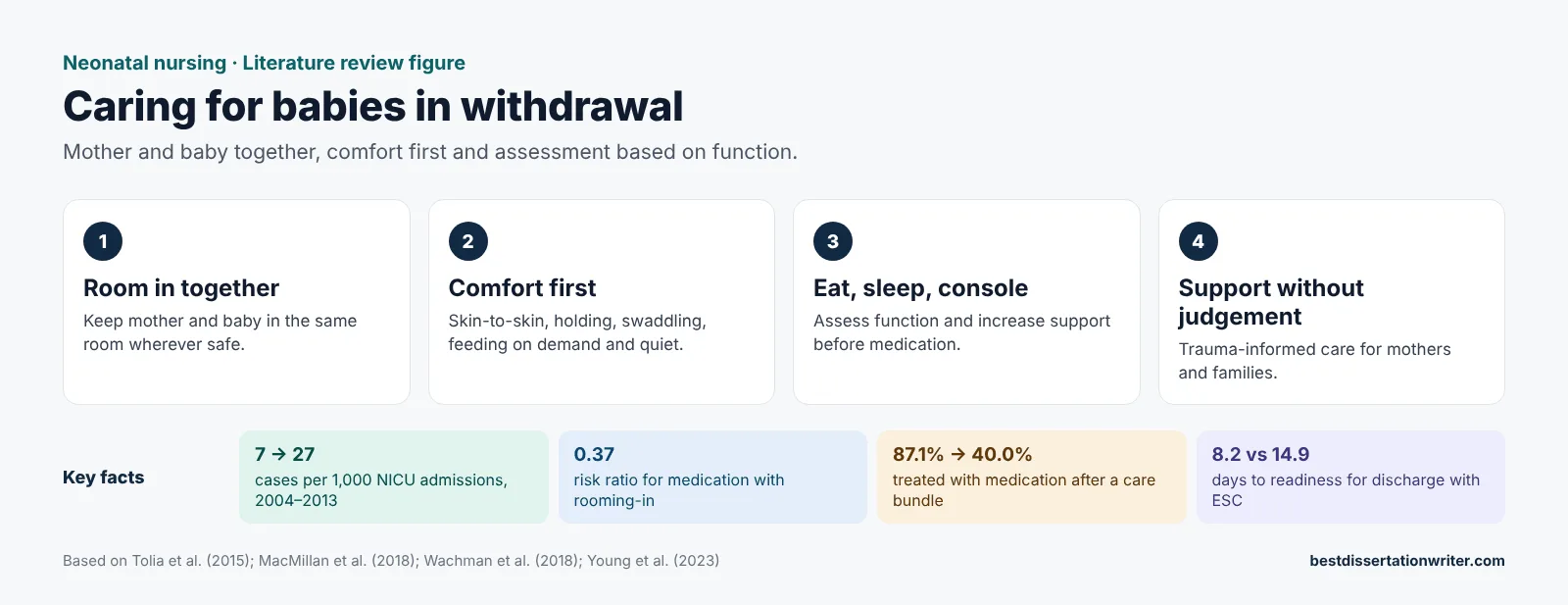
Findings: In US neonatal units, cases rose from 7 to 27 per 1,000 admissions between 2004 and 2013, and 87% of affected infants received medication. Rooming-in reduced the need for medication (risk ratio 0.37) and shortened stays by 10.4 days. A bundle of non-pharmacological care and function-based assessment reduced medication from 87.1% to 40.0%. A trial in 26 hospitals found that the Eat, Sleep, Console approach shortened time to readiness for discharge from 14.9 to 8.2 days without more adverse outcomes.
Conclusion: Neonatal nurses should keep mothers and babies together, deliver non-pharmacological care first, use function-based assessment and support parents without judgement.
Keywords: neonatal abstinence syndrome, opioid withdrawal, non-pharmacological care, rooming-in
Introduction
This systematic review critically examines recent evidence on neonatal abstinence syndrome and its implications for neonatal nursing practice.
When a pregnant woman uses opioids, whether prescribed for pain, as treatment for opioid use disorder or illicitly, the drugs cross the placenta. After birth the supply stops suddenly, and many babies develop signs of withdrawal within a few days. These include tremors, high-pitched crying, irritability, difficulty sleeping, poor feeding, vomiting, loose stools and sweating. Exposure to other substances, such as benzodiazepines, nicotine and some antidepressants, can add to or complicate the picture.
The number of affected babies has risen substantially in many countries alongside wider increases in opioid use. Babies with withdrawal often stay in hospital for weeks, many in neonatal units, and are commonly treated with opioid medicines such as morphine or methadone. Long admissions separate mothers and babies, disrupt breastfeeding and bonding and use scarce neonatal resources.
Nurses play a central role in neonatal abstinence syndrome. They assess withdrawal, provide comfort and feeding support, decide when to escalate concerns, and work with mothers who may feel guilt, stigma and fear of losing custody of their baby. Over the past decade, nursing-led approaches that emphasise keeping mothers and babies together and treating the baby’s function rather than a score have transformed care in many hospitals.
A systematic review approach was chosen to bring together evidence from a national cohort, a meta-analysis, a quality improvement study, a Cochrane review and a large randomised trial.
The term neonatal opioid withdrawal syndrome is increasingly used when withdrawal is specifically linked to opioids, while neonatal abstinence syndrome remains the broader and more familiar term. Whichever term is used, the aim of care is the same: to help the baby feed, sleep and settle, to keep the family together and to prepare parents to care for their baby safely at home.
Review question
What does the evidence show about nursing and family-centred approaches to the care of infants with neonatal abstinence syndrome?
Background to Neonatal Abstinence Syndrome
For many years, assessment was based on the Finnegan Neonatal Abstinence Scoring Tool, in which nurses scored many signs every few hours, with medication started when scores exceeded a threshold. The tool is detailed but time-consuming, involves disturbing the baby to check reflexes and has been criticised for subjectivity and for leading to high rates of medication. Babies with high scores were often transferred to the neonatal unit, away from their mothers.
The Eat, Sleep, Console approach was developed as an alternative. Rather than scoring many signs, nurses and parents ask whether the baby can eat adequately, sleep for at least an hour and be consoled within about ten minutes. If the baby is not managing these functions, the first response is to increase non-pharmacological care, such as more parental presence, skin-to-skin contact, swaddling, feeding on demand and a quiet environment. Medication is added only if these measures are not enough.
Non-pharmacological care is the foundation of all approaches. It includes rooming-in, where mother and baby stay together in the same room; breastfeeding, which is generally encouraged for mothers who are stable in treatment; skin-to-skin contact; holding and gentle rocking; swaddling; small, frequent feeds; and reducing light and noise. Volunteer cuddlers can help when parents cannot be present.
Caring for families affected by substance use requires sensitivity. Mothers may face stigma from staff, involvement of child protection services and their own recovery needs. Nurses who are supportive and non-judgemental can help mothers to stay with their babies and engage in care, while still recognising and acting on genuine safeguarding concerns.
Breastfeeding deserves particular mention. For mothers who are stable in treatment for opioid use disorder and not using other substances, breastfeeding is generally encouraged because small amounts of medicine in breast milk may ease withdrawal, and breastfeeding supports bonding. Nurses need clear local guidance on when breastfeeding is appropriate and how to support mothers who choose to breastfeed after opioid withdrawal is identified in their baby.
Search Strategy and Methods
Evidence for this example was identified through targeted searches of openly accessible bibliographic records, publisher websites and the reference lists of key reviews. Search terms combined keywords for the condition (“neonatal abstinence syndrome”, “neonatal opioid withdrawal syndrome”, “opioid exposure”) with terms for interventions and outcomes (“rooming-in”, “Eat, Sleep, Console”, “non-pharmacological”, “morphine”, “length of stay”, “pharmacological treatment”), joined with the Boolean operators AND and OR. A full systematic review for assessment would run the same strategy in CINAHL, PubMed/MEDLINE, the Cochrane Library and Embase and report the number of records screened in a PRISMA flow diagram.
Sources were eligible if they described the burden of neonatal abstinence syndrome or evaluated approaches to care, including assessment methods, rooming-in, non-pharmacological care and medication. Randomised trials and systematic reviews were prioritised, and a large cohort study and a detailed quality improvement study were included to show the scale of the problem and how change was implemented. Studies of maternal treatment only were excluded.
Five sources published between 2015 and 2023 were included: a national multicentre cohort study, a systematic review and meta-analysis, a quality improvement study, a Cochrane systematic review and a cluster randomised controlled trial (Table 1). The quality of each source was considered using the Critical Appraisal Skills Programme (CASP) checklists, drawing on the certainty ratings reported by the reviews, and findings were synthesised narratively.
Key Findings on Neonatal Abstinence Syndrome
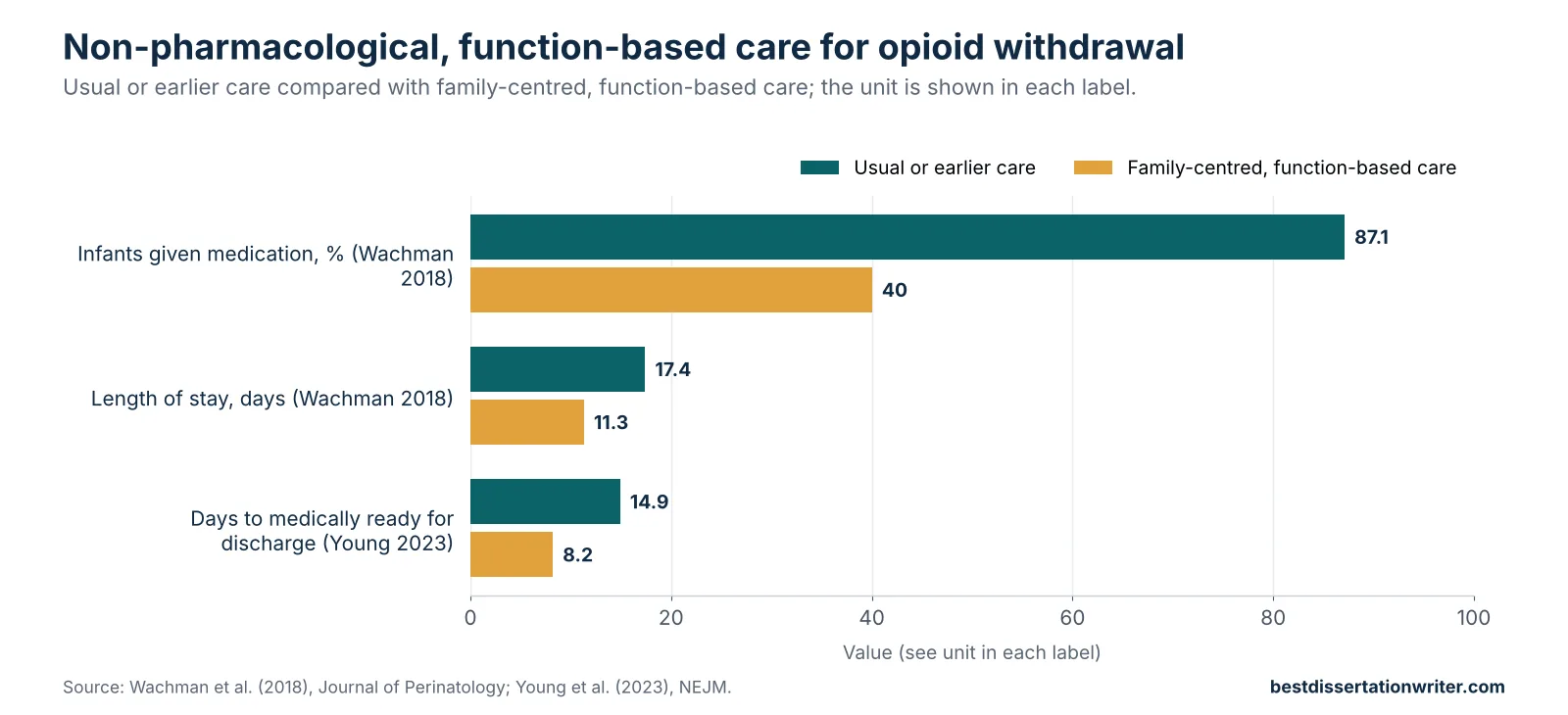
Three themes were identified: the rising burden of neonatal abstinence syndrome, keeping mothers and babies together through rooming-in and non-pharmacological care, and function-based assessment and medication. Table 1 summarises the included sources, and Figure 1 shows how changes in care affected medication and length of stay.
| Author, year | Design | Setting and sample | Key finding |
|---|---|---|---|
| Tolia et al. (2015) | Multicentre cohort study | 674,845 admissions, 299 US NICUs, 2004–2013 | Cases rose from 7 to 27 per 1,000 admissions; 87% treated with medication; median stay 19 days. |
| MacMillan et al. (2018) | Systematic review and meta-analysis | 6 studies, 549 infants | Rooming-in: less medication (RR 0.37) and 10.4 days shorter stay. |
| Wachman et al. (2018) | Quality improvement study | 240 opioid-exposed infants, one US academic hospital | Medication fell from 87.1% to 40.0%; stay from 17.4 to 11.3 days; parental presence increased. |
| Zankl et al. (2021) | Cochrane systematic review | 16 trials, 1,110 infants | Opioids reduced treatment failure vs phenobarbital (RR 0.51); buprenorphine shorter stays than morphine. |
| Young et al. (2023) | Cluster randomised controlled trial | 1,305 infants ≥36 weeks, 26 US hospitals | Eat, Sleep, Console: 8.2 vs 14.9 days to readiness for discharge; similar adverse outcomes. |
Theme 1: The Rising Burden of Neonatal Abstinence Syndrome
A study of 299 neonatal intensive care units in the United States analysed 674,845 admissions between 2004 and 2013 (Tolia et al., 2015). Cases of neonatal abstinence syndrome rose from 7 to 27 per 1,000 admissions, and the share of neonatal unit days used by these babies rose from 0.6% to 4.0%, exceeding 20% in some units. The proportion of affected infants receiving medication rose from 74% to 87%, and median length of stay increased from 13 to 19 days.
These findings show how the condition had come to consume a growing share of neonatal intensive care resources, and how the dominant model of care relied on admission to the neonatal unit and medication. They also suggested that many babies were separated from their mothers for long periods, even though most were born at or near term and were otherwise well. This prompted a search for approaches that could keep families together.
The rising numbers also reflected wider social changes, including increased prescribing of opioids and growth in opioid use disorder among women of childbearing age. Neonatal abstinence syndrome is therefore not only a clinical problem but a public health one, requiring coordinated antenatal, postnatal and community services that support mothers through pregnancy and beyond.
Theme 2: Rooming-In and Non-Pharmacological Care
A systematic review and meta-analysis of six studies with 549 infants compared rooming-in with care in the neonatal unit (MacMillan et al., 2018). Rooming-in was associated with a lower need for medication (risk ratio 0.37) and a shorter length of stay, by an average of 10.4 days. The authors recommended rooming-in as the preferred model of inpatient care where safe and feasible, although the studies were observational and heterogeneous, and publication bias was possible.
A quality improvement study at a large urban academic hospital introduced a non-pharmacological care bundle, including parental presence, skin-to-skin contact, holding, breastfeeding and a low-stimulation environment, followed by staff education, a switch from morphine to methadone and replacement of Finnegan scoring with Eat, Sleep, Console assessment (Wachman et al., 2018). Medication use fell from 87.1% to 40.0%, mean length of stay from 17.4 to 11.3 days, and mean hospital charges by more than $11,000 per infant.
Parental presence at the bedside rose from 55.6% to 75.8% during the programme, and no adverse events were reported. Because several changes were introduced together in a single centre, it was not possible to identify which component was most effective. Nevertheless, the study shows how nurses, physicians and families can work together to transform care, and highlights parental presence as both a goal and a mechanism of improvement.
Theme 3: Function-Based Assessment and Medication
A cluster randomised trial in 26 US hospitals tested the Eat, Sleep, Console approach against usual care with Finnegan scoring for 1,305 infants born at 36 weeks or later with neonatal opioid withdrawal (Young et al., 2023). Among infants who met the trial definition of readiness for discharge, the time from birth to being medically ready was 8.2 days with Eat, Sleep, Console and 14.9 days with usual care, a reduction of 6.7 days. Adverse outcomes in the first three months were similar between groups.
A Cochrane review of 16 trials with 1,110 infants examined opioid treatment for withdrawal (Zankl et al., 2021). Opioids reduced treatment failure compared with phenobarbital (risk ratio 0.51) and diazepam, and buprenorphine was associated with shorter treatment and hospital stays than morphine. In one small trial, adding morphine to supportive care lengthened hospital stays by 15 days, but this evidence was of very low certainty. There was insufficient evidence on non-pharmacological care alone compared with care plus medication.
Together, these findings suggest that medication remains appropriate for some babies, but that many can be managed with non-pharmacological care when mothers and babies are kept together and assessment focuses on function. When medication is needed, the choice of drug and the duration of treatment matter, and nurses’ observations of eating, sleeping and consolability can guide decisions.
The trial also has implications for workload. Function-based assessment may take less time than detailed scoring, but it requires nurses to spend time with families, to support feeding and to coach parents in comforting their baby. In units where nurses care for many babies, volunteers and extended family members can provide additional support, and clear communication between shifts helps to maintain consistent care.
Discussion
This review found that neonatal abstinence syndrome placed growing demands on neonatal units, and that approaches keeping mothers and babies together, prioritising non-pharmacological care and using function-based assessment reduce medication use and length of stay without evidence of harm. The large randomised trial of Eat, Sleep, Console provides the strongest evidence and confirms findings from earlier observational and improvement studies.
The shift in care has important implications for nursing. Instead of scoring signs every few hours, nurses work alongside parents to observe the baby’s eating, sleeping and consolability, and to increase comfort measures when needed. This requires nurses to see parents as the most important part of the treatment and to create an environment where they can stay. Postnatal wards, rather than neonatal units, may become the main setting for care.
Stigma remains a significant barrier in neonatal abstinence syndrome care. Mothers who use opioids may feel judged by staff and may be reluctant to stay or to breastfeed. Training in trauma-informed, non-judgemental care can help nurses to build trust, while clear guidance on safeguarding ensures that genuine risks are addressed. Supporting mothers in their recovery benefits both mother and baby.
Practical challenges in caring for neonatal abstinence syndrome include staffing, space and the needs of mothers with complex social circumstances. Rooming-in requires private rooms or appropriate space on postnatal wards, and mothers may need support with their own health, accommodation and transport. Volunteer cuddler programmes and extended family involvement can help when mothers cannot be present.
This review has limitations. The rooming-in meta-analysis and the quality improvement study were observational, the cohort data are from the United States only, and the Cochrane review found little evidence on non-pharmacological care alone. This review relied on openly accessible, English-language sources and did not involve independent double screening. Future research should examine long-term developmental and family outcomes after different approaches to care.
Long-term follow-up is another gap. Children exposed to opioids before birth may face developmental, behavioural and social challenges, influenced by their home environment as well as by exposure. Connecting families with community health visitors, early intervention services and addiction support after discharge may matter as much for long-term outcomes as the approach used in hospital.
Implications of Neonatal Abstinence Syndrome Evidence for Practice
Neonatal nurses should support rooming-in, encourage parental presence, breastfeeding where appropriate and skin-to-skin contact, swaddle and hold babies, reduce stimulation and use function-based assessment such as Eat, Sleep, Console. A calm, warm environment draws on principles of developmental care and thermoregulation, since withdrawing babies may sweat and lose heat.
Before discharge, parents should be taught safe sleep practices, because babies with withdrawal may be at increased risk, and preterm babies exposed to opioids may also need screening for conditions such as retinopathy of prematurity. Follow-up should support families after discharge.
Units introducing these changes should audit medication use, length of stay, readmissions and parents’ experiences, so that improvements can be measured and sustained, and so that staff can see the difference their care makes for families.
Conclusion
This systematic review examined the evidence on nursing and family-centred approaches to the care of infants with neonatal abstinence syndrome. Keeping mothers and babies together, prioritising non-pharmacological care and using function-based assessment reduce medication and length of stay without increasing harm, while opioid medication remains effective for babies who need it.
Neonatal nurses are at the heart of this change in care. By treating parents as partners and providing compassionate, non-judgemental support, they can help babies through withdrawal while strengthening the bond between mother and child.
References
MacMillan, K. D. L., Rendon, C. P., Verma, K., Riblet, N., Washer, D. B., & Volpe Holmes, A. (2018). Association of rooming-in with outcomes for neonatal abstinence syndrome: A systematic review and meta-analysis. JAMA Pediatrics, 172(4), 345–351. https://doi.org/10.1001/jamapediatrics.2017.5195
Tolia, V. N., Patrick, S. W., Bennett, M. M., Murthy, K., Sousa, J., Smith, P. B., Clark, R. H., & Spitzer, A. R. (2015). Increasing incidence of the neonatal abstinence syndrome in U.S. neonatal ICUs. New England Journal of Medicine, 372(22), 2118–2126. https://doi.org/10.1056/NEJMsa1500439
Wachman, E. M., Grossman, M., Schiff, D. M., et al. (2018). Quality improvement initiative to improve inpatient outcomes for neonatal abstinence syndrome. Journal of Perinatology, 38, 1114–1122. https://doi.org/10.1038/s41372-018-0109-8
Young, L. W., Ounpraseuth, S. T., Merhar, S. L., Hu, Z., Simon, A. E., Bremer, A. A., Lee, J. Y., Das, A., Crawford, M. M., Greenberg, R. G., Smith, P. B., Poindexter, B. B., Higgins, R. D., Walsh, M. C., Rice, W., Paul, D. A., Maxwell, J. R., Telang, S., Fung, C. M., … Devlin, L. A. (2023). Eat, Sleep, Console approach or usual care for neonatal opioid withdrawal. New England Journal of Medicine, 388(25), 2326–2337. https://doi.org/10.1056/NEJMoa2214470
Zankl, A., Martin, J., Davey, J. G., & Osborn, D. A. (2021). Opioid treatment for opioid withdrawal in newborn infants. Cochrane Database of Systematic Reviews, (7), CD002059. https://doi.org/10.1002/14651858.CD002059.pub4
Cite this example
Best Dissertation Writers (2026) Nursing Care of Infants with Neonatal Abstinence Syndrome: A Systematic Review. Available at: https://bestdissertationwriter.com/neonatal-abstinence-syndrome-review/
Best Dissertation Writers
Get expert help with your nursing literature review
Share your topic and deadline with Best Dissertation Writers and get support tailored to your module brief.