Neonatal Resuscitation Training for Nurses and Its Effect on Competence: A Systematic Review
 By Dr. Robertson Prime, Research Fellow
Updated October 17, 2026
14 min read
About 2,900 words
In this review
Abstract
Background: Neonatal resuscitation training prepares nurses, midwives and doctors to help babies who do not breathe at birth, using structured programmes such as the Neonatal Resuscitation Program (NRP), Newborn Life Support and Helping Babies Breathe. Because a significant minority of babies need some help to begin breathing, the competence of the whole birth team matters.
Aim: This systematic review aimed to examine the effects of neonatal resuscitation training on the competence of nurses and other staff and on newborn outcomes.
Methods: Evidence was identified through targeted searches of openly accessible bibliographic records, publisher websites and the reference lists of key reviews. Six sources published between 2011 and 2026 were included: a systematic review with Delphi estimation, a national implementation study, a cohort study of skill retention, a meta-analysis of simulation training, a randomised study of frequent practice and a Cochrane review, synthesised narratively.
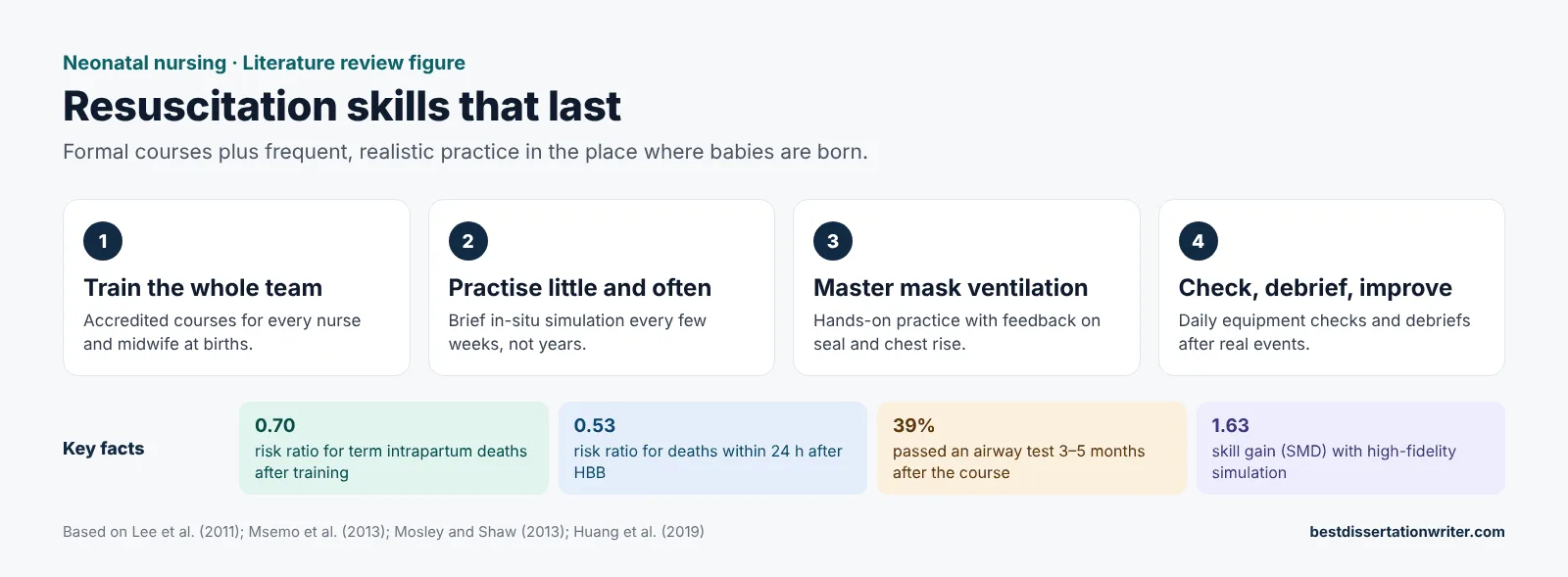
Findings: Facility-based training reduced term intrapartum-related deaths by about 30% (risk ratio 0.70), and national Helping Babies Breathe training in Tanzania was associated with fewer deaths in the first 24 hours (risk ratio 0.53). However, only 39% of Newborn Life Support candidates passed an unannounced airway test at three to five months. High-fidelity simulation improved skills and knowledge, and frequent short practice helped to maintain ventilation skills.
Conclusion: Neonatal and maternity nurses should complete accredited training and take part in frequent, brief simulation practice so that resuscitation skills are maintained between courses.
Keywords: neonatal resuscitation training, NRP, newborn life support
Introduction
This systematic review critically examines recent evidence on neonatal resuscitation training and its implications for neonatal nursing practice.
Most babies begin breathing on their own at birth, but a significant minority need help, usually drying, stimulation and positioning, and some need ventilation with a bag and mask. A small number need chest compressions, intubation or medicines. The first minute after birth is often described as the golden minute, because effective ventilation started promptly can prevent brain injury and death. Failure to breathe at birth remains an important cause of neonatal death worldwide.
Resuscitation at birth is a team activity, and nurses and midwives are frequently the first professionals present. In many settings, especially outside large hospitals, they may be the only skilled attendants at a birth. Their ability to recognise a baby who needs help, open the airway, provide effective ventilation and call for support can determine whether the baby survives without harm.
Structured training programmes have been developed to teach these skills. They include the Neonatal Resuscitation Program (NRP), widely used in North America, Newborn Life Support courses in the UK and Europe, and Helping Babies Breathe, a simplified programme designed for low-resource settings. These programmes use algorithms, practical skill stations and simulated scenarios, and certification is usually renewed every few years.
A systematic review approach was chosen to bring together evidence on mortality, skill retention and training methods from reviews, implementation studies and trials.
In the UK, neonatal resuscitation training is usually delivered through the Newborn Life Support course, while NRP certification is common in North America and many other countries. The programmes share core principles but differ in format, length and recertification intervals. Whatever the programme, nurses and midwives need to understand the algorithm used in their own unit so that teams work from the same plan.
Review question
What are the effects of neonatal resuscitation training on the competence of nurses and other staff and on newborn outcomes?
Background to Neonatal Resuscitation Training
Neonatal resuscitation follows a structured sequence. The baby is dried, kept warm and assessed for breathing, heart rate and tone. If breathing is absent or inadequate, the airway is opened and inflation breaths and ventilation are provided by mask. Heart rate is reassessed, and if it remains very low despite effective ventilation, chest compressions and further interventions follow. Effective mask ventilation is the single most important skill.
Many factors influence how well staff perform during real resuscitation. Technical skills, such as achieving a good mask seal, are difficult to maintain without practice, especially for staff who rarely attend births needing resuscitation. Non-technical skills, including teamwork, leadership, communication and situational awareness, also affect performance. Training increasingly addresses both through realistic simulation and debriefing.
Skill decay is a well-recognised problem in neonatal resuscitation training. Knowledge and practical skills learned on a course may decline within months if not used or practised. This has led to interest in refresher training, low-dose high-frequency practice, in which staff practise short scenarios regularly at work, and in-situ simulation in the clinical environment where real emergencies occur.
Neonatal resuscitation training also has organisational dimensions. Units must release staff for courses, provide equipment and simulators, and create time for regular practice. In low-resource settings, the challenge is to train enough birth attendants and to maintain skills where supervision and equipment are limited. Programmes such as Helping Babies Breathe were designed to be simple, practical and scalable.
Parents may also benefit from training. Families of babies who are discharged with ongoing risks, such as those born very preterm, may be taught basic infant life support before going home. Although this differs from professional neonatal resuscitation training, it reflects the same principle: that confident, practised responses in the first minutes of an emergency can save lives.
Search Strategy and Methods
Evidence for this example was identified through targeted searches of openly accessible bibliographic records, publisher websites and the reference lists of key reviews. Search terms combined keywords for the intervention (“neonatal resuscitation”, “Neonatal Resuscitation Program”, “Newborn Life Support”, “Helping Babies Breathe”, “simulation”, “training”) with terms for outcomes (“mortality”, “stillbirth”, “skills”, “knowledge”, “retention”, “competence”), joined with the Boolean operators AND and OR. A full systematic review for assessment would run the same strategy in CINAHL, PubMed/MEDLINE, the Cochrane Library and Embase and report the number of records screened in a PRISMA flow diagram.
Sources were eligible if they evaluated neonatal resuscitation training for health workers and reported newborn outcomes, skill retention or educational outcomes. Systematic reviews and trials were prioritised, and a national implementation study and a cohort study of skill retention were included because they address mortality and decay of skills in real practice. Studies of resuscitation of older children were excluded.
Six sources published between 2011 and 2026 were included: a systematic review with meta-analysis and Delphi estimation, a national before-and-after implementation study, a longitudinal cohort study, a systematic review and meta-analysis of simulation training, a randomised controlled study and a Cochrane systematic review (Table 1). The quality of each source was considered using the Critical Appraisal Skills Programme (CASP) checklists, drawing on the certainty ratings reported by the reviews, and findings were synthesised narratively.
Key Findings on Neonatal Resuscitation Training
Three themes were identified: the effect of neonatal resuscitation training on newborn survival, the decay of resuscitation skills after training, and methods that improve and maintain competence. Table 1 summarises the included sources, and Figure 1 shows the effects of training on newborn mortality and stillbirth.
| Author, year | Design | Setting and sample | Key finding |
|---|---|---|---|
| Lee et al. (2011) | Systematic review, meta-analysis and Delphi estimation | Facility-based resuscitation training studies | Term intrapartum-related deaths reduced by about 30% (RR 0.70). |
| Msemo et al. (2013) | National before-and-after implementation study | 8 hospitals in Tanzania; 8,124 before and 78,500 after | Helping Babies Breathe: deaths within 24 h RR 0.53; fresh stillbirths RR 0.76. |
| Mosley and Shaw (2013) | Longitudinal cohort study | Newborn Life Support candidates, UK neonatal unit | Only 39% passed an unannounced airway test at 3–5 months; self-rated competence did not predict passing. |
| Huang et al. (2019) | Systematic review and meta-analysis | 15 studies of high-fidelity simulation | Better skills (SMD 1.63) and knowledge (SMD 0.69) than traditional training; retention uncertain. |
| Haynes et al. (2021) | Randomised controlled study | 191 delivery unit staff, Norway | Frequent short simulation practice helped maintain ventilation skills; optimal frequency unclear. |
| Dempsey et al. (2026) | Cochrane systematic review | 27 studies of formal resuscitation training | Early neonatal mortality RR 0.88 vs basic training (moderate certainty). |
Theme 1: Neonatal Resuscitation Training and Newborn Survival
A systematic review and meta-analysis estimated the effect of neonatal resuscitation on neonatal deaths (Lee et al., 2011). Three facility-based studies showed that resuscitation training reduced term intrapartum-related deaths by around 30% (risk ratio 0.70). Evidence for preterm babies was of low quality, and an expert Delphi panel estimated that facility-based resuscitation would prevent a further 10% of preterm deaths. The authors noted that training coverage remained low where most deaths occur.
A national implementation study in Tanzania trained master trainers to disseminate Helping Babies Breathe across eight hospitals (Msemo et al., 2013). Comparing periods before and after training, deaths within the first 24 hours fell significantly (risk ratio 0.53), and fresh stillbirths also fell (risk ratio 0.76), suggesting that some babies previously classed as stillborn were successfully resuscitated. Stimulation of babies rose from 47% to 88%, while the use of face mask ventilation fell from 8.2% to 5.2%.
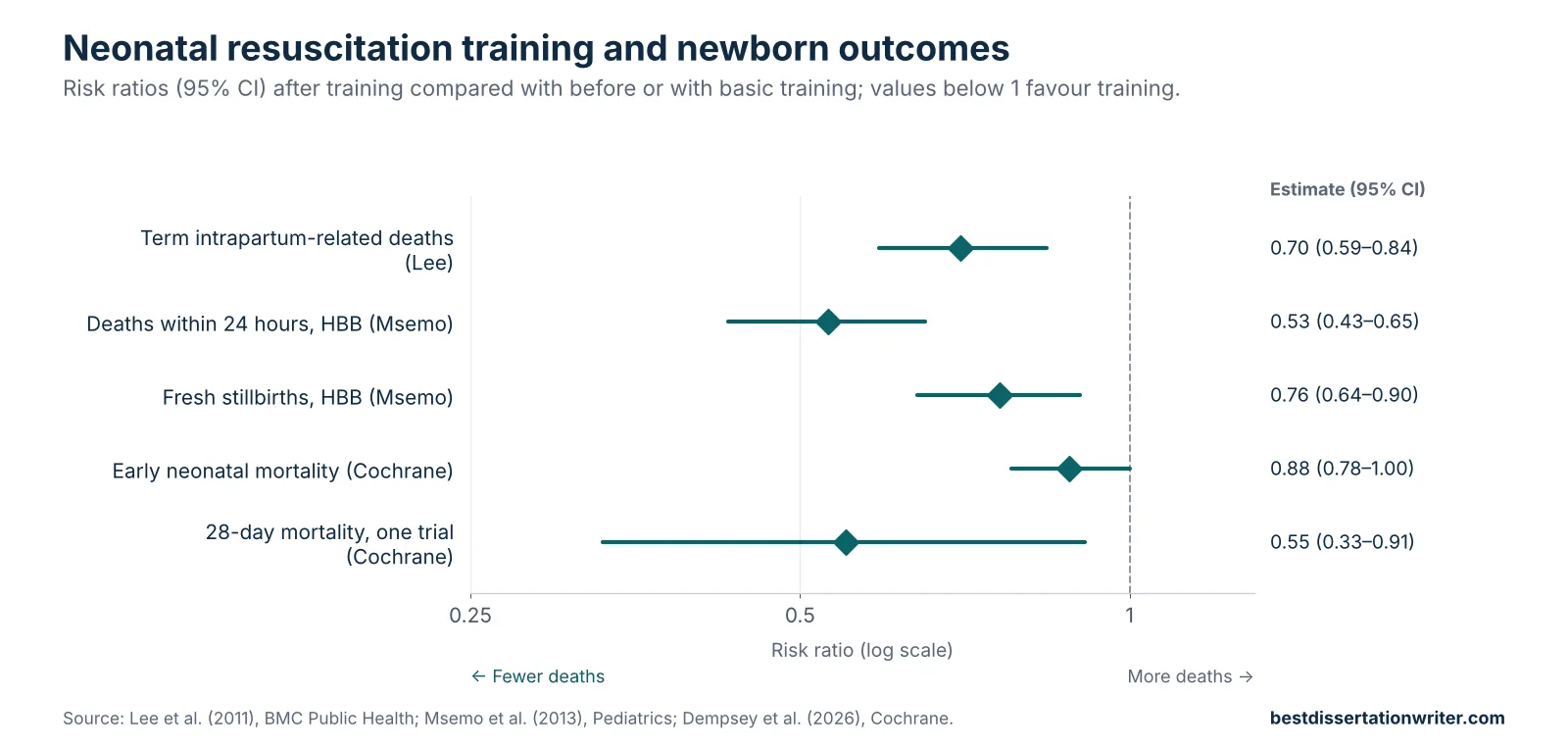
A Cochrane review updated in 2026 examined standardised formal resuscitation training programmes (Dempsey et al., 2026). Compared with basic newborn care training, formal resuscitation training probably reduced early neonatal mortality slightly (risk ratio 0.88, moderate-certainty evidence), and one trial found a reduction in 28-day mortality (risk ratio 0.55, low certainty). Training compared with no training was likely to reduce mortality in the first day and week, but only a few studies contributed to each result, and overall confidence ranged from moderate to very low.
The contrast between the Cochrane estimate and the earlier implementation study is instructive. Large effects seen in before-and-after studies may partly reflect other changes over time, while randomised comparisons with basic training show smaller but still important benefits. Both types of evidence suggest that neonatal resuscitation training saves lives, particularly where skilled care at birth was previously limited.
Theme 2: Skills Decline After Training
A longitudinal cohort study in a UK neonatal unit retested staff who had passed the Newborn Life Support course, using unannounced airway assessments (Mosley and Shaw, 2013). At three to five months, only 39% of 67 candidates passed at the first attempt, and at 12 to 14 months, 44% of 43 candidates did so. Candidates’ self-assessed competence did not differ between those who passed and those who failed, suggesting that staff may not recognise their own skill decline.
Staff who attended more than five resuscitations a month were more likely to pass at 12 to 14 months, and those offered training every six months performed better at three to five months than those offered it yearly. The authors concluded that skills tested in simulation are highly likely to deteriorate within a few months of the course. The study was small and had no baseline test at course completion, but its findings are consistent with wider evidence on resuscitation skill decay.
These findings have important implications for neonatal resuscitation training. Certification every few years is unlikely to maintain competence for staff who rarely attend resuscitations, including many nurses and midwives in smaller units or postnatal areas. Confidence is not a reliable guide to competence, so objective assessment and regular practice are needed.
Theme 3: Simulation and Frequent Practice
A systematic review and meta-analysis of 15 studies examined high-fidelity simulation in neonatal resuscitation training (Huang et al., 2019). Compared with traditional training, high-fidelity simulation improved skill performance (standardised mean difference 1.63) and knowledge (0.69), and compared with low-fidelity simulation it produced smaller improvements. However, long-term retention was uncertain, and the authors cautioned that benefits may not transfer to real clinical situations.
A randomised study in a Norwegian delivery unit tested low-dose high-frequency simulation training with 191 staff from six professions (Haynes et al., 2021). Participants randomised to train twice a month completed an average of eight sessions, compared with 2.8 in the self-guided group, but final scores did not differ between the randomised groups. Staff who completed nine or more sessions performed better than those who did not train, and scores improved for all participants overall, suggesting that frequent short practice can foster and maintain ventilation skills.
Together, these findings suggest that realistic, frequent practice improves performance, but that achieving regular practice in busy units is difficult. The optimal frequency of training is still unclear, and the evidence is mostly limited to simulated performance rather than outcomes for babies. Embedding brief practice into everyday work, for example at the start of shifts, may be more achievable than relying on staff to train in their own time.
Debriefing after real resuscitations is another way to maintain skills. Short, structured discussions after an event help teams to identify what went well and what could be improved, and can reveal equipment or communication problems. Combined with regular simulation, debriefing turns everyday clinical events into learning opportunities and supports a culture of continuous improvement.
Discussion
This review found that neonatal resuscitation training is associated with reduced newborn mortality, particularly from intrapartum-related causes and in low-resource settings, but that skills decline quickly after courses. Simulation-based training improves skills and knowledge, and frequent short practice can help to maintain them, although the best approach to sustaining competence remains uncertain.
The finding that only around four in ten trained staff could pass an unannounced airway test a few months after their course is a challenge for nursing practice. Nurses and midwives may be called on to resuscitate a baby with little warning, and confidence based on past training may be misplaced. Units should therefore treat resuscitation competence as a skill to be maintained continuously rather than a certificate to be renewed periodically.
Effective mask ventilation is the core skill. The Tanzanian study showed that training increased stimulation but not face mask ventilation, suggesting that the most important skill may also be the hardest to implement. Training should give staff repeated hands-on practice in achieving a good seal and adequate chest rise, with feedback, and should be reinforced in the clinical environment where equipment and team members are familiar.
Teamwork and human factors are also important in neonatal resuscitation training. Real resuscitations involve several staff, often arriving at different times, and success depends on clear leadership, communication and shared mental models. In-situ simulation with the whole team can expose system problems, such as missing equipment or unclear roles, that individual courses cannot address.
This review has limitations. Several studies were before-and-after designs, the skill retention study was small and from one unit, simulation outcomes may not reflect real performance, and the Cochrane review found few studies contributing to each comparison. This review relied on openly accessible, English-language sources and did not involve independent double screening. Future research should link training approaches to real resuscitation performance and newborn outcomes.
Equity between settings is a further concern. Staff in small maternity units, birth centres and community settings may attend few resuscitations and have limited access to simulation equipment or instructors. Regional networks, NRP or Newborn Life Support outreach courses and portable simulators can help to ensure that every birth attendant maintains competence, wherever babies are born.
Implications of Neonatal Resuscitation Training Evidence for Practice
Neonatal and maternity nurses should complete accredited training, practise mask ventilation and team scenarios frequently, and check equipment daily. Units should provide brief, regular in-situ practice and objective skill assessment. Resuscitation should always include attention to warmth, building on evidence for thermoregulation, and teaching parents about safe sleep practices can be combined with basic infant life support teaching before discharge.
When resuscitation is unsuccessful, nurses need skills in supporting families after neonatal loss, and for babies who survive, clear plans for follow-up form part of discharge preparation.
Conclusion
This systematic review examined the effects of neonatal resuscitation training on staff competence and newborn outcomes. Training is associated with fewer newborn deaths, particularly in low-resource settings, but skills decline within months. Simulation and frequent practice improve and maintain skills, although the optimal approach is uncertain.
Every baby who needs help to breathe deserves a skilled, confident team. Nurses and midwives can provide this by combining formal courses with regular, realistic practice, supported by units that make time for training and treat competence as an ongoing commitment.
References
Dempsey, E., Joyce, R., Neveln, N., Fiander, M., Barrington, K. J., & Pammi, M. (2026). Standardised formal resuscitation training programmes for reducing mortality and morbidity in newborn infants. Cochrane Database of Systematic Reviews, (4), CD009106. https://www.cochrane.org/evidence/CD009106_does-resuscitation-training-improve-newborn-survival-rates-and-lead-better-health-outcomes-babies
Haynes, J., Rettedal, S., Perlman, J., & Ersdal, H. (2021). A randomised controlled study of low-dose high-frequency in-situ simulation training to improve newborn resuscitation. Children, 8(12), 1115. https://doi.org/10.3390/children8121115
Huang, J., Tang, Y., Tang, J., Shi, J., Wang, H., Xiong, T., Xia, B., Zhang, L., Qu, Y., & Mu, D. (2019). Educational efficacy of high-fidelity simulation in neonatal resuscitation training: A systematic review and meta-analysis. BMC Medical Education, 19. https://doi.org/10.1186/s12909-019-1763-z
Lee, A. C., Cousens, S., Wall, S. N., Niermeyer, S., Darmstadt, G. L., Carlo, W. A., Keenan, W. J., Bhutta, Z. A., Gill, C., & Lawn, J. E. (2011). Neonatal resuscitation and immediate newborn assessment and stimulation for the prevention of neonatal deaths: A systematic review, meta-analysis and Delphi estimation of mortality effect. BMC Public Health, 11(Suppl. 3), S12. https://doi.org/10.1186/1471-2458-11-S3-S12
Mosley, C. M. J., & Shaw, B. N. J. (2013). A longitudinal cohort study to investigate the retention of knowledge and skills following attendance on the Newborn Life Support course. Archives of Disease in Childhood, 98(8), 582–586. https://adc.bmj.com/content/98/8/582
Msemo, G., Massawe, A., Mmbando, D., Rusibamayila, N., Manji, K., Kidanto, H. L., Mwizamuholya, D., Ringia, P., Ersdal, H. L., & Perlman, J. (2013). Newborn mortality and fresh stillbirth rates in Tanzania after Helping Babies Breathe training. Pediatrics, 131(2), e353–e360. https://doi.org/10.1542/peds.2012-1795
Cite this example
Best Dissertation Writers (2026) Neonatal Resuscitation Training for Nurses and Its Effect on Competence: A Systematic Review. Available at: https://bestdissertationwriter.com/neonatal-resuscitation-training-review/
Best Dissertation Writers
Get expert help with your nursing literature review
Share your topic and deadline with Best Dissertation Writers and get support tailored to your module brief.