Prevention of Retained Surgical Items and the Effectiveness of Counting Procedures: A Literature Review
 By Dr. Robertson Prime, Research Fellow
Updated October 26, 2026
14 min read
About 2,800 words
In this review
Abstract
Background: Retained surgical items, such as swabs, needles and instruments unintentionally left inside a patient after surgery, are classed as never events because they should be wholly preventable. Yet they continue to occur, causing pain, infection, further surgery and, rarely, death, and they remain a concern for theatre nurses, who carry primary responsibility for counts.
Aim: This literature review aimed to examine why retained items occur, how effective counting procedures are and what additional strategies may prevent them.
Methods: Evidence was identified through targeted searches of openly accessible bibliographic records, publisher websites and the reference lists of key reviews. Five sources published between 2003 and 2025 were included: a case-control study, a narrative review, a descriptive analysis of 319 events, an integrative review and national incident data, appraised with CASP checklists where applicable and synthesised narratively.
Findings: Emergency surgery, unexpected changes in procedure and higher body weight increased risk. In 319 retained sponge events, the count was reported as correct in 80.6% of cases where it was documented, and human factors (29.2%), leadership (27.6%) and communication (23.1%) were the leading contributing factors. In England, 100 retained foreign objects were reported as never events in one year. Manual counting remains the standard but is fallible, and adjunct technologies are promising but not yet established.
Conclusion: Counting procedures are necessary but not sufficient. Prevention requires disciplined, uninterrupted counts, a team culture that supports scrub nurses to stop procedures, and consideration of adjunct technology in high-risk cases.
Keywords: retained surgical items, swab counts, never events, scrub nurse
Introduction
This narrative review critically examines recent evidence on retained surgical items and its implications for perioperative nursing practice.
Every operation involves dozens and sometimes hundreds of items: swabs, packs, needles, blades, instruments and small pieces of equipment. Most are accounted for routinely, but occasionally one is left inside the patient. The consequences range from no harm to pain, abscess formation, bowel obstruction, further surgery and, very rarely, death. Because these events are considered preventable with established safety procedures, unintentionally retained items are classed as never events in the National Health Service in England and as serious reportable events in many other health systems.
Responsibility for preventing retained surgical items is shared by the whole operating team, but theatre nurses play a central role. The scrub nurse and circulating practitioner carry out counts of swabs, sharps and instruments at defined points during the procedure, record them and inform the surgeon when counts are complete or discrepant. When an item is missing, the team must search for it and, if necessary, obtain an X-ray before the patient leaves the theatre. These procedures are simple in principle but can be undermined by distraction, time pressure, emergencies and poor communication.
A narrative review was chosen because the evidence includes a classic case-control study, analyses of incident reports, a narrative review of prevention, an integrative review of strategies and national incident data, and a narrative approach allows these different forms of evidence to be interpreted together.
The question matters for perioperative nurses because counting is one of their core professional responsibilities, and because retained items can have serious consequences for patients and for the staff involved. Understanding the factors that contribute to these events helps nurses and theatre managers to strengthen counting practice and to design systems that support staff rather than relying on individual vigilance alone.
Review question
Why do retained surgical items still occur, how effective are counting procedures in preventing them, and what additional strategies show promise?
Background to Retained Surgical Items
Swabs and sponges are the items most often retained, because they become saturated with blood and difficult to distinguish from tissue, especially in large body cavities. Needles and small instruments are also retained, as are fragments of broken equipment and items such as guidewires. Most surgical swabs used in the United Kingdom contain a radio-opaque marker so that they can be detected on X-ray, but X-ray is usually performed only when a count discrepancy has been identified.
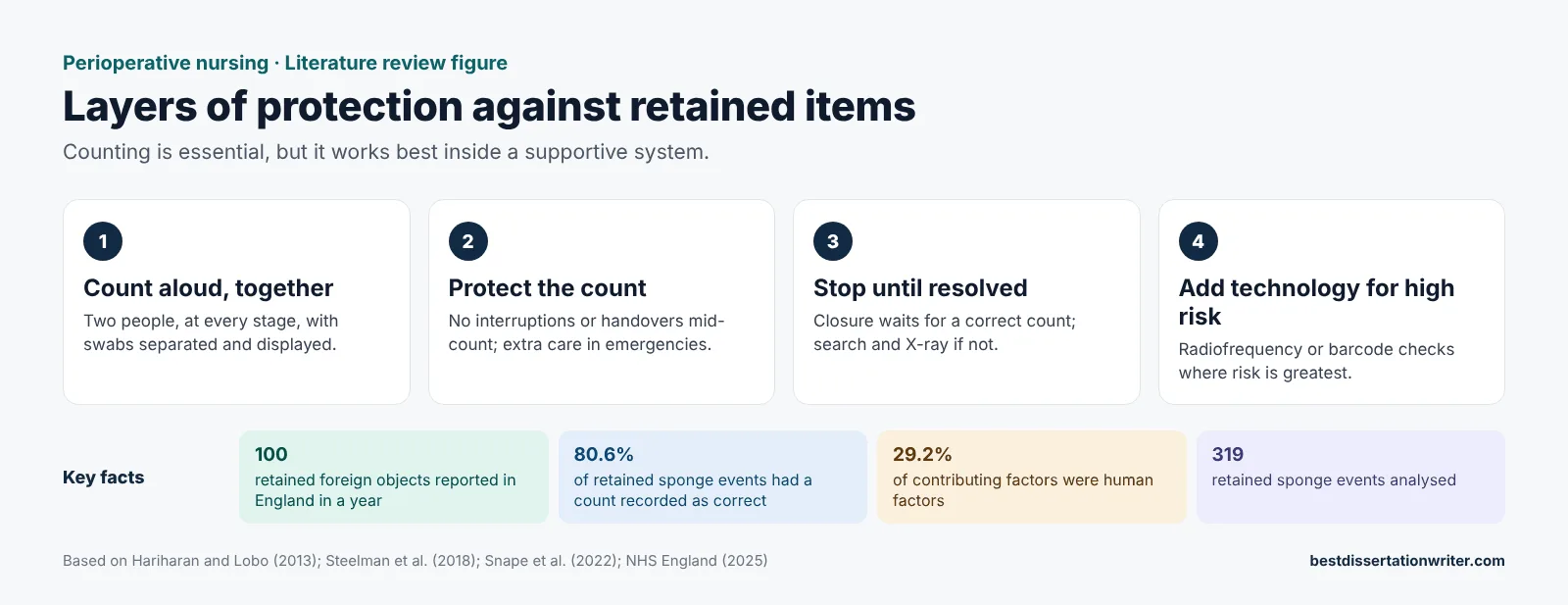
Counting procedures typically require items to be counted before the procedure starts, when items are added, before closure of a cavity, before skin closure and at the end of the procedure. Counts are performed aloud by two people, usually the scrub nurse and the circulating practitioner, and recorded on a count board or record. Swabs are separated and displayed after use so that they can be checked, and packs left inside the patient intentionally must be documented. Local policies set out what to do when a count is incorrect.
The concept of never events reflects the view that such incidents should not occur if robust systemic protective barriers are in place. However, critics argue that labelling events as never events may encourage blame of individuals rather than examination of the systems that allowed them to happen. A human factors approach recognises that counts are performed by people working in complex, interruptive environments, and that errors are more likely when systems are poorly designed or teams are under pressure.
Technology has been proposed to support manual counting. Radiofrequency detection systems use tags embedded in swabs that can be detected by a wand passed over the patient, while barcode systems require each swab to be scanned when it is opened and when it is removed. These technologies aim to provide an independent check that does not rely solely on human counting, but they add cost and require changes to workflow.
The consequences of retained surgical items extend beyond the immediate physical harm. Patients may need further imaging, a second operation and a longer hospital stay, and some experience lasting pain or loss of trust in their care. Staff involved can also be affected, particularly when an investigation focuses on individual blame. For these reasons, retained surgical items are a recurring subject of national safety alerts, professional guidance and local audit, and they are a useful case study for understanding how simple safety procedures succeed or fail in practice.
Search Strategy and Methods
Evidence for this example was identified through targeted searches of openly accessible bibliographic records, publisher websites and the reference lists of key reviews. Search terms combined keywords for the problem (“retained surgical items”, “retained foreign object”, “retained sponge”, “gossypiboma”) with terms for prevention (“swab counts”, “surgical count”, “scrub nurse”, “radiofrequency”, “barcode”, “never events”), joined with the Boolean operators AND and OR. A full narrative review for assessment would run the same strategy in CINAHL, PubMed/MEDLINE, the Cochrane Library and Embase and report the number of records screened in a PRISMA flow diagram.
Sources were eligible if they examined risk factors for, contributing factors to or strategies to prevent retained surgical items, or reported national incident data relevant to the United Kingdom. Because retained items are rare, randomised trials are not feasible, so case-control studies, incident analyses and reviews were included. Case reports of individual patients were excluded.
Five sources published between 2003 and 2025 were included: one case-control study, one narrative review of incidence and prevention, one descriptive analysis of 319 reported retained sponge events, one integrative review of prevention strategies and one national never events report from NHS England (Table 1). Research sources were appraised using the Critical Appraisal Skills Programme (CASP) checklist appropriate to their design, and findings were synthesised narratively.
Key Findings on Retained Surgical Items
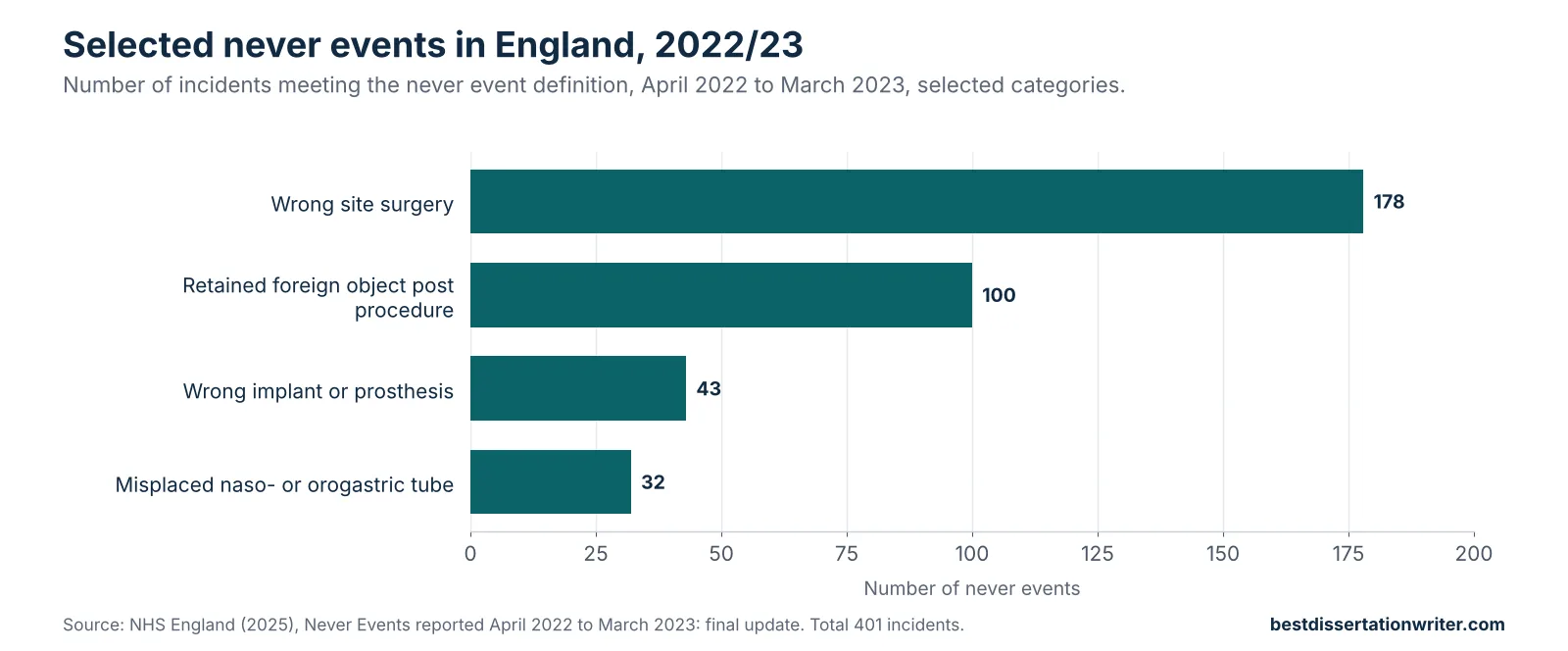
Three themes were identified: the frequency and risk factors of retained surgical items, the limitations of counting procedures and the human factors behind them, and adjunct strategies and technologies. Table 1 summarises the included sources, and Figure 1 places retained foreign objects in the context of other surgical never events reported in England.
| Author, year | Design | Setting and sample | Key finding |
|---|---|---|---|
| Gawande et al. (2003) | Case-control study | 54 cases from malpractice claims; over 230 controls | Emergency surgery, unplanned procedure changes and higher body weight increased risk. |
| Hariharan & Lobo (2013) | Narrative review | Studies published 2000–2012 | Manual counting fallible; sponges most often retained; barcode and radiofrequency systems promising. |
| Steelman et al. (2018) | Descriptive analysis of incident reports | 319 retained sponge events, 2012–2017 | Count reported correct in 80.6%; human factors, leadership and communication leading factors. |
| Snape et al. (2022) | Integrative review | 18 studies of prevention strategies | Count is the standard but human-based; adjunct technologies not yet ready for routine use. |
| NHS England (2025) | National incident data | Never events in England, April 2022–March 2023 | 100 retained foreign objects among 401 never events. |
Theme 1: Frequency and Risk Factors for Retained Surgical Items
NHS England (2025) reported that 401 incidents meeting the definition of a never event occurred in the year from April 2022 to March 2023. Of these, 100 were retained foreign objects after a procedure, second only to wrong site surgery with 178. Other categories included wrong implant or prosthesis (43) and misplaced nasogastric or orogastric tubes with feed administered (32). These figures show that retained items remain one of the most frequent never events despite long-standing counting procedures.
Gawande et al. (2003) studied 54 patients with retained instruments or sponges identified through malpractice claims and compared them with more than 230 control patients. Emergency surgery, unplanned changes in the procedure and higher body weight were associated with an increased risk, and emergency procedures carried a substantially higher risk. Because cases were identified from malpractice claims, the true incidence is likely to be underestimated. Hariharan and Lobo (2013) similarly identified emergency surgery, unexpected changes in procedure, raised body mass index and inaccurate counts as risk factors, and noted that sponges were the items most often retained.
Theme 2: The Limits of Swab Counts and Human Factors
Steelman et al. (2018) analysed 319 reported events of retained surgical sponges between 2012 and 2017. Sponges were most often retained in the abdomen or pelvis (50.2%) and the vagina (23.9%), and 32.7% of events occurred in labour and delivery rather than the operating room. Where a count was performed and its result documented, it was reported as correct in 80.6% of events. In other words, most retained sponges were left despite a count that appeared to be correct.
The analysis identified 1,430 contributing factors in 13 categories. The most frequent were human factors (29.2%), such as distraction, fatigue and inattention; leadership (27.6%), including inadequate policies and staffing; and communication (23.1%), such as failures in handover and team communication. In 69.6% of events, the harm was unexpected additional care or an extended stay, and one patient died. These findings show that retained surgical items are rarely the result of a single individual’s mistake.
The finding that counts were usually recorded as correct is striking. It suggests that counts can be performed incompletely, inaccurately or under pressure without the error being detected, for example when swabs are miscounted, when a count is rushed during a change of staff or when items are not separated and displayed. Swab counts are therefore an essential but fallible barrier, and their reliability depends on the conditions in which they are performed.
Theme 3: Adjunct Strategies and Technologies
Hariharan and Lobo (2013) concluded that manual counting is the current method of prevention but is fallible, and that barcode-based and radiofrequency-tagged sponge systems had shown success in trials. They emphasised the importance of vigilance by theatre staff and called for prospective multicentre trials of technologies that aid manual counting.
Snape et al. (2022) integrated 18 studies of strategies to prevent retained surgical items and grouped them into the surgical count, radiography, radiofrequency technology, barcode technology and other technologies. The surgical count remained the recommended strategy but was described as a human-based process that does not fully prevent retained items. Adjunct technologies were judged not yet ready for routine use, and further research on their effectiveness and cost-effectiveness was recommended.
Discussion
This review shows that retained surgical items continue to occur despite counting procedures, that emergency and complex procedures carry higher risk and that most events reflect a combination of human factors, leadership and communication rather than individual failure alone. Counts are often recorded as correct even when an item has been retained, demonstrating that counting is a necessary but imperfect barrier.
A human factors perspective helps to explain these findings. Counting is a repetitive task performed alongside many other demands, in an environment full of interruptions, alarms and time pressure. Shift changes during long procedures, inexperienced staff, unfamiliar equipment and emergencies all increase the risk of error. Designing counting procedures that minimise interruptions, require counts to be performed aloud by two people and prevent closure until counts are reconciled can make the process more reliable.
Leadership and culture are equally important. The scrub nurse must feel able to stop closure if a count is incorrect, and surgeons must respond by searching rather than dismissing the concern. Steelman et al. (2018) found that leadership and communication were among the most common contributing factors, which suggests that team culture, staffing and policy are as important as individual technique. The WHO surgical safety checklist’s sign-out provides a structured point to confirm counts, but only if it is performed fully.
Technology offers a potential additional layer of protection, particularly in high-risk procedures such as emergency abdominal surgery and obstetrics. However, the evidence for routine use remains limited, costs are significant and new technologies introduce their own workflow challenges. A reasonable approach may be to target adjunct technologies to high-risk situations while continuing to strengthen manual counting for all procedures, and to evaluate their impact carefully.
The setting in which retained surgical items occur also deserves attention. Steelman et al. (2018) found that around a third of retained sponge events happened in labour and delivery rather than the main operating room. Vaginal deliveries and perineal repairs may not always be treated with the same counting discipline as formal operations, and staff in maternity units may have less training in theatre counting procedures. Extending consistent counting practice to every setting where swabs are used, including procedure rooms and delivery suites, is therefore an important implication of the evidence.
The evidence base has limitations. Retained surgical items are rare, so studies rely on incident reports and claims, which are subject to under-reporting and reporting bias. National data may include events that do not strictly meet definitions, and contributing factor analyses depend on the quality of investigations. This review relied on openly accessible, English-language sources and, as a narrative review, did not use formal systematic screening. Future research should evaluate counting practices through observation and test adjunct technologies in multicentre studies.
Implications of Retained Surgical Items Evidence for Practice
For perioperative nurses, the evidence supports performing swab counts aloud with two people at every defined stage, minimising interruptions during counts, separating and displaying used swabs, documenting intentionally retained packs and refusing to accept closure until discrepancies are resolved. Theatre managers should ensure adequate staffing, protect handovers during long cases, provide training in counting procedures and human factors, and investigate events in a just culture. The NHS England never events data can be used to benchmark local practice.
Education is a further priority. Newly qualified nurses, operating department practitioners and staff rotating into theatres need structured training in counting procedures, supervised practice and regular updates. Simulation of count discrepancies can help teams rehearse how to stop, search and escalate without conflict. Audit of counting practice, rather than only of incidents, can reveal weaknesses before harm occurs, and sharing learning from local and national investigations of retained surgical items helps to keep the risk visible to all members of the team.
Counting is confirmed during the sign-out of the WHO surgical safety checklist, and retained items are among the most common never events. Careful handling and positioning during long procedures also help to prevent perioperative pressure injuries, and clear information given before surgery can reduce preoperative anxiety for patients who may later need further procedures.
Conclusion
This narrative review examined why retained surgical items still occur and how they can be prevented. Emergency and complex procedures increase risk, most events involve human factors, leadership and communication, and counts are frequently recorded as correct even when an item has been left behind. Adjunct technologies show promise but are not yet established.
Preventing retained surgical items requires disciplined counting, supportive leadership and a culture in which the scrub nurse’s concerns are acted upon. By combining reliable counts with human factors principles and, where appropriate, adjunct technology, perioperative teams can strengthen the barriers that protect patients from this preventable harm.
References
Gawande, A. A., Studdert, D. M., Orav, E. J., Brennan, T. A., & Zinner, M. J. (2003). Risk factors for retained instruments and sponges after surgery. New England Journal of Medicine, 348(3), 229–235. https://doi.org/10.1056/NEJMsa021721
Hariharan, D., & Lobo, D. N. (2013). Retained surgical sponges, needles and instruments. Annals of the Royal College of Surgeons of England, 95(2), 87–92. https://doi.org/10.1308/003588413X13511609957218
NHS England. (2025). Never Events reported as occurring between April 2022 and March 2023: Final update. https://www.england.nhs.uk/long-read/never-events-reported-as-occurring-between-april-2022-and-march-2023-final-update/
Snape, A. J., Duff, J., Gumuskaya, O., Inder, K., & Hutton, A. (2022). Strategies to prevent inadvertent retained surgical items: An integrative review. Journal of Perioperative Nursing, 35(4), e-11–e-17. https://doi.org/10.26550/2209-1092.1196
Steelman, V. M., Shaw, C., Shine, L., & Hardy-Fairbanks, A. J. (2018). Retained surgical sponges: A descriptive study of 319 occurrences and contributing factors from 2012 to 2017. Patient Safety in Surgery, 12, 20. https://doi.org/10.1186/s13037-018-0166-0
Cite this example
Best Dissertation Writers (2026) Prevention of Retained Surgical Items and the Effectiveness of Counting Procedures: A Literature Review. Available at: https://bestdissertationwriter.com/retained-surgical-items-review-review/
Best Dissertation Writers
Get expert help with your nursing literature review
Share your topic and deadline with Best Dissertation Writers and get support tailored to your module brief.