

Day Surgery Nursing: Preparation, Recovery, and Safe Discharge: A Scoping Review
 By Dr. Robertson Prime, Research Fellow
Updated October 26, 2026
14 min read
About 2,900 words
In this review
Abstract
Background: Day surgery, in which patients are admitted, operated on and discharged on the same day, now accounts for a large share of elective operations. Day surgery nursing covers preoperative assessment, preparation, recovery, discharge and follow-up, often within a few hours, and much of the patient’s recovery takes place at home.
Aim: This scoping review aimed to map evidence on the safety of day case surgery, unplanned admission, recovery at home and the nursing contribution to preparation, discharge and follow-up.
Methods: Evidence was identified through targeted searches of openly accessible bibliographic records, publisher websites and the reference lists of key reviews. Five sources published between 2006 and 2013 were included: three systematic reviews, one case-control study and one cross-sectional study. Findings were charted and summarised descriptively.
Findings: A Cochrane review found day surgery for laparoscopic cholecystectomy to be as safe as an overnight stay. Unanticipated admission occurred after 2.67% of ambulatory procedures and was associated with longer surgery, higher ASA class, age over 80 and obesity. After discharge, 26% of patients had moderate to severe pain on the day of surgery and 9% still did on day 4. Patients valued pre-admission contact, specific information and privacy, and nurse-led telephone follow-up was acceptable and cheaper than clinic review.
Conclusion: Day case surgery is safe for selected patients, but recovery continues at home. Day surgery nursing should focus on careful selection, tailored information, effective analgesia planning and structured follow-up after discharge.
Keywords: day surgery nursing, ambulatory surgery, day case surgery
Introduction
This scoping review critically examines recent evidence on day surgery nursing and its implications for perioperative nursing practice.
Day surgery has transformed elective surgical care. Operations that once required several days in hospital, such as hernia repair, cholecystectomy, arthroscopy and many gynaecological and urological procedures, are now routinely performed with the patient going home the same day. Day case surgery offers advantages for patients, who can recover in familiar surroundings, and for health services, which can treat more patients without increasing bed capacity.
These benefits depend on careful organisation. Patients must be selected appropriately, prepared well in advance, recover quickly from anaesthesia and surgery and go home with adequate support and information. Nurses are central at every stage: they run preoperative assessment clinics, prepare patients on the day, care for them in recovery, make discharge decisions under agreed criteria and provide follow-up after discharge. Day surgery nursing is therefore a distinct area of practice that combines perioperative skills with health education and discharge planning.
A scoping review approach was chosen because the evidence spans different questions and designs, and the aim was to map the main findings rather than to answer a single effectiveness question.
The topic matters because day surgery continues to expand, including to older patients and more complex procedures, and because the shift of recovery from hospital to home places new responsibilities on nurses to prepare patients and their carers. Understanding the evidence helps nurses and managers to design day surgery pathways that are safe, efficient and centred on patients.
Review question
What does the evidence show about the safety of day case surgery, the reasons for unplanned admission, recovery at home and patients’ experience of nursing care, and what follow-up is effective after discharge?
Background to Day Surgery Nursing
In the United Kingdom, day surgery is generally defined as a planned procedure in which the patient is admitted and discharged on the same day, with day surgery intended as the planned outcome. Ambulatory surgery is a broader international term that may also include short stays of up to 23 hours. National bodies have long encouraged day surgery as the default for suitable procedures, and day surgery units may be stand-alone or integrated within main theatre complexes.
Patient selection is based on the procedure, the patient’s health and social circumstances. Many units now focus less on rigid limits for age or body mass index and more on whether the patient’s conditions are stable and optimised, whether they understand the plan and whether they have a responsible adult and suitable home circumstances after discharge. Preoperative assessment, often led by nurses, identifies risks and provides education about fasting, medication, the procedure and recovery.
Discharge is usually nurse-led against agreed criteria, such as stable vital signs, adequate pain control, ability to tolerate fluids, minimal nausea, ability to mobilise and the presence of a responsible adult. Patients are given written and verbal information about pain relief, wound care, warning signs and whom to contact if problems arise. Many units telephone patients the day after surgery to check on their recovery.
The main challenges of ambulatory surgery are unplanned admission, inadequate pain control at home, postoperative nausea and vomiting and patients’ anxiety about managing their own recovery. Each of these has implications for the quality of day surgery nursing, from preparation to follow-up, and each has been the subject of research that can inform practice in day surgery nursing.
The scope of day surgery nursing has grown with the complexity of the procedures performed. Nurses in day units may now care for patients after joint replacement, laparoscopic abdominal surgery or breast surgery, as well as more traditional minor procedures. This expansion requires nurses to combine high-volume efficiency with the clinical judgement needed to recognise patients who are not recovering as expected and who may need to stay in hospital.
Search Strategy and Methods
Evidence for this example was identified through targeted searches of openly accessible bibliographic records, publisher websites and the reference lists of key reviews. Search terms combined keywords for the setting (“day surgery nursing”, “day case surgery”, “ambulatory surgery”, “same-day discharge”) with terms for outcomes and care (“unplanned admission”, “postoperative pain”, “patient experience”, “telephone follow-up”, “discharge”), joined with the Boolean operators AND and OR. A full scoping review for assessment would follow the JBI scoping review method, run the same strategy in CINAHL, PubMed/MEDLINE, the Cochrane Library and Embase and report the number of records screened in a PRISMA-ScR flow diagram.
Sources were eligible if they examined the safety of day surgery, unplanned admission after ambulatory surgery, recovery at home, patients’ experience of day surgery nursing or follow-up after discharge from surgery. Systematic reviews and primary studies of adults were included. Studies of children and of procedures performed under local anaesthesia in outpatient clinics were excluded.
Five sources published between 2006 and 2013 were included: a systematic review of patients’ experience of day surgery nursing, a Cochrane review comparing day surgery with overnight stay for laparoscopic cholecystectomy, a systematic review of telephone follow-up after surgery, a case-control study of unanticipated admission and a cross-sectional study of pain at home (Table 1). Consistent with scoping review methods, findings were charted and summarised descriptively rather than formally appraised.
Key Findings on Day Surgery Nursing
Three themes were identified: the safety of day case surgery and unplanned admission, recovery and pain at home, and patients’ experience of preparation, information and follow-up. Table 1 summarises the included sources, and Figure 1 shows how pain at home changed over the first four days after ambulatory surgery.
| Author, year | Design | Setting and sample | Key finding |
|---|---|---|---|
| Rhodes et al. (2006) | Systematic review of qualitative evidence | Patients’ experience of day surgery nursing | Patients valued pre-admission contact, specific information, communication and privacy. |
| Gramke et al. (2007) | Cross-sectional study | 648 day case surgery patients | 26% had moderate to severe pain on the day of surgery and 9% on day 4. |
| Vaughan et al. (2013) | Cochrane systematic review | 6 trials; 492 participants | Day surgery as safe as overnight stay for laparoscopic cholecystectomy. |
| Whippey et al. (2013) | Case-control study | 200 cases and 200 controls from 20,657 procedures | Unanticipated admission 2.67%; linked to longer surgery, ASA III–IV, age over 80, obesity. |
| Thompson-Coon et al. (2013) | Systematic review | 4 studies of telephone follow-up | Telephone follow-up acceptable and cheaper; evidence of poor quality. |
Theme 1: Safety of Day Case Surgery and Unplanned Admission
Vaughan et al. (2013) compared day surgery with overnight stay for laparoscopic cholecystectomy in six randomised trials with 492 participants. There were no significant differences in serious adverse events (7 of 191 with day surgery and 1 of 200 with overnight stay; rate ratio 3.24, 95% CI 0.74 to 14.09), quality of life, pain, return to normal activity, readmission or failed discharge. The authors concluded that day surgery appeared just as safe as an overnight stay, although the trials were small and at high risk of bias.
Whippey et al. (2013) studied unanticipated admission after 20,657 ambulatory procedures in three Canadian hospitals, comparing 200 admitted patients with 200 who went home. The incidence of unanticipated admission was 2.67%, and the reasons were surgical (40%), anaesthetic (20%) and medical (19%). Surgery lasting one to three hours (odds ratio 16.70) or more than three hours (4.26), ASA class III (4.60) or IV (6.51), age over 80 (5.41) and a body mass index of 30 to 35 (2.81) increased the risk. Specific comorbidities were not associated with admission, and the authors supported using ASA class as a marker of risk.
These findings suggest that day case surgery is safe for appropriately selected patients and that the risk of unplanned admission can be anticipated to some extent. Longer operations, frailer patients and higher ASA classes need careful planning, such as scheduling early on a list, ensuring that a bed is available if needed and preparing the patient for the possibility of an overnight stay.
Theme 2: Recovery and Pain at Home After Ambulatory Surgery
Gramke et al. (2007) followed 648 patients after day case surgery in a Dutch university hospital. On the day of surgery, 26% reported moderate to severe pain, defined as a mean visual analogue score above 40 mm. This fell to 21% on the first postoperative day, 13% on the second, 10% on the third and 9% on the fourth. Operations on the nose and pharynx, abdominal operations, breast plastic surgery and orthopaedic operations were the most painful in the first 48 hours.
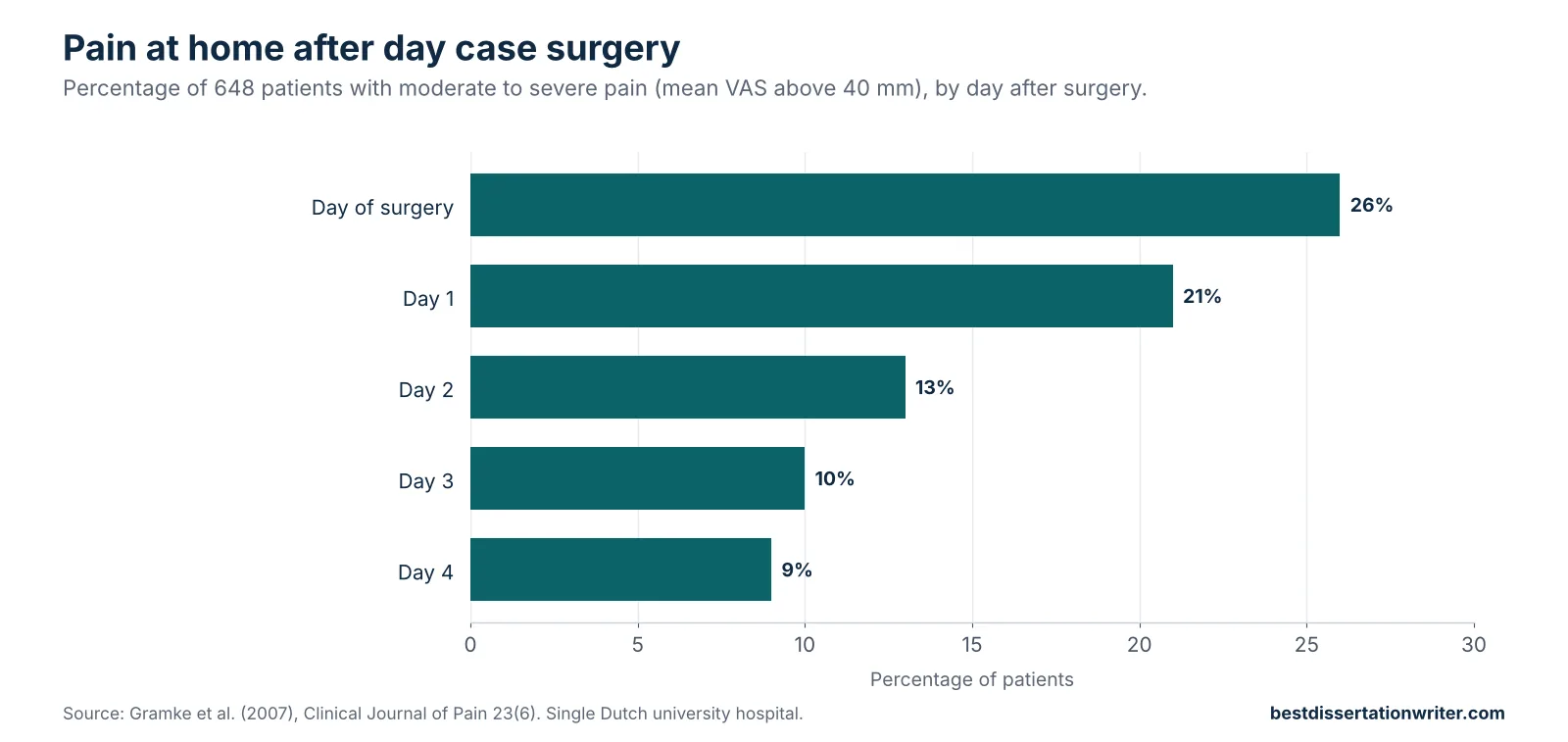
These findings show that a substantial minority of patients experience significant pain at home, when they no longer have direct access to nursing care. Because the most painful procedures could be identified, the authors recommended that analgesia be planned according to the type of operation. For nurses, this highlights the importance of providing take-home analgesia, clear instructions on regular dosing and advice on what to do if pain is not controlled.
Theme 3: Information, Experience and Follow-Up in Day Surgery Nursing
Rhodes et al. (2006) systematically reviewed qualitative evidence on patients’ experience of nursing care in day surgery. Patients valued pre-admission contact, relevant and specific education and information, good communication skills and the maintenance of privacy throughout their care. The review suggests that the short time patients spend in hospital makes the quality of each nursing interaction particularly important.
Thompson-Coon et al. (2013) reviewed telephone consultations in place of face-to-face outpatient follow-up after surgery. Only four studies were included, and their quality was poor, but patients were generally satisfied with telephone follow-up, and one study found higher satisfaction with nurse-led telephone follow-up than with clinic review. Telephone follow-up was also estimated to be cheaper. The authors called for better-quality research before firm conclusions could be drawn.
Discussion
This scoping review shows that day case surgery is safe for appropriately selected patients, that unplanned admission is relatively uncommon but more likely with longer surgery and higher-risk patients, that a significant minority of patients have moderate to severe pain at home and that patients value preparation, specific information and privacy. Nurse-led telephone follow-up appears acceptable and less costly than clinic review, although the evidence is limited.
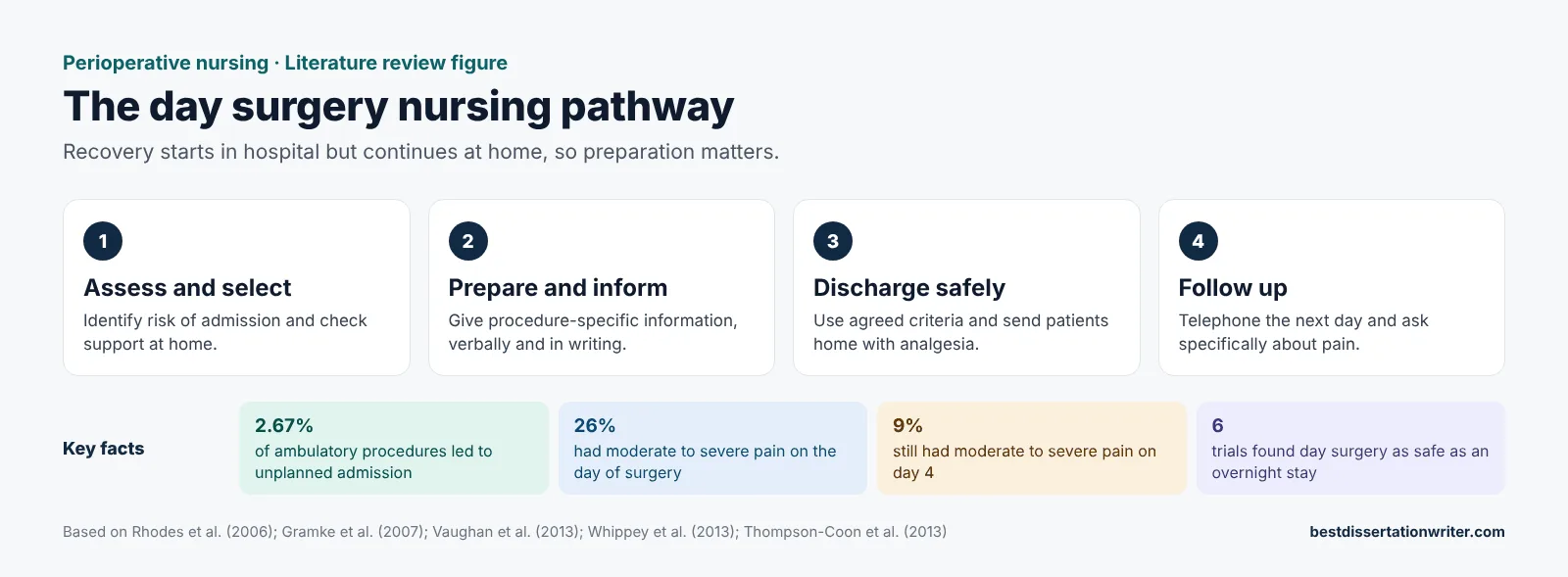
Together, these findings emphasise that recovery from ambulatory surgery continues well beyond discharge. The patient and their carer take on much of the monitoring and management that would otherwise be done by ward nurses, which makes preparation and education central to day surgery nursing. Information about pain relief, wound care, warning signs and whom to contact should be specific to the procedure and given both verbally and in writing.
Preoperative assessment is a key opportunity. Nurses can identify patients at higher risk of unplanned admission, optimise conditions where possible, explain the pathway and check that support at home is in place. They can also address concerns that contribute to preoperative anxiety, which may be heightened when patients know they will be going home soon after their operation.
Postoperative nausea and vomiting is another common reason for delayed discharge and distress at home. Identifying patients at higher risk, giving prophylaxis according to local protocols and advising patients on what to do if symptoms continue after discharge are practical steps that support a smooth recovery.
Pain management at home needs particular attention. The finding that around one in ten patients still had moderate to severe pain on the fourth day suggests that standard advice may not be sufficient for some procedures. Procedure-specific analgesia plans, supply of adequate take-home medication and follow-up calls that ask specifically about pain can help to identify and address problems early.
The efficiency of day case surgery also depends on the reliability of theatre processes, from list planning to the availability of sterile instruments. Day surgery units often have high turnover, short cases and tight scheduling, so delays in sterilisation services, equipment availability or staffing can lead to cancellations and late discharges. The scrub nurse and wider theatre team contribute to a smooth list by preparing equipment in advance and coordinating turnaround between cases.
The findings also have implications for the skills and roles of the workforce. Day surgery nursing requires confidence in nurse-led assessment and discharge, skills in patient education and the ability to manage a rapid flow of patients without losing sight of individual needs. Experienced nurses who can make discharge decisions against agreed criteria help to prevent unnecessary overnight stays, while recognising when a patient is not ready to go home.
Carers and family members are an often overlooked part of the pathway. Because the responsible adult will support the patient overnight, they also need information about pain relief, warning signs and whom to contact. Involving carers in discharge conversations, where the patient agrees, is a simple way for day surgery nursing to extend safe care into the home.
The evidence base has limitations. Several included sources were published more than a decade ago, the Cochrane review covered only one procedure, the admission study was conducted in Canada and the pain study in one Dutch hospital. The telephone follow-up review included few, poor-quality studies. This review relied on openly accessible, English-language sources and did not involve formal systematic screening. Future research should examine recovery at home after a wider range of procedures, evaluate digital follow-up and include older patients and those with more complex needs.
Implications of Day Surgery Nursing Evidence for Practice
For nurses, the evidence supports thorough nurse-led preoperative assessment, identification of patients at higher risk of unplanned admission, procedure-specific information and analgesia plans, privacy and good communication throughout the patient’s stay, criteria-led discharge with written information and structured telephone follow-up after discharge. Professional resources on day surgery practice are available from the British Association of Day Surgery.
Managers should ensure that day surgery units have dedicated preoperative assessment services, appropriate patient selection policies, contingency arrangements for unplanned admission and capacity for follow-up calls. Audit of unplanned admissions, pain at home and patient experience can help units to monitor quality and target improvements in day surgery nursing. Investment in education and preceptorship for new staff can help to build the specific competencies that day surgery nursing requires.
Conclusion
This scoping review mapped evidence on the safety, outcomes and nursing care of day case surgery. Day surgery is safe for appropriately selected patients, unplanned admission is linked to longer operations and higher-risk patients and many patients experience pain at home. Patients value preparation, specific information and privacy, and telephone follow-up is acceptable.
Day surgery nursing extends from the preoperative assessment clinic to the patient’s home. By selecting and preparing patients carefully, planning analgesia according to the procedure and following patients up after discharge, nurses can ensure that the benefits of ambulatory surgery are achieved safely.
References
Gramke, H. F., de Rijke, J. M., van Kleef, M., Raps, F., Kessels, A. G., Peters, M. L., Sommer, M., & Marcus, M. A. (2007). The prevalence of postoperative pain in a cross-sectional group of patients after day-case surgery in a university hospital. Clinical Journal of Pain, 23(6), 543–548. https://doi.org/10.1097/AJP.0b013e318074c970
Rhodes, L., Miles, G., & Pearson, A. (2006). Patient subjective experience and satisfaction during the perioperative period in the day surgery setting: A systematic review. International Journal of Nursing Practice, 12(4), 178–192. https://doi.org/10.1111/j.1440-172X.2006.00575.x
Thompson-Coon, J., Abdul-Rahman, A.-K., Whear, R., Bethel, A., Vaidya, B., Gericke, C. A., & Stein, K. (2013). Telephone consultations in place of face to face out-patient consultations for patients discharged from hospital following surgery: A systematic review. BMC Health Services Research, 13, 128. https://doi.org/10.1186/1472-6963-13-128
Vaughan, J., Gurusamy, K. S., & Davidson, B. R. (2013). Day-surgery versus overnight stay surgery for laparoscopic cholecystectomy. Cochrane Database of Systematic Reviews, (7), CD006798. https://doi.org/10.1002/14651858.CD006798.pub4
Whippey, A., Kostandoff, G., Paul, J., Ma, J., Thabane, L., & Ma, H. K. (2013). Predictors of unanticipated admission following ambulatory surgery: A retrospective case-control study. Canadian Journal of Anesthesia, 60(7), 675–683. https://doi.org/10.1007/s12630-013-9935-5
Cite this example
Best Dissertation Writers (2026) Day Surgery Nursing: Preparation, Recovery, and Safe Discharge: A Scoping Review. Available at: https://bestdissertationwriter.com/day-surgery-nursing-literature-review/
Best Dissertation Writers
Get expert help with your nursing literature review
Share your topic and deadline with Best Dissertation Writers and get support tailored to your module brief.