Nursing Management of Postoperative Nausea and Vomiting: A Systematic Review
 By Dr. Robertson Prime, Research Fellow
Updated October 26, 2026
14 min read
About 2,800 words
In this review
Abstract
Background: Postoperative nausea and vomiting (PONV) is one of the most common and distressing complications after anaesthesia. It delays recovery and discharge, increases the risk of dehydration and wound strain, and is often rated by patients as worse than pain. Nurses assess risk, give prophylactic and rescue antiemetics and offer non-pharmacological measures.
Aim: This systematic review aimed to examine the evidence on risk assessment, pharmacological prophylaxis and non-pharmacological interventions for postoperative nausea and vomiting in adults.
Methods: Evidence was identified through targeted searches of openly accessible bibliographic records, publisher websites and the reference lists of key reviews. Five sources published between 1999 and 2025 were included: a risk score validation study, a large factorial randomised trial and three Cochrane reviews, appraised using CASP checklists and synthesised narratively.
Findings: The incidence of PONV rose from 10% with none to 79% with all four simple risk factors: female sex, non-smoking, previous PONV or motion sickness and postoperative opioids. Ondansetron, dexamethasone and droperidol each reduced risk by about 26%, and their effects were independent and additive. A network meta-analysis of 585 trials confirmed that several antiemetics reliably reduce vomiting. PC6 acupoint stimulation reduced nausea and vomiting compared with sham, and aromatherapy may reduce the need for rescue antiemetics, although certainty was low.
Conclusion: Risk-based prophylaxis with antiemetics, supported by non-pharmacological measures, can reduce postoperative nausea and vomiting. Nurses play a key role in assessing risk, delivering prophylaxis and providing prompt treatment.
Keywords: postoperative nausea and vomiting, PONV, antiemetics, non-pharmacological
Introduction
This systematic review critically examines recent evidence on postoperative nausea and vomiting and its implications for perioperative nursing practice.
Feeling sick and vomiting after an operation are among the experiences patients fear most. Without preventive measures, a substantial proportion of surgical patients are affected, and in high-risk groups the majority may experience symptoms. Beyond the distress it causes, vomiting can strain wounds, increase the risk of aspiration, cause dehydration and electrolyte imbalance, delay eating and drinking and prolong stays in recovery and hospital. In day surgery, it is a common reason for unplanned overnight admission.
Postoperative nausea and vomiting, usually abbreviated to PONV, has many causes. Patient factors, the type of anaesthesia, the use of opioids and the type and duration of surgery all contribute. Because the causes are multiple, prevention and treatment usually combine several approaches, including identifying patients at risk, adjusting the anaesthetic technique, giving prophylactic antiemetics and offering non-pharmacological measures.
A systematic review approach was chosen to focus on a validated risk score, a large randomised trial and Cochrane reviews, which provide the strongest available evidence.
The question matters for perioperative nurses because they assess patients before surgery, administer prescribed antiemetics, monitor for symptoms in recovery and on the ward and provide comfort measures. Their actions can determine whether symptoms are prevented, detected early and treated effectively.
Review question
How can patients at risk of postoperative nausea and vomiting be identified, how effective are antiemetics for prevention, and what is the evidence for non-pharmacological interventions?
Background to Postoperative Nausea and Vomiting
Nausea is an unpleasant sensation of the urge to vomit, while vomiting is the forceful expulsion of stomach contents. Retching is the effort of vomiting without expulsion. These symptoms are controlled by complex pathways in the brain that respond to signals from the gut, the inner ear, higher brain centres and chemicals in the blood. Different antiemetic drugs act on different receptors in these pathways, which is why combinations of drugs can be more effective than single agents.
Risk factors include female sex, a history of PONV or motion sickness, being a non-smoker and the use of opioids after surgery. Volatile anaesthetics and nitrous oxide increase risk, while total intravenous anaesthesia with propofol may reduce it. Longer operations and some types of surgery, such as laparoscopic, gynaecological and ear, nose and throat procedures, have also been associated with higher risk.
Antiemetics commonly used in the United Kingdom include serotonin antagonists such as ondansetron, corticosteroids such as dexamethasone, dopamine antagonists such as droperidol and cyclizine, which is an antihistamine. Newer drugs, such as neurokinin-1 antagonists, are used in some high-risk patients. Each drug has potential side effects, and the choice depends on patient factors, cost and local guidance.
Non-pharmacological interventions include stimulation of the PC6 acupoint on the inner wrist, using pressure bands or electrical devices, and aromatherapy, such as inhaling peppermint oil or isopropyl alcohol. Other measures, such as adequate hydration, avoiding prolonged fasting, gentle movement and good pain control, may also help. These approaches are attractive because they are low-cost, have few side effects and can be offered by nurses.
Patients’ own priorities make this complication especially important. Many patients regard nausea and vomiting as one of the worst aspects of their surgical experience, and anxiety about being sick can add to distress before an operation. Asking patients about previous experiences of postoperative nausea and vomiting, and reassuring them that measures will be taken, is part of compassionate preoperative care.
Search Strategy and Methods
Evidence for this example was identified through targeted searches of openly accessible bibliographic records, publisher websites and the reference lists of key reviews. Search terms combined keywords for the problem (“postoperative nausea and vomiting”, “PONV”) with terms for assessment and interventions (“risk score”, “antiemetics”, “prophylaxis”, “acupressure”, “PC6”, “aromatherapy”, “non-pharmacological”), joined with the Boolean operators AND and OR. A full systematic review for assessment would run the same strategy in CINAHL, PubMed/MEDLINE, the Cochrane Library and Embase and report the number of records screened in a PRISMA flow diagram.
Sources were eligible if they were studies of risk prediction, randomised trials or systematic reviews of interventions for preventing or treating PONV in adults. Studies of children and of nausea and vomiting caused by chemotherapy were excluded.
Five sources published between 1999 and 2025 were included: a two-centre validation of a simplified risk score, a factorial randomised trial of six interventions and three Cochrane reviews of drugs for prevention, PC6 acupoint stimulation and aromatherapy (Table 1). Each source was appraised using the Critical Appraisal Skills Programme (CASP) checklist appropriate to its design, and findings were synthesised narratively and grouped into themes.
Key Findings on Postoperative Nausea and Vomiting
Three themes were identified: assessing the risk of PONV, pharmacological prophylaxis with antiemetics and non-pharmacological interventions. Table 1 summarises the included sources, and Figure 1 shows how the incidence of symptoms rises with the number of risk factors.
| Author, year | Design | Setting and sample | Key finding |
|---|---|---|---|
| Apfel et al. (1999) | Risk score validation study | 2,722 adults at two centres | Incidence rose from 10% (no risk factors) to 79% (four risk factors). |
| Apfel et al. (2004) | Factorial randomised controlled trial | 5,199 high-risk patients | Ondansetron, dexamethasone and droperidol each reduced risk by about 26%; effects additive. |
| Hines et al. (2018) | Cochrane systematic review | 16 studies; 1,036 participants | Aromatherapy may reduce rescue antiemetic use (RR 0.60); isopropyl alcohol gave faster relief. |
| Weibel et al. (2020) | Cochrane network meta-analysis | 585 trials; 97,516 adults | Several drugs reliably reduce vomiting; combinations more effective. |
| Lee et al. (2025) | Cochrane network meta-analysis | Trials of PC6 acupoint stimulation | Reduced nausea (RR 0.68) and vomiting (RR 0.60) versus sham; similar to antiemetics. |
Theme 1: Assessing Risk of Postoperative Nausea and Vomiting
Apfel et al. (1999) cross-validated risk scores from two centres in Finland and Germany, involving 520 and 2,202 adults who received inhalational anaesthesia without prophylaxis. A simplified score based on four predictors, female sex, a history of motion sickness or PONV, non-smoking and the use of postoperative opioids, retained good discrimination. The incidence of postoperative nausea and vomiting was 10%, 21%, 39%, 61% and 79% when none, one, two, three or four risk factors were present. The authors suggested considering prophylaxis for patients with at least two risk factors.
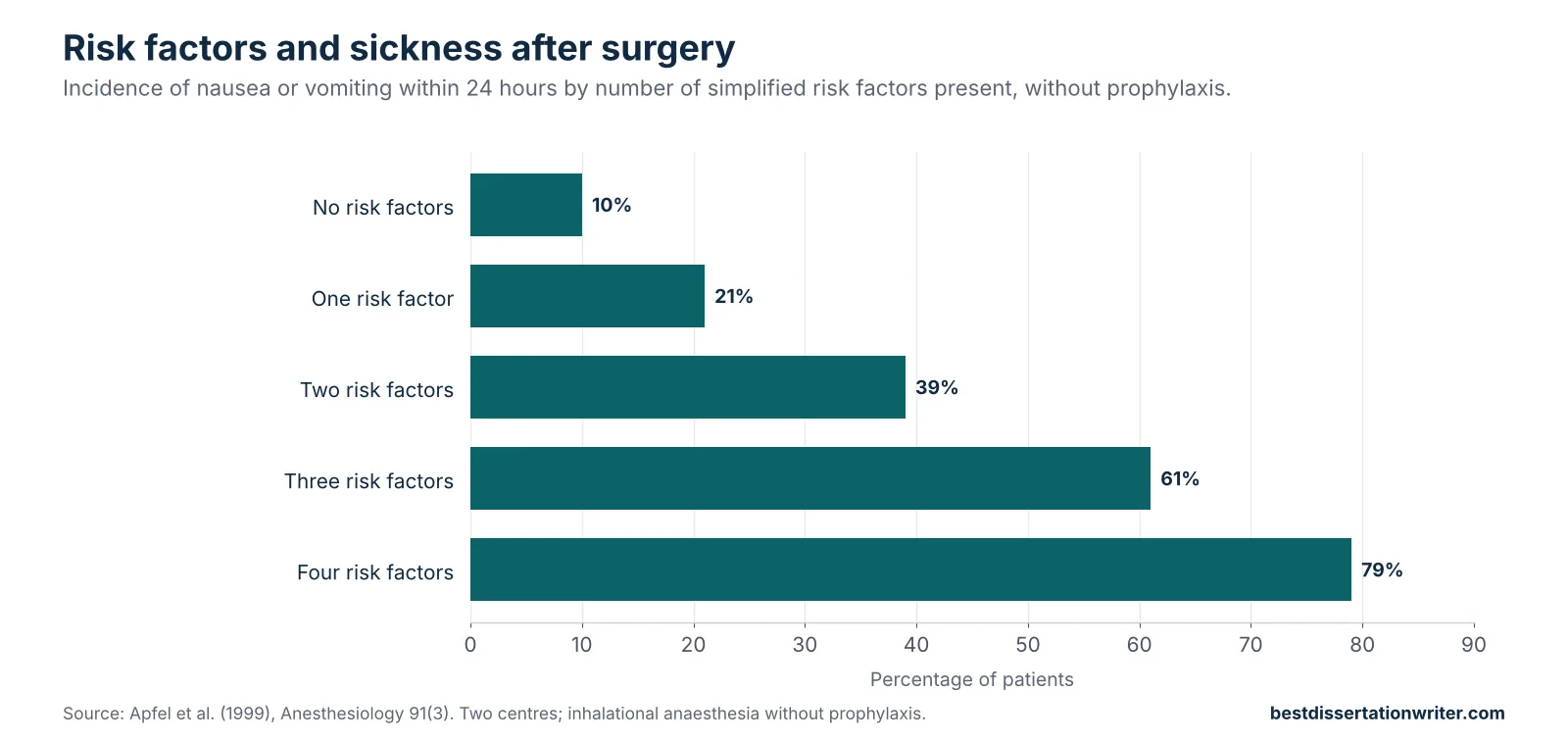
This simple score is widely used because it can be completed quickly at preoperative assessment or on admission. It allows nurses and anaesthetists to identify patients at higher risk and plan prophylaxis accordingly, and it helps to explain to patients why certain measures are recommended for them. Because it was developed in patients receiving inhalational anaesthesia without prophylaxis, its predictions are best treated as a guide to relative risk rather than an exact forecast for every patient.
Theme 2: Antiemetics for Prevention
Apfel et al. (2004) randomised 5,199 high-risk patients in a factorial trial of six interventions. Ondansetron, dexamethasone and droperidol each reduced the risk of PONV by about 26%, propofol by 19% and replacing nitrous oxide with nitrogen by 12%. The interventions acted independently of each other and of baseline risk, so their effects could be combined by multiplying relative risks. Because the absolute benefit depended on baseline risk, the authors recommended that prophylaxis be rarely used for low-risk patients, that a single intervention be considered for moderate-risk patients and that multiple interventions be reserved for high-risk patients.
Weibel et al. (2020) conducted a network meta-analysis of 585 trials with 97,516 adults. Compared with placebo, several drugs reduced vomiting within 24 hours with high-certainty evidence, including aprepitant (risk ratio 0.26), ramosetron (0.44), granisetron (0.45), dexamethasone (0.51) and ondansetron (0.55), while droperidol (0.61) and fosaprepitant (0.06) probably did so. Combinations of drugs generally worked better than single drugs. Evidence on side effects was too limited to rank the drugs by tolerability.
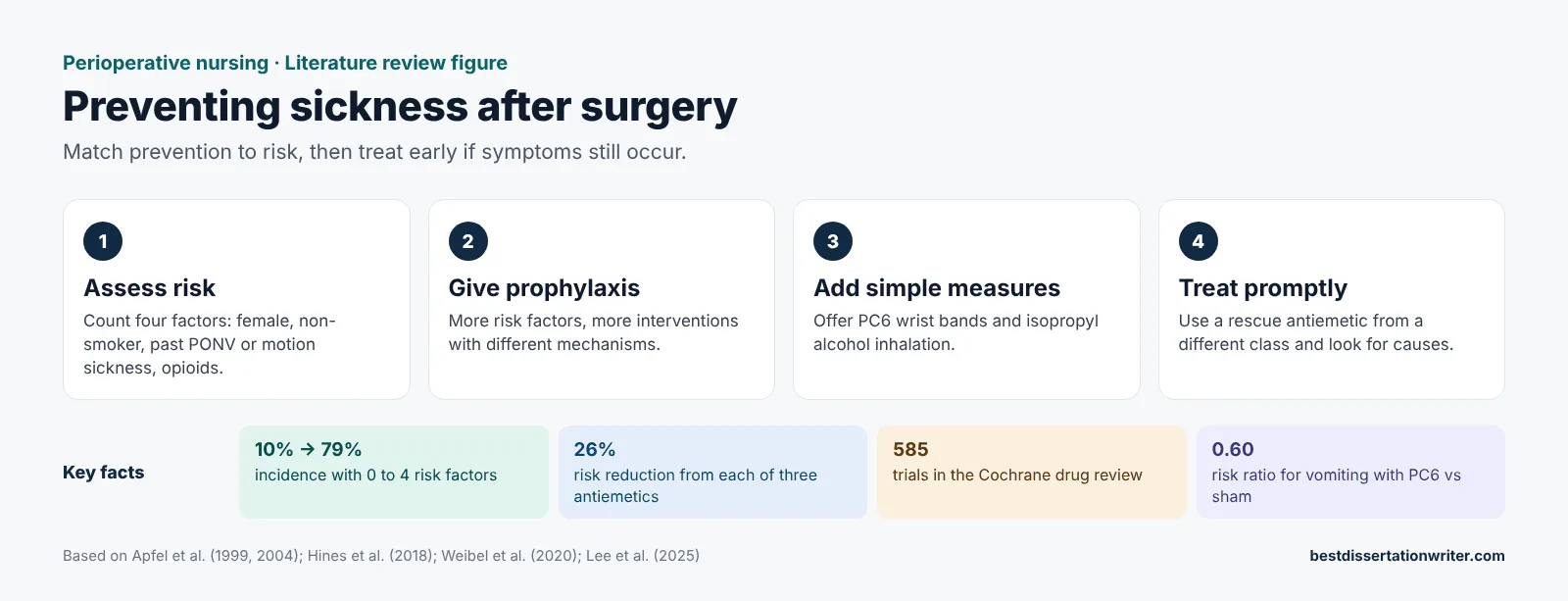
Together, these sources show that antiemetics are effective, that different drugs have broadly similar effects on relative risk and that combining drugs with different mechanisms provides additional benefit. This supports a risk-based approach in which the number of interventions increases with the patient’s risk, rather than giving the same prophylaxis to everyone.
Theme 3: Non-Pharmacological Interventions for PONV
Lee et al. (2025) updated a Cochrane review of PC6 acupoint stimulation. Compared with sham, PC6 stimulation reduced nausea (risk ratio 0.68; 40 trials, 4,742 participants), vomiting (0.60; 45 trials, 5,147 participants) and the need for rescue antiemetics (0.64), with low-certainty evidence. There was no clear difference compared with antiemetic drugs, with moderate-certainty evidence, and adding PC6 stimulation to antiemetics reduced vomiting further, although this evidence was of very low certainty. Side effects were described as minor and transient.
Hines et al. (2018) reviewed 16 studies with 1,036 participants of aromatherapy for treating postoperative nausea and vomiting. Compared with placebo, aromatherapy did not significantly reduce the severity of nausea but may have reduced the need for rescue antiemetics (risk ratio 0.60, 95% CI 0.37 to 0.97), with low-certainty evidence. Inhaling isopropyl alcohol relieved nausea faster than standard antiemetics and reduced the need for rescue drugs, with moderate-certainty evidence. No adverse effects were reported.
Discussion
This review shows that the risk of PONV can be predicted using four simple factors, that antiemetics each reduce risk by a similar relative amount and work additively, that several drugs reliably reduce vomiting and that non-pharmacological interventions such as PC6 stimulation and isopropyl alcohol inhalation may provide additional benefit with few side effects. These findings support a structured, risk-based approach.
Risk assessment is the foundation of effective prevention. Recording the number of risk factors at preoperative assessment or on admission allows the anaesthetist to plan prophylaxis and the anaesthetic technique, and it alerts recovery and ward nurses to patients who need closer monitoring. Including the risk score in the team briefing, alongside other elements of the WHO surgical safety checklist, can help to ensure that the plan is shared.
Nurses play a central role in treatment as well as prevention. When symptoms occur, prompt assessment and treatment are needed. Choosing a rescue antiemetic from a different drug class from the one used for prophylaxis is logical, because the drugs act on different pathways, which is also the basis for the additive effects seen when they are combined. Nurses should also look for contributing causes, such as pain, low blood pressure, dehydration or the effects of opioids, and address them.
Non-pharmacological measures offer nurses practical options. Acupressure wrist bands can be applied before surgery at low cost, and isopropyl alcohol pads are often readily available in clinical areas. These measures do not replace prophylactic antiemetics for high-risk patients, but they may provide additional relief, may reduce the need for rescue drugs and can be particularly valuable for patients who wish to avoid medication or who cannot tolerate certain drugs.
Postoperative nausea and vomiting is closely linked to other aspects of recovery. It can delay eating and drinking and mobilisation, which are key elements of enhanced recovery after surgery, and it is a common reason for delayed discharge in day surgery nursing. Vomiting can also put strain on wounds, and good wound care remains important for preventing surgical site infection. Effective prevention therefore supports wider goals of safe and timely recovery.
Communication between theatre, recovery and ward staff is important for continuity. The patient’s risk score, the prophylaxis given and any symptoms in recovery should be handed over, so that ward nurses know which drugs have been used and which remain available for rescue. Without this information, patients may receive a drug that has already failed, or treatment may be delayed while staff seek advice.
Monitoring should continue after discharge from recovery. Symptoms often develop or recur on the ward, particularly when patients begin to move, eat or receive opioids. Regular assessment using a simple scale, and asking patients directly whether they feel sick rather than waiting for them to report it, can help nurses to identify symptoms early, when they are easier to treat.
Opioid-sparing analgesia deserves mention. Because postoperative opioids are a major risk factor, using regional anaesthesia, regular paracetamol and other non-opioid analgesics where appropriate may reduce the risk of symptoms. Nurses can support this by assessing pain regularly, encouraging non-opioid analgesia and reviewing opioid use with the medical team.
The evidence base has limitations. The risk score was developed in patients receiving inhalational anaesthesia without prophylaxis, which differs from much current practice. The factorial trial included only high-risk patients, and the drug review found limited evidence on side effects. The reviews of PC6 stimulation and aromatherapy found mostly low-certainty evidence and heterogeneous studies. This review relied on openly accessible, English-language sources and did not involve formal systematic screening. Future research should evaluate nurse-led, risk-based protocols and non-pharmacological interventions in pragmatic trials.
Implications of Postoperative Nausea and Vomiting Evidence for Practice
For perioperative nurses, the evidence supports assessing PONV risk using the four simple risk factors, ensuring that prescribed prophylaxis is given, offering acupressure wrist bands to patients who wish to use them, using isopropyl alcohol inhalation as a quick comfort measure, monitoring for symptoms in recovery and on the ward and treating promptly with a rescue antiemetic from a different class. A plain-language summary of the drug evidence is available from Cochrane.
Education helps to make this practice consistent. Nurses who understand the risk factors, the mechanisms of different antiemetics and the evidence for non-pharmacological measures are better placed to advocate for patients, to question missing prophylaxis in high-risk patients and to choose appropriate rescue treatment. Short teaching sessions and simple decision aids in recovery and on surgical wards can support this.
Managers should ensure that local protocols for postoperative nausea and vomiting are based on current evidence, that risk assessment is built into preoperative documentation, that a range of antiemetics and non-pharmacological options is available and that rates of postoperative nausea and vomiting and unplanned admissions are audited.
Conclusion
This systematic review examined risk assessment, pharmacological prophylaxis and non-pharmacological interventions for postoperative nausea and vomiting. Risk can be predicted from four simple factors, antiemetics reduce risk independently and additively, and PC6 stimulation and aromatherapy may provide additional benefit with few side effects.
Postoperative nausea and vomiting is common, distressing and largely preventable. Through systematic risk assessment, risk-based prophylaxis, prompt treatment and the use of simple non-pharmacological measures, perioperative nurses can make recovery from surgery more comfortable and support patients to recover and go home sooner.
References
Apfel, C. C., Korttila, K., Abdalla, M., Kerger, H., Turan, A., Vedder, I., Zernak, C., Danner, K., Jokela, R., Pocock, S. J., Trenkler, S., Kredel, M., Biedler, A., Sessler, D. I., & Roewer, N. (2004). A factorial trial of six interventions for the prevention of postoperative nausea and vomiting. New England Journal of Medicine, 350(24), 2441–2451. https://doi.org/10.1056/NEJMoa032196
Apfel, C. C., Läärä, E., Koivuranta, M., Greim, C.-A., & Roewer, N. (1999). A simplified risk score for predicting postoperative nausea and vomiting: Conclusions from cross-validations between two centers. Anesthesiology, 91(3), 693–700. https://doi.org/10.1097/00000542-199909000-00022
Hines, S., Steels, E., Chang, A., & Gibbons, K. (2018). Aromatherapy for treatment of postoperative nausea and vomiting. Cochrane Database of Systematic Reviews, (3), CD007598. https://doi.org/10.1002/14651858.CD007598.pub3
Lee, A., Zhang, J. Z., Xie, J., Cheng, V., Wong, M. K. H., & Yau, D. K. W. (2025). Stimulation of the wrist acupuncture point PC6 for preventing postoperative nausea and vomiting: A network meta-analysis. Cochrane Database of Systematic Reviews, (9), CD003281. https://doi.org/10.1002/14651858.CD003281.pub5
Weibel, S., Rücker, G., Eberhart, L. H. J., Pace, N. L., Hartl, H. M., Jordan, O. L., Mayer, D., Riemer, M., Schaefer, M. S., Raj, D., Backhaus, I., Helf, A., Schlesinger, T., Kienbaum, P., & Kranke, P. (2020). Drugs for preventing postoperative nausea and vomiting in adults after general anaesthesia: A network meta-analysis. Cochrane Database of Systematic Reviews, (10), CD012859. https://doi.org/10.1002/14651858.CD012859.pub2
Cite this example
Best Dissertation Writers (2026) Nursing Management of Postoperative Nausea and Vomiting: A Systematic Review. Available at: https://bestdissertationwriter.com/postoperative-nausea-and-vomiting/
Best Dissertation Writers
Get expert help with your nursing literature review
Share your topic and deadline with Best Dissertation Writers and get support tailored to your module brief.