Occupational Hazards for Theatre Nurses: Sharps Injuries, Radiation, and Musculoskeletal Disorders: A Systematic Review
 By Dr. Robertson Prime, Research Fellow
Updated October 26, 2026
14 min read
About 2,800 words
In this review
Abstract
Background: Theatre nurses are exposed to a range of occupational hazards, including sharps injuries, musculoskeletal strain from lifting and prolonged standing, ionising radiation from intraoperative imaging and surgical smoke from energy devices. These occupational hazards can affect staff health, wellbeing and retention.
Aim: This systematic review aimed to examine the extent of the main occupational hazards facing perioperative staff and the evidence for protective measures.
Methods: Evidence was identified through targeted searches of openly accessible bibliographic records, publisher websites and the reference lists of key reviews. Five systematic reviews published between 2012 and 2023 were included, appraised using CASP checklists and synthesised narratively.
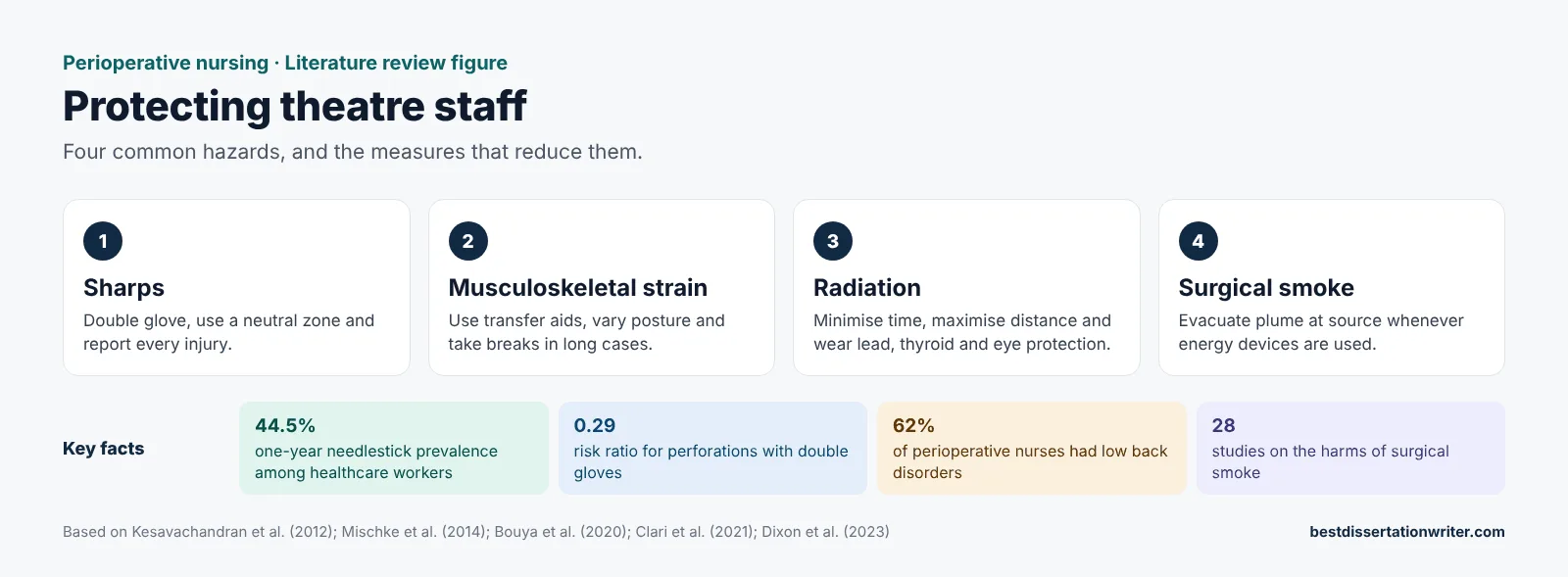
Findings: The pooled one-year prevalence of needlestick injuries among healthcare workers was 44.5%. Double gloving reduced glove perforations during surgery (risk ratio 0.29) without loss of dexterity. Among 3,590 perioperative nurses, musculoskeletal disorders were very common, with low back problems reported by 62%. Orthopaedic staff received variable radiation doses to the eyes, thyroid and hands, with distance and shielding reducing exposure. Surgical smoke contained respirable particles, carcinogenic compounds and, in some studies, viral DNA.
Conclusion: Occupational hazards in the operating theatre are common but can be reduced. Double gloving, ergonomic practice, radiation protection and smoke evacuation should be standard, supported by training, equipment and an organisational commitment to staff safety.
Keywords: occupational hazards, sharps injury, radiation, musculoskeletal
Introduction
This systematic review critically examines recent evidence on occupational hazards and its implications for perioperative nursing practice.
Patient safety in the operating theatre rightly receives a great deal of attention, but the theatre is also a hazardous environment for staff. Nurses and operating department practitioners handle sharp instruments and needles, lift and position patients, stand for long periods in awkward postures, work near X-ray equipment and breathe air that may contain smoke from electrosurgical and laser devices. Over a career, these exposures can lead to injury, infection, chronic pain and other health problems.
Occupational hazards matter for patients as well as staff. Injured or unwell staff may need time off work, contributing to staffing shortages, and chronic pain and fatigue may affect concentration and performance. Experienced theatre nurses who leave the specialty because of musculoskeletal problems take valuable skills with them. Protecting staff is therefore part of maintaining a safe, effective theatre service.
A systematic review approach was chosen to focus on pooled evidence from systematic reviews and meta-analyses covering sharps injuries, musculoskeletal disorders, radiation and surgical smoke.
The question matters because occupational hazards in theatre are well recognised and many protective measures, such as double gloving, safe handling equipment, lead protection and smoke evacuation, are available but not always used consistently. Understanding the evidence can help nurses to protect themselves and their colleagues, and can support managers in making the case for equipment and training.
Review question
How common are the main occupational hazards facing perioperative staff, and what evidence supports measures to reduce them?
Background to Occupational Hazards in the Operating Theatre
Sharps injuries include needlestick injuries, cuts from scalpels and other sharp instruments and puncture wounds from bone fragments or wires. They expose staff to the risk of bloodborne infections such as hepatitis B, hepatitis C and HIV, as well as causing anxiety while test results are awaited. In theatre, sharps are passed between staff frequently, often in a confined space and under time pressure.
Musculoskeletal disorders include back pain, neck and shoulder pain and problems with the knees and feet. Perioperative nurses lift and transfer patients, position limbs and hold retractors, push heavy equipment, stand for long periods and often adopt static or awkward postures while scrubbed. Lead aprons worn during imaging add further load to the spine.
Ionising radiation exposure occurs during procedures that use fluoroscopy, such as orthopaedic, vascular, urological and some gastrointestinal procedures. Staff are mainly exposed to scattered radiation from the patient. The principles of radiation protection are to minimise time, maximise distance and use shielding, including lead aprons, thyroid shields, protective eyewear and mobile screens. Radiation exposure is regulated, and staff who work regularly with radiation may wear dosimeters.
Surgical smoke, also called plume, is produced when tissue is cut or coagulated with electrosurgical, laser or ultrasonic devices. It contains water vapour, particles and chemical by-products of tissue combustion, and may contain viable cells or microorganisms. Smoke evacuation systems capture plume at the source, while standard surgical masks are not designed to filter the smallest particles.
Occupational hazards in theatre rarely occur in isolation. A nurse scrubbed for a long orthopaedic procedure may stand for hours in a lead apron, handle sharp instruments and wires, work close to fluoroscopy and breathe smoke from electrosurgery, all in the same case. The combined burden of these occupational hazards over a working life may be greater than any single exposure suggests, which is why a comprehensive approach to staff protection is needed.
Search Strategy and Methods
Evidence for this example was identified through targeted searches of openly accessible bibliographic records, publisher websites and the reference lists of key reviews. Search terms combined keywords for the setting and population (“operating theatre”, “perioperative nurses”, “healthcare workers”, “surgical staff”) with terms for hazards (“occupational hazards”, “sharps injury”, “needlestick”, “musculoskeletal”, “radiation”, “surgical smoke”), joined with the Boolean operators AND and OR. A full systematic review for assessment would run the same strategy in CINAHL, PubMed/MEDLINE, the Cochrane Library and Embase and report the number of records screened in a PRISMA flow diagram.
Sources were eligible if they were systematic reviews or meta-analyses examining the prevalence of, or interventions for, sharps injuries, musculoskeletal disorders, radiation exposure or surgical smoke among perioperative or healthcare staff. Reviews of other hazards, such as anaesthetic gases, latex allergy and violence, were outside the scope of this example.
Five systematic reviews published between 2012 and 2023 were included: one of radiation exposure in orthopaedic staff, one Cochrane review of gloves for preventing percutaneous injuries, one meta-analysis of needlestick injuries among healthcare workers, one meta-analysis of musculoskeletal disorders among perioperative nurses and one review of the effects of surgical smoke (Table 1). Each was appraised using the Critical Appraisal Skills Programme (CASP) checklist for systematic reviews, and findings were synthesised narratively and grouped into themes.
Key Findings on Occupational Hazards
Three themes were identified: sharps injuries and their prevention, musculoskeletal disorders among perioperative nurses, and exposure to radiation and surgical smoke. Table 1 summarises the included sources, and Figure 1 shows the prevalence of musculoskeletal disorders by body site among perioperative nurses.
| Author, year | Design | Setting and sample | Key finding |
|---|---|---|---|
| Kesavachandran et al. (2012) | Systematic review | 42 articles on orthopaedic staff | Eye and thyroid doses varied widely; distance and lead protection reduced exposure. |
| Mischke et al. (2014) | Cochrane systematic review | 34 trials; 6,890 person-operations | Double gloving reduced perforations (RR 0.29) without loss of dexterity. |
| Bouya et al. (2020) | Systematic review and meta-analysis | 87 studies; 50,916 healthcare workers | One-year needlestick prevalence 44.5%; hypodermic needles most common cause. |
| Clari et al. (2021) | Systematic review and meta-analysis | 22 studies; 3,590 perioperative nurses | Low back disorders in 62%; knee 47%; shoulder 44%. |
| Dixon et al. (2023) | Systematic review | 28 studies of surgical smoke | Respirable particles, carcinogens and viral DNA; evacuation recommended. |
Theme 1: Sharps Injury as an Occupational Hazard
Bouya et al. (2020) pooled 87 studies of 50,916 healthcare workers in 31 countries and found a one-year global prevalence of needlestick injuries of 44.5% (95% CI 35.7% to 53.2%). Hypodermic needles were the most common cause (55.1%). The authors called for better occupational health services and education programmes to prevent injuries. Although the review covered all healthcare workers rather than theatre staff specifically, it shows how common sharps injury remains.
Mischke et al. (2014) reviewed 34 randomised trials involving 6,890 person-operations of gloves for preventing percutaneous exposure injuries in surgical staff. Double gloving reduced glove perforations compared with single gloving (risk ratio 0.29, 95% CI 0.23 to 0.37) and reduced blood stains on the skin (0.35, 95% CI 0.17 to 0.70), with moderate-certainty evidence. Outer glove perforations were similar to single gloves, suggesting no loss of dexterity, and there was no indication that extra layers reduced finger sensitivity. Evidence on needlestick injuries themselves was limited.
The psychological impact of sharps injuries should not be underestimated. Waiting for the results of blood tests after an exposure can cause considerable anxiety for staff and their families, and some may need post-exposure prophylaxis with unpleasant side effects. Preventing these occupational hazards therefore protects mental as well as physical health.
These findings support double gloving as a simple, evidence-based measure to reduce the risk of exposure to blood during surgery. Other measures, such as hands-free passing of sharps using a neutral zone, safety-engineered devices, blunt suture needles where appropriate and prompt disposal of sharps, complement double gloving, although they were not evaluated in the included reviews.
Theme 2: Musculoskeletal Occupational Hazards for Perioperative Nurses
Clari et al. (2021) pooled 22 studies with 3,590 perioperative nurses. Work-related musculoskeletal disorders were highly prevalent, with the lower back most often affected (62%, 95% CI 54% to 70%), followed by the knee (47%), shoulder (44%), waist (42%) and neck (39%). Problems in the ankles and feet, upper back, hands and wrists and elbows were also common. Sex, age and body mass index did not significantly predict low back disorders.
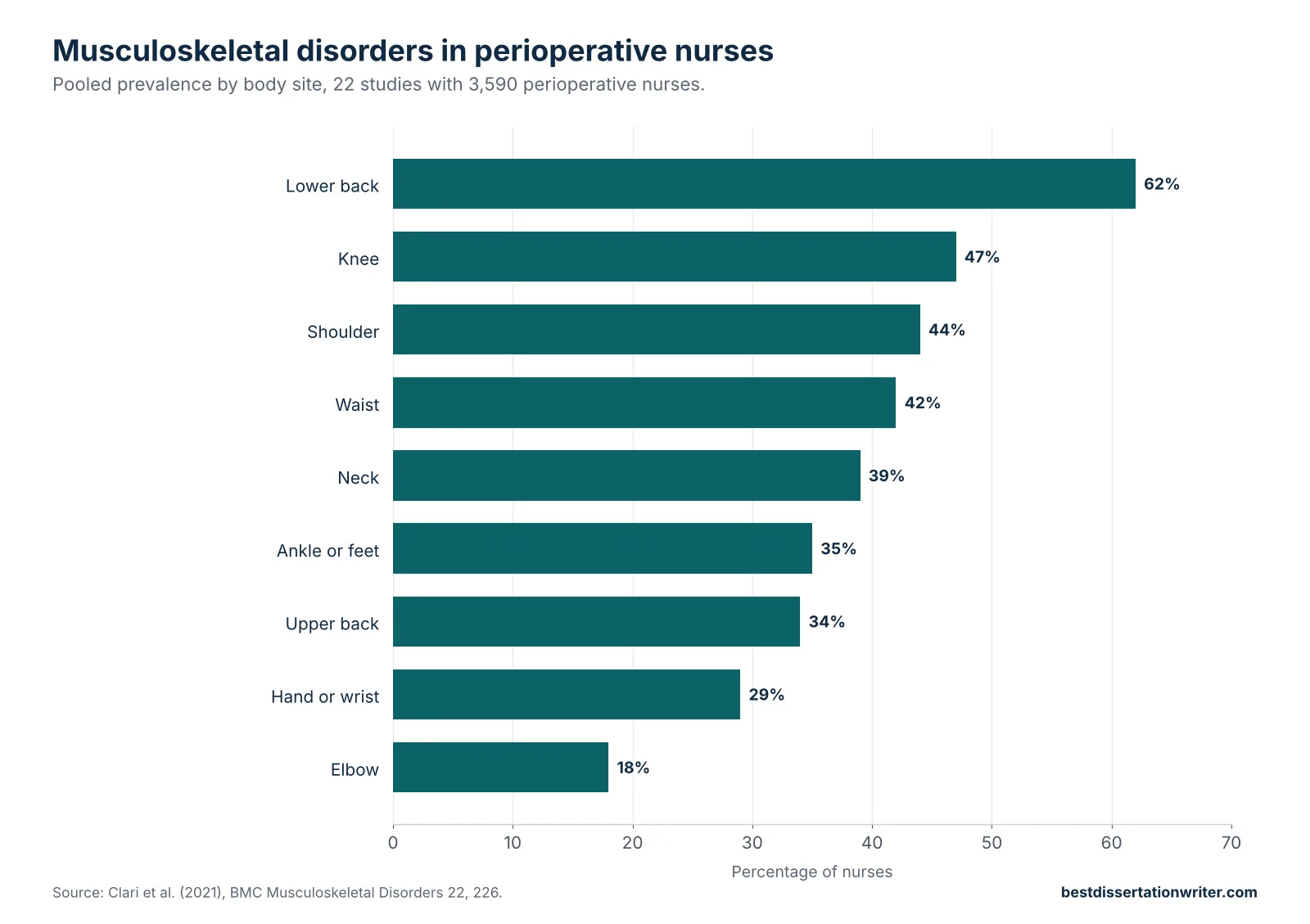
The finding that personal characteristics did not predict low back problems suggests that the causes lie mainly in the work itself: lifting and positioning patients, prolonged standing, static postures, heavy equipment and lead aprons. The authors recommended further research on interventions such as ergonomic education and physical rehabilitation. For nurses and managers, the high prevalence indicates that musculoskeletal problems should be treated as a predictable consequence of theatre work rather than an individual misfortune.
Theme 3: Radiation and Surgical Smoke as Occupational Hazards
Kesavachandran et al. (2012) reviewed 42 articles on radiation exposure of the eyes, thyroid and hands among orthopaedic staff. Annual doses to the hands were generally well below limits, while doses to the eyes and thyroid varied widely between studies. Included studies reported that doses fell sharply with increasing distance from the X-ray beam and were much lower when lead protection was worn, and that minimally invasive procedures tended to involve higher exposure than open surgery.
Dixon et al. (2023) reviewed 28 studies of the harmful effects of surgical smoke on theatre staff. The particles in smoke were of a size that can be inhaled deep into the lungs, three studies detected viral DNA and two found that smoke could infect nasal cells in laboratory conditions. Eight studies identified carcinogenic compounds, some at concentrations above occupational safety limits. Both open and laparoscopic surgery produced particulate levels above air quality standards. The authors recommended local exhaust ventilation and respiratory protection, while noting that the extent of harm from inhalation required further research.
Discussion
This review shows that perioperative staff face several common and potentially serious occupational hazards, and that the evidence on these occupational hazards varies in quality. Needlestick injuries are widespread among healthcare workers, musculoskeletal disorders affect a majority of perioperative nurses, radiation exposure varies with distance and shielding and surgical smoke contains hazardous substances. For several of these hazards, effective protective measures exist, but their use depends on equipment, training and culture.
A recurring theme is the gap between available protection and everyday practice. Double gloving is supported by moderate-certainty evidence, yet single gloving remains common in some settings. Smoke evacuation equipment may be available but not used for every case, and lead protection, particularly thyroid shields and eyewear, may not always be worn. Nurses and managers can close these gaps by making protective measures the default, ensuring that equipment is available in every theatre and monitoring compliance.
Musculoskeletal health needs an organisational approach. Safe moving and handling equipment, such as lateral transfer devices, adjustable tables and positioning aids, can reduce strain, while scheduling that allows rest breaks during long procedures and rotation between scrub and circulating roles may reduce cumulative load. Anti-fatigue mats, well-fitting lead aprons and ergonomic placement of monitors are further practical measures. Early access to occupational health and physiotherapy can help staff with symptoms to remain at work.
Education is a foundation for reducing occupational hazards. New theatre staff may not be aware of the risks of surgical smoke or the correct use of radiation protection, and experienced staff may become complacent. Induction programmes, regular updates and visible role modelling by senior staff can help to establish safe habits. Including occupational hazards in team briefings, for example by confirming that smoke evacuation and lead protection are available for a case, can make staff protection part of routine practice.
A systems perspective also applies to staff safety. Just as human factors principles help to explain errors that harm patients, they help to explain why staff take shortcuts with protective equipment: time pressure, discomfort, poor availability and a culture that prioritises getting the list done. Redesigning workflows so that the safe option is also the easy option is likely to be more effective than reminders alone.
Pregnant staff and those planning pregnancy may have particular concerns about radiation and smoke exposure. Clear local policies, access to occupational health advice and flexibility in allocating staff to cases can help to reassure staff and to manage risk appropriately, while avoiding unnecessary restriction of their roles.
Reporting is important. Sharps injuries and other occupational incidents are often under-reported, particularly when staff consider them minor or worry about blame. Prompt reporting enables post-exposure management and helps organisations to identify patterns, such as particular procedures, devices or times of day associated with injuries. Encouraging reporting in a supportive culture also mirrors the approach taken to patient safety incidents such as never events.
The evidence base has limitations. The needlestick review included all healthcare workers rather than theatre staff alone, the radiation review focused on orthopaedic staff and much of its data came from individual studies with varied methods, and the surgical smoke review relied largely on laboratory and exposure studies rather than health outcomes. The musculoskeletal review relied on self-reported symptoms. This review relied on openly accessible, English-language sources and did not involve formal systematic screening. Future research should evaluate interventions to reduce musculoskeletal disorders among perioperative nurses and examine long-term health outcomes of smoke and radiation exposure.
Implications of Occupational Hazards Evidence for Practice
For perioperative nurses, the evidence supports double gloving during surgery, safe handling and disposal of sharps, prompt reporting of injuries, use of safe moving and handling equipment, attention to posture during long procedures, consistent use of lead aprons, thyroid shields and eyewear during imaging, keeping a safe distance from the beam where possible and using smoke evacuation whenever electrosurgery or lasers are used. Guidance on managing workplace hazards is available from the Health and Safety Executive.
Managers should ensure that protective equipment is available and well maintained, provide training on occupational hazards during induction and at regular intervals, support occupational health services and monitor incidents and staff sickness related to work. Wider theatre risks for patients and staff, including recovery-room issues such as postoperative nausea and vomiting, benefit from the same culture of reporting, learning and continuous improvement.
Conclusion
This systematic review examined the main occupational hazards facing perioperative staff, drawing on five systematic reviews. Needlestick injuries are common, double gloving reduces glove perforations, musculoskeletal disorders affect most perioperative nurses and radiation and surgical smoke present further risks that can be reduced through distance, shielding and evacuation.
Protecting staff from occupational hazards is an essential part of a safe theatre service. By making protective measures routine, investing in equipment and training and fostering a culture in which staff report injuries and raise concerns, perioperative teams can reduce the toll that occupational hazards take on the people who care for surgical patients.
References
Bouya, S., Balouchi, A., Rafiemanesh, H., Amirshahi, M., Dastres, M., Moghadam, M. P., Behnamfar, N., Shyeback, M., Badakhsh, M., Allahyari, J., Al Mawali, A., Ebadi, A., Dezhkam, A., & Daley, K. A. (2020). Global prevalence and device related causes of needle stick injuries among health care workers: A systematic review and meta-analysis. Annals of Global Health, 86(1), 35. https://doi.org/10.5334/aogh.2698
Clari, M., Godono, A., Garzaro, G., Voglino, G., Gualano, M. R., Migliaretti, G., Gullino, A., Ciocan, C., & Dimonte, V. (2021). Prevalence of musculoskeletal disorders among perioperative nurses: A systematic review and meta-analysis. BMC Musculoskeletal Disorders, 22, 226. https://doi.org/10.1186/s12891-021-04057-3
Dixon, K., Dasgupta, P., & Vasdev, N. (2023). A systematic review of the harmful effects of surgical smoke inhalation on operating room personnel. Health Sciences Review, 6, 100077. https://doi.org/10.1016/j.hsr.2023.100077
Kesavachandran, C. N., Haamann, F., & Nienhaus, A. (2012). Radiation exposure of eyes, thyroid gland and hands in orthopaedic staff: A systematic review. European Journal of Medical Research, 17, 28. https://doi.org/10.1186/2047-783X-17-28
Mischke, C., Verbeek, J. H., Saarto, A., Lavoie, M.-C., Pahwa, M., & Ijaz, S. (2014). Gloves, extra gloves or special types of gloves for preventing percutaneous exposure injuries in healthcare personnel. Cochrane Database of Systematic Reviews, (3), CD009573. https://doi.org/10.1002/14651858.CD009573.pub2
Cite this example
Best Dissertation Writers (2026) Occupational Hazards for Theatre Nurses: Sharps Injuries, Radiation, and Musculoskeletal Disorders: A Systematic Review. Available at: https://bestdissertationwriter.com/occupational-hazards-literature-review/
Best Dissertation Writers
Get expert help with your nursing literature review
Share your topic and deadline with Best Dissertation Writers and get support tailored to your module brief.