Compliance With the WHO Surgical Safety Checklist and Its Effect on Patient Outcomes: A Systematic Review
 By Dr. Robertson Prime, Research Fellow
Updated October 26, 2026
14 min read
About 2,800 words
In this review
Abstract
Background: The WHO surgical safety checklist was introduced to improve teamwork and ensure that essential safety checks are performed before anaesthesia, before incision and before the patient leaves the operating theatre. It is now used in operating theatres worldwide, yet questions remain about how consistently it is completed and how much it improves surgical outcomes.
Aim: This systematic review aimed to examine compliance with the checklist and its effect on postoperative complications and mortality.
Methods: Evidence was identified through targeted searches of openly accessible bibliographic records, publisher websites and the reference lists of key reviews. Five sources published between 2009 and 2016 were included: a multinational before-and-after study, a population-based study and three systematic reviews, appraised with CASP checklists and synthesised narratively.
Findings: In eight hospitals in eight countries, deaths fell from 1.5% to 0.8% and complications from 11% to 7% after the checklist was introduced. A meta-analysis of seven studies found fewer complications (risk ratio 0.59), deaths (0.77) and wound infections (0.57), with greater benefit where adherence was higher. However, in 101 Ontario hospitals mortality (0.71% versus 0.65%) and complications (3.86% versus 3.82%) did not change significantly. Initiation exceeded 90%, but the sign-out phase was completed in fewer than half of cases.
Conclusion: The checklist can improve surgical safety when it is used fully and meaningfully, but superficial completion is unlikely to help. Theatre nurses and leaders should focus on genuine team engagement in every phase.
Keywords: WHO surgical safety checklist, surgical outcomes, surgical safety
Introduction
This systematic review critically examines recent evidence on WHO surgical safety checklist and its implications for perioperative nursing practice.
Surgery saves lives and relieves suffering, but it also carries significant risks. Patients can be harmed by wrong-site surgery, anaesthetic complications, infection, unexpected blood loss, retained instruments and failures of communication between team members. Many of these harms are preventable, and they often arise not from a lack of skill but from lapses in routine checks and teamwork under pressure. Improving surgical safety therefore requires systems that make essential checks reliable, whatever the time of day, the experience of the team or the pressure on the theatre list.
In 2008, the World Health Organization launched the Safe Surgery Saves Lives initiative and introduced a simple checklist to be read aloud by the operating team at three points: before induction of anaesthesia, before skin incision and before the patient leaves the operating theatre. The WHO surgical safety checklist confirms the patient’s identity, the procedure and site, allergies, airway and blood loss risks, antibiotic prophylaxis, equipment and counts, and encourages team members to introduce themselves and share concerns. The WHO surgical safety checklist has since been widely adopted, including in the United Kingdom, and theatre nurses frequently lead or coordinate it.
A systematic approach was chosen because the evidence includes influential before-and-after studies, a large population-based study with contrasting results and several systematic reviews, and appraising these together helps to explain why findings differ between settings.
The question matters for perioperative nurses because they are central to the checklist in practice. Theatre nurses often initiate the sign-in, prompt the team at the time-out and complete the sign-out, including counts and specimen labelling. Understanding when the checklist improves surgical outcomes, and when it does not, helps nurses and theatre managers to focus on the elements of implementation that make a real difference to patients.
Review question
How consistently is the WHO surgical safety checklist completed, and what is its effect on postoperative complications and mortality?
Background to WHO Surgical Safety Checklist
The checklist has three phases. The sign-in, performed before induction of anaesthesia, confirms the patient’s identity, site, procedure and consent, checks the anaesthesia machine and medication, and identifies allergies, difficult airway and risk of blood loss. The time-out, performed before skin incision, requires all team members to introduce themselves by name and role, confirm the patient and procedure, review anticipated critical events and confirm antibiotic prophylaxis and imaging. The sign-out, performed before the patient leaves the theatre, confirms the procedure performed, instrument and swab counts, specimen labelling, equipment problems and key concerns for recovery.
The checklist was designed to be adapted locally, and many hospitals have added items such as venous thromboembolism prophylaxis, implant checks or glycaemic control. Some organisations also use team briefings before the list and debriefings at the end, extending the principles of the checklist to the whole operating session. This flexibility supports local ownership, but it also means that the checklist used in one hospital may differ considerably from that used in another.
The checklist is thought to work through two mechanisms. First, it ensures that specific safety steps, such as antibiotic prophylaxis and site marking, are completed reliably. Second, it improves communication and teamwork by creating structured moments when every team member, regardless of hierarchy, is invited to speak. The second mechanism depends on the checklist being performed with genuine engagement rather than as a rapid, box-ticking exercise, which is why compliance and quality of use are central questions for surgical safety.
Implementation has faced challenges. Surgeons, anaesthetists and nurses may perceive the checklist differently, time pressures can encourage shortcuts, and completion may be recorded on paper or electronic systems without the checks actually being discussed aloud. These challenges make it important to distinguish between documented compliance and meaningful use when interpreting research on surgical outcomes.
The way the WHO surgical safety checklist is performed also varies between teams. In some theatres, a single person reads every item while others continue preparing equipment; in others, the whole team stops, faces each other and responds to each question. Some teams treat the time-out as a brief formality, while others use it to discuss the plan, expected difficulties and roles. These differences are rarely captured in studies that record only whether the checklist was completed, yet they are likely to determine whether the WHO surgical safety checklist changes behaviour in practice.
Search Strategy and Methods
Evidence for this example was identified through targeted searches of openly accessible bibliographic records, publisher websites and the reference lists of key reviews. Search terms combined keywords for the intervention (“WHO surgical safety checklist”, “surgical safety checklist”, “time-out”, “sign-out”) with terms for outcomes (“surgical outcomes”, “complications”, “mortality”, “surgical site infection”, “compliance”), joined with the Boolean operators AND and OR. A full systematic review for assessment would run the same strategy in CINAHL, PubMed/MEDLINE, the Cochrane Library and Embase and report the number of records screened in a PRISMA flow diagram.
Sources were eligible if they evaluated the effect of the WHO surgical safety checklist, or locally adapted versions of it, on postoperative complications or mortality, or examined compliance with the checklist and surgical team perceptions. Large multi-site studies and systematic reviews were prioritised. Studies of other surgical checklists unrelated to the WHO model, and reports without outcome or compliance data, were excluded.
Five sources published between 2009 and 2016 were included: one multinational before-and-after study, one population-based before-and-after study and three systematic reviews, of which two examined outcomes and one examined compliance and perceptions (Table 1). The quality of each source was appraised using the Critical Appraisal Skills Programme (CASP) checklist appropriate to its design, and findings were synthesised narratively and grouped into themes.
Key Findings on WHO Surgical Safety Checklist
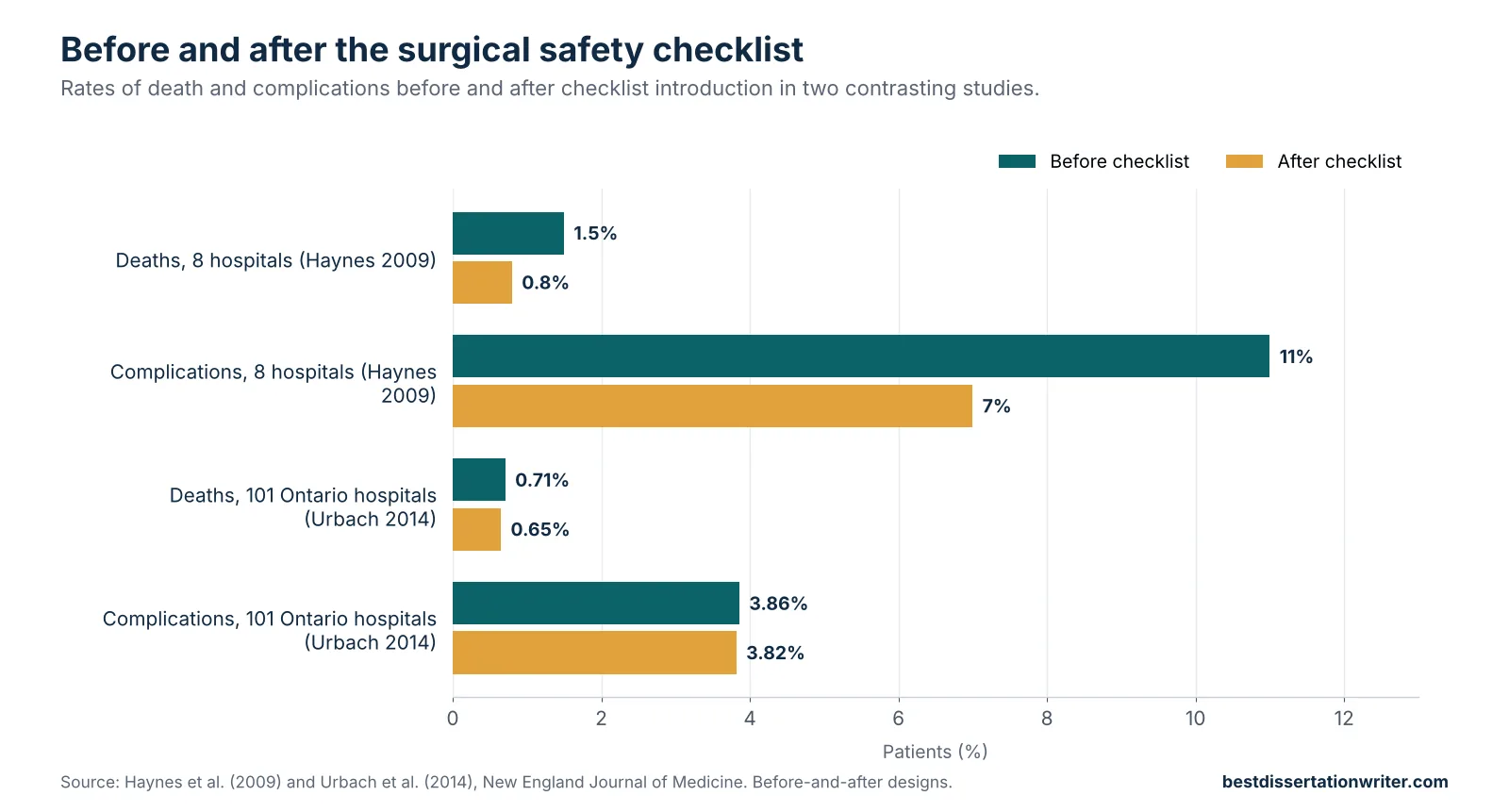
Three themes were identified: the effect of the checklist on complications and mortality, the inconsistency of results between settings, and compliance with each phase of the checklist. Table 1 summarises the included sources, and Figure 1 compares complication and mortality rates before and after checklist introduction in two contrasting studies.
| Author, year | Design | Setting and sample | Key finding |
|---|---|---|---|
| Haynes et al. (2009) | Prospective before-and-after study | 7,688 patients, 8 hospitals in 8 countries | Deaths fell from 1.5% to 0.8%; complications from 11% to 7%. |
| Bergs et al. (2014) | Systematic review and meta-analysis | 7 studies | Complications RR 0.59, mortality RR 0.77, wound infection RR 0.57; benefit linked to adherence. |
| Urbach et al. (2014) | Population-based before-and-after study | 101 hospitals, 215,711 procedures, Ontario | No significant change: mortality 0.71% vs 0.65%; complications 3.86% vs 3.82%. |
| de Jager et al. (2016) | Systematic review | 25 studies | Complications reduced in resource-poor settings but inconsistently in developed nations. |
| Wangoo et al. (2016) | Systematic review | 26 studies of compliance and perceptions | Initiation over 90%; sign-out completed in fewer than half of cases. |
Theme 1: The WHO Surgical Safety Checklist and Surgical Outcomes
Haynes et al. (2009) introduced the checklist in eight hospitals in eight cities, including London, Toronto, New Delhi, Amman, Auckland, Manila, Ifakara and Seattle, enrolling 3,733 patients before and 3,955 after implementation. The death rate fell from 1.5% to 0.8%, and inpatient complications fell from 11% to 7%. These findings were highly influential and contributed to the rapid international adoption of the checklist, although the before-and-after design could not exclude other changes over time or the effect of being studied.
Bergs et al. (2014) systematically reviewed seven studies selected from 723 records. Pooled analysis showed that checklist implementation was associated with fewer postoperative complications (risk ratio 0.59, 95% confidence interval 0.47 to 0.74), lower mortality (0.77, 0.60 to 0.98) and fewer wound infections (0.57, 0.41 to 0.79). Importantly, there was a strong association between adherence to the care elements of the checklist and a reduction in complications, suggesting that benefit depends on how fully the checklist is used. The authors noted substantial methodological heterogeneity and called for higher-quality studies of the WHO surgical safety checklist.
Theme 2: Inconsistent Results Between Settings
Urbach et al. (2014) examined the introduction of checklists across 101 hospitals in Ontario, Canada, comparing 109,341 procedures in the three months before adoption with 106,370 procedures in the three months after. Adjusted operative mortality was 0.71% before and 0.65% after, and surgical complications were 3.86% before and 3.82% after, neither difference being statistically significant. This large, population-based study suggested that mandated introduction of the checklist did not produce the improvements seen in earlier studies.
de Jager et al. (2016) reviewed 25 studies and found that postoperative complications decreased with checklist use in resource-poor settings, but that the checklist did not appear consistently effective in developed nations. In several studies mortality improved even though complications did not, an inconsistency the authors could not explain. They suggested that methodological problems, temporal trends and other concurrent interventions might explain some of the improvements attributed to the checklist.
These contrasting findings are important. In settings where baseline safety practices are weaker, the checklist may introduce checks that were previously missing, producing large gains. In settings with established safety systems and lower baseline complication rates, the additional benefit may be small or difficult to detect. The Ontario study also measured outcomes soon after adoption, when the checklist may not yet have been embedded in team culture.
Theme 3: Compliance With the Checklist
Wangoo et al. (2016) reviewed 26 studies of checklist compliance and surgical team perceptions. Initiation of the checklist exceeded 90% across compliance studies, and verification of patient identity and procedure exceeded 90%. However, the sign-out was the most poorly performed phase, completed in fewer than half of cases, and confirmation of team members’ names and roles was significantly less frequent than other items. Compliance varied widely and depended on staff perceptions, training and leadership.
Team members generally viewed the checklist positively and associated it with better teamwork, communication and awareness of safety. However, when surgeons, anaesthetists and nurses placed different importance on completing it, the checklist could strain relationships. These findings suggest that compliance with the WHO surgical safety checklist is not simply a matter of individual diligence but reflects team culture and leadership, and that the parts of the checklist most dependent on team engagement are the most vulnerable to omission.
Discussion
This review suggests that the WHO surgical safety checklist can improve surgical outcomes, with early studies and a meta-analysis reporting substantial reductions in complications and mortality. However, results are inconsistent, and a large population-based study found no measurable improvement after mandated introduction. The most plausible explanation is that benefit depends on context and, above all, on whether the checklist is used fully and meaningfully rather than merely documented.
The association between adherence and outcomes reported by Bergs et al. (2014), together with the low completion of the sign-out reported by Wangoo et al. (2016), supports this interpretation. A checklist that is read rapidly, completed partially or signed without discussion provides little protection. Conversely, a checklist used as a genuine pause for team communication may prevent errors that would not appear in any single item, by creating space for concerns to be raised.
The sign-out deserves particular attention from nurses. It confirms counts, specimen labelling and equipment problems and hands over key concerns to recovery staff, yet it occurs at the end of the procedure when surgeons may be leaving and the next case is being prepared. Theatre nurses often lead this phase, and organisational support for completing it fully, including expectations that surgeons and anaesthetists remain present, is likely to improve surgical safety.
Cost and resources are not major barriers to the checklist itself, which requires little more than a printed or electronic form and a few minutes of team time. The real investment lies in training, leadership and the cultural change needed for every professional to participate. Because the WHO surgical safety checklist is cheap to deliver, even modest improvements in complications or deaths are likely to be worthwhile, which strengthens the case for investing in high-quality implementation rather than abandoning the checklist where early results are disappointing.
There are also lessons for implementation. Mandating the checklist without training, leadership engagement and local adaptation may produce high documented compliance but little change in practice. Approaches that involve the whole team, use observation rather than self-report to measure compliance, and connect the checklist to briefing and debriefing are more likely to embed its purpose. Perioperative nurses, who are present throughout the patient’s journey, are well placed to champion this approach.
The evidence base has limitations. Most studies used before-and-after designs, which cannot exclude secular trends or the Hawthorne effect, and compliance was often self-reported. Outcome definitions and follow-up periods varied, and few studies measured the quality of checklist use. This review relied on openly accessible, English-language sources and did not involve independent double screening. Future research should use controlled designs, observe how the checklist is performed and examine which elements most strongly influence surgical outcomes.
Implications of WHO Surgical Safety Checklist Evidence for Practice
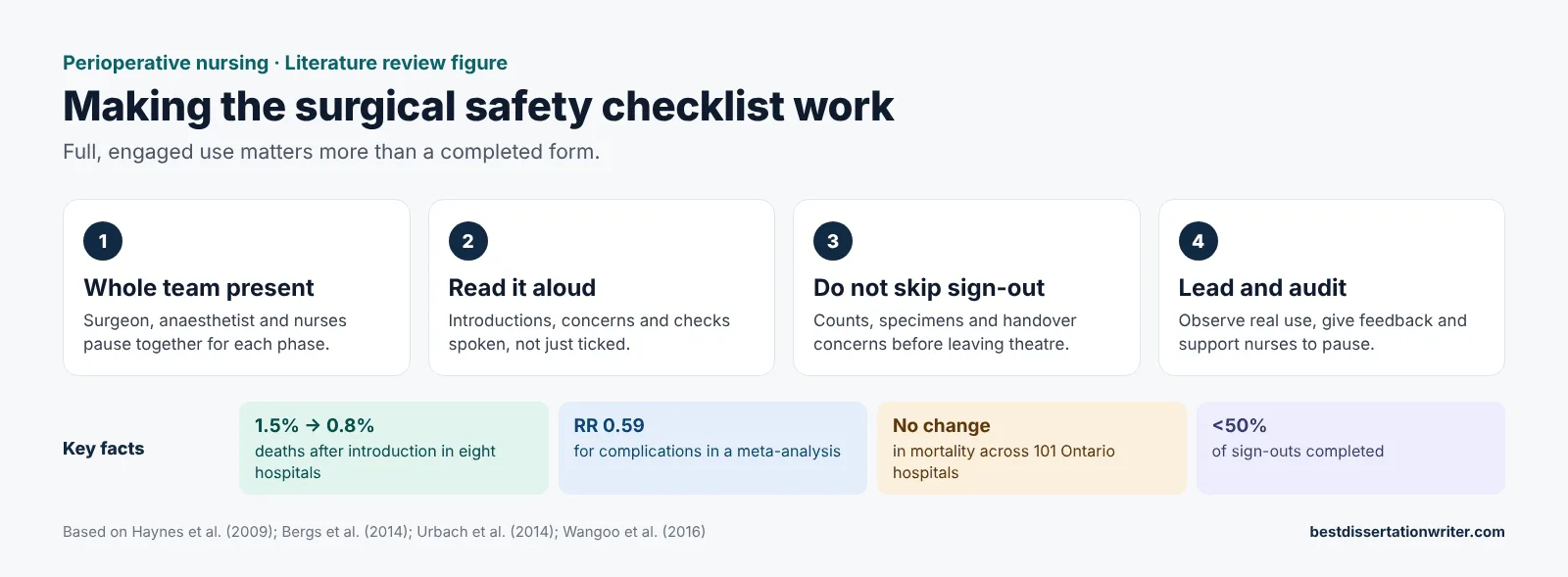
For perioperative nurses, the evidence supports performing every phase of the checklist aloud with the whole team present, ensuring that introductions are made, and treating the sign-out as seriously as the time-out. Nurses should feel empowered to pause the procedure if checks are incomplete, and theatre managers should support this through clear policy, training, observational audit and leadership from all professions. Briefings and debriefings can extend the benefits. The WHO safe surgery programme provides access to the checklist and related resources.
The checklist supports antibiotic timing and other measures that prevent surgical site infection, and its sign-out confirms counts that protect against retained surgical items. Its success depends on communication and teamwork in the operating theatre, and it is one of the main defences against never events such as wrong-site surgery.
Conclusion
This systematic review examined compliance with the WHO surgical safety checklist and its effect on surgical outcomes. Early studies and a meta-analysis reported substantial reductions in complications and deaths, but results were inconsistent between settings, and a large population-based study found no measurable improvement after mandated introduction. Compliance was high at the start of the checklist but poor at the sign-out.
The WHO surgical safety checklist is not a guarantee of safety, but it is a powerful tool when used fully and meaningfully. Perioperative nurses and theatre leaders can maximise its value by ensuring genuine team engagement in every phase, so that the checklist becomes a shared conversation about surgical safety rather than a form to be completed.
References
Bergs, J., Hellings, J., Cleemput, I., Zurel, Ö., De Troyer, V., Van Hiel, M., Demeere, J.-L., Claeys, D., & Vandijck, D. (2014). Systematic review and meta-analysis of the effect of the World Health Organization surgical safety checklist on postoperative complications. British Journal of Surgery, 101(3), 150–158. https://doi.org/10.1002/bjs.9381
de Jager, E., McKenna, C., Bartlett, L., Gunnarsson, R., & Ho, Y.-H. (2016). Postoperative adverse events inconsistently improved by the World Health Organization surgical safety checklist: A systematic literature review of 25 studies. World Journal of Surgery, 40(8), 1842–1858. https://doi.org/10.1007/s00268-016-3519-9
Haynes, A. B., Weiser, T. G., Berry, W. R., Lipsitz, S. R., Breizat, A.-H. S., Dellinger, E. P., Herbosa, T., Joseph, S., Kibatala, P. L., Lapitan, M. C. M., Merry, A. F., Moorthy, K., Reznick, R. K., Taylor, B., & Gawande, A. A. (2009). A surgical safety checklist to reduce morbidity and mortality in a global population. New England Journal of Medicine, 360(5), 491–499. https://doi.org/10.1056/NEJMsa0810119
Urbach, D. R., Govindarajan, A., Saskin, R., Wilton, A. S., & Baxter, N. N. (2014). Introduction of surgical safety checklists in Ontario, Canada. New England Journal of Medicine, 370(11), 1029–1038. https://doi.org/10.1056/NEJMsa1308261
Wangoo, L., Ray, R. A., & Ho, Y.-H. (2016). Compliance and surgical team perceptions of WHO Surgical Safety Checklist: Systematic review. International Surgery, 101(1–2), 35–49. https://doi.org/10.9738/INTSURG-D-15-00105.1
Cite this example
Best Dissertation Writers (2026) Compliance With the WHO Surgical Safety Checklist and Its Effect on Patient Outcomes: A Systematic Review. Available at: https://bestdissertationwriter.com/who-surgical-safety-checklist-review/
Best Dissertation Writers
Get expert help with your nursing literature review
Share your topic and deadline with Best Dissertation Writers and get support tailored to your module brief.