Family Involvement and Open Visiting Policies in Intensive Care Units: An Integrative Review
 By Dr. Robertson Prime, Research Fellow
Updated October 17, 2026
14 min read
About 2,800 words
In this review
Abstract
Background: Open visiting policies allow families to be with critically ill relatives for most or all of the day, replacing restricted visiting hours that have long been common in intensive care. Family involvement is increasingly seen as part of high-quality critical care, but concerns about infection, workload and staff stress persist.
Aim: This integrative review aimed to examine the evidence on open visiting policies and family involvement in adult intensive care and their effects on patients, families and staff.
Methods: Evidence was identified through targeted searches of openly accessible bibliographic records, publisher websites and the reference lists of key reviews. Five sources published between 2013 and 2020 were included: a national survey, an international guideline, a systematic review and meta-analysis, a cluster-crossover randomised trial and a structured literature review, synthesised thematically.
Findings: In a survey of 606 US hospitals, 89.6% of ICUs had restrictive visiting. A meta-analysis found flexible visiting associated with less delirium (odds ratio 0.39) and anxiety, with no increase in infections but higher staff burnout. A trial in 36 ICUs found no significant reduction in delirium (18.9% vs 20.1%) but lower family anxiety and depression, with no significant change in infections or clinician burnout.
Conclusion: Critical care nurses should support open visiting policies with family education and staff support, recognising clear benefits for families and possible benefits for patients.
Keywords: open visiting policies, family involvement, family-centred care
Introduction
This integrative review critically examines recent evidence on open visiting policies and its implications for critical care nursing practice.
Admission to intensive care is frightening for patients and families. Patients may be sedated, intubated, confused or unable to speak, and families face sudden uncertainty about whether their relative will survive. For many years, intensive care units restricted visiting to short periods, limited the number of visitors and excluded children, often on the grounds of infection control, patient rest and the need for staff to work without interruption.
Attitudes have changed. Families are now increasingly recognised as partners in care who can comfort and reorient patients, provide information about their preferences and history, and take part in decisions. Many professional organisations have called for open or flexible visiting, and family involvement has become a core element of family-centred care. However, restrictive practices remain common, and staff often express concerns about workload, privacy and safety.
Nurses are central to how visiting policies work in practice. They welcome families, explain what is happening, decide when visits need to be paused and support families through distressing events. Their attitudes and workload therefore shape whether open visiting policies benefit patients and families or become an additional source of stress.
An integrative approach was chosen because the evidence includes surveys, guidelines, a meta-analysis, a large trial and a literature review, which together describe current practice and outcomes.
Review question
What does the evidence show about open visiting policies and family involvement in adult intensive care, and what are their effects on patients, families and staff?
Background to Open Visiting Policies
Visiting policies vary widely. Restrictive policies set fixed hours, limit visitors to one or two at a time and may exclude children. Flexible or open visiting policies allow families to visit at most times of the day and night, sometimes with brief restrictions during procedures, handover or ward rounds. The lack of a single definition makes it difficult to compare studies, since some flexible policies allow 12 hours a day while others allow unrestricted access.
Several benefits have been proposed. Family presence may calm patients, help them to understand where they are and reduce the risk of delirium. Families may feel less anxious and more able to trust staff if they can see care being given and talk to nurses regularly. Family involvement can also help nurses to understand the patient as a person, including their routines, communication preferences and values.
Concerns have also been raised. Staff worry that frequent visitors may interrupt care, increase infection risk, compromise privacy or exhaust patients. Nurses may feel observed and judged, and spending more time with families can increase workload and emotional demands. Families themselves may become exhausted if they feel obliged to stay at the bedside for long periods.
Family-centred care provides a framework for balancing these considerations. It emphasises respect, information sharing, participation and collaboration, and recognises that the needs of patients, families and staff are connected. Visiting policies are one practical expression of how far a unit embraces this approach.
The COVID-19 pandemic brought these questions into sharp focus. Many units suspended visiting entirely to control infection, and staff, patients and families experienced the effects of separation directly. Nurses often became the only link between patients and families, using video calls and telephone updates. These experiences have prompted renewed reflection on the value of family presence and on how open visiting policies can be maintained safely during outbreaks.
Search Strategy and Methods
Evidence for this example was identified through targeted searches of openly accessible bibliographic records, publisher websites and the reference lists of key reviews. Search terms combined keywords for the intervention (“open visiting”, “flexible visiting”, “visitation policy”, “family presence”, “family involvement”) with terms for the setting and outcomes (“intensive care”, “critical care”, “delirium”, “anxiety”, “satisfaction”, “burnout”), joined with the Boolean operators AND and OR. A full integrative review for assessment would run the same strategy in CINAHL, PubMed/MEDLINE, the Cochrane Library and Embase and report the number of records screened in a PRISMA flow diagram.
Sources were eligible if they examined visiting policies or family presence in adult intensive care, using any design, and reported on practice, patient, family or staff outcomes. A national survey was included to describe practice, an international guideline to describe recommended practice, and a meta-analysis, a randomised trial and a literature review to assess effects. Studies limited to neonatal or paediatric units were excluded.
Five sources on open visiting policies published between 2013 and 2020 were included: a national survey, an international clinical practice guideline, a systematic review and meta-analysis, a cluster-crossover randomised trial and a structured literature review (Table 1). The quality of each source was considered using the Critical Appraisal Skills Programme (CASP) checklists, and findings were synthesised thematically in line with integrative review methods.
Key Findings on Open Visiting Policies
Three themes were identified: the persistence of restrictive visiting, the effects of open visiting policies on patients and families, and the impact on staff and the barriers to implementation. Table 1 summarises the included sources, and Figure 1 presents outcomes from the largest randomised trial of flexible visiting.
| Author, year | Design | Setting and sample | Key finding |
|---|---|---|---|
| Liu et al. (2013) | National survey | 606 hospitals, United States (2008–2009) | 89.6% of ICUs had restrictive visiting; 61.9% had three or more restrictions. |
| Davidson et al. (2017) | International clinical practice guideline | 29 members; 238 studies reviewed | 23 recommendations on communication, family presence and support; all weak. |
| Nassar Junior et al. (2018) | Systematic review and meta-analysis | 16 studies, 7 meta-analysed | Flexible visiting: less delirium (OR 0.39) and anxiety; no rise in infections; higher family satisfaction and staff burnout. |
| Rosa et al. (2019) | Cluster-crossover randomised trial (ICU Visits) | 1,685 patients, 36 ICUs, Brazil | Delirium 18.9% vs 20.1% (not significant); lower family anxiety and depression; no change in infection or burnout. |
| Ning and Cope (2020) | Structured literature review | 16 articles on open visiting in adult ICUs | Benefits for patients and families; barriers include staff attitudes, patient protection, culture and organisation. |
Theme 1: The Persistence of Restrictive Visiting
A national survey of 606 hospitals in the United States, conducted in 2008 and 2009, examined visiting policies in intensive care (Liu et al., 2013). Most units, 89.6%, had restrictive policies, and 61.9% imposed three or more restrictions, most commonly on visiting hours, number of visitors and age of visitors. Almost all allowed exceptions, and open policies were more common in smaller hospitals. The authors noted wide variation in practice.
International guidelines for family-centred care in neonatal, paediatric and adult intensive care, developed by 29 international members, reviewed 238 studies and made 23 recommendations covering communication, family presence, family support, consultations and the environment (Davidson et al., 2017). All recommendations were weak, reflecting the early stage of research in this field. Even so, the inclusion of family presence as a core topic shows that guideline developers regard open access as part of good practice.
A structured literature review of 16 articles on open visiting in adult intensive care found that it had not been widely adopted worldwide despite its documented benefits (Ning and Cope, 2020). The authors identified the lack of a clear, consistent definition of open visiting as a problem and highlighted barriers including negative staff perceptions, concerns about protecting patients, family and cultural considerations, and organisational challenges.
Taken together, these sources show a gap between policy and practice. Guidelines and literature reviews support family presence, yet restrictive visiting has persisted in many units. This gap suggests that the main barriers are not a lack of evidence on benefits but concerns among staff and organisational constraints, which must be addressed if open visiting policies are to become routine.
Theme 2: Effects of Open Visiting Policies on Patients and Families
A systematic review and meta-analysis of 16 studies, seven of which were pooled, compared flexible and restrictive visiting policies (Nassar Junior et al., 2018). Flexible policies were associated with less delirium (odds ratio 0.39) and lower anxiety in patients, with no significant increase in ICU-acquired infections or mortality. Families reported greater satisfaction. However, the authors cautioned that the conclusions were based on few studies with small samples and moderate risk of bias, mostly observational.
The ICU Visits trial tested these findings in a cluster-crossover randomised trial in 36 adult units in Brazil (Rosa et al., 2019). Flexible visiting of up to 12 hours a day, supported by family education, was compared with restricted visiting of a median 1.5 hours a day. Among 1,685 patients, delirium occurred in 18.9% with flexible visiting and 20.1% with restricted visiting, a difference that was not statistically significant. ICU-acquired infections were 3.7% compared with 4.5%, also not significantly different.
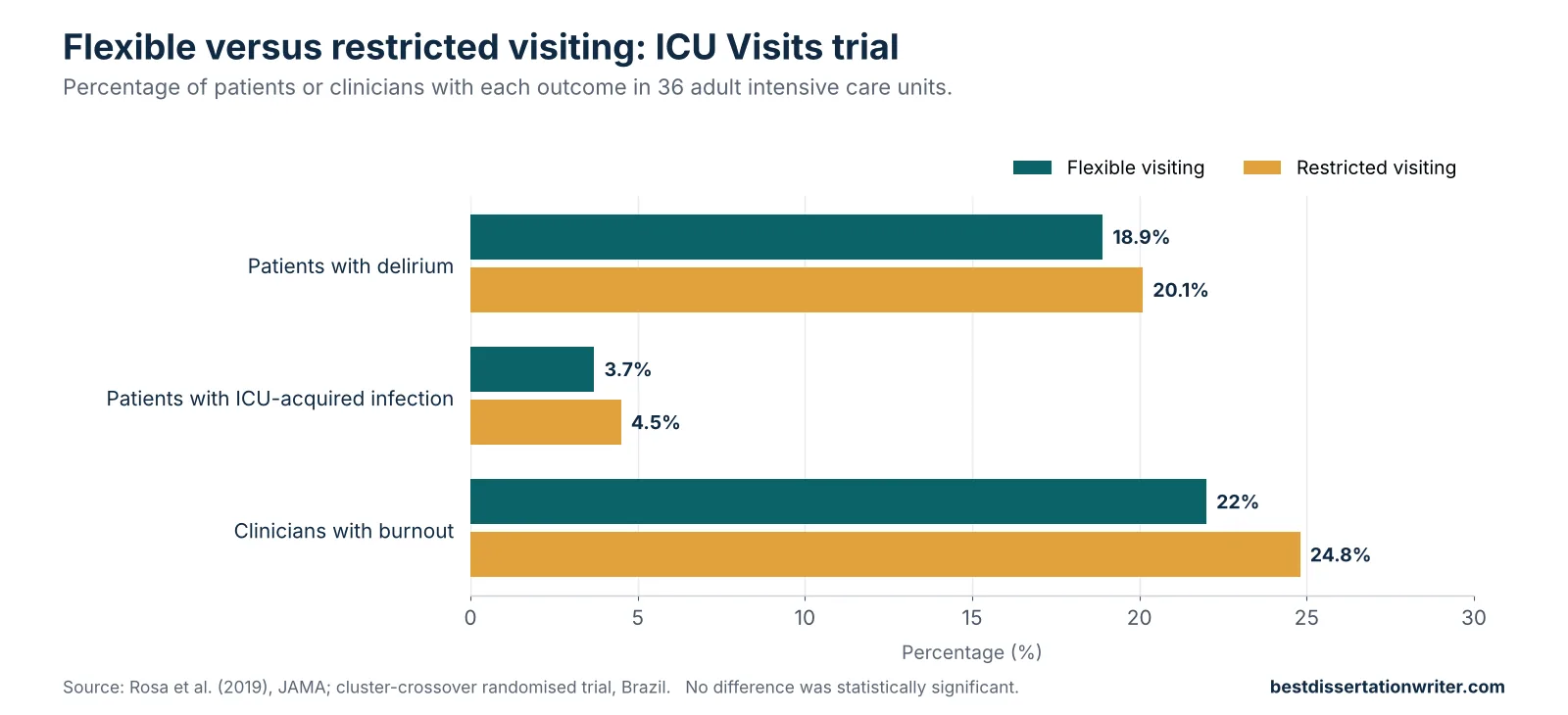
Family members benefited clearly. In the trial, those in the flexible visiting group had significantly lower symptoms of anxiety and depression. Together with the meta-analysis, which found greater family satisfaction, this suggests that open visiting policies consistently help families, while their effect on delirium is less certain than earlier observational studies suggested. Importantly, neither study found that open visiting increased infection.
The trial also highlights the value of preparing families. Families in the flexible visiting group received education about the intensive care environment, infection control and how to support patients, which may have helped them to feel more confident and less anxious. Simply opening the doors without such preparation might not produce the same benefits for families or staff.
Theme 3: Impact on Staff and Barriers to Implementation
Staff wellbeing is a key concern. The meta-analysis found that flexible policies were associated with higher burnout among ICU professionals (Nassar Junior et al., 2018). However, in the randomised trial, clinician burnout was 22.0% with flexible visiting and 24.8% with restricted visiting, with no significant difference (Rosa et al., 2019). The trial included family education, which may have helped families to understand unit routines and reduced pressure on staff.
The literature review identified negative staff attitudes as a major barrier to open visiting (Ning and Cope, 2020). Nurses may worry about being observed, about interruptions to care and about the emotional demands of supporting families for longer periods. These concerns are understandable and suggest that open visiting needs to be implemented with staff involvement, clear guidance and support, rather than imposed without preparation.
Organisational factors also matter. Space at the bedside, facilities for families, policies for children and arrangements for pausing visits during procedures all influence how open visiting works. Units that prepare families with information about what to expect, how to help and when to step out are likely to find open visiting easier to sustain.
Cultural expectations shape both family behaviour and staff responses. In some communities, large numbers of relatives expect to be present, while in others families defer to professionals. Nurses need cultural awareness and flexibility to adapt open visiting policies to the families they serve, while maintaining safety and the privacy of other patients.
Discussion
This review found that restrictive visiting remains common despite guidance supporting family presence, and that open visiting policies consistently benefit families by reducing anxiety and depression and increasing satisfaction. Evidence on delirium is mixed: observational studies suggested a substantial reduction, but the largest randomised trial found no significant difference. Fears that open visiting increases infection were not supported by either the meta-analysis or the trial.
The contrast between the meta-analysis and the trial is instructive. Observational studies may overestimate benefits because units that adopt open visiting may also differ in other ways, such as staffing, sedation practice or culture. The trial was more rigorous but may have been limited by the modest difference in actual visiting time and by high delirium prevention standards in both groups. Families may still contribute to delirium prevention when they are actively involved in reorientation rather than simply present.
For nurses, the findings support a shift from asking whether families should be present to asking how their presence can best be supported. Family involvement can range from being present and offering comfort to helping with simple care, such as mouth care or repositioning, and taking part in ward rounds and decisions. These forms of participation require nurses to explain, invite and guide, which takes time but may build trust and reduce conflict.
Staff concerns must be taken seriously. Evidence on burnout is mixed, and the experience of nurses who feel overwhelmed by family demands is real. Open visiting policies should be accompanied by support for staff, including education, clear guidance on when to pause visits, adequate staffing and opportunities to discuss difficult interactions. Engaging nurses in designing the policy is likely to increase acceptance.
This review has limitations. It included a small number of sources, much of the evidence was observational, and the survey data are now dated. Definitions of open and flexible visiting varied. This review relied on openly accessible, English-language sources and did not involve independent double screening. Future research should test models of active family involvement and examine long-term outcomes for patients, families and staff.
There is also a need to consider the wellbeing of families who stay for long periods. Open access should not become an expectation that families remain at the bedside continuously. Nurses can encourage families to rest, eat and sleep, reassuring them that care will continue and that they will be contacted if anything changes.
Implications of Open Visiting Policies Evidence for Practice
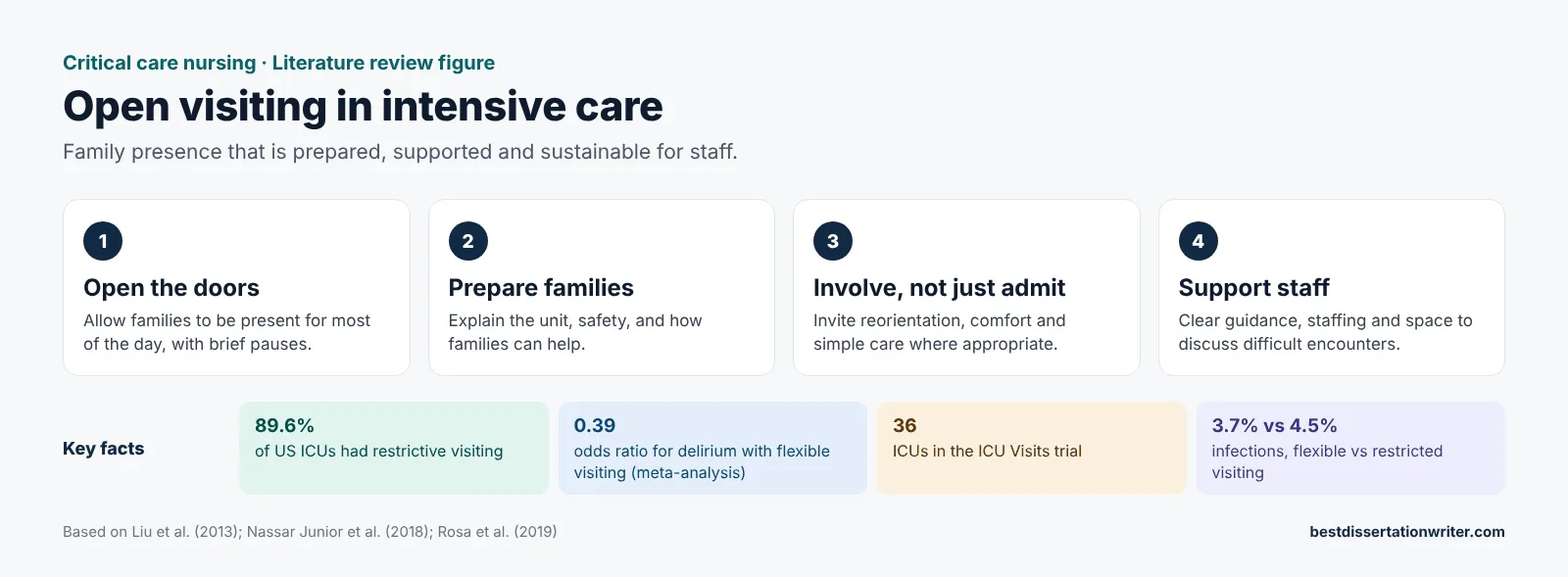
Critical care nurses should support open visiting policies that allow families to be present for most of the day, combined with written and verbal information about the unit, safety and how to help. Families can be invited to take part in reorientation and simple care, which may support prevention of ICU delirium and early mobilisation. Principles of family-centred care from paediatric settings offer useful lessons.
Family presence also helps to prepare families for recovery after discharge, when patients and relatives may experience post-intensive care syndrome. Units should review their policies with staff, provide support for nurses and evaluate the effects on families and staff over time.
Conclusion
This integrative review examined the evidence on open visiting policies and family involvement in adult intensive care. Restrictive visiting remains common, yet open visiting policies reduce family anxiety and depression and increase satisfaction without increasing infection. Effects on patient delirium are uncertain, and effects on staff burnout are mixed.
Open visiting is best seen as part of family-centred care rather than a stand-alone policy. With preparation, education and support for staff, critical care nurses can make family presence a source of comfort and partnership for patients, families and teams.
References
Davidson, J. E., Aslakson, R. A., Long, A. C., Puntillo, K. A., Kross, E. K., Hart, J., Cox, C. E., Wunsch, H., Wickline, M. A., Nunnally, M. E., Netzer, G., Kentish-Barnes, N., Sprung, C. L., Hartog, C. S., Coombs, M., Gerritsen, R. T., Hopkins, R. O., Franck, L. S., Skrobik, Y., … Curtis, J. R. (2017). Guidelines for family-centered care in the neonatal, pediatric, and adult ICU. Critical Care Medicine, 45(1), 103–128. https://doi.org/10.1097/CCM.0000000000002169
Liu, V., Read, J. L., Scruth, E., & Cheng, E. (2013). Visitation policies and practices in US ICUs. Critical Care, 17(2), R71. https://doi.org/10.1186/cc12677
Nassar Junior, A. P., Besen, B. A. M. P., Robinson, C. C., Falavigna, M., Teixeira, C., & Rosa, R. G. (2018). Flexible versus restrictive visiting policies in ICUs: A systematic review and meta-analysis. Critical Care Medicine, 46(7), 1175–1180. https://doi.org/10.1097/CCM.0000000000003155
Ning, J., & Cope, V. (2020). Open visiting in adult intensive care units: A structured literature review. Intensive and Critical Care Nursing, 56, 102763. https://doi.org/10.1016/j.iccn.2019.102763
Rosa, R. G., Falavigna, M., da Silva, D. B., Sganzerla, D., Santos, M. M. S., Kochhann, R., de Moura, R. M., Eugênio, C. S., da Silva Ribeiro Haack, T., Barbosa, M. G., et al. (2019). Effect of flexible family visitation on delirium among patients in the intensive care unit: The ICU Visits randomized clinical trial. JAMA, 322(3), 216–228. https://doi.org/10.1001/jama.2019.8766
Cite this example
Best Dissertation Writers (2026) Family Involvement and Open Visiting Policies in Intensive Care Units: An Integrative Review. Available at: https://bestdissertationwriter.com/open-visiting-policies-review-review/
Best Dissertation Writers
Get expert help with your nursing literature review
Share your topic and deadline with Best Dissertation Writers and get support tailored to your module brief.