Communication About End-of-Life Care in Intensive Care: A Literature Review of Nursing Practice
 By Dr. Robertson Prime, Research Fellow
Updated October 17, 2026
14 min read
About 2,900 words
In this review
Abstract
Background: Communication about end-of-life care is central to intensive care, where many deaths follow decisions to withhold or withdraw life-sustaining treatment and families are asked to represent the wishes of patients who cannot speak. Nurses are present throughout these conversations and support families before, during and after them.
Aim: This narrative review aimed to examine the evidence on interventions to improve end-of-life communication with families in intensive care and the role of nurses.
Methods: Evidence was identified through targeted searches of openly accessible bibliographic records, publisher websites and the reference lists of key reviews. Five sources published between 2007 and 2018 were included: a systematic review of nursing roles, three randomised controlled trials and an international guideline, synthesised narratively.
Findings: A proactive family conference with a bereavement brochure reduced post-traumatic stress symptoms in relatives from 69% to 45%, anxiety from 67% to 45% and depression from 56% to 29%. Communication facilitators reduced family depression at six months and shortened ICU stays among patients who died. A nurse-led family support programme did not reduce family distress but improved ratings of communication and shortened ICU stays for decedents.
Conclusion: Critical care nurses should help to plan proactive family meetings, give families time to talk, provide written information and coordinate support, within a family-centred and palliative care approach.
Keywords: communication about end-of-life care, family meetings, palliative care
Introduction
This narrative review critically examines recent evidence on communication about end-of-life care and its implications for critical care nursing practice.
Death is common in intensive care, and many deaths follow decisions to withhold or withdraw treatments such as mechanical ventilation, dialysis or vasopressors when they are no longer helping the patient. Most patients are too ill to take part in these decisions, so clinicians rely on families to describe what the patient would have wanted. These conversations are among the most difficult in healthcare, and they often happen under time pressure, in unfamiliar surroundings and at moments of great distress.
The quality of these conversations has lasting effects. Families who feel poorly informed, excluded or rushed may experience anxiety, depression, post-traumatic stress and complicated grief long after the death. Conflict between families and clinicians can also prolong treatment that patients would not have wanted. Good communication, by contrast, can help families to understand the situation, feel that their relative’s wishes were respected and begin to grieve.
Nurses are at the bedside throughout. They often recognise first when families are struggling, answer questions between meetings, attend family meetings, explain what was said afterwards and support families at the bedside as death approaches. Their role in communication is therefore central, although it is not always recognised or supported.
A narrative approach was chosen because the evidence consists of several distinct interventions tested in trials, together with an international guideline, which are best interpreted together.
Communication about end-of-life care is also shaped by culture, religion and family dynamics. Families differ in how much information they want, who should be involved and how decisions should be made. Some prefer clinicians to take the lead, while others want to make decisions themselves. Nurses who understand these differences can help teams to adapt their approach and avoid misunderstandings.
Review question
What does the evidence show about interventions to improve communication about end-of-life care with families in intensive care, and what is the role of nurses?
Background to Communication About End-of-Life Care
Family meetings, also called family conferences, are the main setting for discussions about goals of care and end-of-life decisions. They usually involve the senior doctor, the bedside nurse and family members, and sometimes other professionals such as social workers, chaplains or palliative care specialists. Their purpose is to share information about the patient’s condition and prognosis, understand the patient’s values and preferences, and reach shared decisions about treatment.
Several communication frameworks have been developed. They encourage clinicians to prepare for the meeting, find out what families understand, give clear information about prognosis, allow time for emotions, ask about the patient’s values, and summarise decisions. A consistent finding is that families value being listened to, and that clinicians often speak much more than families during meetings.
Palliative care principles apply throughout. Even when treatment aims to prolong life, attention to symptoms, comfort, dignity and family support is important. When the focus shifts to comfort, nurses manage symptom relief, prepare families for what to expect, support rituals and help families to be present at the time of death.
Nurses may face particular challenges. They may disagree with treatment decisions, feel excluded from meetings or be left to manage families’ questions without knowing what doctors have said. These challenges contribute to moral distress and highlight the importance of teamwork in communication about end-of-life care.
Poor communication about end-of-life care has been linked to family dissatisfaction, complaints and conflict with staff. Families who receive inconsistent messages from different clinicians, or who feel that bad news was given abruptly, may lose trust in the team. Consistency between doctors and nurses, and continuity in who speaks with the family, are therefore important elements of good practice.
Search Strategy and Methods
Evidence for this example was identified through targeted searches of openly accessible bibliographic records, publisher websites and the reference lists of key reviews. Search terms combined keywords for the topic (“end-of-life”, “family meeting”, “family conference”, “goals of care”, “withdrawal of treatment”) with terms for the setting and outcomes (“intensive care”, “communication”, “family distress”, “post-traumatic stress”, “nurse”), joined with the Boolean operators AND and OR. A full narrative review for assessment would run the same strategy in CINAHL, PubMed/MEDLINE, the Cochrane Library and Embase and report the number of records screened in a PRISMA flow diagram.
Sources were eligible if they evaluated interventions to improve communication with families of critically ill adults or provided guidance on such communication. Randomised controlled trials were prioritised, a systematic review was included to describe nursing roles, and an international guideline was included to reflect recommended practice. Studies limited to children or to settings outside intensive care were excluded.
Five sources published between 2007 and 2018 were included: three randomised controlled trials, a systematic review of nursing roles and an international clinical practice guideline (Table 1). The quality of each source was considered using the Critical Appraisal Skills Programme (CASP) checklists, and findings were synthesised narratively.
Key Findings on Communication About End-of-Life Care
Three themes were identified: structured, proactive family meetings; dedicated communication support for families; and the role of nurses in communication about end-of-life care. Table 1 summarises the included sources, and Figure 1 shows the effect of a proactive communication strategy on bereaved relatives.
| Author, year | Design | Setting and sample | Key finding |
|---|---|---|---|
| Lautrette et al. (2007) | Randomised controlled trial | Families of 126 dying patients, 22 ICUs, France | Proactive conference and brochure: PTSD symptoms 45% vs 69%; anxiety 45% vs 67%; depression 29% vs 56%. |
| Adams et al. (2011) | Systematic review | 44 studies, 10 countries, acute care | Nurses act as information broker, supporter and advocate; little evidence linking roles to outcomes. |
| Curtis et al. (2016) | Randomised controlled trial | 168 patients with ≥30% predicted mortality, 268 family members, 2 US hospitals | Communication facilitators: less family depression at 6 months; ICU stay among decedents 7.7 vs 28.5 days. |
| Davidson et al. (2017) | International clinical practice guideline | 29 members; 238 studies | 23 weak recommendations on communication, family presence and family support. |
| White et al. (2018) | Randomised controlled trial (PARTNER) | 1,420 patients and their families, 5 US ICUs | Nurse-led family support: no change in anxiety or depression; better communication ratings; shorter ICU stay for decedents. |
Theme 1: Structured, Proactive Family Meetings
A randomised trial in 22 intensive care units in France tested a proactive end-of-life conference with a bereavement brochure for families of 126 patients who were dying (Lautrette et al., 2007). Intervention meetings were longer (median 30 compared with 20 minutes), and family members spent more time talking (median 14 compared with 5 minutes). At 90 days, post-traumatic stress symptoms were present in 45% of relatives in the intervention group compared with 69% of controls, anxiety in 45% compared with 67% and depression in 29% compared with 56%.
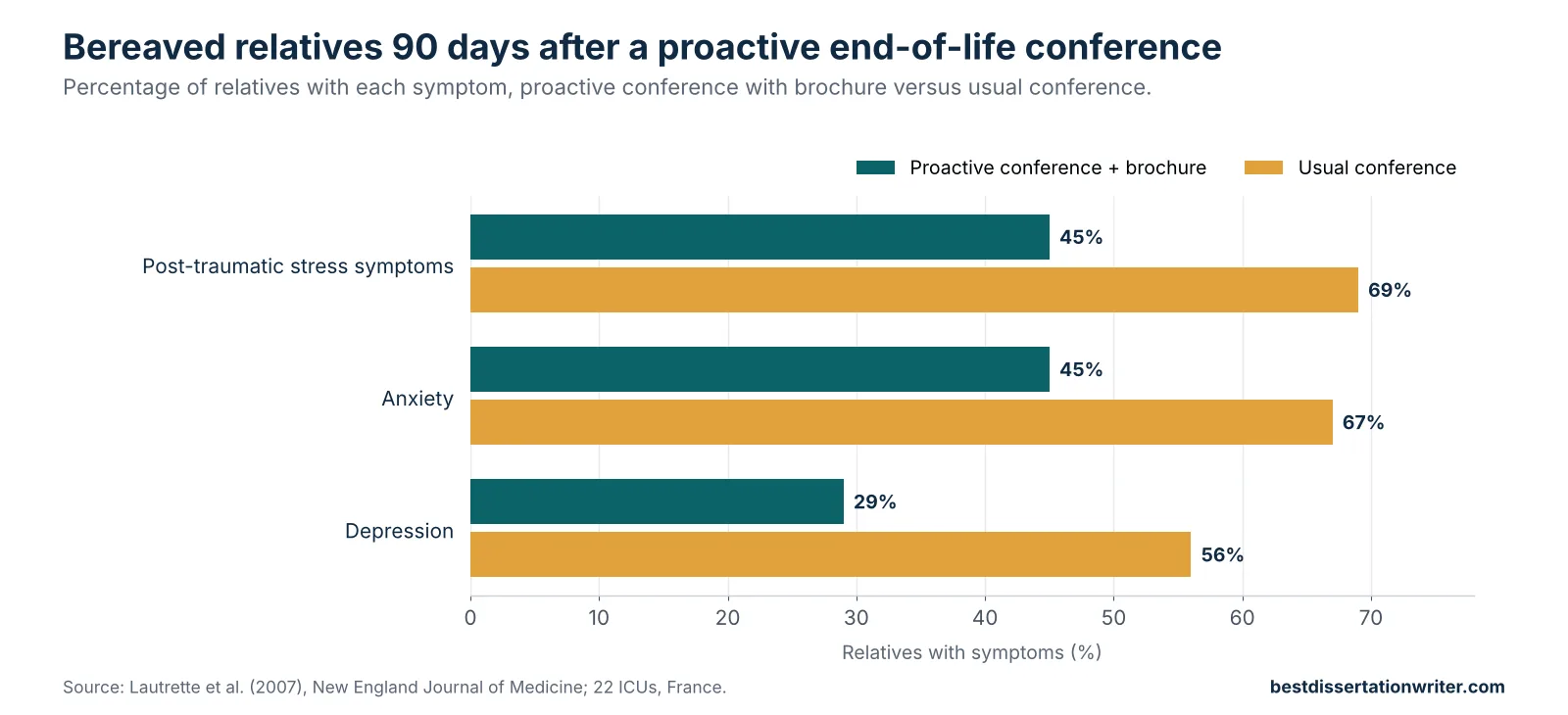
This trial showed that a simple intervention, giving families more time to talk and written information about bereavement, can substantially reduce psychological harm. The intervention was based on a structured approach to listening, acknowledging emotions and supporting decisions. The trial was relatively small and conducted in one country, and follow-up was limited to 90 days, but its effects were large and clinically meaningful.
International guidelines for family-centred care in intensive care, developed by 29 members and based on 238 studies, made 23 recommendations covering communication with families, family presence, family support and the environment (Davidson et al., 2017). All recommendations were weak, reflecting limited evidence, but the inclusion of communication as a core topic confirms its importance. The guideline provides a framework for embedding structured family meetings within wider family-centred care.
For nurses, the French trial offers a practical message about communication about end-of-life care: giving families space to speak may matter as much as the information clinicians provide. Nurses can encourage families to share memories of the patient, ask questions and express feelings, both in formal meetings and at the bedside.
Theme 2: Dedicated Communication Support for Families
A randomised trial at two hospitals tested communication facilitators who supported communication between clinicians and families of 168 patients with a predicted mortality of at least 30% (Curtis et al., 2016). Family members in the intervention group had fewer depressive symptoms at six months, although there were no differences in anxiety or post-traumatic stress. Among patients who died, intensive care stays were much shorter (7.7 compared with 28.5 days), and costs were lower, suggesting that better communication reduced prolonged treatment.
The PARTNER trial tested a family support intervention delivered by nurses with advanced communication training in five intensive care units in the United States (White et al., 2018). Among families of 1,420 patients at high risk of death or severe disability, nurses met families daily and arranged clinician-family meetings at least weekly. The intervention did not reduce family anxiety or depression at six months, but families rated the quality of communication and patient-centredness of care more highly, and intensive care stays were shorter among patients who died.
Together, these trials suggest that dedicated support can improve families’ experience of communication and reduce prolonged treatment at the end of life, although effects on family psychological outcomes are inconsistent. In-hospital mortality was higher in the intervention group in the PARTNER trial, but there was no difference by six months, which may reflect earlier decisions to focus on comfort rather than additional harm.
Theme 3: The Role of Nurses in End-of-Life Communication
The PARTNER trial is notable because the intervention was led by bedside nurses rather than doctors or external facilitators (White et al., 2018). Nurses were trained in communication skills, supported families daily and coordinated meetings, at an estimated cost of about 170 US dollars per patient. The improvements in families’ ratings of communication show that nurses can take a structured, leading role in family support when they are trained and given time.
A systematic review of 44 studies from ten countries examined nursing roles and strategies in end-of-life decision-making in acute care (Adams et al., 2011). Three roles emerged: information broker, supporter and advocate. Nurses shared and clarified information, supported families emotionally and advocated for patients’ wishes. However, the review found little evidence linking these roles to outcomes for patients and families, which the PARTNER trial later began to address.
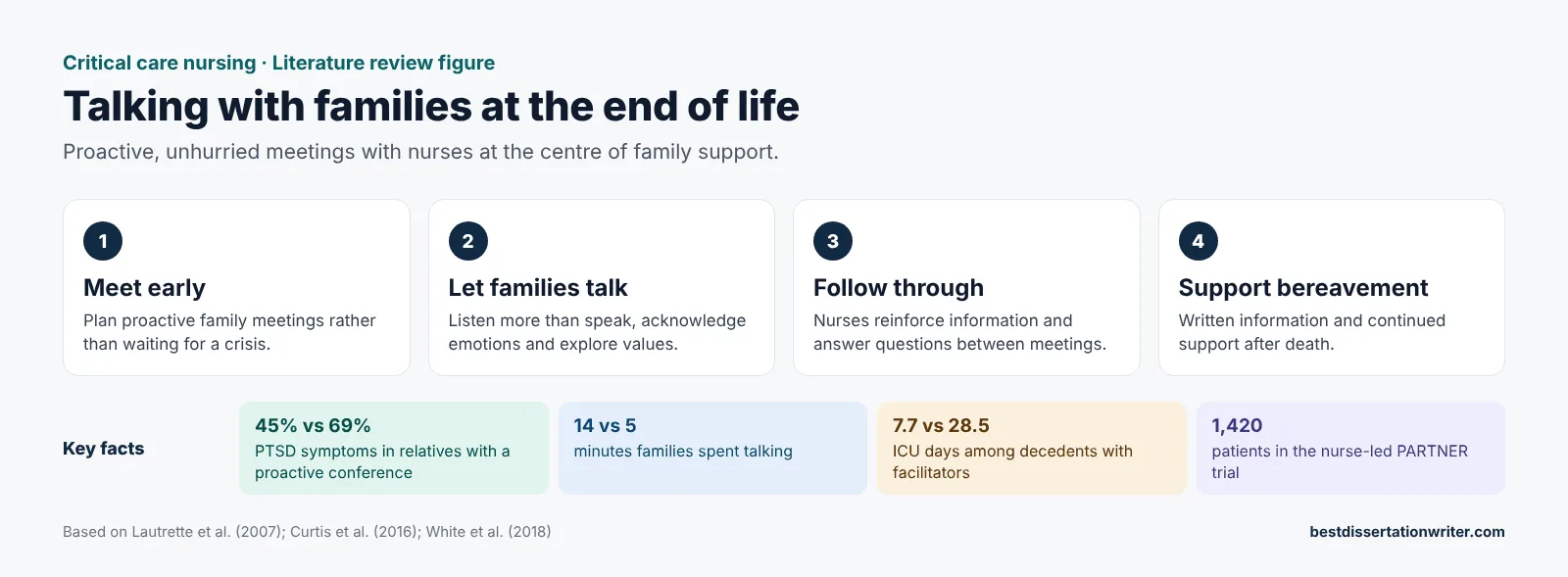
Across the trials, effective communication involved more than a single meeting: it required preparation, continuity, follow-up and attention to families’ emotions, all of which nurses are well placed to provide.
These findings support a team approach in which nurses contribute their knowledge of the patient and family, help families to prepare questions, attend meetings and reinforce what was discussed. When nurses are excluded from meetings, they may be unable to answer families’ questions consistently, which can undermine trust and add to families’ distress.
Nurses also contribute to communication about end-of-life care in less visible ways: explaining changes in monitoring when treatment is withdrawn, describing what dying may look like, inviting families to touch and talk to the patient, and making space for religious or cultural practices. These moments are rarely captured in research, yet families often remember them as the most important parts of care.
Discussion
This review found that structured, proactive communication can reduce psychological harm in bereaved families, and that dedicated communication support, including nurse-led support, improves families’ experience of communication and reduces prolonged treatment at the end of life. Effects on anxiety, depression and post-traumatic stress were strong in one trial but inconsistent in others, which suggests that the content, timing and delivery of interventions matter.
One explanation for these differences is the population studied. The French trial focused on families of patients who were already dying, while the US trials included patients at high risk of death, some of whom survived. Interventions that help families to prepare for death may have different effects from those that support decision-making under uncertainty. Another explanation is that family distress has many causes, not all of which can be addressed by communication alone.
The findings have important implications for nursing. Communication about end-of-life care should not be seen as the responsibility of doctors alone. Nurses with communication training can lead structured family support, and their continuous presence allows them to recognise distress, clarify information and maintain trust between meetings. Recognising and resourcing this role may improve families’ experience and reduce moral distress among nurses.
Palliative care expertise is also valuable. Integrating palliative care principles into intensive care, through specialist consultation or training for intensive care staff, can support symptom management, communication and family support. Bereavement follow-up, such as the brochure used in the French trial, recognises that families’ needs continue after the death.
This review has limitations. It included a small number of trials, conducted in high-income countries, and outcomes were measured differently between studies. The guideline’s recommendations were all weak. This review relied on openly accessible, English-language sources and did not involve independent double screening. Future research should test nurse-led communication models in different cultural settings and measure long-term bereavement outcomes.
Education is essential. Many nurses report feeling unprepared for difficult conversations, and communication skills training, simulation and mentoring can build confidence. The PARTNER trial shows that training bedside nurses is feasible and can change families’ experiences, suggesting that investment in communication about end-of-life care should be part of critical care nursing education.
Implications of Communication About End-of-Life Care Evidence for Practice
Critical care nurses should help to plan early, proactive family meetings, attend them where possible, encourage families to speak and reinforce information afterwards. Written information about bereavement and practical support at the bedside should be offered to families of dying patients. Nurses should draw on therapeutic communication skills, and lessons from end-of-life care at home can inform transitions when patients are discharged to die at home.
Comfort-focused care should continue to include attention to skin, sleep and symptoms, including prevention of device-related pressure injuries and relief of sleep disruption. Units should provide communication training for nurses and include them as full members of the team in family meetings.
Units should also audit communication about end-of-life care, for example by recording whether family meetings took place, who attended and what was decided, and by seeking feedback from bereaved families to guide improvement.
Conclusion
This narrative review examined the evidence on improving communication about end-of-life care with families in intensive care. Proactive family conferences with time for families to talk reduced psychological harm in bereaved relatives, and dedicated communication support, including nurse-led support, improved families’ experience and reduced prolonged treatment for patients who died.
Nurses are central to communication at the end of life. With training, time and inclusion in family meetings, critical care nurses can help families to understand, participate in decisions and begin to grieve, as part of family-centred palliative care.
Good communication about end-of-life care is ultimately a shared responsibility of the whole team, in which nurses play an essential part.
References
Adams, J. A., Bailey, D. E., Anderson, R. A., & Docherty, S. L. (2011). Nursing roles and strategies in end-of-life decision making in acute care: A systematic review of the literature. Nursing Research and Practice, 2011, 527834. https://doi.org/10.1155/2011/527834
Curtis, J. R., Treece, P. D., Nielsen, E. L., et al. (2016). Randomized trial of communication facilitators to reduce family distress and intensity of end-of-life care. American Journal of Respiratory and Critical Care Medicine, 193(2), 154–162. https://doi.org/10.1164/rccm.201505-0900OC
Davidson, J. E., Aslakson, R. A., Long, A. C., Puntillo, K. A., Kross, E. K., Hart, J., Cox, C. E., Wunsch, H., Wickline, M. A., Nunnally, M. E., Netzer, G., Kentish-Barnes, N., Sprung, C. L., Hartog, C. S., Coombs, M., Gerritsen, R. T., Hopkins, R. O., Franck, L. S., Skrobik, Y., … Curtis, J. R. (2017). Guidelines for family-centered care in the neonatal, pediatric, and adult ICU. Critical Care Medicine, 45(1), 103–128. https://doi.org/10.1097/CCM.0000000000002169
Lautrette, A., Darmon, M., Megarbane, B., et al. (2007). A communication strategy and brochure for relatives of patients dying in the ICU. New England Journal of Medicine, 356(5), 469–478. https://doi.org/10.1056/NEJMoa063446
White, D. B., Angus, D. C., Shields, A. M., et al. (2018). A randomized trial of a family-support intervention in intensive care units. New England Journal of Medicine, 378(25), 2365–2375. https://doi.org/10.1056/NEJMoa1802637
Cite this example
Best Dissertation Writers (2026) Communication About End-of-Life Care in Intensive Care: A Literature Review of Nursing Practice. Available at: https://bestdissertationwriter.com/communication-about-end-of-life-care/
Best Dissertation Writers
Get expert help with your nursing literature review
Share your topic and deadline with Best Dissertation Writers and get support tailored to your module brief.