Prevention of Central Line-Associated Bloodstream Infections in Intensive Care: A Systematic Review
 By Dr. Robertson Prime, Research Fellow
Updated October 17, 2026
14 min read
About 2,800 words
In this review
Abstract
Background: Central line-associated bloodstream infections are among the most serious complications of intensive care, causing illness, longer stays, extra costs and deaths. Most are considered preventable, and nurses carry out many of the practices that prevent them, from skin preparation to line maintenance.
Aim: This systematic review aimed to examine the effectiveness of interventions to prevent central line-associated bloodstream infections in intensive care.
Methods: Evidence was identified through targeted searches of openly accessible bibliographic records, publisher websites and the reference lists of key reviews. Five sources published between 2006 and 2015 were included: two large quality improvement programmes, two randomised trials and a Cochrane systematic review, synthesised narratively.
Findings: A checklist-based programme in 103 Michigan ICUs cut catheter-related bloodstream infections by up to 66% over 18 months, and a national programme in England saw rates fall from 3.7 to 1.48 per 1,000 catheter days, although a secular trend contributed. Chlorhexidine-alcohol skin antisepsis reduced catheter-related infections compared with povidone iodine-alcohol (hazard ratio 0.15). Daily chlorhexidine bathing reduced hospital-acquired bloodstream infections by 28%, and chlorhexidine dressings reduced infections per 1,000 patient days.
Conclusion: Critical care nurses should apply insertion and maintenance bundles consistently, use chlorhexidine-based antisepsis, bathing and dressings, and remove lines that are no longer needed.
Keywords: bloodstream infections, central line, CLABSI, infection prevention
Introduction
This systematic review critically examines recent evidence on bloodstream infections and its implications for critical care nursing practice.
Central venous catheters are used in most critically ill patients to give drugs, fluids and nutrition and to monitor the circulation. They are essential, but they provide a direct route for micro-organisms to enter the bloodstream. Central line-associated bloodstream infections, often abbreviated to CLABSI, can lead to sepsis, prolonged ventilation, longer intensive care stays and death, and they add substantially to the cost of care.
Bloodstream infections linked to central lines were once regarded as an unavoidable consequence of intensive care. Over the past two decades, however, programmes combining simple evidence-based practices with changes in safety culture have shown that rates can be reduced dramatically. Many of these practices, including hand hygiene, skin preparation, dressing care, hub decontamination and daily review of the need for the line, are carried out or overseen by nurses.
A systematic review approach was chosen to bring together the strongest evidence from large improvement programmes, randomised trials and a Cochrane review, and to judge the certainty and applicability of that evidence.
The burden falls unequally. Patients who are immunosuppressed, receiving parenteral nutrition, undergoing renal replacement therapy or staying in intensive care for long periods are at particular risk, because their lines remain in place for longer and are accessed more often. For these patients, every handling of the line is an opportunity either to introduce organisms or to prevent them.
Review question
How effective are interventions to prevent central line-associated bloodstream infections in intensive care?
Background to Bloodstream Infections
Micro-organisms can reach the bloodstream through a central line in two main ways. Early after insertion, skin organisms migrate along the outside of the catheter from the insertion site. Later, organisms enter through the hub and connectors when the line is accessed, travelling along the inside of the catheter. Prevention therefore focuses on both insertion and maintenance.
Insertion bundles typically include hand hygiene, full barrier precautions, chlorhexidine-based skin antisepsis, choosing the best insertion site and avoiding the femoral vein where possible. Maintenance bundles include hand hygiene before handling the line, decontaminating hubs and connectors, keeping dressings clean and intact, changing administration sets at appropriate intervals and reviewing daily whether the line is still needed. Checklists empower nurses to stop a procedure when steps are missed.
Chlorhexidine is central to many of these practices. It is used for skin preparation before insertion, in dressings placed over the insertion site and in daily bathing of patients to reduce the number of micro-organisms on the skin. Each of these uses has been tested in trials, with differing strength of evidence.
Surveillance is another important element of infection prevention. Measuring rates of bloodstream infections per 1,000 catheter days allows units to monitor performance, compare themselves with others and see whether improvement efforts are working. However, definitions and methods of surveillance vary, which can make comparisons difficult.
Nurses access central lines many times each day to give drugs, take blood samples and change infusions. Each access involves opening the closed system, so the quality of hand hygiene and hub decontamination at the bedside has a direct effect on risk. In busy units, where several infusions may run through one line and staff may be interrupted, maintaining aseptic technique consistently requires skill, attention and an environment that supports careful practice.
Search Strategy and Methods
Evidence for this example was identified through targeted searches of openly accessible bibliographic records, publisher websites and the reference lists of key reviews. Search terms combined keywords for the outcome (“bloodstream infection”, “catheter-related infection”, “CLABSI”, “CRBSI”) with terms for the device and interventions (“central venous catheter”, “central line”, “bundle”, “checklist”, “chlorhexidine”, “dressing”, “bathing”, “intensive care”), joined with the Boolean operators AND and OR. A full systematic review for assessment would run the same strategy in CINAHL, PubMed/MEDLINE, the Cochrane Library and Embase and report the number of records screened in a PRISMA flow diagram.
Sources were eligible if they evaluated interventions to prevent catheter-related or central line-associated bloodstream infections in adult intensive care, using randomised, quasi-experimental or large before-and-after designs, or systematically reviewed such studies. Large quality improvement programmes were included because they represent the main approach used in practice. Studies limited to children or to peripheral catheters were excluded.
Five sources published between 2006 and 2015 were included: two large quality improvement programmes, a cluster randomised crossover trial, a multicentre randomised controlled trial and a Cochrane systematic review (Table 1). The quality of each source was considered using the Critical Appraisal Skills Programme (CASP) checklists, drawing on the certainty ratings reported by the Cochrane review, and findings were synthesised narratively.
Key Findings on Bloodstream Infections
Three themes were identified: the impact of bundles and safety programmes, the role of chlorhexidine in skin antisepsis and bathing, and dressings that protect the insertion site. Table 1 summarises the included sources, and Figure 1 shows the effects of the main interventions on bloodstream infections.
| Author, year | Design | Setting and sample | Key finding |
|---|---|---|---|
| Pronovost et al. (2006) | Multicentre quality improvement cohort (Keystone ICU) | 103 ICUs, 375,757 catheter days, Michigan, USA | Median rate 2.7 to 0 per 1,000 catheter days; up to 66% reduction sustained at 18 months. |
| Bion et al. (2013) | National stepped quality improvement programme (Matching Michigan) | 215 ICUs, England | Adult rate fell from 3.7 to 1.48 per 1,000 CVC days; reduction largely reflected a secular trend. |
| Climo et al. (2013) | Cluster randomised crossover trial | 7,727 patients, 9 ICU and transplant units, USA | Daily chlorhexidine bathing cut hospital-acquired bloodstream infections by 28% (6.60 to 4.78 per 1,000 days). |
| Mimoz et al. (2015) | Multicentre randomised controlled trial (CLEAN) | 2,349 adults, 11 ICUs, France | Chlorhexidine-alcohol vs povidone iodine-alcohol: catheter-related infection HR 0.15; more skin reactions. |
| Ullman et al. (2015) | Cochrane systematic review | 22 studies, 7,436 participants | Chlorhexidine dressings reduced CRBSI per 1,000 patient days (RR 0.51, moderate certainty). |
Theme 1: Bundles and Safety Programmes Against Bloodstream Infections
The Michigan Keystone ICU project involved 103 intensive care units and 375,757 catheter days (Pronovost et al., 2006). An evidence-based intervention to reduce catheter-related bloodstream infections was introduced across the participating units. The median infection rate fell from 2.7 per 1,000 catheter days at baseline to zero within three months, and the mean rate fell from 7.7 to 1.4 at 16 to 18 months. The incidence rate ratio fell to 0.34 at 16 to 18 months, a reduction of up to 66% that was sustained.
The Matching Michigan programme attempted to replicate this approach across intensive care units in England, with 215 units submitting data (Bion et al., 2013). In adult units, the mean rate of central venous catheter bloodstream infections fell from 3.7 to 1.48 per 1,000 catheter patient days, a reduction of about 60%. However, rates also fell in units before they joined the programme, and the authors concluded that much of the improvement reflected a wider national trend towards reducing healthcare-associated infections.
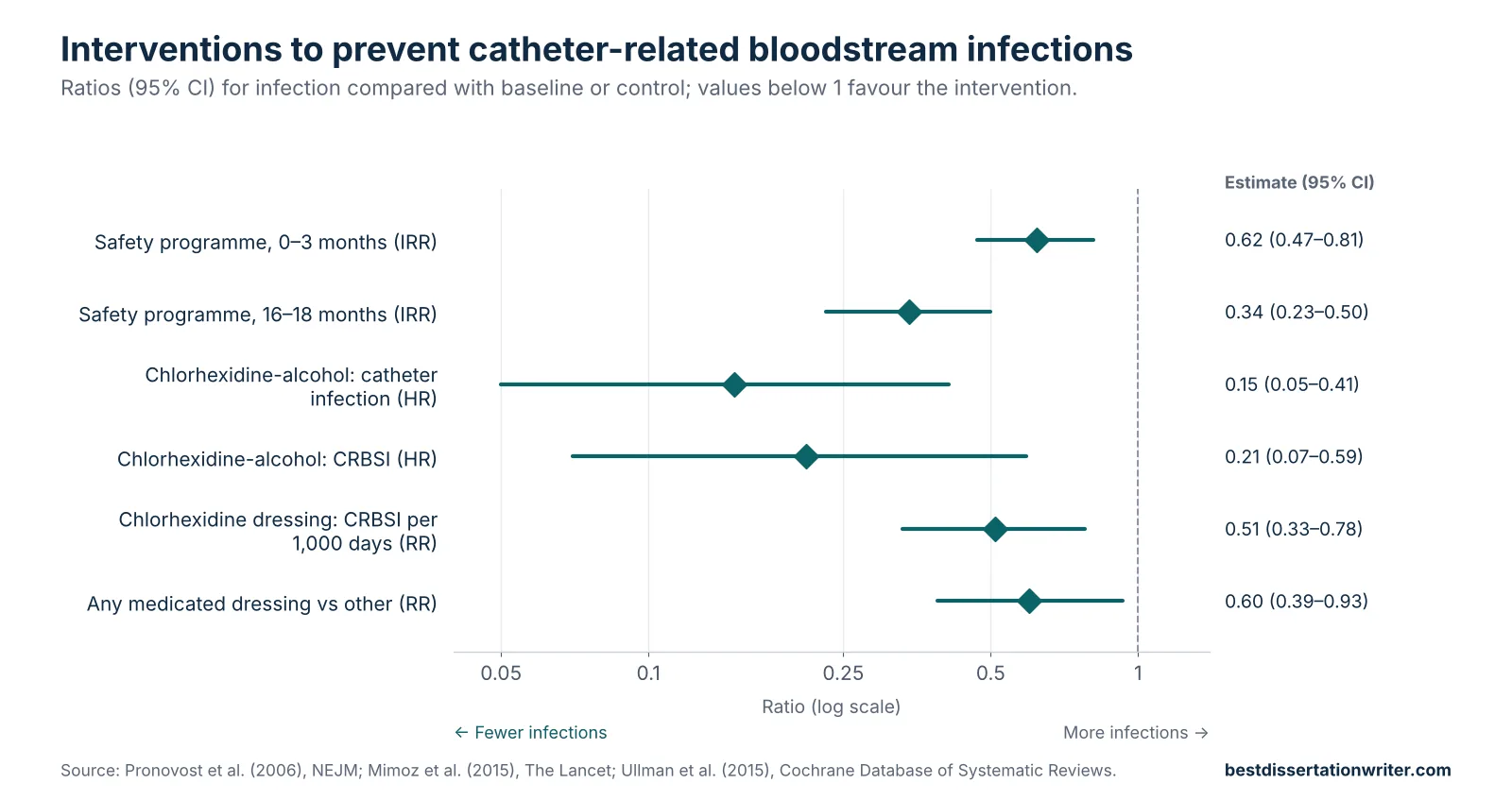
These programmes show that dramatic reductions are achievable, but they are before-and-after studies without randomised controls, so other changes may have contributed. The contrasting interpretation of Matching Michigan highlights the importance of context, culture and national policy, and suggests that bundles work best when embedded in wider systems of infection prevention rather than introduced in isolation.
A further lesson is that improvement programmes of this kind usually involve more than a list of technical steps. They depend on teams seeing infections as preventable rather than inevitable, on regular feedback of data and on nurses feeling able to raise concerns when practice falls short. Units that copy only the checklist, without these cultural elements, may struggle to achieve the same results.
Theme 2: Chlorhexidine for Skin Antisepsis and Bathing
The CLEAN trial randomised 2,349 adults in 11 French intensive care units who needed central venous, dialysis or arterial catheters to skin antisepsis with chlorhexidine-alcohol or povidone iodine-alcohol (Mimoz et al., 2015). Catheter-related infections occurred at 0.28 compared with 1.77 per 1,000 catheter days (hazard ratio 0.15, 95% CI 0.05 to 0.41), and catheter-related bloodstream infections were also reduced (hazard ratio 0.21). Severe skin reactions were more frequent with chlorhexidine (2.6% compared with 0.7%), but no systemic adverse events occurred.
A cluster randomised crossover trial in nine intensive care and bone marrow transplant units compared daily bathing with chlorhexidine-impregnated washcloths with non-antimicrobial washcloths in 7,727 patients (Climo et al., 2013). Hospital-acquired bloodstream infections fell from 6.60 to 4.78 per 1,000 patient days, a 28% reduction, and acquisition of multidrug-resistant organisms fell by 23%. No serious skin reactions occurred.
These trials provide strong evidence for chlorhexidine in two areas of nursing practice. Chlorhexidine-alcohol should be used for skin preparation before insertion and during dressing changes, and daily chlorhexidine bathing offers a simple, low-cost way to reduce bloodstream infections across the unit. Nurses should monitor for skin reactions and be aware of concerns about the development of chlorhexidine resistance with widespread use.
Daily bathing is a nursing task that is easy to overlook when units are busy, yet the trial suggests that it is one of the most effective measures available. Building chlorhexidine bathing into daily care plans, providing ready-to-use washcloths and explaining its purpose to patients and families can help to make it routine.
Theme 3: Dressings That Protect the Insertion Site
A Cochrane review of 22 studies with 7,436 participants compared dressings and securement devices for central venous catheters (Ullman et al., 2015). Chlorhexidine-impregnated dressings reduced the frequency of catheter-related bloodstream infection per 1,000 patient days compared with standard polyurethane dressings (risk ratio 0.51, 95% CI 0.33 to 0.78; moderate-certainty evidence). Medication-impregnated dressings as a group reduced infections compared with all other dressing types (risk ratio 0.60; high-certainty evidence).
However, when infection was measured as the proportion of patients affected rather than per 1,000 patient days, the difference was uncertain. The review also found limited evidence on other outcomes, such as skin damage and dressing failure. Dressing choice is therefore one part of a wider approach that includes keeping dressings clean, dry and intact and changing them when they become loose or soiled.
Securement is a related concern. Lines that move in and out of the insertion site can carry skin organisms along the catheter and cause mechanical complications. The Cochrane review examined securement devices as well as dressings, but evidence was limited, so nurses must rely on careful fixation, regular inspection and prompt replacement of dressings that no longer hold the line securely.
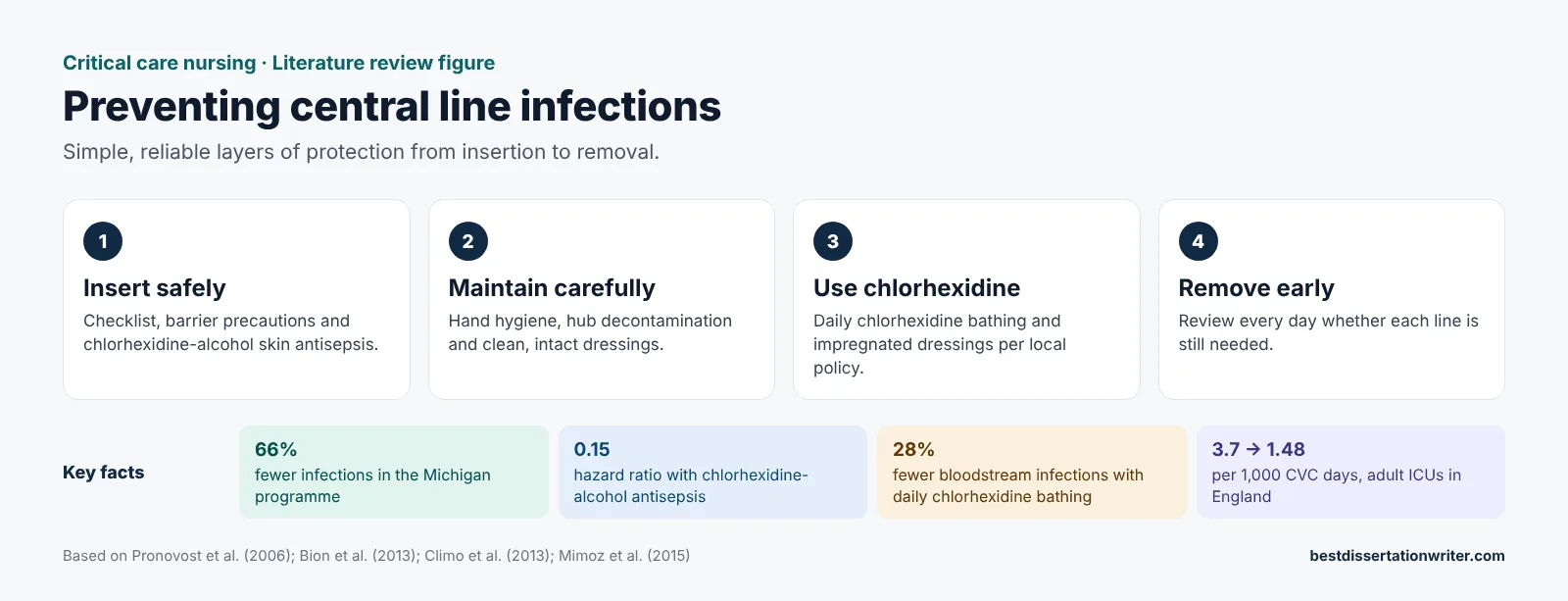
Across the three themes, the interventions with the strongest evidence share an important feature: they are simple, inexpensive and largely within the control of the bedside team. Their effect depends less on new technology than on doing well-established things reliably, for every patient and every line, around the clock.
Discussion
This review found consistent evidence that bloodstream infections linked to central lines can be greatly reduced. Large safety programmes achieved sustained reductions, chlorhexidine-alcohol skin antisepsis was markedly more effective than povidone iodine-alcohol, daily chlorhexidine bathing reduced bloodstream infections across intensive care units, and chlorhexidine dressings reduced infection rates. Together, these findings support a layered approach in which several simple measures are applied reliably.
Nurses are central to this approach. Many of the effective practices, including skin preparation during dressing changes, daily bathing, dressing care, hub decontamination and challenging unnecessary lines, are nursing responsibilities. Checklists that authorise nurses to stop a procedure when steps are missed, and daily discussions about whether each line is still needed, give nurses an active role in infection prevention rather than simply carrying out instructions.
The Matching Michigan experience shows that results depend on context. Bundles introduced into units where infection rates are already falling, or where staff see them as a box-ticking exercise, may show less effect than in the original programme. Leadership, feedback of infection data, staff engagement and a culture that encourages speaking up are likely to be as important as the technical content of the bundle.
Sustaining improvement is a further challenge. Staff turnover, high workload and new devices can all erode compliance over time. Ongoing education, regular audit of bundle compliance and feedback of infection rates help to keep prevention at the forefront of practice, and nurse-to-patient ratios that allow time for careful line care are likely to matter.
This review has limitations. The two programmes used before-and-after designs, the trials were conducted in specific countries and settings, and the Cochrane review included studies of varying quality. This review relied on openly accessible, English-language sources and did not involve independent double screening. Future research should examine how best to sustain bundle compliance and evaluate newer technologies such as antimicrobial caps and catheter securement devices.
Finally, the evidence focuses mainly on adults in high-income countries. Units with fewer resources may not be able to afford impregnated dressings or daily chlorhexidine washcloths, and may need to prioritise the measures with the greatest effect at the lowest cost, such as hand hygiene, chlorhexidine-alcohol skin antisepsis and early removal of unnecessary lines. Adapting bundles to local resources, rather than abandoning them, is likely to be the most effective approach.
Implications of Bloodstream Infections Evidence for Practice
Critical care nurses should follow insertion and maintenance bundles for every central line, use chlorhexidine-alcohol for skin preparation, consider daily chlorhexidine bathing and chlorhexidine dressings in line with local policy, decontaminate hubs before every access and prompt daily review of whether each line is still needed. These practices build on wider efforts to reduce hospital-acquired infections and complement bundles that prevent ventilator-associated pneumonia.
Patients and families should be told about the purpose of lines and the importance of hygiene, and survivors’ experiences, including infections, can be explored through ICU diaries. Removing lines promptly also reduces discomfort, which should be monitored through regular ICU pain assessment.
Infection data should be shared openly with the whole team, including nurses, doctors and support staff, so that everyone understands the current rate and their contribution to reducing it.
Conclusion
This systematic review examined the effectiveness of interventions to prevent central line-associated bloodstream infections in intensive care. Bundles and safety programmes, chlorhexidine-alcohol skin antisepsis, daily chlorhexidine bathing and chlorhexidine dressings all reduce bloodstream infections, although the effects of programmes depend on context and wider trends.
Nurses are at the heart of CLABSI prevention. Reliable, everyday application of simple evidence-based practices, supported by leadership, feedback and a culture of safety, can prevent many serious infections and save lives.
Every unit should know its own infection rate, celebrate periods without infections and investigate each new case as a chance to learn.
References
Bion, J., Richardson, A., Hibbert, P., Beer, J., Abrusci, T., McCutcheon, M., Cassidy, J., Eddleston, J., Gunning, K., Bellingan, G., Patten, M., Harrison, D., & Matching Michigan Collaboration & Writing Committee. (2013). ‘Matching Michigan’: A 2-year stepped interventional programme to minimise central venous catheter-blood stream infections in intensive care units in England. BMJ Quality & Safety, 22(2), 110–123. https://doi.org/10.1136/bmjqs-2012-001325
Climo, M. W., Yokoe, D. S., Warren, D. K., Perl, T. M., Bolon, M., Herwaldt, L. A., Weinstein, R. A., Sepkowitz, K. A., Jernigan, J. A., Sanogo, K., & Wong, E. S. (2013). Effect of daily chlorhexidine bathing on hospital-acquired infection. New England Journal of Medicine, 368(6), 533–542. https://doi.org/10.1056/NEJMoa1113849
Mimoz, O., Lucet, J.-C., Kerforne, T., et al. (2015). Chlorhexidine-alcohol versus povidone iodine-alcohol antisepsis for catheter-related infection prevention: An open-label, multicentre, randomised controlled trial. The Lancet, 386(10008), 2069–2077. https://doi.org/10.1016/S0140-6736(15)00244-5
Pronovost, P., Needham, D., Berenholtz, S., Sinopoli, D., Chu, H., Cosgrove, S., Sexton, B., Hyzy, R., Welsh, R., Roth, G., Bander, J., Kepros, J., & Goeschel, C. (2006). An intervention to decrease catheter-related bloodstream infections in the ICU. New England Journal of Medicine, 355(26), 2725–2732. https://doi.org/10.1056/NEJMoa061115
Ullman, A. J., Cooke, M. L., Mitchell, M., Lin, F., New, K., Long, D. A., Mihala, G., & Rickard, C. M. (2015). Dressings and securement devices for central venous catheters (CVC). Cochrane Database of Systematic Reviews, (9), CD010367. https://doi.org/10.1002/14651858.CD010367.pub2
Cite this example
Best Dissertation Writers (2026) Prevention of Central Line-Associated Bloodstream Infections in Intensive Care: A Systematic Review. Available at: https://bestdissertationwriter.com/bloodstream-infections-review-review/
Best Dissertation Writers
Get expert help with your nursing literature review
Share your topic and deadline with Best Dissertation Writers and get support tailored to your module brief.