
Community Outreach Strategies to Increase Vaccination Uptake: The Role of Nurses: A Systematic Review
 By Dr. Robertson Prime, Research Fellow
Updated October 28, 2026
14 min read
About 2,800 words
In this review
Abstract
Background: Vaccination uptake remains below the level needed to protect every community, and the World Health Organization reports that 13.5 million children received no vaccine at all in 2025. Nurses deliver vaccines, advise parents and run community outreach, so understanding which strategies raise vaccination uptake is central to public health nursing.
Aim: This systematic review aimed to examine the evidence on strategies, including reminders, education and community outreach, that increase vaccination uptake and the role of nurses in delivering them.
Methods: Evidence was identified through targeted searches of openly accessible bibliographic records, publisher websites and the reference lists of key reviews. Five sources published between 2014 and 2026 were included: three Cochrane reviews, a systematic review of vaccine hesitancy strategies and a WHO fact sheet. The research sources were appraised using CASP checklists and synthesised narratively.
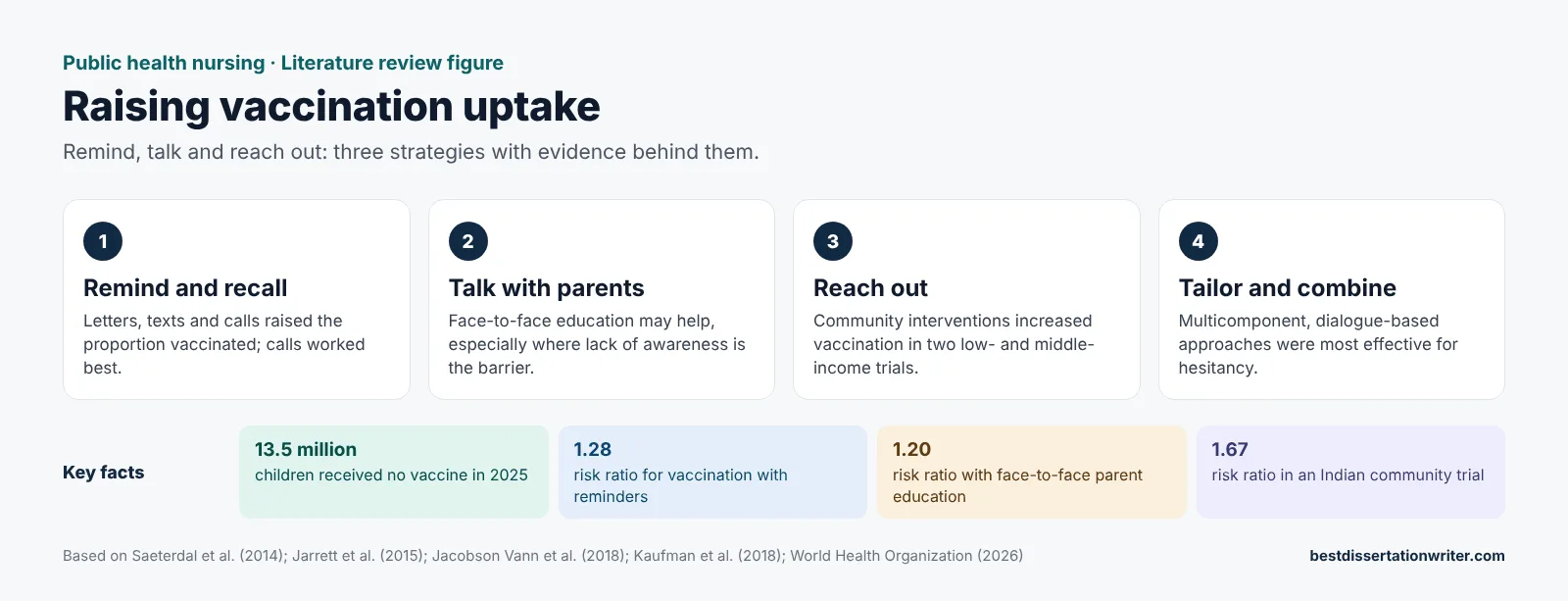
Findings: Reminder and recall interventions increased the proportion vaccinated (risk ratio 1.28; 55 trials, 138,625 participants), with telephone calls performing best. Face-to-face education for parents may improve children’s vaccination status (risk ratio 1.20), with low-certainty evidence. Community interventions in India and Pakistan increased the number of children vaccinated, although only two trials were identified. A review of 181 evaluation studies found that multicomponent and dialogue-based interventions were most effective, but few studies measured vaccination uptake.
Conclusion: Reminders, dialogue with parents and community outreach can all raise vaccination uptake, but the evidence varies in certainty. Nurses should use reminder systems, listen to concerns and tailor outreach to local communities.
Keywords: vaccination uptake, vaccine uptake, immunisation uptake
Introduction
This systematic review critically examines recent evidence on vaccination uptake and its implications for public health nursing practice.
Vaccination is one of the most effective public health measures, yet protection depends on enough people being vaccinated. The World Health Organization (WHO) reports that in 2025 about 85% of infants received three doses of diphtheria, tetanus and pertussis vaccine, but 13.5 million children received no vaccine at all and a further 6 million were only partly vaccinated. Coverage for the first dose of measles vaccine reached 84%, and nearly 21 million children missed this dose, compared with 19 million in 2019.
Falling or uneven vaccination uptake allows preventable diseases to return, particularly in communities where coverage is already low. The reasons are varied. Some people face practical barriers such as distance, cost, opening hours or lack of reminders. Others lack information, hold concerns about safety, or have lost trust in services. A strategy that works in one setting may therefore fail in another.
Nurses are central to immunisation. They give vaccines in clinics, schools and homes, advise parents, keep records and often lead outreach to groups that are missed by routine services. A systematic review design was chosen because the question concerns the effectiveness of interventions and several robust syntheses exist.
Review question
Which strategies increase vaccination uptake, how effective are reminders, education and community outreach, and what does this mean for nursing practice?
Background to Vaccination Uptake
Improving vaccination uptake involves understanding the barriers people face. These are often grouped into problems of access, such as services that are hard to reach, and problems of demand, such as low awareness or confidence. Interventions may address either. Reminders and flexible clinics tackle access, while education and community engagement address demand. Many successful programmes combine both.
Reminder and recall systems contact patients to prompt them to attend for a vaccination that is due or overdue. They may use letters, postcards, telephone calls, automated calls or text messages, and they are often run by practice staff or nurses from immunisation registers. Because they require little discussion, they are attractive for busy services.
Education and communication aim to give people the information and support they need to decide. This may be done through leaflets, mass media or face-to-face conversations. Vaccine hesitancy, defined as delay in accepting or refusing vaccines despite availability, is a particular challenge because it reflects doubts and worries that information alone may not resolve.
Community outreach goes to where people are. It may involve trusted local figures, mobile clinics, work with schools and faith or community groups, and activity in neighbourhoods with low coverage. Such approaches can reach people who rarely attend services, but they are resource intensive and need to be adapted to local culture and circumstances.
The nursing contribution spans the whole immunisation pathway. Nurses check records to find children who are overdue, prepare vaccines and give them safely, observe for reactions, document what was given and report adverse events. They also hold conversations that influence whether people return for the next dose, and many take part in school and community programmes. Because they are often the main point of contact, their skills in listening and explaining are as important as their technical skills.
Trust shapes every part of this work. People are more likely to accept a vaccine when they trust the person offering it and the system behind them. Past experiences of discrimination, language barriers or unfair treatment can reduce trust, and some communities may have specific reasons for doubting services. Understanding these reasons, rather than assuming a lack of knowledge, is an important step towards approaches that people find respectful and useful.
Search Strategy and Methods
Evidence for this example was identified through targeted searches of openly accessible bibliographic records, publisher websites and the reference lists of key reviews. Search terms combined keywords for the problem (“vaccination”, “immunisation”, “vaccine hesitancy”, “coverage”, “uptake”) with terms for the intervention and provider (“reminder”, “recall”, “education”, “community”, “outreach”, “nurse”), joined with the Boolean operators AND and OR. A full systematic review of vaccination uptake strategies for assessment would run the same strategy in CINAHL, PubMed/MEDLINE, the Cochrane Library and Web of Science and report the number of records screened in a PRISMA flow diagram.
Sources were eligible if they evaluated strategies intended to increase vaccination uptake or reduce hesitancy, or provided authoritative data on coverage. Systematic reviews and Cochrane reviews were prioritised. Studies of vaccine safety or effectiveness, rather than of strategies to increase uptake, were excluded.
Five sources on vaccination uptake published between 2014 and 2026 were included: three Cochrane reviews, a systematic review of vaccine hesitancy strategies and the WHO fact sheet that provides global context (Table 1). The quality of each research source was considered using the Critical Appraisal Skills Programme (CASP) checklists, and findings were synthesised narratively.
Key Findings on Vaccination Uptake
Three themes were identified: reminder and recall systems, education and dialogue with parents, and community outreach. Table 1 summarises the included sources, and Figure 1 shows the effects on vaccination uptake reported by the three Cochrane reviews.
| Author, year | Design | Setting and sample | Key finding |
|---|---|---|---|
| Saeterdal et al. (2014) | Cochrane systematic review | 2 cluster randomised trials (India, Pakistan) | Children vaccinated more likely in intervention communities (India RR 1.67). |
| Jarrett et al. (2015) | Systematic review | 166 peer-reviewed and 15 grey literature studies | Multicomponent and dialogue-based interventions most effective; few measured uptake. |
| Jacobson Vann et al. (2018) | Cochrane systematic review | 75 studies; 55 trials with 138,625 participants | Reminders increased proportion vaccinated (RR 1.28); telephone calls best. |
| Kaufman et al. (2018) | Cochrane systematic review | 10 studies; 4,527 participants | Face-to-face education may improve vaccination status (RR 1.20); low certainty. |
| World Health Organization (2026) | Fact sheet (global data, 2025) | Worldwide coverage estimates | 85% DTP3 coverage; 13.5 million zero-dose children. |
Theme 1: Reminder and Recall Systems and Vaccination Uptake
Jacobson Vann et al. (2018) updated a Cochrane review of patient reminder and recall interventions. It included 75 studies from 10 countries, mostly in the United States, and the pooled analysis of randomised trials covered 55 studies with 138,625 participants. Reminders probably increased the proportion of people vaccinated (risk ratio 1.28; 95% confidence interval 1.23 to 1.35), a difference of about 8 percentage points, with moderate-certainty evidence.
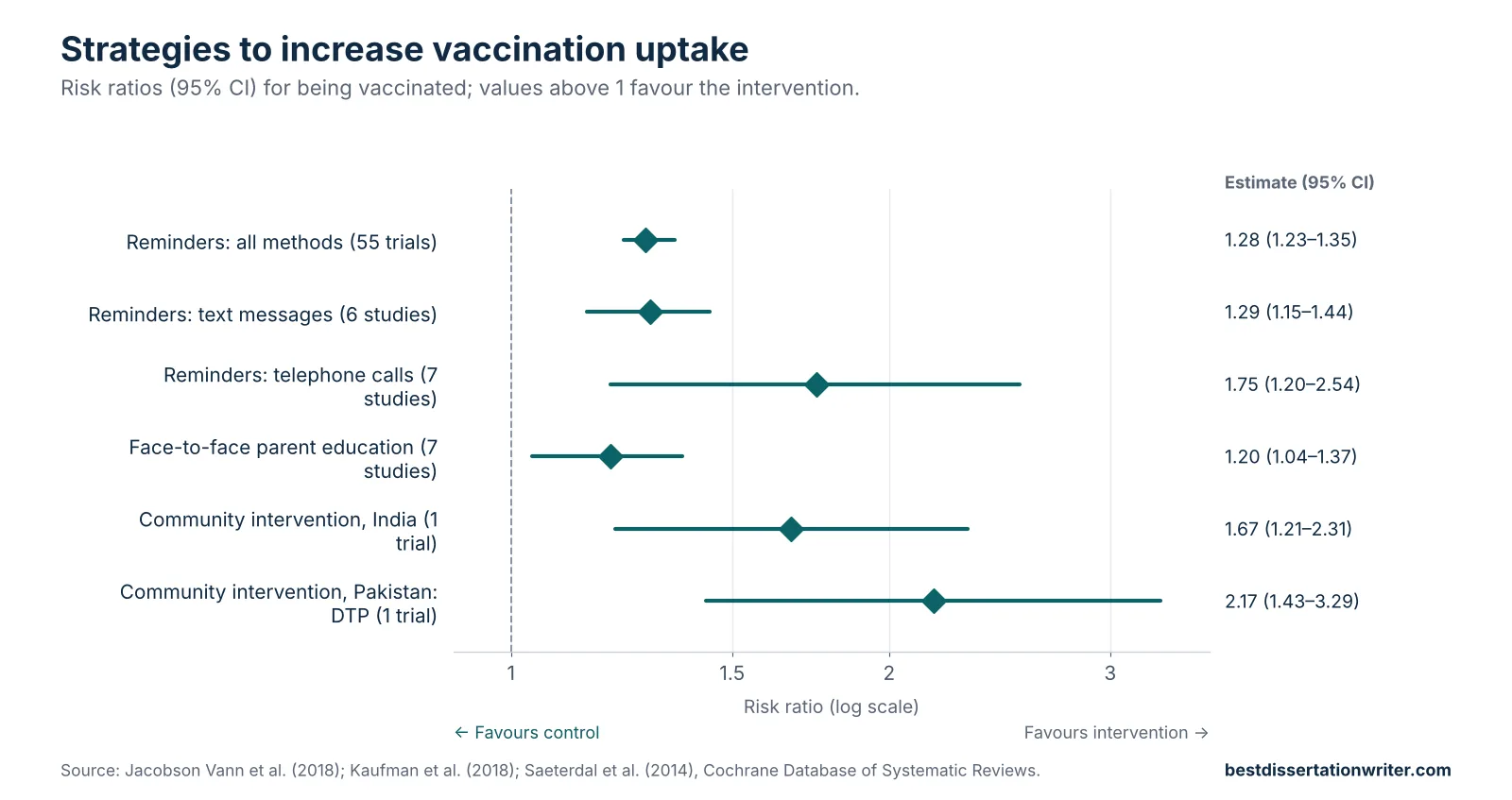
Single methods all helped. Text messages gave a risk ratio of 1.29 (6 studies), letters 1.29 (27 studies), postcards 1.18 (8 studies) and automated calls 1.17 (5 studies), with telephone calls performing best (risk ratio 1.75; 7 studies; moderate certainty). Effects were similar for childhood vaccinations (risk ratio 1.22; 23 studies; high certainty) and adolescent vaccinations (1.29; 10 studies; high certainty), and larger for childhood influenza vaccination (1.51; moderate certainty). For other adult vaccines the evidence was uncertain. The authors concluded that reminder and recall systems in primary care are likely to be effective.
These results come from trials in which reminders were usually sent by services to patients who were due or overdue, which implies that accurate registers and up-to-date contact details are essential. A reminder that reaches the wrong address, or that arrives in a language the person cannot read, is unlikely to help. The review did not examine how reminders should be worded, so services may need to test messages locally and ask patients what they find clear and helpful.
Theme 2: Education and Dialogue with Parents
Kaufman et al. (2018) reviewed face-to-face interventions to inform or educate parents about early childhood vaccination. They included 10 studies with 4,527 participants, seven from high-income countries. Face-to-face education may improve children’s vaccination status (risk ratio 1.20; 95% CI 1.04 to 1.37; 7 studies, 3,004 participants) and intention to vaccinate, and probably improves parents’ knowledge, although certainty was mostly low. Effects on attitudes were unclear. The cost per fully immunised child in one study was about eight times that of usual care.
The authors suggested that face-to-face education may work best where lack of awareness is the main barrier and that its effect is less certain where concerns or hesitancy are the main obstacle. Jarrett et al. (2015) reached a complementary conclusion in a systematic review of strategies for vaccine hesitancy. They described 166 peer-reviewed and 15 grey literature evaluation studies, noting that only 14% of the peer-reviewed studies and 25% of the grey literature studies measured impact on vaccination uptake or on knowledge, awareness or attitudes.
Moderate-quality evidence supported social mobilisation, mass media, communication training for health-care workers, non-financial incentives and reminder and recall interventions. The authors concluded that multicomponent and dialogue-based interventions were most effective, and that because the evidence base is limited and hesitancy is complex, strategies should be tailored to the target population, their reasons for hesitancy and the local context.
Theme 3: Community Outreach Strategies
Saeterdal et al. (2014) reviewed interventions aimed at communities to inform or educate about early childhood vaccination and found only two cluster-randomised trials, one from India and one from Pakistan. In India, children in the intervention communities were more likely to be vaccinated (risk ratio 1.67; 95% CI 1.21 to 2.31; moderate certainty). In Pakistan, where trusted community members were targeted, measles vaccination increased (risk ratio 1.63) and diphtheria, tetanus and pertussis vaccination more than doubled (risk ratio 2.17), while polio vaccination did not change.
Knowledge of vaccines and parents’ attitudes also improved slightly, with low-certainty evidence. The authors concluded that the evidence was limited, that community-targeted interventions may improve attitudes and probably increase uptake under some circumstances, that some may be resource intensive at scale and that they may work best when targeted at areas or groups with low coverage. The evidence comes from only two low- and middle-income settings, so its relevance to other countries is uncertain.
Discussion
This systematic review shows that several strategies can raise vaccination uptake. Reminders and recall have the most robust evidence, with moderate to high certainty, and consistent benefits across childhood, adolescent and influenza vaccination. Face-to-face education and community outreach also help, although the evidence is of lower certainty and comes from few studies.
The strength of the evidence for reminders is important for practice. Reminder systems are relatively simple to run and can be built into immunisation registers or practice systems. The superior performance of telephone calls suggests that a personal contact may add value, although calls take more time than letters or text messages. Services can choose the method that best fits their resources and population.
Dialogue matters for vaccination uptake among hesitant parents. The finding that multicomponent and dialogue-based interventions were most effective fits with nursing practice, since nurses are used to listening to concerns, giving honest information and respecting choice. Training in communication, and in how to respond to common worries, may help nurses to hold these conversations confidently. Reminders and education address different barriers, so combining them is sensible.
Community outreach needs careful targeting. Because it can be costly and the evidence is limited to a few trials, it is best used where coverage is lowest and barriers are greatest. Outreach that involves trusted community members and responds to local needs appears more promising than generic approaches. Evaluation should be built in so that services learn which approaches work.
Equity should guide the choice of strategy. Coverage is often lowest among people who are poor, who move frequently, who are new to a country or who have difficulty reaching services. Universal reminders may reach everyone on a register but miss those who are not registered at all. Outreach that goes to communities, works through trusted people and offers vaccination at convenient times and places can help to close gaps, and nurses with local knowledge can help to identify who is being missed.
Conversations about hesitancy benefit from a clear approach. Nurses can begin by asking what the person already knows and what worries them, listen without interrupting, give accurate and balanced information in plain language and respect the person’s right to decide while making clear their own recommendation. Many people are not firmly opposed to vaccination but simply have questions, and an unhurried conversation can make the difference between delay and acceptance.
Several limitations should be noted. Many of the trials were conducted in the United States, the community evidence came from two trials in low- and middle-income settings, and many outcomes had low-certainty evidence. The hesitancy review found that few studies measured uptake. This review relied on openly accessible, English-language sources and did not involve formal systematic screening. Future research should test nurse-led approaches and evaluate outreach in a wider range of communities.
Implications of Vaccination Uptake Evidence for Practice
For nurses, the evidence supports using reminder and recall systems, having open and respectful conversations with parents and tailoring outreach to communities where coverage is low. Immunisation work links naturally with other public health activity, such as smoking cessation advice in the same community contacts and the work of school nurses in school-based vaccination. As in the review of communicable disease outbreak management, high coverage protects people who cannot be vaccinated. Information on national programmes and outbreaks is available from the UK Health Security Agency.
In practice, a nurse can combine the strategies in one contact. They can check that the person is on the register and that the contact details are right, offer the vaccination or book an appointment, explain what to expect, answer questions and agree how they will be reminded. Where a family has missed several appointments, the nurse can ask about the reasons and, with permission, arrange a visit or involve a community worker. Records should then be updated so that follow-up is not lost.
Managers and commissioners should maintain accurate registers, fund reminder systems, support training in communication and ensure that outreach is directed to areas with low coverage. Evaluation should measure vaccination uptake itself and not only knowledge or attitudes, so that services can learn from what they do.
Conclusion
This systematic review examined evidence on strategies to increase vaccination uptake. Reminders are effective, face-to-face education and community outreach can help, and dialogue-based, multicomponent approaches appear most promising. The certainty of the evidence varies, and many gaps remain.
Vaccination uptake depends on both access and trust, and nurses contribute to both. By reminding, listening and reaching out to communities who are missed by routine services, nurses can help to protect children and adults from preventable disease.
References
Jacobson Vann, J. C., Jacobson, R. M., Coyne-Beasley, T., Asafu-Adjei, J. K., & Szilagyi, P. G. (2018). Patient reminder and recall interventions to improve immunization rates. Cochrane Database of Systematic Reviews, (1), CD003941. https://doi.org/10.1002/14651858.CD003941.pub3
Jarrett, C., Wilson, R., O’Leary, M., Eckersberger, E., Larson, H. J., & SAGE Working Group on Vaccine Hesitancy. (2015). Strategies for addressing vaccine hesitancy – A systematic review. Vaccine, 33(34), 4180–4190. https://doi.org/10.1016/j.vaccine.2015.04.040
Kaufman, J., Ryan, R., Walsh, L., Horey, D., Leask, J., Robinson, P., & Hill, S. (2018). Face-to-face interventions for informing or educating parents about early childhood vaccination. Cochrane Database of Systematic Reviews, (5), CD010038. https://doi.org/10.1002/14651858.CD010038.pub3
Saeterdal, I., Lewin, S., Austvoll-Dahlgren, A., Glenton, C., & Munabi-Babigumira, S. (2014). Interventions aimed at communities to inform and/or educate about early childhood vaccination. Cochrane Database of Systematic Reviews, (11), CD010232. https://doi.org/10.1002/14651858.CD010232.pub2
World Health Organization. (2026, July 15). Immunization coverage [Fact sheet]. https://www.who.int/news-room/fact-sheets/detail/immunization-coverage
Cite this example
Best Dissertation Writers (2026) Community Outreach Strategies to Increase Vaccination Uptake: The Role of Nurses: A Systematic Review. Available at: https://bestdissertationwriter.com/vaccination-uptake-literature-review/
Best Dissertation Writers
Get expert help with your nursing literature review
Share your topic and deadline with Best Dissertation Writers and get support tailored to your module brief.