Community-Based Obesity Prevention Programmes and the Contribution of Nurses: A Systematic Review
 By Dr. Robertson Prime, Research Fellow
Updated October 28, 2026
14 min read
About 2,900 words
In this review
Abstract
Background: Obesity prevention programmes aim to stop children and adults gaining excess weight before health problems develop, and they are a major public health priority. The World Health Organization reports that 1 in 7 people worldwide were living with obesity in 2024. Nurses working in schools, health visiting, general practice and community services are well placed to deliver and support prevention work.
Aim: This systematic review aimed to examine the evidence on the effectiveness of community-based programmes to prevent obesity and what this means for public health nursing.
Methods: Evidence was identified through targeted searches of openly accessible bibliographic records, publisher websites and the reference lists of key reviews. Five sources published between 2013 and 2026 were included: a Cochrane review, two systematic reviews, a non-randomised controlled trial and a global fact sheet. The research sources were appraised using CASP checklists and synthesised narratively.
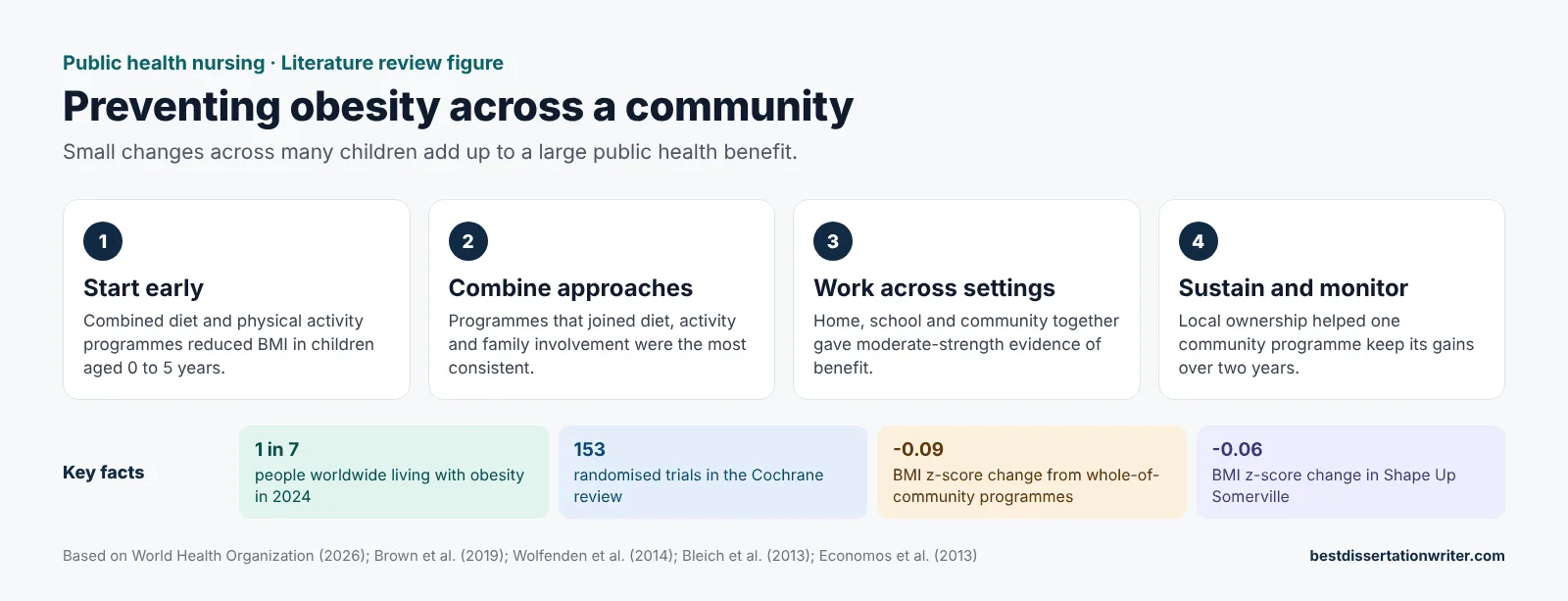
Findings: A Cochrane review of 153 randomised trials found that diet and physical activity combined reduced body mass index in children aged 0 to 5 years, while physical activity alone reduced it in children aged 6 to 12 years. A meta-analysis of whole-of-community interventions found a small reduction in BMI z-score (mean difference -0.09). Four of nine community-based studies showed favourable changes in BMI, and a two-year community trial in Massachusetts reduced BMI z-score by 0.06 relative to controls.
Conclusion: Combined, multi-setting programmes that involve families, schools and communities show modest but worthwhile effects. Nurses can contribute by supporting family-centred, community-wide approaches and by monitoring and sustaining local programmes.
Keywords: obesity prevention programmes, community programmes, diet and exercise
Introduction
This systematic review critically examines recent evidence on obesity prevention programmes and its implications for public health nursing practice.
Obesity is one of the most pressing public health challenges of the century. The World Health Organization (WHO) estimates that in 2024, 2.6 billion adults were overweight, including 940 million living with obesity, and that 400 million children and adolescents aged 5 to 19 years were overweight, 170 million of them with obesity. Overall, around 1 in 7 people worldwide were living with obesity. Excess weight raises the risk of type 2 diabetes, heart disease and some cancers, and weight gained in childhood often persists into adult life.
Treating established obesity is difficult and expensive, which is why many health systems have invested in obesity prevention programmes. These range from classroom teaching and school meals to changes in local food and physical activity environments. They are usually delivered by teams that include teachers, dietitians, public health practitioners and nurses, and they often involve families as well as individual children.
Nurses contribute in many ways. School nurses and health visitors measure growth and talk with families about food and activity, practice nurses give brief advice, and community nurses help to connect people with local services. A systematic review design was chosen because the question concerns the effectiveness of obesity prevention programmes.
Review question
Which obesity prevention programmes reduce weight gain in children, does the setting or the age of the child make a difference, and what does the evidence suggest for public health nursing?
Background to Obesity Prevention Programmes
Obesity develops when energy intake exceeds energy use over a long period, but the reasons behind this are not simply individual choices. Food that is cheap, heavily marketed and energy dense, together with environments that discourage walking and play, create conditions in which weight gain is common. For this reason, many obesity prevention programmes try to change the environment as well as behaviour, for example by improving school food or creating safe spaces for physical activity.
Programmes differ in what they target. Some focus on diet alone, others on physical activity alone, and many combine diet and exercise with parent education or changes to the school day. They also differ in setting. A programme may be delivered in nurseries and schools, in the home, in primary care or across a whole community, using several settings at once to reinforce the same messages.
Age matters. The early years are a period when eating habits and activity patterns are formed, and parents have a strong influence on what young children eat. Primary school children spend long hours in school, which makes it a natural setting for community programmes. Adolescents have more independence over food and activity and are harder to reach, and the evidence for this group has been less consistent.
Public health nursing is concerned with the health of populations as well as individuals. It includes health promotion, screening and the identification of families who may need extra support. Nurses are trusted and often see children and families repeatedly, which gives them an opportunity to reinforce messages about healthy eating and activity and to refer families to local services when needed.
Evaluating obesity prevention programmes is difficult. Weight changes slowly, many influences outside the programme affect it, and children grow, so measures such as BMI z-score are used to compare them with others of the same age and sex. Trials therefore need large samples and long follow-up, and even well-run studies often find modest effects. Systematic reviews bring together many trials so that patterns can be seen that no single study could show.
Search Strategy and Methods
Evidence for this example was identified through targeted searches of openly accessible bibliographic records, publisher websites and the reference lists of key reviews. Search terms combined keywords for the problem (“obesity”, “overweight”, “weight gain”, “BMI”) with terms for the intervention and setting (“prevention”, “community”, “school”, “diet”, “physical activity”, “nurse”), joined with the Boolean operators AND and OR. A full systematic review of obesity prevention programmes for assessment would run the same strategy in CINAHL, PubMed/MEDLINE, the Cochrane Library and Web of Science and report the number of records screened in a PRISMA flow diagram.
Sources were eligible if they evaluated obesity prevention programmes intended to stop excess weight gain in children or young people and reported weight-related outcomes, or if they provided authoritative data on the scale of the problem. Systematic reviews and controlled trials were prioritised. Studies of the treatment of children who already had obesity were excluded.
Five sources published between 2013 and 2026 were included: a Cochrane review of randomised trials of obesity prevention programmes, two systematic reviews, a non-randomised controlled trial and the WHO fact sheet that provides global context (Table 1). The quality of each research source was considered using the Critical Appraisal Skills Programme (CASP) checklists, and findings were synthesised narratively.
Key Findings on Obesity Prevention Programmes
Three themes were identified: the effects of programmes by age group, the evidence for community-wide approaches that work across several settings, and the experience of a sustained community programme in practice. Table 1 summarises the included sources, and Figure 1 shows the effects on body mass index reported by the Cochrane review.
| Author, year | Design | Setting and sample | Key finding |
|---|---|---|---|
| Bleich et al. (2013) | Systematic review | 9 community-based studies (5 randomised); high-income countries | 4 of 9 favourable on BMI; combined diet and exercise with school component more effective. |
| Economos et al. (2013) | Non-randomised controlled trial | 1,028 children; 3 Massachusetts cities; 2 years | BMI z-score fell 0.06 more than controls; lower odds of overweight in boys and girls. |
| Wolfenden et al. (2014) | Systematic review and meta-analysis | 8 trials; children and adolescents | BMI z-score mean difference -0.09 across 6 trials; modest population effect. |
| Brown et al. (2019) | Cochrane systematic review | 153 randomised trials; mostly US and Europe | Diet and activity reduced BMI at ages 0–5; activity alone reduced BMI at ages 6–12. |
| World Health Organization (2026) | Fact sheet (global data, 2024) | Worldwide population estimates | 1 in 7 people living with obesity; 170 million young people aged 5–19 with obesity. |
Theme 1: Obesity Prevention Programmes by Age Group
Brown et al. (2019) updated a Cochrane review of interventions for preventing obesity in children. It included 153 randomised controlled trials, mostly from the United States and Europe, and 85 of them targeted children aged 6 to 12 years. In children aged 0 to 5 years, programmes combining diet and physical activity reduced body mass index (BMI) by 0.07 kg/m² on average (95% confidence interval -0.14 to -0.01; 16 trials, 6,261 children), and the certainty of the evidence was moderate. Physical activity alone showed a possible reduction of 0.22 kg/m² that did not reach statistical significance.
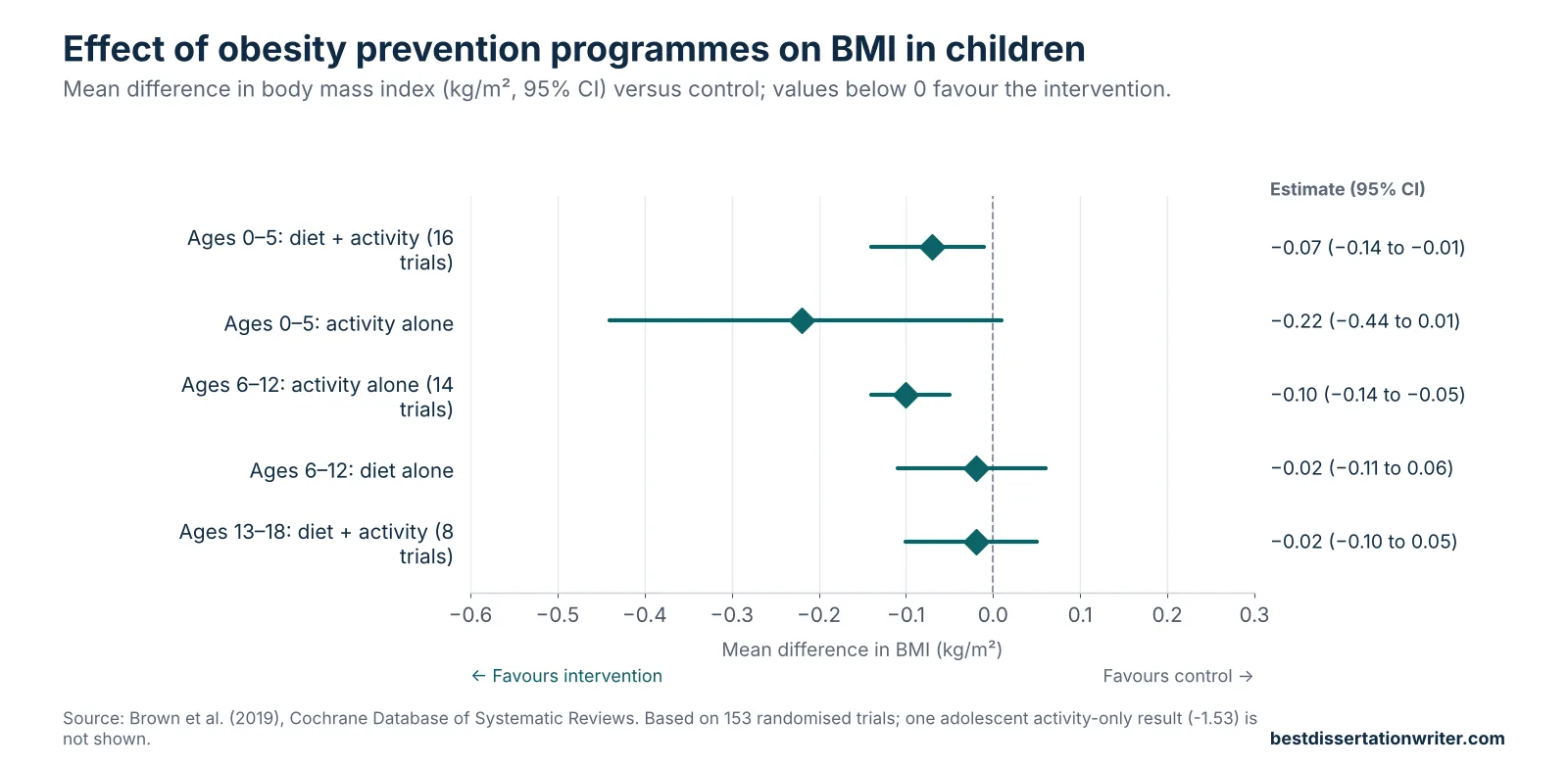
In children aged 6 to 12 years, programmes that focused only on physical activity reduced BMI by 0.10 kg/m² (95% CI -0.14 to -0.05; 14 trials, 16,410 children) with moderate-certainty evidence, whereas diet-only programmes showed no clear effect (mean difference -0.02; 95% CI -0.11 to 0.06). Combined programmes in this age group produced a small reduction in BMI z-score of 0.05 (95% CI -0.10 to -0.01; 20 trials, 24,043 children), but the certainty of that evidence was low.
For adolescents the evidence was weaker. Physical activity alone reduced BMI by 1.53 kg/m² in four trials, but the certainty was very low, and combined programmes showed no effect (mean difference -0.02; 95% CI -0.10 to 0.05; 8 trials, 16,583 young people). The authors concluded that obesity prevention programmes combining diet and physical activity can reduce the risk of obesity in young children, that evidence for diet-only programmes in older children is lacking, and that the programmes did not appear to cause adverse effects or widen health inequalities.
Theme 2: Community Programmes That Work Across Settings
Wolfenden et al. (2014) reviewed whole-of-community interventions, which use several settings and sectors to change the environment and behaviour of an entire population. Eight trials, all in children or adolescents, were identified from searches covering 1990 to 2011. Seven of the eight reported a significant effect on at least one measure of adiposity. A meta-analysis of six trials found a small reduction in BMI z-score in intervention communities (mean difference -0.09; 95% CI -0.16 to -0.02). The authors concluded that whole-of-community interventions can achieve modest reductions in weight gain among children.
Bleich et al. (2013) reviewed community-based childhood obesity prevention studies in the United States and other high-income countries. Nine studies were included, five randomised and four non-randomised. One was delivered in the community alone, three combined the community with schools, and five combined the community with at least one other setting such as the home. Four of the nine reported favourable changes in BMI or BMI z-score, and two reported behavioural improvements, one in physical activity and one in vegetable intake.
The authors concluded that there was moderate-strength evidence that a combined diet and exercise intervention delivered in the community, with a school component, is more effective at preventing obesity or overweight. They also called for more research and more consistent methods, since the small number of studies and the variety of designs made comparison difficult. Together, these two reviews suggest that community-based obesity prevention programmes can work, although the effects are modest and not guaranteed.
Theme 3: Sustained Environmental Change in Practice
Economos et al. (2013) reported two-year results from Shape Up Somerville, a community-based programme in Massachusetts. One city received the intervention and two matched cities served as controls. In the first year the programme increased opportunities for physical activity and the availability of healthier food, and in the second year it supported local policies and handed the work to community members. The 1,028 children in the analysis had a mean age of 7.61 years.
Over two years, BMI z-score fell by 0.06 more in the intervention community than in the control communities (95% CI -0.08 to -0.04). The odds of overweight or obesity were lower in the intervention community for boys (odds ratio 0.61) and for girls (odds ratio 0.78), and children who already had overweight or obesity were more likely to move out of that category (odds ratios 3.18 for boys and 1.93 for girls). The trial was not randomised, so differences between the cities could have influenced the results, but it shows what sustained, community-led obesity prevention programmes can achieve.
Discussion
This review shows that obesity prevention programmes can work, but the effects are generally small. Combined programmes reduced BMI in young children, physical activity programmes helped primary school children, whole-of-community interventions produced a modest reduction in BMI z-score, and a sustained programme in Massachusetts improved weight outcomes for boys and girls. None of the effects was large, and the certainty of the evidence varied from high to very low.
Small effects can still matter at the level of a population. A reduction of 0.06 to 0.09 in BMI z-score is modest for an individual child, but it applies to every child in a community, and over many years it could shift the proportion of children who develop obesity. This is the logic behind obesity prevention programmes and public health more broadly: a small change in many people can prevent more disease than a large change in a few.
The evidence also suggests that no single component is enough. Programmes that combined diet and exercise, involved families and used several settings had the most consistent results, while programmes that targeted diet alone or activity alone were less reliable. Because these strategies reinforce each other, nurses can encourage families to think about food, activity, sleep and screen time together rather than as separate issues.
Equity deserves attention. The Cochrane review found no evidence that programmes widened health inequalities, which is reassuring, but children in more deprived areas also experience more of the environmental pressures that drive obesity. Obesity prevention programmes that improve food and play environments for everyone may therefore help to narrow the gap, and nurses who know their communities can help to shape programmes that reach those who need them most.
Implementation matters as much as design. A programme that works in a trial may fail in practice if staff lack time, if families are not engaged or if funding ends. The Somerville programme, which handed the work to community members in its second year, shows how local ownership may help a programme to continue. Nurses who already have relationships with schools and families are well placed to help programmes adapt to local needs, although none of the included sources provided direct evidence on nurse-led delivery.
Several limitations should be noted. The included sources were mostly from high-income countries, many trials had short follow-up, and the certainty of some findings was low. The summaries of the included reviews did not report the professional background of those delivering the programmes, so the specific contribution of nurses could not be isolated. This review also relied on openly accessible, English-language sources and did not involve formal systematic screening. Future research should test nurse-led and nurse-supported programmes and follow children for longer.
Implications of Obesity Prevention Programmes Evidence for Practice
For nurses, the evidence supports advising families on diet and physical activity together, particularly in the early years, measuring and discussing growth sensitively, and supporting school and community programmes that change the environment. Work with young children and families links closely with health visiting and with the role of school nurses, and nurses can use local data to target families who may benefit most. Official information on the scale of the problem is available from the WHO obesity and overweight fact sheet.
Managers and commissioners should favour programmes that act across settings, involve families, build in local ownership and are evaluated over time. Nursing teams can support this by sharing local data, taking part in partnerships and helping programmes to continue beyond their initial funding. The same partnership working is needed in other population health tasks, such as communicable disease outbreak management, where nurses coordinate with schools and community services.
Practical steps follow from the evidence. Nurses can record growth consistently, discuss weight with families in a respectful and non-judgemental way, signpost local activity and cooking groups, and feed back what they learn about local barriers to those who plan services. Reviewing the same few measures over time also allows teams to see whether a local programme is making a difference.
Conclusion
This systematic review examined evidence on community-based obesity prevention programmes. Combined diet and physical activity programmes reduced BMI in young children, whole-of-community interventions achieved modest reductions in BMI z-score, and a sustained programme in Massachusetts showed that local change is possible. The effects were small, and the certainty of the evidence varied.
The case for obesity prevention programmes rests on the size of the problem and on the fact that small changes across a population can have large benefits. Through family-centred advice, support for schools and communities and attention to equity, nurses can help to make healthy choices easier for children and their families.
References
Bleich, S. N., Segal, J., Wu, Y., Wilson, R., & Wang, Y. (2013). Systematic review of community-based childhood obesity prevention studies. Pediatrics, 132(1), e201–e210. https://doi.org/10.1542/peds.2013-0886
Brown, T., Moore, T. H. M., Hooper, L., Gao, Y., Zayegh, A., Ijaz, S., Elwenspoek, M., Foxen, S. C., Magee, L., O’Malley, C., Waters, E., & Summerbell, C. D. (2019). Interventions for preventing obesity in children. Cochrane Database of Systematic Reviews, (7), CD001871. https://doi.org/10.1002/14651858.CD001871.pub4
Economos, C. D., Hyatt, R. R., Must, A., Goldberg, J. P., Kuder, J., Naumova, E. N., Collins, J. J., & Nelson, M. E. (2013). Shape Up Somerville two-year results: A community-based environmental change intervention sustains weight reduction in children. Preventive Medicine, 57(4), 322–327. https://doi.org/10.1016/j.ypmed.2013.06.001
Wolfenden, L., Wyse, R., Nichols, M., Allender, S., Millar, L., & McElduff, P. (2014). A systematic review and meta-analysis of whole of community interventions to prevent excessive population weight gain. Preventive Medicine, 62, 193–200. https://doi.org/10.1016/j.ypmed.2014.01.031
World Health Organization. (2026, October 7). Obesity and overweight [Fact sheet]. https://www.who.int/news-room/fact-sheets/detail/obesity-and-overweight
Cite this example
Best Dissertation Writers (2026) Community-Based Obesity Prevention Programmes and the Contribution of Nurses: A Systematic Review. Available at: https://bestdissertationwriter.com/obesity-prevention-programmes-review/
Best Dissertation Writers
Get expert help with your nursing literature review
Share your topic and deadline with Best Dissertation Writers and get support tailored to your module brief.