
Major Incident Preparedness and the Role of Emergency Nurses: A Scoping Review
 By Dr. Robertson Prime, Research Fellow
Updated November 2, 2026
15 min read
About 2,900 words
In this review
Abstract
Background: Major incident preparedness is the capacity of a health service and its staff to respond to events that overwhelm normal resources, such as mass casualty incidents, disasters and outbreaks. Emergency nurses are on the front line of such events, so their knowledge, competence and confidence are central to a safe response.
Aim: This scoping review aimed to map the evidence on the preparedness of emergency nurses for major incidents and disasters, including the competencies they need, how prepared they feel and what training appears to help.
Methods: Evidence was identified through targeted searches of openly accessible bibliographic records, publisher websites and repositories. Five sources published between 2017 and 2025 were included: four reviews and a cross-sectional survey. Sources were charted and summarised descriptively.
Findings: A scoping review of 12 studies found that the most common domains of disaster nursing competence were communication, planning, decontamination and safety, the Incident Command System and ethics. A systematic review of 17 articles found that disaster experience and training increased preparedness, yet nurses widely felt insufficiently prepared. An integrative review of 36 articles found that all preparedness activities improved knowledge, skills or attitudes, but only five articles scored 100% on quality appraisal and the most effective method could not be identified. A mapping review of 15 articles identified five themes, led by communication, preparation and planning, incident management, safety and security, and intervention. A survey of 271 emergency nurses in Iran reported a mean preparedness of 6.75 out of 10 and a mean core competency score of 2.88 out of 5.
Conclusion: Emergency nurses need competencies in communication, planning, incident management and safety, and many report feeling underprepared. Evidence on the most effective training is limited, so services should combine realistic exercises with local evaluation.
Keywords: major incident preparedness, disaster preparedness, mass casualty
Introduction
This scoping review critically examines recent evidence on major incident preparedness and its implications for emergency nursing practice.
A major incident is an event in which the number or type of casualties, or the nature of the hazard, exceeds what a health service can manage with its normal arrangements. Examples include transport crashes, explosions, fires, floods, outbreaks of infectious disease and terrorist attacks. The emergency department is usually the first hospital area to feel the effects, and emergency nurses are among the first clinicians to receive casualties.
Major incident preparedness covers the plans, training, equipment and exercises that help staff respond effectively. For nurses it includes knowing the hospital’s plan, understanding their role within it, communicating clearly, triaging and caring for casualties, protecting their own safety and that of others and taking decisions under pressure. Because major incidents are rare, most nurses have little or no direct experience, and preparedness depends on training and rehearsal.
Much of the international literature uses the term disaster nursing, whereas United Kingdom services speak of major incidents, and the two overlap. This review draws on both. It asks: what does the evidence show about the preparedness of emergency nurses for major incidents and disasters, which competencies do they need and what is known about training? A scoping review was chosen because the evidence includes reviews and surveys of different designs and because the aim is to map what exists and identify gaps.
Background to Major Incident Preparedness
Planning for major incident preparedness is usually organised in phases: preparing before an incident, responding during it and recovering afterwards. Hospitals typically hold written plans that set out how the department will clear space, call in staff, set up a command structure and receive casualties. Nurses are expected to follow these plans, yet studies suggest that many are not familiar with them and have limited chances to practise.
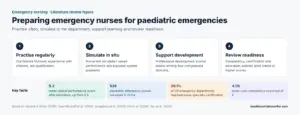
Emergency nurses’ contribution begins with triage, the rapid sorting of casualties by urgency. In a major incident, this may be done with different tools and under different pressures from everyday triage, which is the subject of the review of triage tools. Nurses must also manage the flow of patients through a department that may already be crowded, a problem discussed in the review of emergency department overcrowding.
Other aspects of the nursing role include communicating with patients, relatives, colleagues and the incident command team, applying infection prevention and decontamination procedures, recognising hazards and protecting staff. Preparedness therefore requires technical skill and non-technical skills such as leadership, teamwork and ethical judgement. Each of these appears in the literature on disaster nursing competencies.
Preparedness is not only an individual matter. A hospital’s major incident preparedness depends on whether plans are kept up to date, whether staff know them and whether exercises are held often enough for knowledge to be retained. Individual nurses can be well trained and still struggle if the department lacks equipment, space or clear command arrangements, so the literature considers both personal competence and organisational readiness.
Search Strategy and Methods
Evidence for this example was identified through targeted searches of openly accessible bibliographic records, publisher websites and repositories. Search terms combined keywords for the situation (“major incident”, “disaster”, “mass casualty”, “preparedness”) with terms for the population and outcomes (“emergency nurses”, “core competencies”, “training”, “knowledge”, “confidence”), joined with the Boolean operators AND and OR. A full scoping review for assessment would run the same strategy in CINAHL, PubMed/MEDLINE, Scopus and Embase and report the records screened in a PRISMA-ScR flow diagram.
Sources were eligible if they were reviews or empirical studies of the preparedness, competencies or training of nurses, especially emergency nurses, for disasters and major incidents. Studies of patients, policy documents without research methods and papers on a single incident were excluded.
Five sources published between 2017 and 2025 were included (Table 1). In line with scoping review methods, sources were charted and summarised descriptively, without a pooled estimate of effect or a formal judgement on quality, although the quality assessments reported by the review authors are noted.
The aim of this section is to describe what the five sources report about major incident preparedness without implying that the findings can be pooled. The reviews cover different years, use different definitions of disaster and include different types of study, and so a count of studies or a list of domains is presented as a description of the literature and not as a measurement of effect.
Key Findings on Major Incident Preparedness
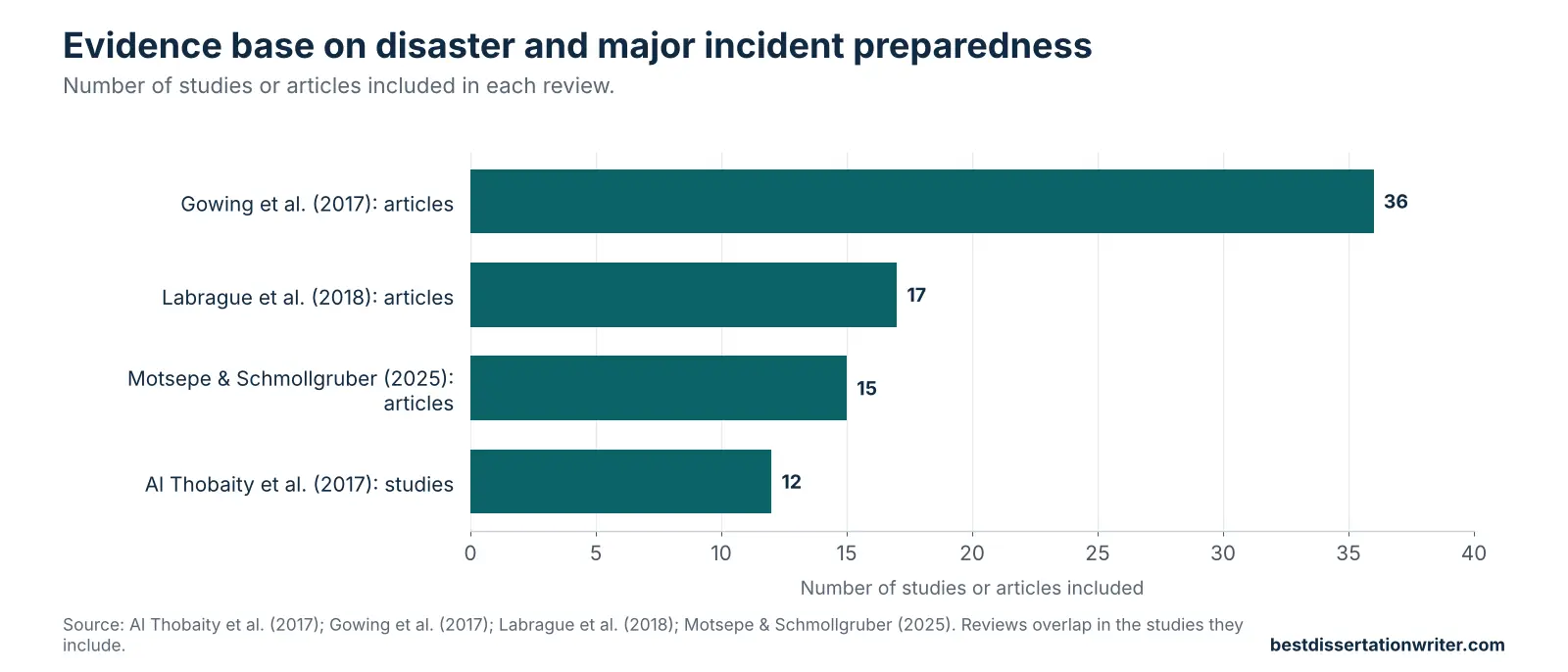
Three themes were identified: the competencies that emergency nurses need, how prepared nurses feel and are, and what is known about training and education. Table 1 summarises the included sources, and Figure 1 shows the number of studies in each of the four reviews.
| Author, year | Design | Setting and sample | Key finding |
|---|---|---|---|
| Al Thobaity et al. (2017) | Scoping review | 12 studies | Most common domains: communication, planning, decontamination and safety, Incident Command System, ethics. |
| Chegini et al. (2022) | Cross-sectional survey | 271 emergency nurses in Iran | Mean preparedness 6.75 of 10; mean core competency 2.88 of 5; communication lowest. |
| Gowing et al. (2017) | Integrative literature review | 36 articles | All preparedness activities improved knowledge, skills or attitudes; best method unknown. |
| Labrague et al. (2018) | Systematic review | 17 articles | Experience and training increased preparedness; nurses felt insufficiently prepared. |
| Motsepe & Schmollgruber (2025) | Focused mapping review | 15 articles | Five themes led by communication, planning, incident management, safety and intervention. |
Theme 1: Competencies Needed
Al Thobaity et al. (2017) carried out a scoping review, following the Joanna Briggs Institute method, of the most common domains of the core competencies of disaster nursing. Searching six databases, they included twelve studies. The domains varied across studies, but the most common were communication, planning, decontamination and safety, the Incident Command System and ethics.
The authors concluded that nurses need to understand the disaster plan, including its content and where to find it, that they need skills in communicating during a disaster and that they need to be aware of ethical issues. They recommended including these domains in planning and training, such as disaster drills, and called for nurses to take part in future research to define core competencies within each domain. This is an early map of what competence in a major incident involves.
Motsepe and Schmollgruber (2025) reviewed the disaster preparedness competencies that emergency nurses need, using a focused mapping review and synthesis. They searched six databases for articles published between 2006 and 2022. From 38 articles identified, 15 remained after screening. Five themes emerged: communication, preparation and planning, the incident management system, safety and security, and intervention.
Although the two reviews were conducted eight years apart and used different methods, their lists overlap strongly. Communication, planning, incident command and safety appear in both. This consistency suggests that these domains are likely to be important for major incident preparedness in emergency nursing, and it gives educators a reasonable starting point for the content of training, even though neither review tested whether competence in these domains improves outcomes for patients.
Theme 2: How Prepared Nurses Feel and Are
Labrague et al. (2018) carried out a systematic review of studies published from 2006 to 2016 that measured nurses’ preparedness for disaster response. They searched five databases and included 17 articles. Previous disaster response experience and disaster-related training were found to increase preparedness, yet nurses widely reported feeling insufficiently prepared and lacking confidence. The authors recommended that hospitals adopt policies to address these gaps and called for more research and realistic disaster exercises.
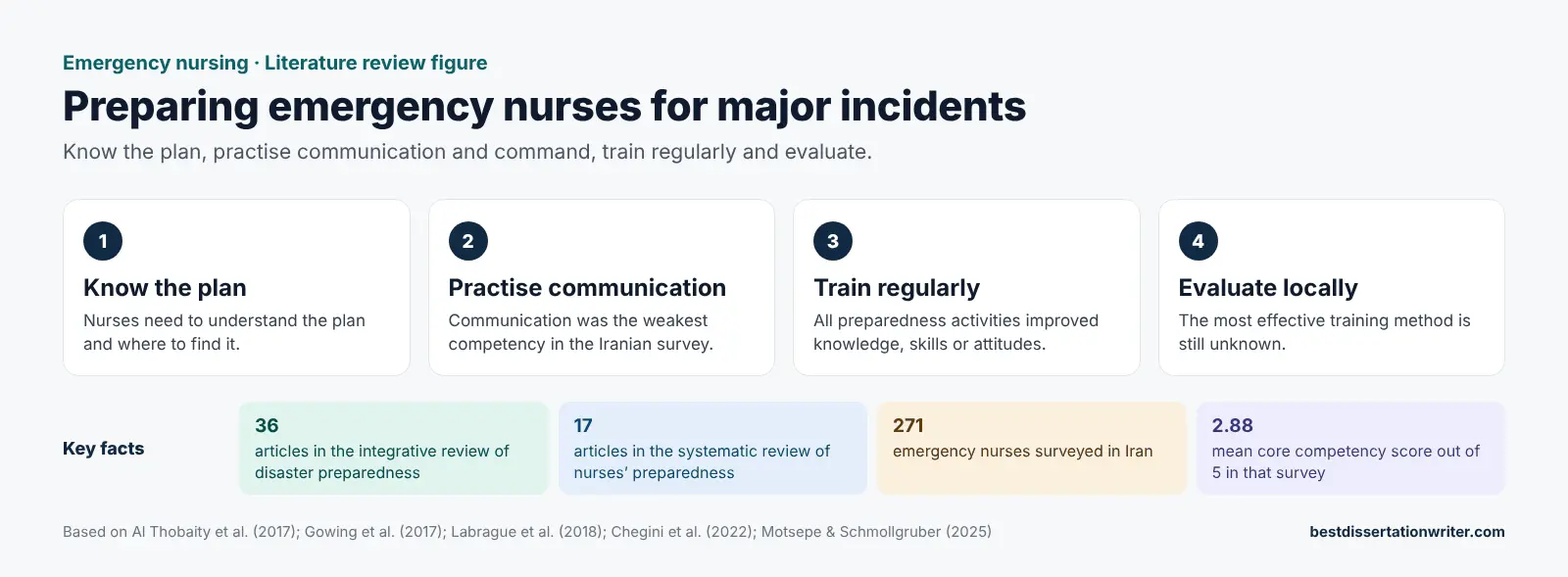
Chegini et al. (2022) surveyed 271 nurses from the emergency departments of six hospitals in Qazvin, Iran, between August and December 2020, using a 45-item scale of disaster core competencies and a single-item scale of preparedness. The mean preparedness score was 6.75 out of 10 and the mean core competency score was 2.88 out of 5. Technical skills had the highest subscale mean (3.24) and communication skills the lowest (2.57).
Competence and preparedness were significantly associated. The authors concluded that gaps remain in emergency nurses’ disaster preparedness and core competencies and that managers should support improvement through routine disaster scenario sessions and formal preparedness training. Because the survey was cross-sectional, relied on self-report and came from one city in Iran, it cannot be generalised, but it adds to the picture that nurses see communication as a weak area, which fits with its prominence in the competency reviews.
Theme 3: Training and Education
Gowing et al. (2017) carried out an integrative literature review of disaster preparedness among health professionals and support staff, asking what is effective. They searched major health databases, assessed the quality of studies with the Mixed Methods Appraisal Tool and analysed the findings thematically. They included 36 articles. Staff may not be fully prepared, the most effective content and methods of preparedness are unknown, and staff willingness to work during disasters needs further study.
All preparedness activities improved knowledge, skills or attitudes, but most studies focused on external disasters and on medical, nursing, public health or paramedic staff. Only five of the 36 articles scored 100% on the appraisal tool, so the findings cannot be generalised, and the authors could not identify the most effective method. They called for higher-quality research, inclusion of the whole care team, attention to internal disasters and validated competencies and measurement tools.
This finding is important for educators. It suggests that any structured preparation, whether lectures, tabletop exercises or simulations, tends to improve knowledge and confidence, but that the evidence does not show which is best. Services must therefore make practical choices, for example by combining short, regular exercises with periods of more realistic simulation, and by evaluating the results locally, instead of relying on a single method.
The sources agree that experience and practice matter. Labrague et al. found that experience and training increased preparedness, and Chegini et al. found that nurses rated technical skills more highly than communication, which is a skill that may be developed through scenario-based exercises. Realistic exercises that include communication, command and handover, and that involve nurses as well as doctors and managers, are therefore a sensible element of any programme.
A useful way to read the sources is to ask what a nurse would need to do on the day. First, they must know that an incident has been declared and what the plan asks of them. Second, they must be able to communicate and follow the command structure. Third, they must triage and care for casualties safely. The evidence reviewed here maps closely onto this sequence and suggests that major incident preparedness is built from simple elements practised repeatedly.
Discussion
This scoping review suggests that emergency nurses’ major incident preparedness rests on a recognisable set of competencies, that many nurses feel only partly prepared and that training of many kinds is associated with improved knowledge and confidence. The sources are consistent in the domains they identify, which gives a basis for education, but they are less helpful about which training methods lead to better care.
A recurring limitation is the quality and type of evidence. Most studies measure knowledge, attitudes or self-reported preparedness, not what happens to patients in a real incident, and only five of 36 articles in one review scored fully on quality appraisal. The sources are mostly from the United States, Asia, the Middle East and Africa, and none is from a United Kingdom emergency department. Findings on major incident preparedness should therefore be adapted to local plans and national guidance.
The scoping design has its own limits. It maps the evidence without appraising each source in depth, and overlap between the reviews means that some of the same primary studies may appear more than once. The reviews were searched to different years, from 2016 to 2022, and so newer studies may not be captured. This review relied on openly accessible, English-language sources.
The studies also remind readers that preparedness varies between countries and services. Nurses in the survey from Iran reported average preparedness of 6.75 out of 10, but the same instrument might yield different results in a United Kingdom department with different plans and training. Comparisons across countries should therefore be made with caution, and each service should assess its own major incident preparedness rather than assume that results from elsewhere apply.
Even so, the practical messages are clear. Nurses should be familiar with the plan and their role, and should practise communication and incident command. Managers should provide time and resources for exercises, and should include nurses in planning. Staff willingness to attend and work during an incident is also a matter for planners, because a plan depends on people being able and willing to carry it out.
Implications of Major Incident Preparedness Evidence for Practice
For practice, the evidence supports making sure that every emergency nurse knows the major incident plan and where to find it, running regular drills and scenario sessions that include communication, command and decontamination, supporting nurses to take part in joint exercises with other services, and evaluating what staff learn. Guidance for services is available from NHS England emergency planning and the Royal College of Nursing.
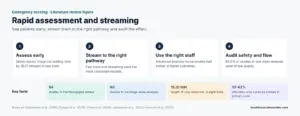
Managers should also consider how training for major incident preparedness is recorded, how new staff and agency nurses are included and how preparedness is reviewed after exercises and real events. The link between everyday emergency nursing and major incident response, for example through rapid assessment and streaming, is considered in the review of rapid assessment and streaming.
Emergency nurses themselves can contribute to preparedness. Taking part in exercises, reporting gaps in plans, helping to update action cards and sharing lessons after drills are all ways of improving major incident preparedness from within the department. Nurse leaders can encourage this by making time available and by recognising the contribution of staff who take on planning roles.
Future research should test the effect of training on performance in simulated and real incidents, compare methods of education directly, include emergency nurses from United Kingdom settings and examine preparedness for internal incidents, such as fires or loss of power in the hospital. Studies that follow nurses over time would show how long the benefits of training last.
Overall, the evidence on major incident preparedness in emergency nursing is consistent on what nurses need to know, but less clear on how best to teach it. Emergency departments can act on the first without waiting for the second, by running regular, practical exercises and by asking nurses what they feel unready for.
Conclusion
This scoping review found that major incident preparedness in emergency nursing rests on competencies in communication, planning, incident management and safety, that many nurses feel underprepared and that evidence on the best training methods is limited.
Emergency nurses, educators and managers can use these findings on major incident preparedness to plan realistic, regular exercises and to build the evidence base through local evaluation and research.
References
Al Thobaity, A., Plummer, V., & Williams, B. (2017). What are the most common domains of the core competencies of disaster nursing? A scoping review. International Emergency Nursing, 31, 64–71. https://doi.org/10.1016/j.ienj.2016.10.003
Chegini, Z., Arab-Zozani, M., Kakemam, E., Lotfi, M., Nobakht, A., & Aziz Karkan, H. (2022). Disaster preparedness and core competencies among emergency nurses: A cross-sectional study. Nursing Open, 9(2), 1294–1302. https://doi.org/10.1002/nop2.1172
Gowing, J. R., Walker, K. N., Elmer, S. L., & Cummings, E. A. (2017). Disaster preparedness among health professionals and support staff: What is effective? An integrative literature review. Prehospital and Disaster Medicine, 32(3), 321–328. https://doi.org/10.1017/S1049023X1700019X
Labrague, L. J., Hammad, K., Gloe, D. S., McEnroe-Petitte, D. M., Fronda, D. C., Obeidat, A. A., Leocadio, M. C., Cayaban, A. R., & Mirafuentes, E. C. (2018). Disaster preparedness among nurses: A systematic review of literature. International Nursing Review, 65(1), 41–53. https://doi.org/10.1111/inr.12369
Motsepe, T. L., & Schmollgruber, S. (2025). Emergency nurses’ disaster preparedness competencies: A focused mapping review and synthesis. Health SA Gesondheid, 30, Article a2770. https://doi.org/10.4102/hsag.v30i0.2770
Cite this example
Best Dissertation Writers (2026) Major Incident Preparedness and the Role of Emergency Nurses: A Scoping Review. Available at: https://bestdissertationwriter.com/major-incident-preparedness-review/
Best Dissertation Writers
Get expert help with your nursing literature review
Share your topic and deadline with Best Dissertation Writers and get support tailored to your module brief.