Workplace Violence Against Emergency Nurses: Prevalence, Impact, and Prevention: A Systematic Review
 By Dr. Robertson Prime, Research Fellow
Updated November 2, 2026
14 min read
About 2,900 words
In this review
Abstract
Background: Workplace violence is a persistent hazard for emergency nurses, who care for distressed, intoxicated, frightened and sometimes aggressive patients and relatives in crowded settings. It harms the health and wellbeing of staff, affects the quality of care and contributes to nurses leaving the profession.
Aim: This systematic review aimed to examine the evidence on the prevalence of workplace violence against nurses and healthcare workers, the effectiveness of prevention interventions in emergency departments and nurses’ reporting of incidents.
Methods: Evidence was identified through targeted searches of openly accessible bibliographic records, publisher websites and repositories. Five sources published between 2014 and 2024 were included: three systematic reviews or meta-analyses, a Cochrane review and a large cross-sectional survey. The sources were appraised using CASP checklists and synthesised narratively.
Findings: A quantitative review of 136 articles covering 151,347 nurses found that 36.4% had experienced physical violence and 66.9% non-physical violence, with physical violence most prevalent in emergency, geriatric and psychiatric settings. A meta-analysis of 253 studies found that 61.9% of healthcare workers had been exposed to workplace violence, with higher rates in emergency departments. A systematic review of 15 studies of emergency department interventions found that most showed a positive effect. A Cochrane review of nine studies found that education may increase knowledge and improve attitudes but may not reduce aggression. A survey of 3,363 nurses found that only 16.1% of those exposed proactively reported incidents.
Conclusion: Workplace violence is common in emergency nursing, and evidence for prevention is limited and of low certainty. Under-reporting is a serious problem, so services should combine training with organisational support and easy, trusted reporting.
Keywords: workplace violence, aggression, violence against nurses
Introduction
This systematic review critically examines recent evidence on workplace violence and its implications for emergency nursing practice.
Emergency departments are open to everyone, at any hour, and often at moments of fear, pain or crisis. Patients and relatives may be frightened, intoxicated, in withdrawal or affected by mental illness, and they may wait for long periods in crowded spaces. In this environment, nurses are at particular risk of verbal abuse, threats and physical assault.
Workplace violence has been defined in different ways, but it generally covers incidents in which staff are abused, threatened or assaulted in circumstances related to their work. It includes physical violence, such as hitting or kicking, and non-physical violence, such as verbal abuse, threats and harassment. The harm is not limited to injury: it can include anxiety, loss of confidence, sickness absence and a decision to leave nursing.
Despite the scale of the problem, workplace violence is often treated as part of the job, and many incidents are never reported. It is presented as a systematic review of five key sources.
Review question
What does the evidence show about the prevalence of workplace violence against nurses, what is known about interventions to prevent it in emergency departments and what influences whether nurses report it?
Background to Workplace Violence in Emergency Nursing
Emergency nurses meet people at their most vulnerable and, sometimes, most volatile. A patient who is in pain, afraid or confused may lash out, and relatives who are anxious about a loved one may become angry when told of a delay. Nurses at triage and in the waiting area are often the first to receive this anger. The reviews of emergency department overcrowding and of triage show how the conditions of the department can increase the risk.
Responses to workplace violence are usually described at three levels. Individual approaches include training in de-escalation, communication and self-defence. Organisational approaches include policies, reporting systems, staffing and support after an incident. Environmental approaches include security staff, alarms, building design and access control. A comprehensive programme normally combines all three.
Violence also interferes with clinical care. A nurse who is distracted or injured may be less able to carry out a systematic assessment, such as the primary survey described in primary survey, or to recognise deterioration in a patient with sepsis, as discussed in sepsis in the emergency department. Protecting staff is therefore also a way of protecting patients.
The effects of violence on nurses are wide ranging. Some are physical, such as bruises, fractures and, more rarely, serious injury. Others are psychological, including fear of returning to work, hypervigilance and symptoms of stress. These effects can persist after the incident has passed, and they can affect colleagues who witness it. The cost to services includes sickness absence, turnover and the effort needed to recruit and train replacements.
Search Strategy and Methods
Evidence for this example was identified through targeted searches of openly accessible bibliographic records, publisher websites and repositories. Search terms combined keywords for the problem (“workplace violence”, “aggression”, “patient and visitor violence”, “assault”) with terms for the population and outcomes (“emergency nurses”, “healthcare workers”, “prevalence”, “prevention”, “training”, “reporting”), joined with the Boolean operators AND and OR. A full systematic review for assessment would run the same strategy in CINAHL, PubMed/MEDLINE, PsycINFO and the Cochrane Library and report the records screened in a PRISMA flow diagram.
Sources were eligible if they were systematic reviews or meta-analyses of the prevalence of violence against nurses or healthcare workers, reviews of interventions to prevent it, or large studies of reporting. Studies of violence between colleagues, such as bullying by managers, were excluded unless they were part of a wider review.
Five sources published between 2014 and 2024 were included (Table 1). The quality of each source was considered using the Critical Appraisal Skills Programme (CASP) checklists, and findings were synthesised narratively under themes.
Because the five sources differ in design, the findings are described in terms of what each measured. Prevalence reviews report the proportion of staff who say that they have been exposed, intervention reviews report effects on incidents, knowledge and attitudes, and the survey on reporting describes the factors linked to whether staff speak up. Differences in how workplace violence was defined, and the period over which it was measured, are noted where they matter.
Key Findings on Workplace Violence
Three themes were identified: the prevalence of workplace violence, the effectiveness of prevention interventions, and the reporting of incidents. Table 1 summarises the included sources, and Figure 1 shows the prevalence of physical and non-physical violence in two large reviews.
| Author, year | Design | Setting and sample | Key finding |
|---|---|---|---|
| Cai et al. (2024) | Cross-sectional survey | 3,363 nurses in China | 53.9% experienced violence; only 16.1% of them proactively reported; ED nurses more likely to report. |
| Geoffrion et al. (2020) | Cochrane review | 9 studies; 1,688 participants | Education may improve knowledge and attitudes but may not reduce aggression; low to very low certainty. |
| Liu et al. (2019) | Systematic review and meta-analysis | 253 studies; 331,544 participants | 61.9% exposed to any violence; higher in emergency departments. |
| Spector et al. (2014) | Quantitative review | 136 articles; 151,347 nurses | 36.4% physical and 66.9% non-physical violence; physical violence most common in emergency settings. |
| Wirth et al. (2021) | Systematic review | 15 studies in emergency departments | Most showed positive effects; evidence limited. |
Theme 1: Prevalence of Workplace Violence
Spector et al. (2014) carried out a quantitative review of nurses’ exposure to physical and non-physical violence, bullying and sexual harassment. They included 136 articles covering 151,347 nurses in 160 samples, drawn from three databases. Across studies, 36.4% of nurses reported physical violence and 66.9% reported non-physical violence, while 39.7% reported bullying and 25% sexual harassment.
Physical violence was most prevalent in emergency, geriatric and psychiatric facilities, and patients were the main source of violence in the Anglo and European regions, whereas in the Middle East patients’ families and friends were the most common source. This is one of the clearest statements in the literature that emergency nursing is among the settings with the highest risk.
Liu et al. (2019) pooled epidemiological studies of workplace violence by patients and visitors against all healthcare workers. They included 253 studies with 331,544 participants. Overall, 61.9% of healthcare workers reported exposure to any form of workplace violence, 42.5% reported non-physical violence and 24.4% reported physical violence in the past year. Verbal abuse was the most common non-physical form (57.6%), followed by threats (33.2%) and sexual harassment (12.4%).
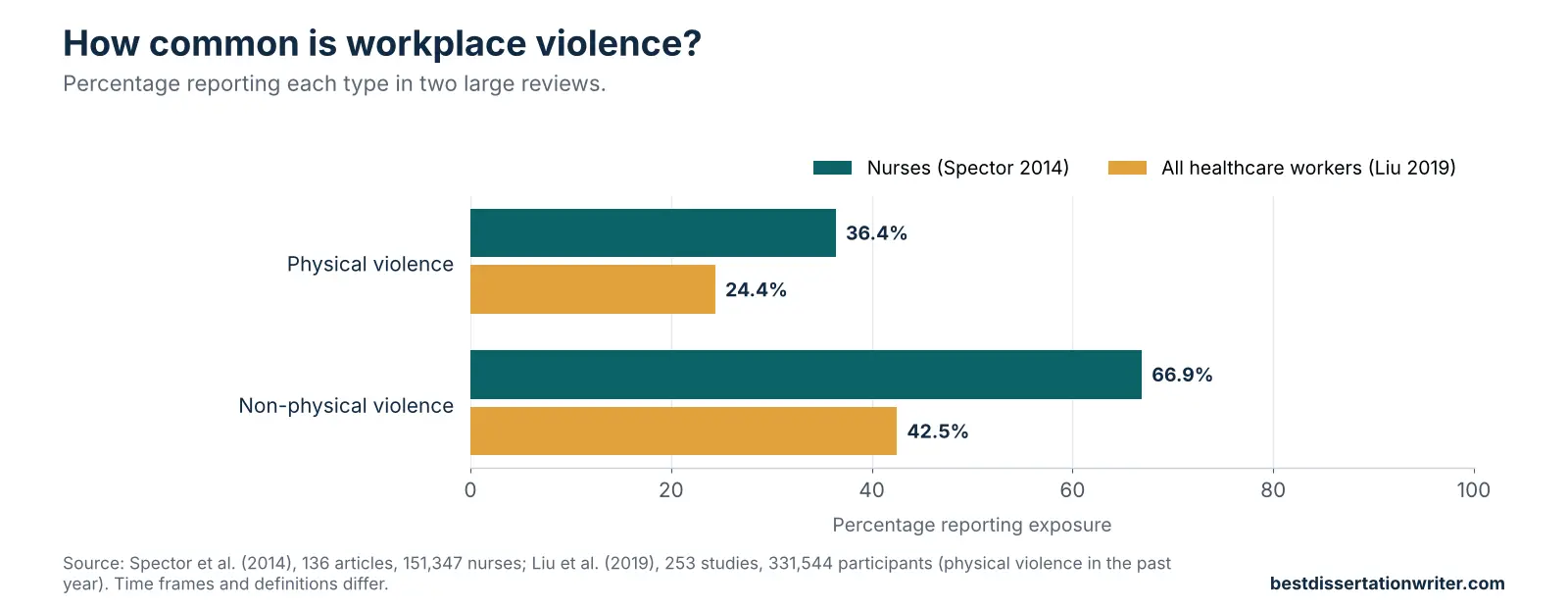
Prevalence varied by country, setting, work schedule and occupation, and was highest in Asian and North American countries, in psychiatric and emergency departments, and among nurses and physicians. The two reviews differ in population and in the time period measured, so their figures are not directly comparable, but both point to high rates and to emergency nursing as a high-risk setting. Because the studies relied on self-report, some variation may reflect differences in definitions and in willingness to disclose.
Theme 2: Prevention Interventions
Wirth et al. (2021) systematically reviewed interventions for workplace violence prevention in emergency departments. They searched five databases for studies from January 2010 to May 2021 and included 15 studies, 11 of which tested behavioural interventions such as training in de-escalation or self-defence. The other four also included organisational or environmental measures. Most studies showed that interventions had a positive effect, mainly by reducing violent incidents or improving staff preparedness.
The authors noted that the evidence is still limited and recommended further high-quality studies, particularly on environmental and organisational interventions. The studies were mostly uncontrolled or of modest design, so the positive findings should be interpreted with caution. They suggest, however, that emergency departments can reasonably invest in training and in structural measures while the evidence develops.
Geoffrion et al. (2020) provide a more cautious picture in a Cochrane review of education and training to prevent or minimise workplace aggression toward healthcare workers. They included nine studies with 1,688 participants: four cluster randomised trials, three randomised trials and two controlled before-and-after studies. Five studies reported episodes of aggression. Results on short-term aggression were very uncertain, and long-term results suggested that education may not reduce aggression (risk ratio 1.14, 95% confidence interval 0.95 to 1.37, low certainty).
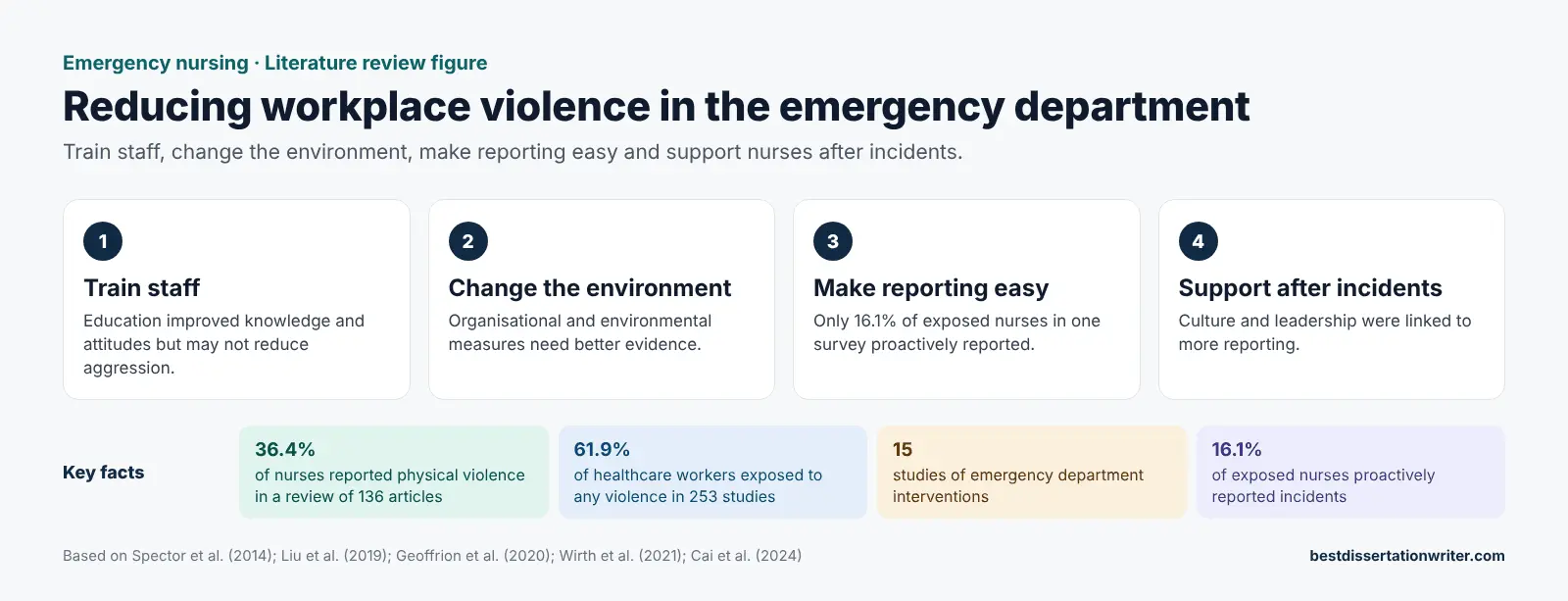
Education may increase knowledge (standardised mean difference 0.86, low certainty) and may improve attitudes (0.59, very low certainty), but may have no effect on skills. The authors concluded that education combined with training may not reduce workplace aggression, although it may increase knowledge and positive attitudes, and noted that programmes may increase reporting of incidents, which could partly explain the lack of reduction in reported aggression. Confidence in the findings is low because the evidence comes from few studies, many small and at risk of bias.
Taken together, the two reviews suggest a balanced view. Training is widely used and appears to improve staff knowledge and preparedness, but there is no strong evidence that it alone reduces the number of incidents. A sensible approach for emergency departments is therefore to treat training as one part of a package that also includes policy, environment, staffing and support, and to monitor incidents so that the effect can be judged locally.
Theme 3: Reporting of Incidents
Cai et al. (2024) conducted a cross-sectional study of 3,363 nurses in general and specialised hospitals in Jiangsu Province, China, in 2023, to assess barriers and facilitators to reporting patient and visitor violence. A total of 1,813 nurses (53.9%) reported experiencing such violence in the past year, but only 16.1% of them proactively reported incidents.
Higher reporting was associated with working in an emergency department (odds ratio 1.788), outpatient or paediatric departments, a hospital that actively encourages reporting (2.700), a hospital that safeguards staff interests (2.072) and prior hearing about violence. Lower reporting was associated with working five to nine night shifts per month and with selective reporting based on the severity of the violence. The authors concluded that the reporting rate is notably low and that nurse managers should address both facilitating and blocking factors.
This source is from one province in China, and its findings may not apply to the United Kingdom, but it illustrates a widely recognised problem. Where reporting is low, the true burden of workplace violence is hidden, and services cannot learn from incidents or provide support. The finding that organisational encouragement was associated with more than twice the odds of reporting suggests that culture and leadership are practical levers.
A central message from the sources is that the visible figures understate the problem. Prevalence estimates rely on what staff are willing to report in a survey, and the survey of reporting shows that most exposed nurses did not proactively report incidents to their organisation. If workplace violence is under-reported, then services are likely to underestimate the risk and to underinvest in prevention, so improving reporting is itself a safety measure.
Discussion
This systematic review shows that workplace violence is common in healthcare and especially so in emergency departments. Roughly a third of nurses worldwide reported physical violence and about two-thirds reported non-physical violence in one review, and similar patterns were seen across all healthcare workers in another. Emergency nurses are therefore at high risk.
The evidence on prevention is weaker than the evidence on prevalence. Interventions in emergency departments mostly reported positive effects, but the studies were limited, and the Cochrane review found very low to low certainty evidence that training reduces aggression. The review also noted that programmes may increase reporting, which complicates the measurement of effect. This is a reason to evaluate interventions with care and to measure staff experience as well as incident counts.
There are limitations to this review. It included only five sources, and prevalence figures come from self-reported surveys with different definitions and time frames. The reviews overlap in the studies they include, and the reporting study is from a single country. None of the sources focused on the experiences of emergency nurses in United Kingdom departments. This review relied on openly accessible, English-language sources.
Another point concerns the nurse’s role in the immediate response. The reviews of training suggest that knowledge and attitudes can be improved, and in an emergency this may help nurses to recognise early signs of agitation, to speak calmly and to call for help in good time. Teams that practise how they would respond, including who leads, who protects other patients and how security is called, are likely to cope better when an incident occurs, although the evidence for this is limited.
Even with these limits, the findings are consistent enough to guide practice. Violence is common, training helps knowledge and preparedness, reporting is low and organisational culture matters. Emergency nurses should not be expected to manage workplace violence on their own, and services should take responsibility for a safe environment, for follow-up after incidents and for making it easy to report.
Implications of Workplace Violence Evidence for Practice
For practice, the evidence supports offering training in communication and de-escalation to all emergency staff, combining it with environmental and organisational measures, making incident reporting simple and encouraged, and giving prompt support to nurses after an incident. Guidance is available from the Royal College of Nursing and the Health and Safety Executive.
Support after an incident deserves particular attention. Nurses who have experienced workplace violence should be offered time to recover, a chance to talk through what happened and information about their options, including reporting to the police where appropriate. A response that is quick and respectful sends a message that the organisation takes violence seriously, and it may encourage others to report in future.
Managers should record and review incidents, share lessons with staff and consider whether staffing, waiting times and the layout of waiting areas contribute to risk. A culture in which violence is not accepted as part of the job is more likely to lead to reporting and to support.
Future research should evaluate comprehensive prevention programmes in controlled designs, test environmental and organisational measures, examine the experience of emergency nurses in United Kingdom settings and explore how best to encourage reporting. Studies that measure nurses’ wellbeing and retention, as well as incident counts, would be particularly valuable.
Conclusion
This systematic review found that workplace violence is common among nurses, especially in emergency settings, that evidence on prevention is limited and of low certainty and that reporting is low.
Emergency nurses need training, a safe environment and a culture that supports reporting, and services should evaluate what works in their own departments.
References
Cai, J., Ying, Y., Wang, H., Yu, W., Wu, S., Zhang, Y., & Wang, Y. (2024). Exploring barriers and facilitators in nurses’ reporting of patient and visitor violence: A cross-sectional study in China. BMJ Open, 14(12), Article e091232. https://doi.org/10.1136/bmjopen-2024-091232
Geoffrion, S., Hills, D. J., Ross, H. M., Pich, J., Hill, A. T., Dalsbø, T. K., Riahi, S., Martínez-Jarreta, B., & Guay, S. (2020). Education and training for preventing and minimizing workplace aggression directed toward healthcare workers. Cochrane Database of Systematic Reviews, (9), Article CD011860. https://doi.org/10.1002/14651858.CD011860.pub2
Liu, J., Gan, Y., Jiang, H., Li, L., Dwyer, R., Lu, K., Yan, S., Sampson, O., Xu, H., Wang, C., Zhu, Y., Chang, Y., Yang, Y., Yang, T., Chen, Y., Song, F., & Lu, Z. (2019). Prevalence of workplace violence against healthcare workers: A systematic review and meta-analysis. Occupational and Environmental Medicine, 76(12), 927–937. https://doi.org/10.1136/oemed-2019-105849
Spector, P. E., Zhou, Z. E., & Che, X. X. (2014). Nurse exposure to physical and nonphysical violence, bullying, and sexual harassment: A quantitative review. International Journal of Nursing Studies, 51(1), 72–84. https://doi.org/10.1016/j.ijnurstu.2013.01.010
Wirth, T., Peters, C., Nienhaus, A., & Schablon, A. (2021). Interventions for workplace violence prevention in emergency departments: A systematic review. International Journal of Environmental Research and Public Health, 18(16), Article 8459. https://doi.org/10.3390/ijerph18168459
Cite this example
Best Dissertation Writers (2026) Workplace Violence Against Emergency Nurses: Prevalence, Impact, and Prevention: A Systematic Review. Available at: https://bestdissertationwriter.com/workplace-violence-literature-review/
Best Dissertation Writers
Get expert help with your nursing literature review
Share your topic and deadline with Best Dissertation Writers and get support tailored to your module brief.