

Different Types of Literature Reviews, and How to Choose the Right One
 By Dr. Robertson Prime, Research Fellow
Updated November 16, 2026
18 min read
About 3,600 words
There are many types of literature review, and choosing the right one shapes everything that follows: how you search, which sources you include, how you judge them and how you write the review. A narrative review for a dissertation chapter and a systematic review for a health journal are both literature reviews, but they use very different literature review methods.
This guide explains the main types of literature review, from narrative, thematic and critical reviews to scoping, rapid and systematic reviews and meta-analyses. For each type of literature review, you will see what it is, when to use it, how it is done and what its limits are, followed by a comparison table and a step-by-step guide to choosing the right one.
- The types: eight common types of literature review, each explained with its purpose, method, strengths and typical use.
- The comparison: a table comparing the kinds of literature review by search, appraisal, synthesis and time needed.
- The decision: a step-by-step guide and decision chart to help you choose the right type of literature review for your research question.
On this page
Key takeaways
- The types of literature review differ mainly in how systematically they search, appraise and synthesize the evidence.
- Most dissertation chapters are narrative or thematic reviews, written with a clear but flexible search strategy.
- Scoping reviews map a field, systematic reviews answer a precise question, and meta-analyses combine results statistically.
- Choose the type of literature review that fits your research question, your time and what your program expects.
Types of Literature Review: Understanding the Different Types of Literature Review in Research
All types of literature review share one aim: to summarize and make sense of the existing research on a topic. They also share a starting point: the existing literature, and the gaps in the literature that it reveals. What separates the kinds of literature review is how they go about it, and how much of the process is planned and reported.
Grant and Booth (2009) described 14 review types in their widely cited typology of reviews. They compared them on four dimensions, which are a useful way to understand the literature review methods behind each type.
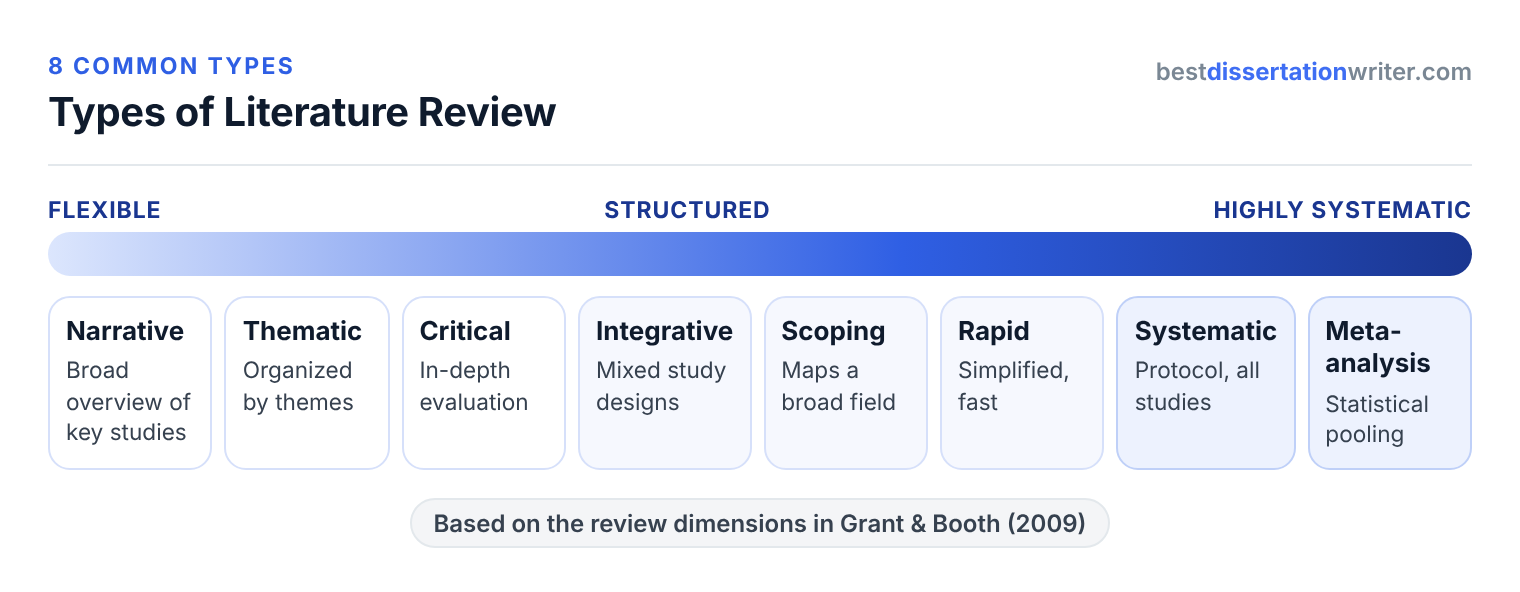
- Search: how widely and how systematically the review looks for sources. A narrative review may search a few key databases, while a systematic review searches several databases with a recorded strategy and often looks for unpublished studies too.
- Appraisal: whether each study’s quality is judged, and how. Some types of literature review appraise studies informally, while systematic reviews use formal checklists or risk-of-bias tools.
- Synthesis: how the findings are brought together. This can be a narrative discussion by themes, a table of study characteristics, or a statistical combination of results in a meta-analysis.
- Analysis: what the review concludes about the evidence as a whole, such as what is known, how strong it is and what research gaps remain for future research.
Understanding the different types of review articles
Published review articles come in a whole review family, and each review provides something different. Understanding the different types of reviews helps you read research papers in your research area critically and choose the appropriate type of literature review for your own work.
- Reviews that provide a broad overview: narrative and scoping reviews provide a broad overview of existing research on a topic. They offer a summary of literature that maps the research evidence and points to directions for future research.
- Reviews that answer a precise question: systematic reviews follow a protocol so that the systematic review process is transparent. Their systematic review methods to search several databases aim for comprehensive coverage of the literature, and the Cochrane Handbook for Systematic Reviews of Interventions sets the standard approach to systematic reviews in health.
- Reviews that combine data: reviews and meta-analyses require studies that are similar enough to pool their research findings. That is why systematic reviews and meta-analyses are so often published together.
- Reviews of qualitative research: qualitative evidence syntheses, also called qualitative systematic reviews, provide a synthesis of qualitative research on people’s experiences and views. Mixed methods reviews bring quantitative and qualitative research studies together.
- Reviews that stay up to date: a living systematic review is updated regularly as new studies are published, which suits fast-moving topics where findings change quickly.
Whatever the type, the review approach should be based on your research question and the type of evidence available. Methods journals such as BMC Medical Research Methodology publish guidance on many review types, and university research guides often summarize the common types of reviews for students.
Narrative Review, Thematic and Critical Reviews
These are the most flexible types of literature review. They are the kinds of literature review most students write for a thesis or dissertation chapter.
1. Narrative literature review
A narrative literature review, sometimes called a traditional review, discusses the key studies on a topic and explains how they fit together. It is the most common type of literature review in coursework and dissertations.
- What it does: it gives a broad, readable overview of existing research, identifies the main debates and points to gaps in research. The author decides which studies matter most and builds an argument around them.
- How it is done: the search is usually focused but not exhaustive, and the inclusion of sources is based on relevance and judgment. Good narrative reviews still describe how sources were found, so the reader can trust the coverage.
- Strengths: it is flexible, quick compared with systematic methods, and well suited to broad or theory-based questions. It also lets you trace how ideas developed over time.
- Limits: because the selection is not systematic, it can be influenced by the author’s choices. Examiners will look for a clear search strategy and balanced coverage to reduce this risk.
2. Thematic literature review
A thematic review is a narrative review organized around themes or concepts rather than authors or dates. Many supervisors treat it as the default type of literature review for Chapter 2.
- What it does: it groups studies under themes, such as causes, effects and interventions, and discusses each theme in its own section. Each section synthesizes several sources and ends with what the theme shows.
- When to use it: when your topic has several distinct aspects that the literature discusses separately. It works for most social science, education, business and health topics.
- How to do it well: choose themes from patterns in the relevant literature and your notes, not from your first guesses, and order them so they build toward your research gap. Our guide to the thematic literature review shows the full method.
3. Critical review
A critical review goes beyond describing the literature to evaluate it in depth. It questions the methods, assumptions and theories behind the research and often proposes a new interpretation.
- What it does: it weighs the strengths and weaknesses of the existing research, explains why studies disagree and challenges accepted ideas where the evidence is weak.
- When to use it: for theory-heavy topics, contested debates or doctoral work where examiners expect a strong critical voice.
- Limits: like a narrative review, it does not usually follow a formal protocol, so its quality depends on fair, well-supported judgment. See how to write a critical literature review for the method.
Integrative, Scoping and Rapid Reviews
These types of literature review are more structured than a narrative review but less demanding than a full systematic review. Each answers a different kind of question.
4. Integrative review
An integrative review combines studies with different designs, such as experimental and non-experimental research, and sometimes theoretical literature, to build a fuller understanding of a topic. Whittemore and Knafl (2005) set out an updated methodology for it, and it is widely used in nursing research.
- What it does: it brings quantitative studies and qualitative studies together, which a meta-analysis cannot do. The aim is a comprehensive picture of what is known about a problem.
- How it is done: it follows defined stages, including problem identification, literature search, data evaluation, data analysis and presentation. Combining different kinds of evidence needs careful, transparent methods.
- When to use it: when the evidence on your question comes from mixed research methods and you want to integrate it rather than review only one kind.
5. Scoping review
A scoping review maps the available literature on a broad topic: how much research exists, what kinds of studies have been done and where the gaps are. Arksey and O’Malley (2005) proposed a widely used framework for it.
- What it does: it charts the size, range and nature of the research, rather than answering a narrow question about effectiveness. It is often used to decide whether a full systematic review is worthwhile.
- How it is done: it follows a systematic search and a clear set of steps, but it usually does not appraise the quality of each study in depth. Results are often presented as tables and maps of the evidence.
- When to use it: for new, broad or complex topics where you need to understand the scope of available research before narrowing your question, and for identifying gaps in research.
6. Rapid review
A rapid review uses systematic review methods but simplifies or shortens some steps to deliver results quickly, often for policy or practice decisions.
- What it does: it gives a timely summary of the evidence when decision-makers cannot wait for a full systematic review.
- How it is done: it shortens the review process, for example by limiting the number of databases, the date range or the depth of appraisal, and it should state these shortcuts openly. The trade-off is speed in exchange for some risk of missing studies.
- When to use it: when a question is urgent and a quick, transparent answer is more useful than a complete one.
Systematic Reviews and Meta-Analyses
These are the most rigorous types of literature review. They follow a protocol, report every step and aim to minimize bias.
7. Systematic review
A systematic review answers a specific research question by finding, appraising and synthesizing all the eligible studies, using methods set out in advance. The Cochrane Handbook is the standard guide for systematic reviews of interventions.
- What it does: it gives the most complete and least biased summary of the evidence on a focused question, such as whether an intervention works.
- How it is done: a protocol defines the question, search strategy and inclusion criteria; several databases are searched; studies are screened, often by two reviewers; and each study’s quality is appraised. Reporting usually follows the PRISMA 2020 guidelines, the preferred reporting items for systematic reviews.
- When to use it: when your program or journal expects it, or when your question is precise enough to be answered by all the available studies.
- Limits: it takes much longer than other kinds of literature review and needs clear criteria from the start. Our guide to the systematic literature review structure explains its sections.
8. Meta-analysis
A meta-analysis is a form of research synthesis: a statistical technique, usually carried out within a systematic review, that combines the numerical results of several studies into one overall estimate.
- What it does: it pools results to give a more precise estimate of an effect than any single study, and tests whether results differ across studies.
- When it is possible: only when studies are similar enough in design, population and outcome to be combined. If the literature is too heterogeneous, a narrative synthesis is used instead.
- Skills needed: it requires statistical knowledge and software, so it is less common in student dissertations unless the program focuses on quantitative research.
Comparison Table: Types of Literature Review at a Glance
The table compares the main types of literature review side by side. Use it to see which kinds of literature review match your question and your time.
| Type | Search | Appraisal | Synthesis | Typical time | Best for |
|---|---|---|---|---|---|
| Narrative | Focused, not exhaustive | Informal | Narrative discussion | Weeks | Broad overviews, dissertations |
| Thematic | Focused, not exhaustive | Informal | By themes | Weeks | Chapter 2 of a dissertation |
| Critical | Purposive | In-depth judgment | Argument and interpretation | Weeks to months | Theory and debate |
| Integrative | Systematic | Varies by design | Integrates mixed evidence | Months | Nursing, mixed evidence |
| Scoping | Systematic, broad | Usually none | Charts and maps | Months | Mapping a new field |
| Rapid | Systematic, simplified | Simplified | Narrative or tabular | Weeks to months | Urgent policy questions |
| Systematic | Exhaustive, protocol | Formal tools | Narrative or statistical | Months to over a year | Precise questions |
| Meta-analysis | Exhaustive, protocol | Formal tools | Statistical pooling | Months to over a year | Combining effect sizes |
Typical times are rough planning guides for a single researcher and vary widely by topic and field.
Common types of review and the type of evidence they use
Each type of review is built for a particular type of evidence. Matching the two is the simplest way to avoid choosing the wrong one.
- Quantitative evidence: trials and cohort studies with similar outcomes suit a systematic review, and a meta-analysis when the numbers can be pooled.
- Qualitative evidence: interview and focus group studies suit a qualitative evidence synthesis or a thematic review that respects their context.
- Mixed evidence: a combination of designs suits an integrative or mixed methods review, which can bring different kinds of findings together.
- Theory and argument: conceptual and theoretical literature suits a critical or narrative review that can weigh competing ideas.
Other types of literature review you may meet
Specialized reviews include several more kinds of literature review in Grant and Booth’s typology. You may see these in published research even if you do not write one yourself.
- Umbrella review: a review of existing systematic reviews on a broad topic, which summarizes what several reviews have found rather than going back to individual studies.
- Mixed methods review: a review that combines quantitative and qualitative evidence in a structured way, often with separate syntheses that are then brought together.
- Qualitative evidence synthesis: a review that brings together qualitative studies to explore experiences, views or processes, using methods such as thematic synthesis.
- Realist review: a review that asks what works, for whom and in what circumstances, by looking at the mechanisms behind complex interventions.
How to Choose the Right Type of Literature Review
Choosing the right type of literature review is a practical decision. It depends on your research question, the evidence available, your time and the expectations of your program.
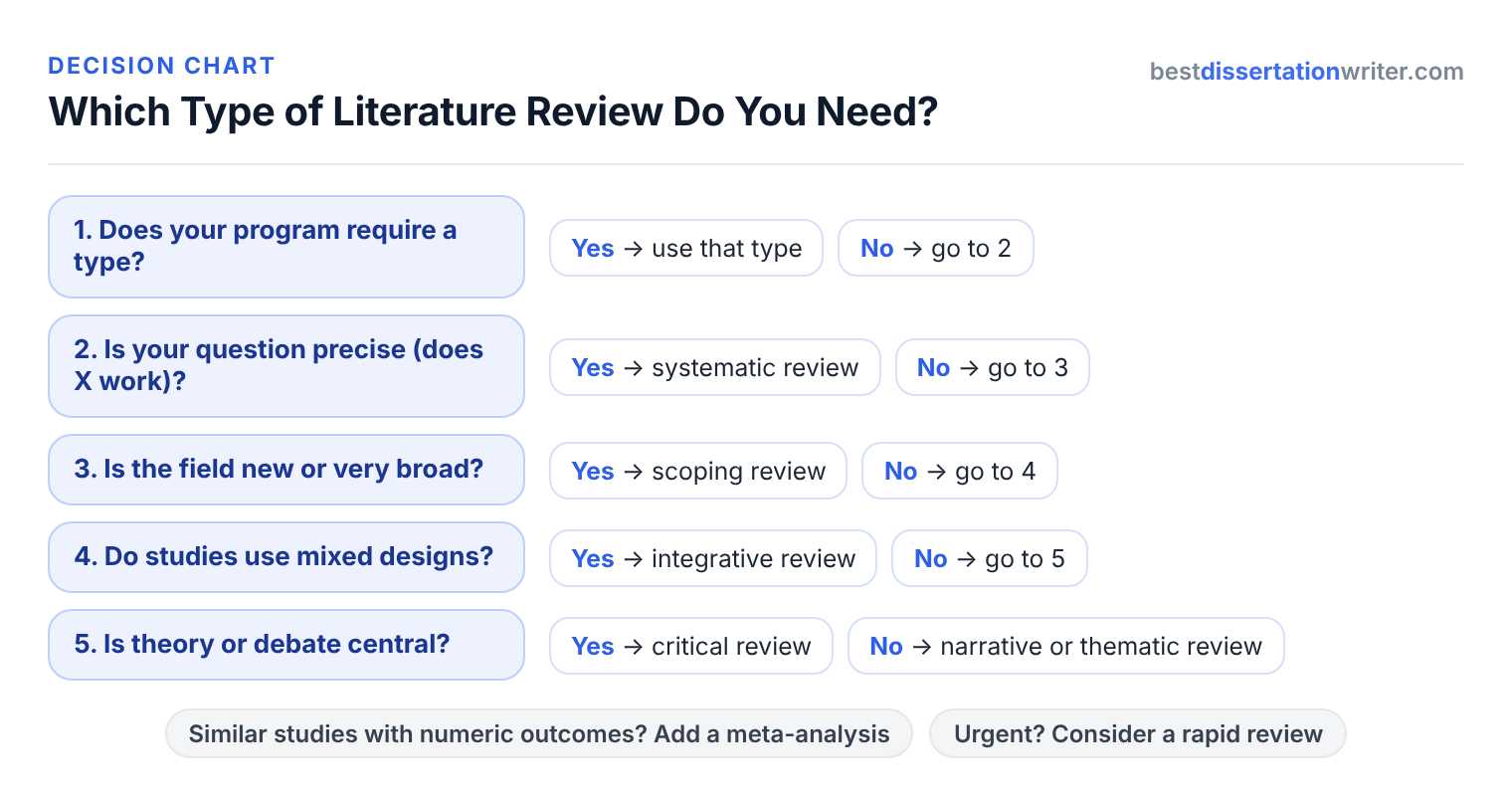
- Check what your program requires. Read your handbook and ask your supervisor which type of literature review is expected. Some programs require a systematic review, while most dissertation chapters expect a narrative or thematic review, and this decision overrides the others.
- Look closely at your research question. A precise question about effectiveness, such as whether one intervention works better than another, suits a systematic review. A broad question about what is known, or how a topic is understood, suits a narrative, thematic or scoping review.
- Do a quick scoping search. Search one or two databases to see how much literature exists. If there is very little, a narrative or scoping review may be the only realistic option; if there are hundreds of similar studies, a systematic review or meta-analysis becomes possible.
- Consider the kind of evidence. If the studies use very different methods, an integrative or mixed methods review fits better than a meta-analysis. If they share designs and outcomes, statistical pooling may be possible.
- Be honest about time and resources. Systematic literature review methods often need a second reviewer and months of work. If you have one semester and work alone, a well-documented narrative or rapid approach is usually more realistic.
- Write down your choice and the reason. State the type of literature review and why you chose it in your introduction or methods. This shows examiners that the decision was deliberate and part of your research methodology.
Choosing a review type: the right type of review and review method for your research question
Once you have chosen a review type, write it into your methods section with a short justification. The template below shows the wording many supervisors expect.
Template
This chapter presents a [type of literature review] of research on [topic]. This approach was chosen because [reason linked to the research question]. Sources were identified through [databases] using [search terms], and were limited to [inclusion criteria].
Examples: Matching Research Questions to Types of Literature Review
The fastest way to understand the types of literature review is to see which questions each one answers. The examples below use illustrative topics.
| Research question | Best type of literature review | Why |
|---|---|---|
| How has research on remote work and wellbeing developed since 2010? | Narrative or thematic | Broad, descriptive and interpretive |
| What research exists on social media use among older adults? | Scoping | Maps a broad, emerging field |
| Does mentoring reduce early-career teacher attrition? | Systematic (with meta-analysis if possible) | Precise question about effect |
| What is known about family involvement in nursing home care, from all study types? | Integrative | Combines quantitative and qualitative evidence |
| Are current theories of motivation adequate for online learning? | Critical | Evaluates and challenges theory |
Matching a question to a type of literature review
Weak
“I will do a systematic review of everything written about leadership.”
The question is too broad for systematic literature review methods, and “everything” cannot be screened properly.
Strong
“I will do a scoping review of research on distributed leadership in primary schools since 2010, then narrow my question.”
The type matches a broad question and a clear scope.
See how to describe your type of literature review in your methods (about 100 words)
“This chapter takes the form of a thematic literature review. A thematic approach was chosen because the research on teacher wellbeing addresses several distinct aspects, including workload, support and professional identity, which are best discussed separately.
Sources were identified through ERIC and Google Scholar using combinations of ‘teacher’, ‘wellbeing’ and ‘workload’, and were limited to peer-reviewed studies published in English since 2012.”
Summary of literature review types
In short, the types of literature review range from flexible narrative reviews to strict systematic reviews and meta-analyses. The right type of literature review is the one that fits your question, your evidence and your program, and is described honestly in your methods.
For a full walk-through of writing whichever type you choose, see our guide on how to write a literature review. For complete samples, browse our literature review examples, or return to the main guide on how to write a dissertation.
FAQs About the Types of Literature Review
What are the four types of literature reviews?
Lists vary, but four types of literature review are often named in research methods textbooks: the narrative (or traditional) review, the systematic review, the meta-analysis and the meta-synthesis, which combines qualitative studies. These four cover the main ways of searching and combining evidence.
In practice, there are many more kinds of literature review. Grant and Booth (2009) described 14, including scoping, rapid, integrative, critical and umbrella reviews. Check which type your program expects before you start, because the choice changes how you search and how long the review will take.
Which type of literature review is best for a dissertation?
For most dissertations, a narrative or thematic literature review is the best fit. It lets you cover the key studies, organize them by themes and build an argument that leads to your research question, without the time and team that a full systematic review needs.
Some programs, especially in health sciences, require a systematic or scoping review, sometimes as the whole dissertation. Always check your handbook and agree the type of literature review with your supervisor before you begin searching, so your search strategy matches it from the start.
What is the difference between a narrative and a scoping review?
A narrative review discusses key studies on a topic and builds an interpretive argument, with a focused but not exhaustive search. A scoping review uses a systematic search to map how much research exists, what kinds of studies have been done and where the gaps are.
Narrative reviews often evaluate and interpret the evidence, while scoping reviews usually chart it without appraising each study in depth. A scoping review is often a first step before a systematic review, because it shows whether enough studies exist to answer a narrower question.
What are the 7 types of research?
There is no single official list, but research methods texts commonly describe types such as descriptive, correlational, experimental, quasi-experimental, exploratory, explanatory and evaluation research. They are often grouped further into qualitative, quantitative and mixed methods approaches.
These are types of primary research, which collect new data. The types of literature review are different: they review research that already exists. Your literature review will often discuss studies of several of these research types, whether you plan systematic reviews or primary research yourself.
Best Dissertation Writers
Need help with your literature review?
Get a critical, well-structured review with current sources and a clear research gap.