

What Is a Literature Review? Definition, Purpose and Major Sections
 By Dr. Robertson Prime, Research Fellow
Updated November 16, 2026
20 min read
About 4,100 words
If you have just been asked to write a literature review, the first question is a simple one: what is a literature review, exactly? A literature review is a structured, critical summary and synthesis of the published research on a topic. It shows what is already known, how the research fits together and where the gaps are that new research could fill.
This guide answers the question “what is a literature review” in plain language. It explains the definition, the purpose, the main parts and the different types, then walks you through how to conduct a literature review, with examples and writing tips you can use straight away.
- The literature review definition: what a literature review is, in simple words, and what it means in a research paper, a thesis and a dissertation.
- The purpose and parts: the purpose of a literature review, and the parts of a literature review: what goes in its introduction, body and conclusion.
- The method: a step-by-step overview of how to conduct a literature review, plus a weak-vs-strong example and a checklist.
On this page
Key takeaways
- The short answer to what is a literature review: a critical survey of existing research that builds an argument about what is known and what is missing.
- It summarizes and synthesizes sources, rather than listing them one at a time.
- The three parts of a literature review are an introduction, a body organized by themes, and a conclusion that states the research gap.
- The purpose of a literature review is to show your knowledge of the field and to justify your own research question.
What Is a Literature Review? A Clear Definition
So, what is a literature review? The standard literature review definition is a piece of academic writing that surveys the scholarly sources on a particular subject, evaluates them and connects them to show the current state of knowledge. The “literature” is the body of published research on your topic: journal articles, scholarly books, conference papers and reputable reports.
The key word in the literature review definition is “review”. A literature review does not simply report what each source says. It examines the existing research as a whole, compares findings, judges the quality of the evidence and explains what all of it means for your research question.
What is a literature review in simple words?
In simple words, what is a literature review? It is your account of what other researchers have already found about your topic, and what they have not yet found. Think of it as a guided tour of a conversation among scholars.
- It tells a story about the research: instead of listing studies, it explains how ideas developed, where researchers agree and where they disagree. A reader should finish it understanding the shape of the field, not just the names of authors.
- It has a point of view: a good literature review takes a position on the evidence, for example that one explanation is better supported than another. That position is backed by the sources you cite.
- It leads somewhere: the review ends by showing a gap in the literature, such as a question nobody has answered, which your own research will address.
What is a literature review in a research paper?
In a journal article or course research paper, the literature review is usually part of the introduction, or a short section straight after it. It is focused and selective, covering only the studies the reader needs to understand why the paper’s research question matters.
- Short and targeted: it may run from a few paragraphs to a few pages, depending on the journal or assignment. Every source must earn its place by supporting the paper’s argument.
- Leads to the research question: the final paragraph usually states the gap and the specific question the paper answers. In this sense, the review is the bridge between existing research and your new research.
- Same definition, smaller scale: the literature review definition does not change in a paper; only the length does. It still summarizes, synthesizes and evaluates, and the purpose of a literature review in a paper is still to justify the study.
What is a literature review in a thesis or dissertation?
In a thesis or dissertation, the answer to “what is a literature review” is bigger. It is usually a full chapter, often Chapter 2, that reviews the research on your topic in depth before you present your own study.
- A full chapter: it has its own introduction, several thematic sections with subheadings, a section on gaps in the research and a chapter summary. Many programs also expect a theoretical framework within it.
- Evidence of expertise: examiners read it to judge whether you know your field well enough to carry out independent research. Depth, accuracy and critical analysis of the literature all count.
- A foundation for your methods: by reviewing how earlier studies were designed, the chapter also helps you justify your own research methods.
So, in a dissertation, what is a literature review? It is the chapter that proves your study is needed. To see one in full, read our annotated chapter two literature review sample.
What is a literature review across fields of study?
The literature review definition is the same in every field of knowledge, but what reviewers expect changes from one subject area to another. Before you start, it helps to know how your discipline approaches reviewing literature.
- Sciences and health: a review of literature here often draws on data from multiple studies and gives most weight to recent, peer-reviewed research. Some health programs expect a systematic review, where the methods for analyzing existing research are written down in advance.
- Social sciences and education: reviews compare different points of view and research traditions, such as surveys and interviews, and ask how context shapes findings. The analysis of existing research is often organized around debates.
- Humanity and arts subjects: in the humanities, a lit review engages closely with scholars’ arguments in books and articles, and older works can remain central. The existing body of interpretation matters as much as new research.
- Every field: whether you review existing research on a specific population or a whole theory, and however you use the literature, a literature review requires you to narrow down the topic to one topic and one research question. With thousands of articles on many subjects, a structured and comprehensive review of the research on a specific topic is far more useful than a broad survey.
The number of sources you need also varies by field and level, so check your handbook. Whatever the field, you will learn how to write a strong review faster if you annotate two or three published reviews in your subject area first, noting how they handle existing literature and the available literature on key concepts.
Why Is a Literature Review Important? The Purpose of a Literature Review
Knowing what is a literature review is only half the answer; you also need to know why your supervisor wants one. The purpose of a literature review can be summed up in six jobs, and a strong review does all of them.

- It maps the existing research: the first purpose of a literature review is orientation. A literature review shows the main theories, methods and findings in your research area. Readers new to the topic can see the landscape quickly, and experts can see that you know it.
- It identifies gaps: by setting studies side by side, the review reveals what has not been studied, what has been studied poorly and where findings conflict. These gaps in the literature are the reason your research is needed.
- It justifies your research question: the review builds a logical case that ends with your question. If the review is convincing, the reader agrees that the question is worth answering before you even describe your study.
- It shows your knowledge in the field: a thorough, well-structured review demonstrates that you have read widely and understand the scholarly conversation. This matters most in graduate work, where it is part of how you are assessed.
- It informs your methods: seeing how others designed their studies, and where those designs fell short, helps you choose stronger methods. Many methodology chapters refer back to the literature review for this reason.
- It avoids repetition: checking what has already been studied stops you from repeating work that is already done. It also helps you build on earlier findings instead of starting from nothing.
How a literature review helps you define your research and identify gaps in existing research on a topic
The purpose of a literature review is easiest to see in a real example. Imagine you want to study how flexible work affects stress in hospital nurses.
- Before the review: your topic is broad, and you do not yet know whether flexible work and nurse stress have already been studied, or how. You might repeat a study that already exists.
- After the review: you know which questions are settled, which findings conflict and which groups have been left out, such as night-shift nurses in rural hospitals. That lets you define your research precisely and identify gaps worth filling.
- The result: your research question is sharper, your methods build on earlier work, and the purpose of a literature review, justifying your study, is met.
The Main Parts of a Literature Review
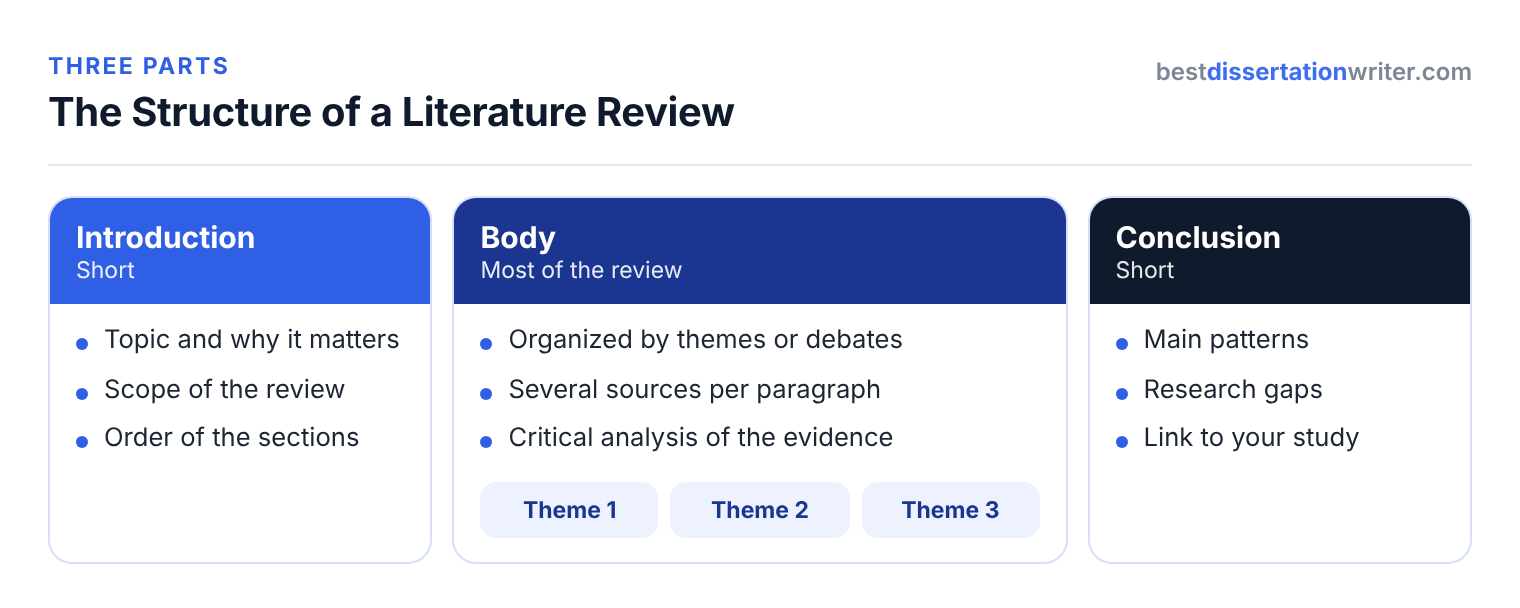
Once you know what is a literature review, its structure makes sense. Almost every review, short or long, has the same three parts of a literature review: an introduction, a body and a conclusion. Each of the parts of a literature review has a different job, explained below.
1. The introduction
The introduction is the first of the parts of a literature review. It tells the reader what the review covers and how it is organized. It is usually short, from one paragraph in a paper to a page or two in a dissertation.
- The topic and its importance: open by naming the topic and explaining briefly why it matters, for example to practice, policy or theory.
- The scope: state what the review includes and excludes, such as the years, populations or types of study covered, so the reader knows the boundaries.
- The organization: end by previewing the order of the sections, which acts as a map for the rest of the review.
2. The body of the literature review
The body of the literature review is the largest of the parts of a literature review, and it is where the real work happens. It discusses the research in sections, usually organized by themes, and each section makes a point about the evidence.
- Organized by themes or debates: group studies that address the same idea, rather than discussing one study per paragraph. Common patterns are thematic, chronological, methodological and theoretical.
- Synthesis in every paragraph: each paragraph should summarize and synthesize several sources, showing where they agree and where they differ, instead of describing them one by one.
- Critical analysis of the literature: judge how strong the evidence is by looking at research designs, samples and settings. This is what turns a summary into a review.
3. The conclusion
The conclusion is the last of the three parts of a literature review, and it pulls the threads together. It summarizes what the literature shows, states the gaps clearly and links them to your own research.
- Main findings: summarize the key patterns in two or three sentences, without repeating every study.
- The research gaps: state plainly what is still unknown and why it matters.
- The link forward: in a dissertation, end with a sentence that leads into your methodology chapter or research question.
Different Types of Literature Reviews
Part of answering what is a literature review is knowing that there are several kinds, each with the same basic parts of a literature review but different methods. The type you write depends on your research question, your field and what your program expects.
| Type | What it does | Where you will see it |
|---|---|---|
| Narrative review | Discusses key studies and themes in a flexible, readable way | Most dissertation chapters and course papers |
| Thematic review | Organizes the research by themes or concepts | Dissertation Chapter 2 |
| Critical review | Evaluates the quality and assumptions of research in depth | Theory-heavy and doctoral work |
| Scoping review | Maps how much research exists and where the gaps are | New or broad topics, health research |
| Systematic review | Answers a precise question using a protocol and explicit criteria | Health sciences, evidence-based practice |
- Most students write a narrative or thematic review: these are flexible and suit most research questions in the social sciences, education, business and humanities. Our guide to the thematic literature review shows that structure in detail.
- Critical reviews go deeper into evaluation: they question methods and theories closely, which suits topics with competing explanations. See how to write a critical literature review.
- Scoping reviews map a broad field: they show how much research exists on a topic and what kinds of studies have been done, without judging each one in depth. The literature review definition still applies: the review must summarize, synthesize and identify gaps.
Systematic review vs narrative review: which do you need?
The literature review definition covers both, but they are built differently. Most students write a narrative or thematic review unless their program asks for a systematic review.
- Systematic review and scoping review methods are strict: they search set databases with explicit criteria and report every step, so another researcher could repeat them. Read about the systematic literature review structure if your program expects one.
- Narrative reviews are flexible: a narrative or thematic review selects the most relevant studies and organizes them around ideas. It still needs a clear search strategy, but it does not have to report every record screened, which makes it practical for a dissertation chapter and true to the purpose of a literature review.
- Your program decides: check your handbook or ask your supervisor which type is expected before you start searching. Changing from a narrative to a systematic review halfway through usually means redoing the search.
What a Literature Review Is Not
A useful way to understand what is a literature review is to look at what it is often confused with. Each of these has a different job, and none of them fits the literature review definition.
- Not an annotated bibliography: an annotated bibliography lists sources one by one, each with a short summary and evaluation. A literature review synthesizes those sources into an argument organized by themes, so it reads as one connected piece of writing.
- Not a summary of each source: a literature review is a summary and analysis together. If your draft has one paragraph per article, starting with each author’s name, it is closer to a list of summaries than a review.
- Not a research paper: a research paper reports a new study with its own data. A literature review discusses studies that others have already done, although it is often one part of a larger paper or a dissertation.
- Not always a systematic review: a systematic review is one specific type of literature review with a strict protocol. The literature review definition covers both, but the methods differ. Most dissertation literature reviews are narrative or thematic, with a clear but less formal search strategy.
Literature review vs annotated bibliography
Weak
“Smith (2020) studied online learning and found lower engagement. Lee (2021) studied online learning and found higher engagement.”
This reads like an annotated bibliography: one source at a time, with no connection or judgment.
Strong
“Findings on online engagement are mixed: some surveys report a decline (Smith, 2020), while course-log data suggest improvement over time (Lee, 2021), which may reflect how engagement was measured.”
This is a literature review: it groups the evidence, compares it and explains the difference.
How to Conduct and Write a Literature Review: A Step-by-Step Overview
Now that you know what is a literature review, here is how one is produced. The process has six stages, from defining your research to writing the final draft, and each stage builds on the one before.
Step by step: from existing research to a well-structured review
The steps below show how the definition becomes a finished piece of writing. Each step explains what to do, why it matters and what you should have at the end of it.
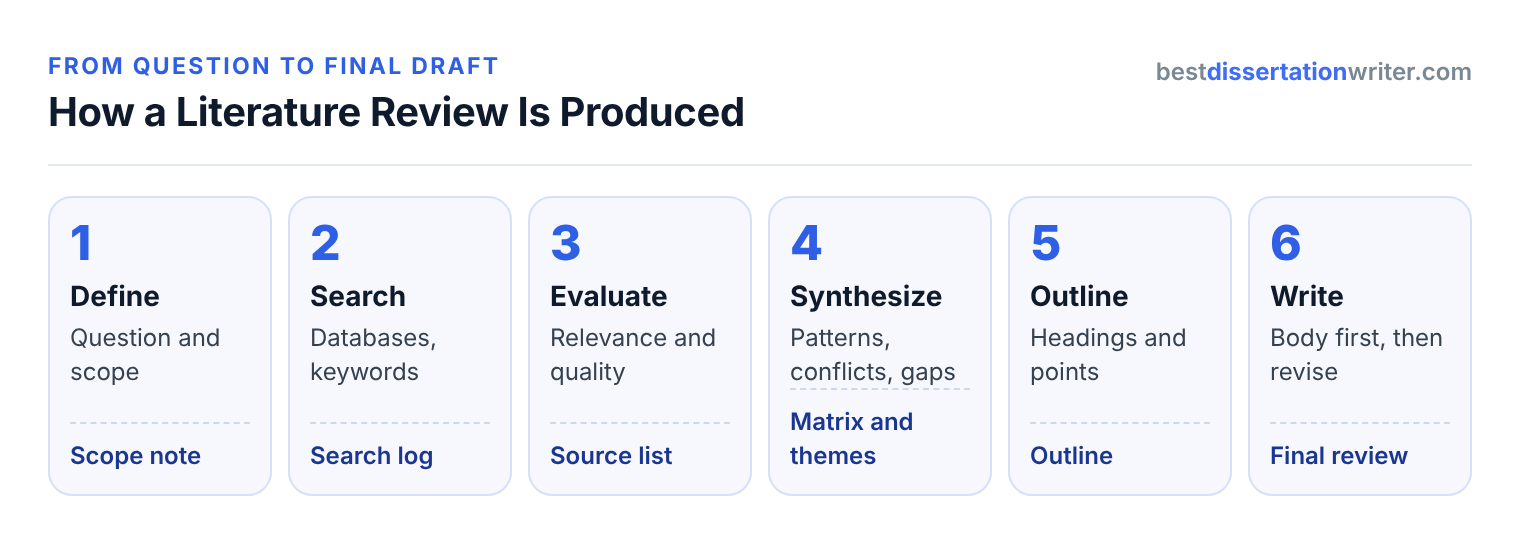
- Define your research question and scope. Turn your broad research topic into a focused question, then decide what the review will include, such as years, populations and types of study. A clear question tells you which literature is relevant and narrows down the topic to something you can cover well.
- Search for sources. Search at least one subject database plus Google Scholar, using keywords and synonyms for each key concept. University libraries and research guides at university websites list the best databases for each subject, and a subject librarian can help you build a search strategy.
- Screen and evaluate what you find. Read titles and abstracts first, then the full text of promising sources. Keep only those that are relevant, credible and strong enough to rely on, and note their limitations as you go.
- Take notes and synthesize. Record each source’s aim, method, findings and limitations in a table, often called a synthesis matrix. Then look across the table for patterns, conflicts and gaps, and turn the patterns into themes.
- Outline the review. Choose a structure, usually thematic, and draft headings for each section. Under each heading, list the point you will make and the sources that support it.
- Write and revise. Write the body sections first, then the introduction and conclusion. Revise for argument, synthesis, accuracy and style, check that the draft has all three parts of a literature review, and check every citation against your reference list.
Each of these stages is explained in detail, with templates, in our step-by-step guide on how to write a literature review. The UNC Writing Center guide to literature reviews is also a helpful outside view of the process.
What a Good Literature Review Looks Like: Example and Writing Tips
The clearest answer to what is a literature review is to see a good one, because examples show the literature review definition in action. The example below uses an illustrative topic, remote work and employee wellbeing, with placeholder citations.
See a short literature review introduction example (about 110 words)
This review examines research on remote work and employee wellbeing published since 2015. It focuses on peer-reviewed studies of office-based employees in North America and Europe, identified through PsycInfo, Business Source Complete and Google Scholar.
The review is organized in three themes: flexibility and job satisfaction, stress and isolation, and organizational support. It concludes by identifying gaps in the research, particularly the lack of studies in small organizations, which the present study addresses.
Writing tips for a good literature review
These writing tips turn the literature review definition into practice, and address the problems that appear most often in first drafts. Use them as a checklist when you revise.
- Lead with your own claims: start each paragraph with the point you want to make, then bring in the sources. Starting with “Smith (2020) found…” puts the author, not your argument, in charge.
- Synthesize, don’t list: aim to cite two or more sources in most paragraphs and say how they relate. Phrases such as “similarly”, “in contrast” and “taken together” signal synthesis.
- Evaluate the evidence: comment on sample sizes, research designs and settings, and say how much weight each finding deserves. This shows critical analysis, which examiners reward.
- Keep it well-structured: use clear subheadings that name each theme, and end each section by linking it to the next. A reader should never wonder why a paragraph is there.
- Use the right tense: past tense for a specific study (“Lee surveyed”) and present perfect for a body of research (“researchers have found”). Our tips on writing a literature review cover tense and style in detail.
Template
[Your claim about the theme], as shown by [Source A] and [Source B]. However, [Source C] found [different result], possibly because [difference in method or setting]. Overall, [your interpretation], although [what remains unknown].
Checklist: does your draft meet the literature review definition?
Use this checklist to test whether your draft does what a literature review should do. If you can tick all five, your draft has all the parts of a literature review in working order.
- It has a clear scope. The introduction says what is covered and what is not.
- It is organized by themes. Sections group sources around ideas, not authors.
- It synthesizes. Most paragraphs compare two or more sources.
- It evaluates. The strengths and weaknesses of the evidence are discussed.
- It ends with a gap. The conclusion states what is missing and links to your research.
For complete samples, browse our literature review examples. For the wider picture, see our guide on how to write a dissertation.
FAQs: What Is a Literature Review?
What is a literature review in simple words?
In simple words, the literature review definition is a summary and discussion of what other researchers have already found about a topic. It brings together the most important studies, explains how they relate to each other and shows where they agree or disagree.
It also points out what has not yet been studied, which is called a gap in the literature. In a dissertation, that gap becomes the reason for your own research, so the review leads naturally into your research question and methods.
What is the purpose of a literature review?
A literature review has several purposes. It maps the existing research on a topic, shows the main theories and methods, and identifies gaps where more research is needed. It also demonstrates that you know your field well, which matters in graduate assessment.
Most importantly, the purpose of a literature review is to justify your research question by showing why it is worth answering. Reviewing earlier studies also helps you choose stronger methods and avoid repeating work that has already been done.
What makes a good literature review?
A good literature review is focused, organized and critical. It has a clear scope, groups sources by themes rather than by author, and synthesizes several studies in each paragraph instead of summarizing them one at a time.
It also evaluates the evidence, explaining which findings are strong and which are limited, and it ends by stating a clear research gap. Accurate citations, consistent style and clear subheadings make it easy for examiners to follow. In short, a good review fulfils the purpose of a literature review: it leads clearly to your study.
Is a literature review a primary or secondary source?
A literature review is generally treated as a secondary source. It discusses and analyzes research that other people have carried out, rather than reporting new data of its own. Primary sources are the original studies that the review examines.
A published review article is still useful early in the research process, because it summarizes a field and points you to key primary studies. Always read and cite the original studies for any finding you rely on: a review guides your academic research but does not replace it.
Best Dissertation Writers
Need help with your literature review?
Get a critical, well-structured review with current sources and a clear research gap.