
Chapter guide
Dissertation Introduction Chapter: Section-by-Section Guides and Examples
Your dissertation introduction chapter sets up everything that follows. These guides take you through each section of Chapter 1 in the order you write it, from the background of the study to the limitations, with weak and strong examples throughout.
You will also find 14 complete introduction chapters across nursing, psychology, business, education and more.
Nothing matches that search. Try a shorter word, such as “problem” or “theory”.
Recommended first
Start here
Step by step
Write Chapter 1 Section by Section 11 steps
Follow the guides in order. Each one explains what the section does and how to write it, with weak and strong examples.
- Background of the Study Set the context and lead the reader toward your research gap. 12 min
- Problem Statement Name the specific gap your study addresses and why it matters. 11 min
- Purpose of the Study State in one sentence what your study will do and how. 10 min
- Research Aim Write the broad goal your whole study works toward. 11 min
- Research Objectives Break your aim into specific, measurable steps. 11 min
- Research Questions Turn your objectives into clear questions your study will answer. 14 min
- Hypotheses Write testable predictions for quantitative research questions. 12 min
- Significance of the Study Explain who will use your findings and how. 11 min
- Theoretical Framework Choose the theory that explains the relationships you study. 13 min
- Scope and Delimitations Set the boundaries of your study and justify each one. 17 min
- Limitations of the Study Acknowledge weaknesses honestly and explain what they mean. 14 min
Example library
14 Full Dissertation Introduction Chapter Examples
Complete Chapter 1 examples with verified references. Filter by research design to find one that matches your study.
Browse
All guides in Dissertation Introduction Chapter 12 posts
- Guide How to Write a Research Question: 5 Steps + Research Guides Learn how to write a research question in 5 steps: narrow a general topic, test that it is clear and focused, and compare weak vs strong examples.
- Guide Scope and Delimitations in Research: Guide + Examples Learn the scope and delimitation of a research study: write the delimitations of the study with examples and see delimitations of a study vs limitations.
- Guide How to Write Limitations of the Study in a Research Paper Learn how to write limitations of the study in the discussion section of your research paper, with each limitation type, weak vs strong examples and a template.
- Guide How to Develop a Theoretical Framework in a Research Paper Learn how to write a theoretical framework for your research paper or dissertation, how it differs from a conceptual framework, and see weak vs strong examples.
- Guide Write a Dissertation Introduction Chapter: PhD Thesis Guide How to write a dissertation introduction chapter or PhD thesis introduction: present your topic and research, engage the reader and structure the paper well.
- Guide What Is a Hypothesis? Definition, Types and Examples What is a hypothesis? Get a definition and explanation, learn to formulate a testable hypothesis, and see how to test it with null vs alternative examples.
- Guide How to Write the Background of the Study in Research How to write background of the study: learn to write the background of a study in a research paper introduction, with online and library sources and examples.
- Guide How to Write the Significance of the Study, With Examples The significance of the study explains why your research matters. Learn how to write the significance of a study in a research paper, with clear examples.
- Guide Purpose of the Study: How to Write a Purpose Statement Learn how to write the purpose of the study: a clear purpose statement with examples, common mistakes, and how it differs from a statement of purpose (SOP).
- Guide How to Write a Strong Problem Statement in Research Learn how to write a strong problem statement in research: the three-part structure, a step-by-step method, weak vs strong examples and a ready template.
- Guide Research Aim: Writing Research Aims and Objectives Guide Write a research aim and clear aims and objectives for a research proposal or research project; link each measurable research objective to a research question.
- Guide How to Write Research Objectives: 5 Steps and Examples Learn how to write research objectives in 5 steps: link each research objective to your aim, research question and hypothesis, with weak vs strong examples.
Overview
What Goes in a Dissertation Introduction Chapter?
The dissertation introduction chapter, usually Chapter 1, tells your reader what you are studying, why it matters and how you will investigate it. Examiners read it first, and every later chapter refers back to the problem, purpose and questions you set out here.
Most introduction chapters include the sections below. The exact names and order vary by university and research design, so check your program handbook as well.
- Background of the study: the wider context and key research that lead toward your topic.
- Problem statement: the specific gap in research or practice your study addresses.
- Purpose, aim and objectives: what the study will do, its overall goal and the steps toward it.
- Research questions and hypotheses: the questions you will answer, with predictions for quantitative designs.
- Significance of the study: who will use your findings and how.
- Theoretical framework: the theory that explains the relationships or experiences you study.
- Scope, delimitations and limitations: the boundaries of the study and its known weaknesses.
How the Introduction Chapter Sections Connect
These sections are not separate boxes to tick. Each one should follow from the one before it, so a reader can trace a straight line from your problem statement to your research questions.
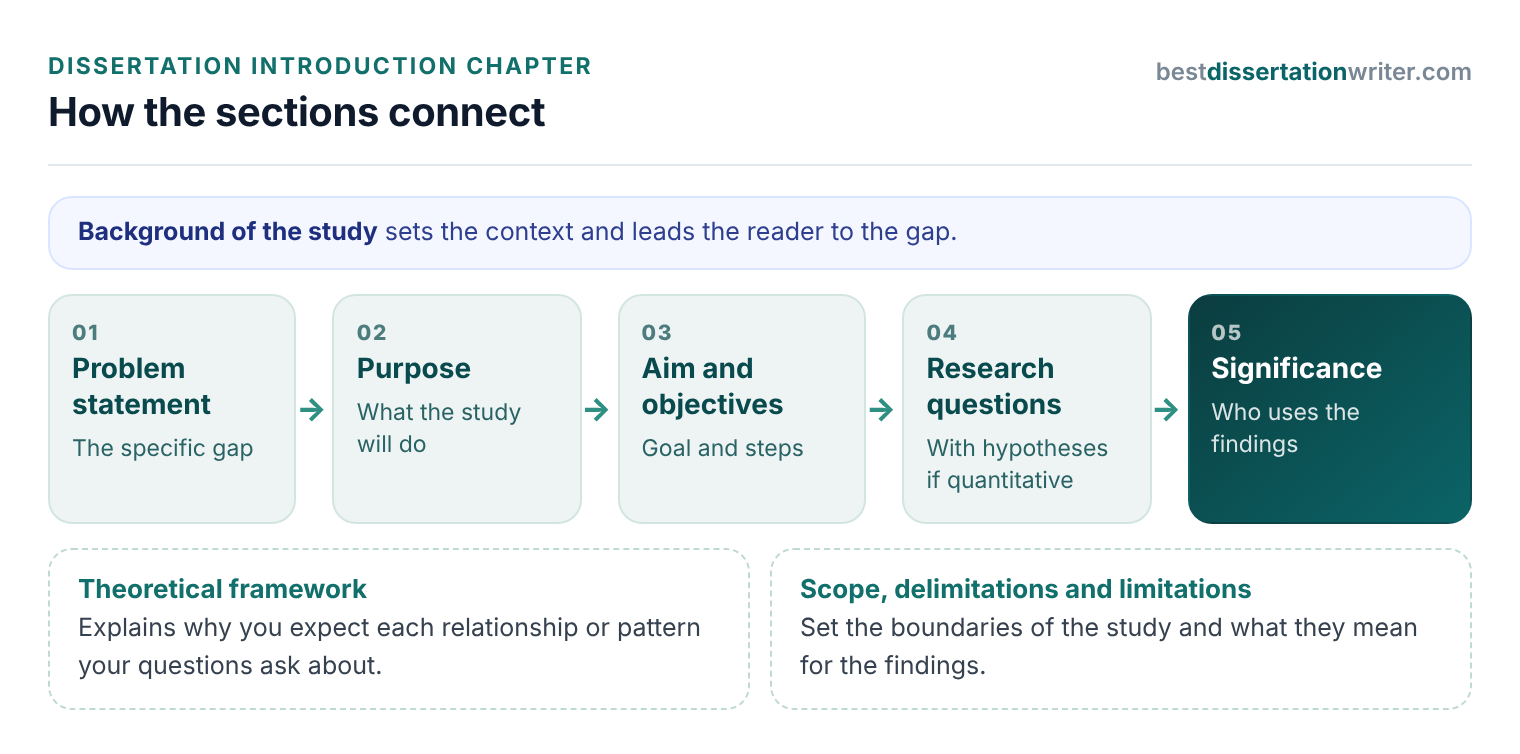
A useful check is to read your problem statement, purpose and research questions one after another. If the same key concepts, population and setting appear in all three, your chapter is aligned.
How Research Design Changes the Chapter
Your design shapes several sections. Quantitative studies pair each research question with a hypothesis, qualitative studies use open “how” and “what” questions, and mixed methods studies usually include both.
The full examples on this page cover all three designs, plus one conceptual study, so you can compare how each section changes.
Common Mistakes in the Introduction Chapter
- A vague problem: describing a topic instead of naming a specific gap.
- Misaligned questions: research questions that do not follow from the purpose statement.
- Theory as decoration: naming a theory without explaining how it shapes the questions.
- Too much literature: turning the background into a full literature review, which belongs in Chapter 2.
Write It Early, Revise It Last
Draft the introduction early to guide your study, then revise it once your results and conclusion are written so it matches the dissertation you completed.
Before you submit, reread the problem statement, purpose and research questions together and make sure they still match your findings.
FAQs
Frequently asked questions
Quick answers to the questions students ask most about the dissertation introduction chapter.
Still have a question?
Our writers can review your draft or write the section with you.
Ask an expertWhat are the main sections of a dissertation introduction chapter?
Most introduction chapters include the background of the study, the problem statement, the purpose of the study, research aims and objectives, research questions or hypotheses, the significance of the study and the theoretical framework. Many also cover scope, delimitations, limitations, assumptions and definitions of key terms.
The exact list depends on your university, your field and your research design. Check your program handbook first, then use the guides on this page to write each required section in the order your handbook sets out.
In what order should I write the introduction chapter sections?
A practical order is to start with the problem statement, because every other section depends on it. Then write the purpose, aim and objectives, and research questions, so the core of the chapter is aligned before you add anything else.
Next, draft the background to lead up to that problem, followed by the significance and theoretical framework. Finish with the scope, delimitations and limitations. You can still present the sections in your handbook’s order; this is only the order in which they are easiest to write.
How long should a dissertation introduction chapter be?
There is no single correct length. It depends on your degree level, discipline and university, and many programs set a target range for each chapter in their handbook or guidelines.
Focus on covering every required section clearly rather than on a word count. A doctoral introduction is usually more detailed than a master’s or undergraduate one, especially in the background and theoretical framework. If you are unsure, ask your supervisor for the expected range and look at recent dissertations from your department.
What is the difference between the introduction and the literature review?
The introduction chapter sets up your study. It gives enough background to show why the problem matters, states the gap and explains what your study will do, citing only the key sources needed to make that case.
The literature review, usually Chapter 2, analyzes the research in depth. It compares studies, evaluates methods and builds a detailed argument for the gap. If your background section starts comparing many studies in detail, move that material into your literature review and keep the introduction focused.
Keep going
Other dissertation chapters
Best Dissertation Writers
Need help writing your dissertation introduction?
Our expert writers can help you draft your background, problem statement, purpose and research questions to your brief.