

The Effect of Minimum Wage Increases on Small Business Hiring Practices in Metropolitan Labor Markets
 By Dr. Robertson Prime, Research Fellow
Updated October 24, 2026
18 min read
About 3,600 words
By Dr. Robertson Prime, Research Fellow
Updated October 24, 2026
18 min read
About 3,600 words
This dissertation introduction example examines how minimum wage increases affect hiring among small businesses in metropolitan labor markets. It is a complete Chapter 1 for an explanatory sequential mixed-methods study built around a difference-in-differences design.
Every reference in the chapter has been checked against its published source. The breakdown near the end shows how an economics introduction handles a contested literature and a causal design.
On this page
What this example shows
- A focused gap: the study looks at small firms rather than the labor market as a whole.
- A causal design: difference-in-differences compares areas with and without recent increases.
- Sector differences: industry is tested as a moderator, with food service and retail expected to differ.
- Owners explain: interviews describe the adjustments behind the numbers.
Background of the Study: Minimum Wage and Small Business Hiring
Introduction
Minimum wage policy remains one of the most extensively studied yet persistently contested areas of labor economics, with decades of empirical research yielding divergent conclusions regarding whether minimum wage increases meaningfully reduce employment among the low-wage workers such policies are designed to benefit (Card & Krueger, 2015; Neumark & Wascher, 2008).
While much of this literature has examined aggregate employment effects across entire labor markets, comparatively less attention has been directed toward how wage increases specifically shape the hiring practices of small businesses, which operate with narrower profit margins, more limited access to capital, and less capacity to absorb labor cost increases than larger firms, and which constitute a disproportionate share of employment in many metropolitan low-wage labor markets (Dube et al., 2010).
This chapter introduces the background, problem, purpose, and design of a mixed-methods study examining the effect of wage increases on small business hiring practices in metropolitan labor markets.
Background of the Study
Card and Krueger’s (1994) influential study of fast-food employment following New Jersey’s minimum wage increase challenged the traditional competitive labor market prediction that minimum wage increases necessarily reduce employment, finding no significant negative employment effect relative to a comparison group of Pennsylvania restaurants, a finding subsequently replicated and extended across a range of settings using the county-pairs methodology developed by Dube, Lester, and Reich (2010), which similarly found minimal employment effects across contiguous county borders with differing minimum wage levels.
Cengiz et al. (2019) extended this line of research using a bunching estimator applied to the full distribution of the wage distribution, finding that job losses at the bottom of the wage distribution following wage increases were largely offset by wage gains for workers who retained employment, with minimal net employment effects across a broad range of state-level minimum wage changes.
At the same time, an important body of research employing alternative methodologies has reached considerably more cautionary conclusions.
Neumark and Wascher’s (2008) extensive review of the minimum wage employment literature concluded that the preponderance of well-identified studies find negative employment effects, particularly among younger and less-skilled workers, and Jardim et al.’s (2018) study of Seattle’s phased minimum wage increase to fifteen dollars found evidence of reduced hours worked among low-wage employees, even as average earnings per employee increased, suggesting that employer responses to substantial minimum wage increases may operate through hours reduction rather than, or in addition to, headcount reduction.
Meer and West (2016) similarly found that wage increases were associated with reduced employment growth rates over time, an effect that traditional short-run studies focused on immediate employment levels may be poorly positioned to detect.
A smaller but growing body of research has specifically examined firm size as a moderator of minimum wage employment effects, with Harasztosi and Lindner (2019) finding, in the context of a large Hungarian minimum wage increase, that firms exhibited meaningfully different capacity to pass increased labor costs through to prices, with smaller and less profitable firms exhibiting greater employment sensitivity to minimum wage increases than larger, more capitalized firms.
Allegretto and Reich (2018) similarly found that heterogeneity in employer responses to wage increases, including adjustments to hiring pace, employee turnover, and non-wage compensation, varied meaningfully by firm size and industry sector within the metropolitan labor markets they examined.
Despite this growing recognition that firm size may condition minimum wage employment effects, relatively few studies have combined rigorous quantitative analysis of small business hiring outcomes with qualitative exploration of the specific operational and financial decision-making processes through which small business owners respond to wage increases (Aaronson & French, 2007; Giuliano, 2013).
Problem Statement and Purpose of the Study
Statement of the Problem
Despite an extensive minimum wage employment literature, it remains unclear whether minimum wage increases produce meaningfully different hiring effects among small businesses specifically, as opposed to the broader metropolitan labor market examined in aggregate, and which specific operational adjustments, reduced hiring pace, reduced hours, increased automation, or price pass-through, small business owners rely upon in response to increased labor costs (Dube et al., 2010; Harasztosi & Lindner, 2019).
Existing quantitative research has frequently examined aggregate or industry-level employment effects without adequately isolating small business hiring practices as a distinct unit of analysis, while qualitative research capturing small business owners’ own decision-making processes in response to wage increases remains comparatively limited (Allegretto & Reich, 2018).
This gap in the literature is problematic because municipal and state policymakers currently lack clear, empirically grounded guidance regarding whether minimum wage policy design, including phase-in schedules, small business exemptions, or tax credit offsets, should be differentiated to account for small businesses’ distinct cost structures and hiring capacity, and because small business advocacy organizations and labor economists frequently offer conflicting characterizations of minimum wage impact that are not adequately reconciled by the existing aggregate-level evidence (Neumark & Wascher, 2008; Meer & West, 2016).
Without integrated, mixed-methods evidence connecting small business hiring outcomes to owners’ own operational decision-making, policymakers risk designing minimum wage policy without a clear understanding of its differential impact on the small business segment of metropolitan labor markets (Jardim et al., 2018).
Purpose of the Study
The purpose of this explanatory sequential mixed-methods study is to examine the effect of minimum wage increases on small business hiring outcomes in metropolitan labor markets, and to explore how small business owners themselves describe and explain their hiring and operational responses to wage increases.
In the first, quantitative phase, employment and hiring data from small businesses, defined as firms with fewer than 50 employees, will be examined across metropolitan areas that have implemented wage increases, using a comparison group of similar metropolitan areas without recent minimum wage changes.
In the second, qualitative phase, a purposive sample of small business owners will participate in semi-structured interviews exploring the specific operational decisions underlying the quantitative hiring patterns identified in phase one.

Research Questions and Hypotheses
RQ1. Do small businesses in metropolitan areas that have implemented minimum wage increases exhibit significantly different hiring growth rates than comparable small businesses in metropolitan areas without recent minimum wage increases?
H1. Small businesses in metropolitan areas with recent minimum wage increases will exhibit significantly lower hiring growth rates than small businesses in comparison metropolitan areas.
RQ2. Does industry sector significantly moderate the relationship between minimum wage increases and small business hiring growth?
H2. The relationship between minimum wage increases and hiring growth will differ significantly across industry sectors, with food service and retail sectors exhibiting a significantly larger negative relationship than professional service sectors.
RQ3. How do small business owners describe the specific operational adjustments they make in response to minimum wage increases, and what factors do they identify as shaping their hiring decisions?
Significance and Theoretical Framework
Significance of the Study
This study carries significance for labor economics theory, small business policy, and municipal wage policy design.
Theoretically, the study extends the firm-heterogeneity strand of minimum wage research by directly isolating small business hiring outcomes as a distinct unit of analysis and testing industry sector as a moderator of minimum wage employment effects within that population specifically, addressing a gap left by studies that examine aggregate or industry-undifferentiated employment effects (Harasztosi & Lindner, 2019; Allegretto & Reich, 2018).
Practically, findings may directly inform how municipalities and states design minimum wage policy, providing evidence-based guidance regarding whether phase-in schedules, small business tax credits, or sector-specific provisions should be incorporated to mitigate disproportionate impact on small business hiring capacity.
Given that small businesses constitute a substantial share of employment in most metropolitan labor markets and are frequently cited by both proponents and opponents of minimum wage increases, evidence clarifying the actual magnitude and mechanism of small business hiring response carries substantial relevance for policymakers, small business advocacy organizations, and labor economists alike (Dube et al., 2010).
More broadly, the qualitative phase of this study contributes owner-centered accounts that can inform the design of small business support programs accompanying future minimum wage policy changes (Giuliano, 2013).
Theoretical Framework
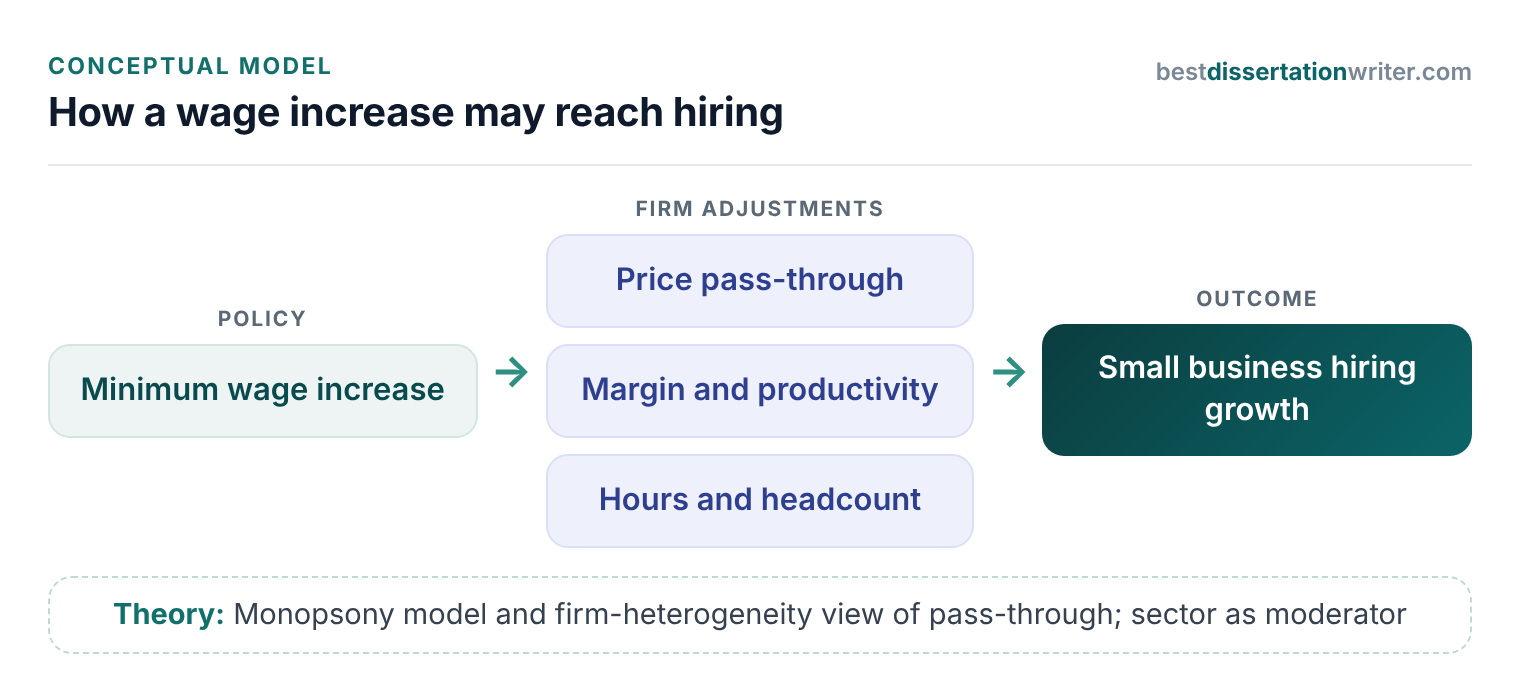
This study is grounded primarily in the monopsony model of labor markets, which departs from the traditional competitive labor market prediction that minimum wage increases necessarily reduce employment, proposing instead that employers with wage-setting power may respond to wage increases with minimal or even positive employment effects up to a certain threshold, a model consistent with the empirical findings of Card and Krueger (1994) and subsequent county-pairs research (Dube et al., 2010).
This framework provides the theoretical basis for hypothesizing that minimum wage employment effects may vary systematically depending on firm-level labor market power, a characteristic plausibly correlated with firm size.
This monopsony framework is paired with a firm-heterogeneity perspective on labor cost pass-through, as articulated by Harasztosi and Lindner (2019), which proposes that firms differ meaningfully in their capacity to absorb increased labor costs through price pass-through, profit margin compression, productivity gains, or hours and headcount adjustment, with smaller and less capitalized firms generally possessing less capacity to absorb costs through channels other than employment adjustment.
Integrating these two frameworks allows the study to test whether small businesses, as a population plausibly possessing less monopsony power and less cost-absorption capacity than larger firms, exhibit hiring responses to minimum wage increases that differ systematically from the more muted aggregate effects documented in prior labor market research (Meer & West, 2016).
Nature of the Study, Key Terms, Assumptions and Limitations
Nature of the Study
This study will employ an explanatory sequential mixed-methods design, in which quantitative employment data are collected and analyzed first, followed by a qualitative interview phase designed to explain and contextualize the quantitative findings (Creswell & Creswell, 2023).
The quantitative phase will employ a difference-in-differences design comparing small business hiring growth in a set of metropolitan areas that implemented minimum wage increases within the preceding three years against a matched set of comparison metropolitan areas without recent minimum wage changes, using establishment-level employment data disaggregated by firm size and industry sector.
In the quantitative phase, hiring growth, employee hours, and turnover data will be analyzed using difference-in-differences regression to estimate the causal effect of minimum wage increases on small business hiring outcomes, with industry sector included as a moderating variable.
In the qualitative phase, a purposive sample of 12 to 15 small business owners operating in the treatment metropolitan areas, selected to represent a range of industry sectors and post-increase hiring trajectories, will participate in semi-structured interviews, which will be analyzed using thematic analysis to identify recurring patterns in how owners describe their operational and hiring responses to wage increases.
Definitions of Key Terms
Small business: A firm employing fewer than 50 workers, consistent with common thresholds used in labor market research examining firm-size heterogeneity in employment response (Harasztosi & Lindner, 2019).
Minimum wage increase: A legislated or voter-approved increase in the statutory hourly wage floor applicable to covered employers within a given jurisdiction (Card & Krueger, 2015).
Hiring growth rate: The net rate of change in an establishment’s employee headcount over a defined period, typically measured using administrative employment data (Cengiz et al., 2019).
Monopsony power: The degree to which an employer possesses wage-setting power in a local labor market due to limited competition among employers for workers, allowing the employer to pay wages below the competitive market rate absent a wage floor (Dube et al., 2010).
Labor cost pass-through: The extent to which an employer transfers increased labor costs to consumers through higher prices, rather than absorbing those costs through reduced profit margins or reduced employment (Harasztosi & Lindner, 2019).
Metropolitan labor market: A geographically bounded labor market, typically corresponding to a metropolitan statistical area, within which employers and workers are assumed to interact under broadly similar economic conditions (Meer & West, 2016).
Assumptions
This study operates under several assumptions. It is assumed that administrative employment data accurately capture small business hiring, hours, and turnover patterns, and that any measurement limitations in this data do not systematically differ between treatment and comparison metropolitan areas.
It is assumed that the selected comparison metropolitan areas provide an adequate counterfactual for estimating the causal effect of minimum wage increases, absent other confounding policy or economic differences between treatment and comparison areas (Dube et al., 2010).
It is further assumed that small business owner interview participants will be willing and able to accurately describe the operational and hiring decisions they made in response to wage increases, and that these self-reported accounts meaningfully reflect the actual decision-making processes underlying the quantitative hiring patterns observed.
Scope and Delimitations
The scope of this study is delimited to small businesses, defined as firms with fewer than 50 employees, operating within metropolitan statistical areas that have implemented a minimum wage increase within the preceding three years, and does not extend to large firms, rural labor markets, or minimum wage changes implemented more than three years prior to the study period.
The study is further delimited to hiring, hours, and turnover outcomes and does not examine other potential employer responses such as automation investment or benefit restructuring in quantitative depth, although these are explored to the extent they arise within qualitative interviews.
The study examines minimum wage increases implemented through standard legislative or ballot-initiative processes and does not examine emergency or temporary wage mandates (Cengiz et al., 2019).
Limitations
Several limitations should be acknowledged. The difference-in-differences design, while methodologically strong, cannot fully rule out the influence of unobserved local economic shocks that coincide with minimum wage implementation and differentially affect treatment and comparison metropolitan areas.
Reliance on establishment-level administrative data may not fully capture informal employment adjustments, such as reduced overtime availability or altered scheduling practices, that small businesses may use in response to minimum wage increases (Jardim et al., 2018).
The three-year post-implementation window may be insufficient to capture longer-run adjustment processes such as gradual automation adoption or business exit, which prior research suggests may unfold over a longer time horizon (Meer & West, 2016).
Finally, the qualitative sample, while purposively selected for range, cannot be assumed to represent the full diversity of small business owner experience across all industry sectors and metropolitan contexts examined in the quantitative phase.
Summary
This chapter introduced the background, problem, purpose, and theoretical grounding of a proposed mixed-methods study examining the effect of minimum wage increases on small business hiring practices in metropolitan labor markets.
While the broader minimum wage employment literature remains divided, with some research finding minimal aggregate employment effects and other research finding more pronounced effects, particularly using firm-size-differentiated and long-run methodologies, this literature has not been sufficiently integrated with owner-centered qualitative evidence to clarify the specific mechanisms through which small businesses respond to wage increases.
Grounded in the monopsony model of labor markets and a firm-heterogeneity perspective on labor cost pass-through, this explanatory sequential mixed-methods study aims to clarify whether, and through what specific operational mechanisms, wage increases shape small business hiring in metropolitan labor markets, with implications for wage policy design, small business support, and labor economics theory.
Chapter Two will present a comprehensive review of the existing literature on minimum wage employment effects, firm-size heterogeneity, and small business labor cost adjustment, further situating this study within its scholarly context.
References
Aaronson, D., & French, E. (2007). Product market evidence on the employment effects of the minimum wage. Journal of Labor Economics, 25(1), 167–200.
Allegretto, S., & Reich, M. (2018). Are local minimum wages absorbed by price increases? Estimates from Internet-based restaurant menus. ILR Review, 71(1), 35–63.
Card, D., & Krueger, A. B. (1994). Minimum wages and employment: A case study of the fast-food industry in New Jersey and Pennsylvania. American Economic Review, 84(4), 772–793.
Card, D., & Krueger, A. B. (2015). Myth and measurement: The new economics of the minimum wage (20th anniversary ed.). Princeton University Press.
Cengiz, D., Dube, A., Lindner, A., & Zipperer, B. (2019). The effect of minimum wages on low-wage jobs. Quarterly Journal of Economics, 134(3), 1405–1454.
Creswell, J. W., & Creswell, J. D. (2023). Research design: Qualitative, quantitative, and mixed methods approaches (6th ed.). SAGE Publications.
Dube, A., Lester, T. W., & Reich, M. (2010). Minimum wage effects across state borders: Estimates using contiguous counties. Review of Economics and Statistics, 92(4), 945–964.
Giuliano, L. (2013). Minimum wage effects on employment, substitution, and the teenage labor supply: Evidence from personnel data. Journal of Labor Economics, 31(1), 155–194.
Harasztosi, P., & Lindner, A. (2019). Who pays for the minimum wage? American Economic Review, 109(8), 2693–2727.
Jardim, E., Long, M. C., Plotnick, R., van Inwegen, E., Vigdor, J., & Wething, H. (2018). Minimum wage increases and individual employment trajectories. National Bureau of Economic Research Working Paper No. 25182.
Meer, J., & West, J. (2016). Effects of the minimum wage on employment dynamics. Journal of Human Resources, 51(2), 500–522.
Neumark, D., & Wascher, W. (2008). Minimum wages. MIT Press.
Why This Minimum Wage Dissertation Introduction Example Works
Few economics topics are as debated as the minimum wage, so the introduction must show exactly where a new study fits. This example does that in four ways.
- A narrow, defensible gap: Rather than re-arguing whether minimum wages reduce employment, the chapter asks how small firms in particular respond.
- Theory on both sides: The monopsony model explains why effects may be small, and the pass-through perspective explains why small firms may differ.
- Causal design explained: The nature of the study describes the difference-in-differences comparison in plain terms, including its treatment and comparison areas.
- Known threats named: The limitations admit that local economic shocks could coincide with wage increases and bias the estimates.
Problem statement: weak vs. strong
Weak
“Economists disagree about the minimum wage, so more research is needed.”
Disagreement alone is not a gap, and this does not say what a new study would add.
Strong
“It remains unclear whether minimum wage increases produce different hiring effects among small businesses specifically, as opposed to the broader metropolitan labor market examined in aggregate.”
This names the population that has been overlooked and the precise comparison the study will make.
How to Adapt This Structure
In a contested field, summarize the competing positions briefly in the background, then narrow to the specific group or setting your study adds. If you use a causal design, explain your comparison group in plain language.
For section-by-section guidance, see how to write a problem statement, the background of the study and the limitations of the study. You can compare this chapter with the community health workers and chronic disease example, browse all dissertation introduction examples, or return to the how to write a dissertation hub.
The University of Leeds Library also keeps a collection of dissertation examples by subject.
FAQs About This Minimum Wage Dissertation Introduction
What is a difference-in-differences design?
Difference-in-differences compares the change in an outcome over time in a group affected by a policy with the change in a similar group that was not affected. The difference between those two changes estimates the policy’s effect.
In this example, metropolitan areas with recent minimum wage increases are compared with matched areas without them. The design is stronger than a simple before-and-after comparison, but it still depends on both groups following similar trends before the policy began. The chapter therefore needs a matched comparison group that is as similar as possible to the treatment areas.
What is the monopsony model of the labor market?
In a monopsony, employers have some power to set wages because workers have limited alternatives. Under those conditions, a modest minimum wage increase may not reduce employment and can even raise it.
This example uses the monopsony model to explain why earlier studies often found small employment effects. Pairing it with a view of how firms absorb labor costs lets the chapter argue that small businesses may still respond differently from larger employers. Presenting both theories also shows that the study engages fairly with both sides of the debate.
Why add interviews to an economics dissertation?
Employment data can show whether hiring changed, but not how owners made their decisions. Interviews reveal the adjustments behind the numbers, such as raising prices, cutting hours or delaying hiring.
This example selects owners from treatment areas across sectors and hiring patterns. Their accounts help explain the quantitative results and make the findings more useful for policymakers designing support for small businesses when the minimum wage rises. Mixed methods are less common in economics, so explaining the reason for interviews is especially important.
Best Dissertation Writers
Want an introduction chapter like this for your topic?
Get a custom Chapter 1 written around your research problem, field and deadline.