The Role of Community Health Workers in Reducing Disparities in Chronic Disease Management Among Low-Income Populations
 By Dr. Robertson Prime, Research Fellow
Updated October 24, 2026
19 min read
About 3,800 words
This dissertation introduction example examines how community health workers help low-income adults manage diabetes and hypertension. It is a complete Chapter 1 for an explanatory sequential mixed-methods study at a federally qualified health center.
Every reference in the chapter has been checked against its published source. The breakdown near the end shows how a public health introduction combines clinical outcomes with patients’ own explanations.
On this page
What this example shows
- A comparison group: enrolled patients are compared with matched patients receiving usual care.
- Clinical outcomes: hemoglobin A1c and blood pressure come from health records, not self-report.
- Program components: care coordination, health education and social support are tested separately.
- Patient explanations: interviews ask how the relationship with community health workers changed self-management.
Background of the Study: Community Health Workers and Chronic Disease
Introduction
Chronic diseases such as diabetes, hypertension, and cardiovascular disease disproportionately burden low-income populations, who experience not only higher prevalence rates but also poorer disease control, more frequent hospitalizations, and higher mortality than higher-income patients managing the same conditions (Peretz et al., 2020).
A substantial share of this disparity has been attributed not to differences in disease severity but to well-documented barriers in access, health literacy, and trust that limit low-income patients’ engagement with conventional clinical care between office visits (Viswanathan et al., 2010).
Community health workers, frontline public health workers who are trusted members of, or have an unusually close understanding of, the community they serve, have increasingly been deployed as a bridge between clinical systems and underserved communities, yet the specific mechanisms and conditions under which their involvement measurably improves chronic disease outcomes remain incompletely specified in the literature (Kangovi et al., 2020; WHO, 2018).
This chapter introduces the background, problem, purpose, and design of a mixed-methods study examining the role of community health workers in reducing disparities in chronic disease management among low-income populations.
Background of the Study
The community health worker model has a long international history, originating in low-resource global health settings before being formally adapted into United States public health practice, where it has expanded substantially over the past two decades in response to growing recognition that clinical encounters alone are insufficient to manage chronic disease in socially and economically disadvantaged populations (Rosenthal et al., 2010).
The Health Resources and Services Administration’s national workforce study characterized community health workers as occupying a unique position between formal health systems and community members, using shared language, lived experience, and cultural understanding to provide health education, care coordination, and social support that licensed clinical staff are often poorly positioned to deliver (Rush, 2012).
A substantial body of intervention research has documented favorable associations between involvement of community health workers and chronic disease outcomes, including improved glycemic control among patients with diabetes, better blood pressure control among patients with hypertension, and increased rates of medication adherence and preventive screening (Kim et al., 2016; Islam et al., 2015).
Kangovi et al. (2020) found that a standardized community health worker intervention emphasizing patient-defined goals and structured relationship-building significantly improved primary care access and chronic disease control among low-income patients relative to usual care, while also identifying core structural elements, adequate supervision, manageable caseloads, and clearly defined scope of practice, associated with intervention fidelity and effectiveness.
At the same time, other reviews have noted considerable heterogeneity in intervention design, outcome measurement, and program duration across the community health worker literature, making it difficult to draw firm conclusions about which specific program features drive the disparities-reduction effects most consistently observed (Viswanathan et al., 2010; O’Brien et al., 2009).
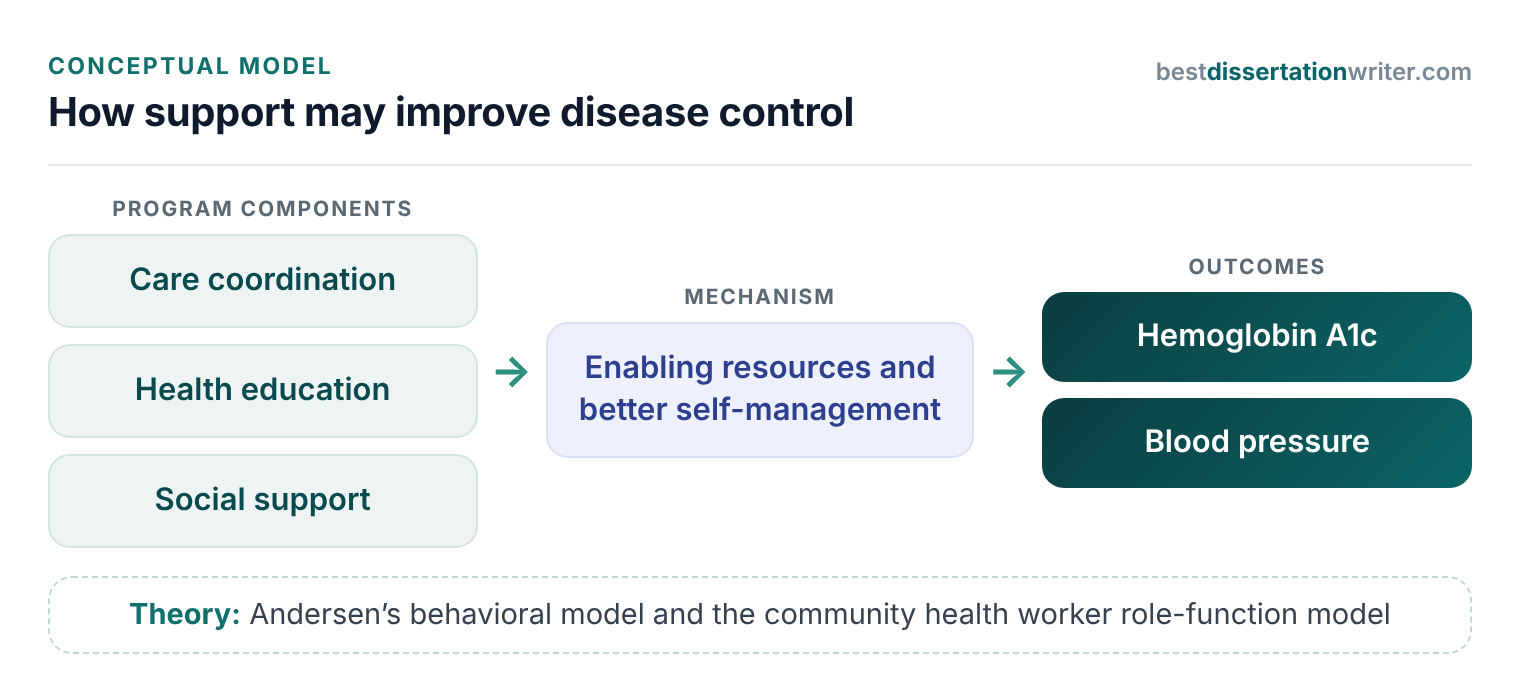
Andersen’s behavioral model of health services use offers one theoretical account of how community health workers may operate on chronic disease disparities, proposing that healthcare utilization and outcomes are jointly shaped by predisposing factors, enabling resources, and perceived need, with community health workers plausibly functioning as an enabling resource that reduces the practical, informational, and trust-related barriers low-income patients face in accessing and sustaining chronic disease self-management behaviors (Andersen, 1995).
Despite this theoretical grounding, relatively few studies have combined rigorous outcome measurement with qualitative exploration of how low-income patients themselves experience support from community health workers, leaving open questions about which specific relational and logistical mechanisms most directly account for observed improvements in disease management (Balcazar et al., 2011; Findley et al., 2014).
Problem Statement and Purpose of the Study
Statement of the Problem
Despite two decades of expanding community health worker programming, chronic disease disparities between low-income and higher-income patients persist, and it remains unclear which specific components of community health worker intervention, care coordination, health education, social support, or advocacy, most directly contribute to improved chronic disease management outcomes among low-income populations (Peretz et al., 2020; Viswanathan et al., 2010).
Existing evaluations of programs that employ community health workers have frequently varied widely in design, dosage, and outcome measurement, and few have paired quantitative outcome data with patient-reported accounts of the mechanisms through which support from community health workers influenced their disease self-management, leaving healthcare systems without clear guidance on how to structure these programs for maximal disparities-reduction impact (O’Brien et al., 2009; Rosenthal et al., 2010).
This gap in the literature is problematic because health systems and payers are increasingly investing in programs that employ community health workers as a cost-effective disparities-reduction strategy without a precise understanding of which program elements are responsible for observed effects, risking the implementation or continued funding of program models that are less effective than alternative configurations, or the premature discontinuation of programs whose benefits are not adequately captured by existing outcome metrics (Kangovi et al., 2020; Ingram et al., 2007).
Purpose of the Study
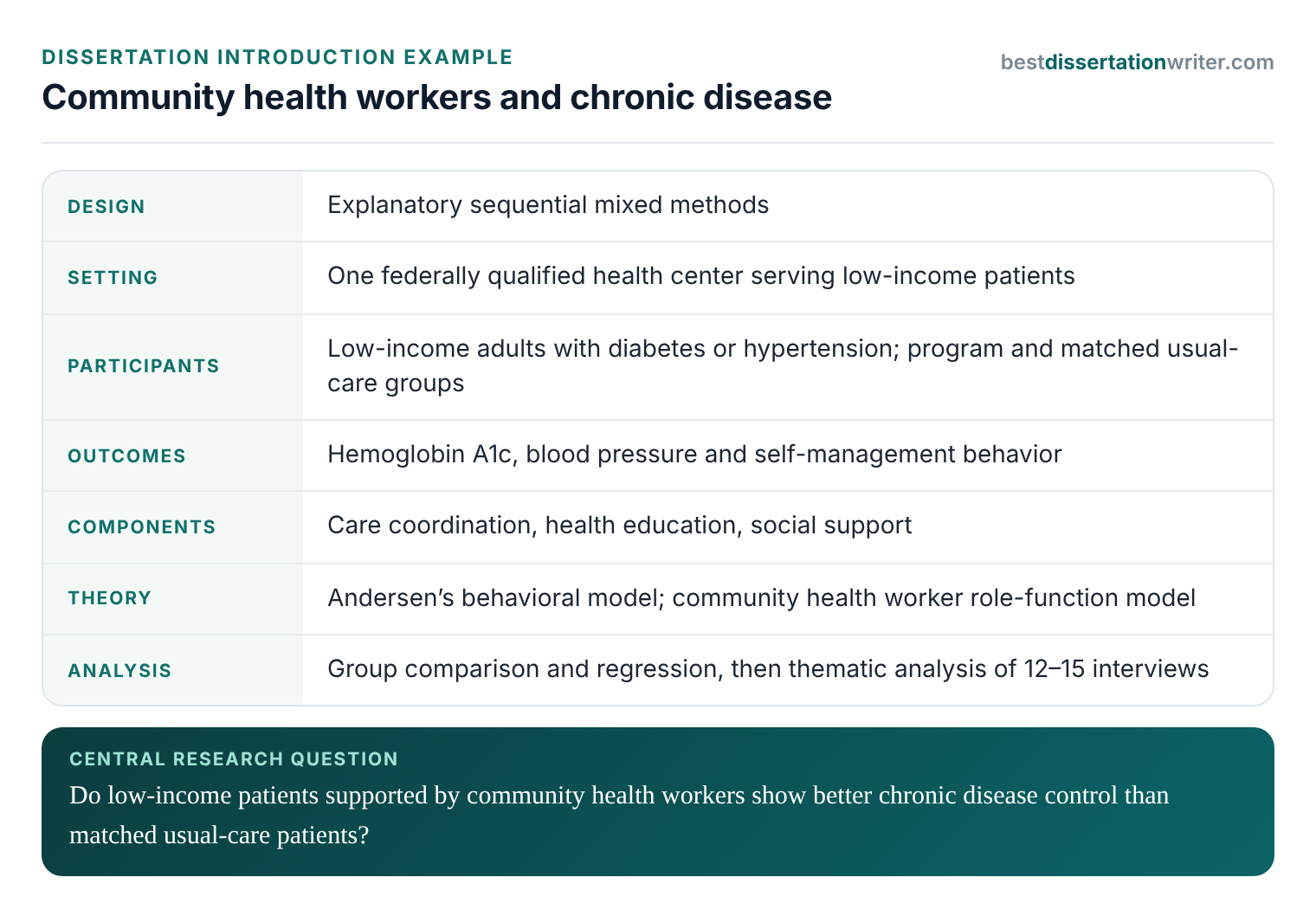
The purpose of this explanatory sequential mixed-methods study is to examine the relationship between involvement of community health workers and chronic disease management outcomes among low-income adults with diabetes or hypertension, and to explore how patients themselves experience and attribute value to specific components of support from community health workers.
In the first, quantitative phase, clinical outcome data and patient-reported self-management behaviors will be compared between low-income patients enrolled in a community health worker program and a matched comparison group receiving usual care.
In the second, qualitative phase, a purposive subsample of enrolled patients will participate in semi-structured interviews exploring their perceptions of the community health worker relationship and its influence on their disease management.
Research Questions and Hypotheses
RQ1. Do low-income patients enrolled in a community health worker program demonstrate significantly improved chronic disease control, measured by hemoglobin A1c or blood pressure, relative to a matched usual-care comparison group?
H1. Patients enrolled in the community health worker program will demonstrate significantly greater improvement in disease-specific clinical indicators than patients receiving usual care.
RQ2. Do specific community health worker program components, care coordination, health education, and social support, differentially predict improvement in patient-reported self-management behavior?
H2. Care coordination and social support will each independently and significantly predict improvement in self-management behavior, over and above the variance explained by baseline disease severity and sociodemographic characteristics.
RQ3. How do low-income patients describe the mechanisms through which their relationship with a community health worker influenced their chronic disease self-management and engagement with the healthcare system?
Significance and Theoretical Framework
Significance of the Study
This study carries significance for health services research, community health worker program design, and health equity policy.
Theoretically, the study extends Andersen’s behavioral model of health services use by empirically testing involvement of community health workers as a specific enabling resource that reduces access and trust barriers among low-income patients, and by identifying which discrete program components most directly account for improved disease management within that framework (Andersen, 1995).
Practically, findings may directly inform how health systems structure and fund programs that employ community health workers, providing evidence-based guidance regarding which program components, care coordination, structured health education, or relationship-based social support, most warrant prioritization when resources are constrained (Kangovi et al., 2020).
Given the accelerating adoption of community health worker models within value-based care and Medicaid managed care arrangements, evidence clarifying which program features most reliably reduce chronic disease disparities carries substantial relevance for healthcare payers and policymakers (Rosenthal et al., 2010).
More broadly, the qualitative phase of this study contributes patient-centered accounts that can inform community health worker training curricula and supervision models grounded in what patients themselves identify as most valuable (Wennerstrom et al., 2015).
Theoretical Framework
This study is grounded primarily in Andersen’s (1995) behavioral model of health services use, which proposes that healthcare utilization and health outcomes are jointly determined by predisposing factors such as demographic and social structure characteristics, enabling resources such as income, insurance, and access to supportive services, and perceived need for care, with the model positing that interventions targeting enabling resources can meaningfully improve outcomes even when predisposing factors remain unchanged.
This framework provides the theoretical basis for conceptualizing support from community health workers as an enabling resource that operates on chronic disease outcomes by reducing practical and informational barriers to sustained self-management.
This behavioral framework is paired with the community health worker role-function model articulated by Rosenthal et al. (2010) and Rush (2012), which characterizes community health worker impact as operating through a combination of cultural mediation, informal counseling and social support, care coordination and system navigation, and individual and community capacity building.
Integrating these two frameworks allows the study to test not only whether involvement of community health workers predicts improved chronic disease outcomes in aggregate, but which of these specific role functions most directly accounts for the disparities-reduction effect observed among low-income patients (Balcazar et al., 2011).
Nature of the Study, Key Terms, Assumptions and Limitations
Nature of the Study
This study will employ an explanatory sequential mixed-methods design, in which quantitative clinical and self-report data are collected and analyzed first, followed by a qualitative interview phase designed to explain and contextualize the quantitative findings (Creswell & Creswell, 2023).
Participants will be recruited from a federally qualified health center serving a predominantly low-income patient population, comparing patients enrolled in an existing community health worker program with a matched comparison group of patients receiving usual chronic disease care at the same clinic.
In the quantitative phase, clinical outcome data, including hemoglobin A1c and blood pressure readings, will be extracted from electronic health records at baseline and at a six-month follow-up, alongside a validated patient self-management behavior scale and a measure of specific community health worker program components received.
Data will be analyzed using multiple regression and repeated-measures comparison to test the predictive relationship between program enrollment and component-specific involvement on clinical and behavioral outcomes, controlling for relevant demographic and baseline severity variables.
In the qualitative phase, a purposive sample of 12 to 15 enrolled patients representing a range of outcome trajectories will participate in semi-structured interviews, which will be analyzed using thematic analysis to identify recurring patterns in how patients describe the mechanisms of community health worker influence on their self-management.
Definitions of Key Terms
Community health worker: A frontline public health worker who is a trusted member of, or has an unusually close understanding of, the community served, and who serves as a liaison between health and social services and the community to facilitate access and improve service delivery (Rosenthal et al., 2010).
Chronic disease management: The ongoing set of clinical, behavioral, and self-monitoring activities involved in controlling a long-term health condition such as diabetes or hypertension, encompassing medication adherence, lifestyle modification, and regular clinical follow-up (Islam et al., 2015).
Health disparity: A preventable difference in the burden of disease, injury, or opportunity to achieve optimal health experienced by socially disadvantaged populations relative to more advantaged groups (Peretz et al., 2020).
Enabling resource: A structural or social factor, such as income, insurance status, or access to supportive services, that facilitates or constrains an individual’s ability to obtain and sustain use of health services (Andersen, 1995).
Care coordination: The deliberate organization of patient care activities and information sharing among participants involved in a patient’s care to achieve safer and more effective service delivery (Kangovi et al., 2020).
Low-income population: Individuals or households whose income falls at or below a defined threshold, typically 200% of the federal poverty level, that is associated with reduced access to healthcare resources and increased chronic disease burden (Viswanathan et al., 2010).
Assumptions
This study operates under several assumptions. It is assumed that electronic health record data accurately capture patients’ clinical indicators at baseline and follow-up, and that any missing or incomplete records do not systematically differ between the community health worker and comparison groups.
It is assumed that patients’ self-reported disease management behaviors and their reports of specific program components received reasonably reflect their actual experience of the intervention (Kim et al., 2016).
It is further assumed that the matched comparison group, while not randomly assigned, provides an adequate counterfactual for estimating program effects, and that interview participants will be willing and able to articulate the specific mechanisms through which their relationship with a community health worker influenced their self-management behavior.
Scope and Delimitations
The scope of this study is delimited to low-income adult patients with a diagnosis of diabetes or hypertension who are receiving care at a single federally qualified health center, and does not extend to pediatric populations, other chronic conditions, or patients receiving care in private or hospital-based settings.
The study is further delimited to a single community health worker program model already in operation at the study site, and does not compare outcomes across multiple distinct program models or staffing structures.
The study examines clinical and self-management outcomes over a six-month follow-up period and does not assess longer-term outcomes such as hospitalization rates or mortality, which are acknowledged as theoretically downstream of the outcomes examined (Findley et al., 2014).
Limitations
Several limitations should be acknowledged. The single-site design limits the generalizability of findings to programs that employ community health workers operating in different healthcare systems, geographic regions, or funding structures.
The use of a matched, non-randomized comparison group introduces the possibility of unobserved selection effects that could bias estimates of program impact, despite efforts to match on observable baseline characteristics (O’Brien et al., 2009).
Reliance on patient self-report for both self-management behavior and program component exposure introduces the possibility of recall and social desirability bias, and the six-month follow-up window may be insufficient to capture the full trajectory of chronic disease improvement associated with sustained support from community health workers.
Finally, the qualitative sample, while purposively selected for range, cannot be assumed to represent the full diversity of patient experience within the program, and findings regarding mechanism should be interpreted as illustrative rather than exhaustive (Wennerstrom et al., 2015).
Summary
This chapter introduced the background, problem, purpose, and theoretical grounding of a proposed mixed-methods study examining the role of community health workers in reducing disparities in chronic disease management among low-income populations.
While existing research has documented generally favorable associations between involvement of community health workers and chronic disease outcomes, considerable heterogeneity in program design and outcome measurement has left the field without a precise understanding of which specific program components most directly drive these effects, and without patient-centered accounts of the mechanisms involved.
Grounded in Andersen’s behavioral model of health services use and the community health worker role-function model, this explanatory sequential mixed-methods study aims to clarify which components of support from community health workers most meaningfully improve chronic disease management among low-income patients, and how patients themselves experience that support, with implications for program design, health equity policy, and health services theory.
Chapter Two will present a comprehensive review of the existing literature on community health worker interventions, chronic disease disparities, and health services utilization theory, further situating this study within its scholarly context.
References
Andersen, R. M. (1995). Revisiting the behavioral model and access to medical care: Does it matter? Journal of Health and Social Behavior, 36(1), 1–10.
Balcazar, H., Rosenthal, E. L., Brownstein, J. N., Rush, C. H., Matos, S., & Hernandez, L. (2011). Community health workers can be a public health force for change in the United States: Three actions for a new paradigm. American Journal of Public Health, 101(12), 2199–2203.
Creswell, J. W., & Creswell, J. D. (2023). Research design: Qualitative, quantitative, and mixed methods approaches (6th ed.). SAGE Publications.
Findley, S., Matos, S., Hicks, A., Chang, J., & Reich, D. (2014). Community health worker integration into the health care team accomplishes the triple aim in a patient-centered medical home: A Bronx tale. Journal of Ambulatory Care Management, 37(1), 82–91.
Ingram, M., Torres, E., Redondo, F., Bradford, G., Wang, C., & O’Toole, M. L. (2007). The impact of promotoras on social support and glycemic control among members of a farmworker community on the US–Mexico border. The Diabetes Educator, 33(Suppl. 6), 172S–178S.
Islam, N., Nadkarni, S. K., Zahn, D., Skillman, M., Kwon, S. C., & Trinh-Shevrin, C. (2015). Integrating community health workers within Patient Protection and Affordable Care Act implementation. Journal of Public Health Management and Practice, 21(1), 42–50.
Kangovi, S., Mitra, N., Grande, D., Long, J. A., & Asch, D. A. (2020). Evidence-based community health worker program addresses unmet social needs and generates positive return on investment. Health Affairs, 39(2), 207–213.
Kim, K., Choi, J. S., Choi, E., Nieman, C. L., Joo, J. H., Lin, F. R., Gitlin, L. N., & Han, H.-R. (2016). Effects of community-based health worker interventions to improve chronic disease management and care among vulnerable populations: A systematic review. American Journal of Public Health, 106(4), e3–e28.
O’Brien, M. J., Squires, A. P., Bixby, R. A., & Larson, S. C. (2009). Role development of community health workers: An examination of selection and training processes in the intervention literature. American Journal of Preventive Medicine, 37(6), S262–S269.
Peretz, P. J., Islam, N., & Matiz, L. A. (2020). Community health workers and Covid-19: Addressing social determinants of health in times of crisis and beyond. New England Journal of Medicine, 383(19), e108.
Rosenthal, E. L., Brownstein, J. N., Rush, C. H., Hirsch, G. R., Willaert, A. M., Scott, J. R., Holderby, L. R., & Fox, D. J. (2010). Community health workers: Part of the solution. Health Affairs, 29(7), 1338–1342.
Rush, C. H. (2012). Return on investment from employment of community health workers. Journal of Ambulatory Care Management, 35(2), 133–137.
Viswanathan, M., Kraschnewski, J. L., Nishikawa, B., Morgan, L. C., Honeycutt, A. A., Thieda, P., Lohr, K. N., & Jonas, D. E. (2010). Outcomes and costs of community health worker interventions: A systematic review. Medical Care, 48(9), 792–808.
Wennerstrom, A., Bui, T., Harden-Barrios, J., & Price-Haywood, E. G. (2015). Integrating community health workers into a patient-centered medical home to support disease self-management among Vietnamese Americans: Lessons learned. Health Promotion Practice, 16(1), 72–83.
World Health Organization. (2018). WHO guideline on health policy and system support to optimize community health worker programmes. World Health Organization.
Why This Community Health Workers Dissertation Introduction Example Works
Public health dissertations are often judged on whether they can show real-world impact. This community health workers example builds that case in four ways.
- A components question: Instead of asking only whether programs work, RQ2 asks which components drive improvement, which the problem statement names as the open question.
- Objective outcomes: Clinical indicators from health records strengthen RQ1 because they do not rely on patients’ memory or self-report.
- Theory linked to equity: Andersen’s model treats community health workers as enabling resources, which ties the study directly to health disparities.
- Single-site honesty: The chapter admits that one health center limits generalizability and that a matched comparison is not a randomized trial.
Research question: weak vs. strong
Weak
“Do community health workers help patients?”
This names no outcome, population, comparison or time frame.
Strong
“Do low-income patients enrolled in a community health worker program demonstrate significantly improved hemoglobin A1c or blood pressure relative to a matched usual-care group?”
This specifies the population, measurable outcomes and the comparison the analysis will test.
How to Adapt This Structure
For a program evaluation, write one question about overall effect, one about which components matter, and one qualitative question about how participants experience the program. Name your comparison group in the purpose statement.
For section-by-section guidance, see how to write a research question, the significance of the study and the limitations of the study. You can compare this chapter with the procedural justice and public trust example, browse all dissertation introduction examples, or return to the how to write a dissertation hub.
If you are planning a public health doctorate, see this guide to the DrPH degree. The University of Leeds Library also keeps a collection of dissertation examples by subject.
FAQs About This Community Health Workers Dissertation Introduction
Why use a matched comparison group instead of a randomized trial?
Randomizing patients to receive or not receive support from community health workers is often impractical or ethically difficult in an existing clinic program. A matched comparison group of usual-care patients at the same clinic is a realistic alternative.
The trade-off is that matching cannot rule out every difference between groups. This example acknowledges that in its limitations, which is exactly what your committee will look for in any quasi-experimental design. Clear matching criteria, such as age, diagnosis and baseline severity, also make the comparison easier to defend.
What do community health workers do in chronic disease care?
Community health workers are frontline workers who usually share the community, language or experiences of the patients they serve. In chronic disease care, they often coordinate appointments, teach self-management skills and offer social support.
This example tests three of those functions separately: care coordination, health education and social support. Breaking the role into components lets the study show which activities are most closely linked to better self-management among low-income patients. Findings at this level are especially useful for clinics deciding how to train and deploy community health workers.
How is Andersen’s behavioral model used in health services research?
Andersen’s model explains health care use through predisposing factors, enabling resources and perceived need. It is widely used to study why some groups use services less or have poorer outcomes.
In this example, community health workers are framed as an enabling resource that helps low-income patients overcome barriers to care. That framing gives the study a clear theoretical reason to expect better disease control among patients who receive their support. It also helps you organize the background section around the barriers that low-income patients face.
Best Dissertation Writers
Want an introduction chapter like this for your topic?
Get a custom Chapter 1 written around your research problem, field and deadline.