
The Influence of Remote Work Flexibility on Employee Retention in Small-to-Midsize Technology Firms
 By Dr. Robertson Prime, Research Fellow
Updated October 24, 2026
17 min read
About 3,400 words
This dissertation introduction example examines how remote work flexibility influences employee retention in small-to-midsize technology firms. It is a complete Chapter 1 for a quantitative, correlational study that also tests a mediation model.
Every reference in the chapter has been checked against its published source. Use the breakdown near the end to see how the questions, theory and analysis fit together.
On this page
What this example shows
- Defined population: firms with 10 to 500 employees are defined up front, so the scope is clear.
- A testable mechanism: organizational commitment is proposed as the reason flexibility lowers turnover intention.
- Controls named early: compensation satisfaction, tenure and firm size are built into RQ3.
- Two theories, two roles: self-determination theory explains the direct link, and job embeddedness theory explains retention.
Background of the Study: Remote Work Flexibility and Retention
Introduction
Employee retention has become a central strategic concern for small-to-midsize technology firms operating in a labor market characterized by intense competition for skilled technical talent, elevated turnover costs, and a workforce that has come to expect a degree of schedule and location flexibility that was uncommon prior to 2020 (Kniffin et al., 2021).
While large technology employers have the resources to offer extensive compensation and benefits packages to offset the demands of in-office work, small-to-midsize firms often rely more heavily on non-monetary levers, including remote work flexibility, to remain competitive in recruiting and retaining employees (Chatterjee et al., 2022).
Despite the widespread adoption of flexible and hybrid work arrangements across the technology sector, the specific strength and nature of the relationship between remote work flexibility and employee retention within small-to-midsize firms, as distinct from large enterprises with substantially different organizational resources, remains insufficiently understood.
This chapter introduces the background, problem, purpose, and design of a quantitative study examining the influence of remote work flexibility on employee retention among employees of small-to-midsize technology firms.
Background of the Study
The rapid, large-scale shift toward remote and hybrid work arrangements has fundamentally altered employee expectations regarding where and how work is performed, with survey research consistently indicating that a substantial majority of knowledge workers now regard flexibility over work location and scheduling as a significant factor in employment decisions (Rudolph et al., 2021; Yang et al., 2022).
Within the technology sector specifically, remote work flexibility has been linked to a range of positive organizational outcomes, including increased employee autonomy, reduced commuting burden, and improved perceived work-life balance, though researchers have also identified potential trade-offs, including reduced spontaneous collaboration and, for some employees, blurred boundaries between work and personal life (Wang et al., 2021).
Employee retention, commonly operationalized in organizational research through measures of actual turnover or, more frequently in cross-sectional survey research, through validated turnover intention scales, has long been recognized as a critical outcome for technology firms given the substantial costs associated with recruiting, onboarding, and training replacement talent in a highly specialized and competitive labor market (Newman & Ford, 2021).
Job embeddedness theory offers one influential explanation for why employees remain with or leave an organization, proposing that retention is shaped by the degree to which employees feel connected to, fit within, and would sacrifice by leaving their current organizational and community context (Mitchell et al., 2001), a framework that raises the question of how remote work arrangements may reshape organizational embeddedness itself.
Recent studies conducted since 2020 have begun to examine remote work flexibility as a specific predictor of retention-related outcomes, with several finding that perceived autonomy over work location and schedule is associated with lower turnover intention and higher organizational commitment, even after accounting for compensation and job satisfaction (Spurk & Straub, 2020; Wontorczyk & Rożnowski, 2022).
However, much of this research has been conducted within large multinational technology corporations or across mixed-industry samples, leaving open questions about whether these associations hold with comparable strength within small-to-midsize technology firms, which typically differ from large enterprises in organizational structure, resource availability, and the degree of interpersonal proximity between employees and leadership (Choudhury et al., 2021).
Additionally, research on the so-called “autonomy paradox” has shown that technologies granting professionals greater flexibility can also intensify expectations of constant availability (Mazmanian et al., 2013), suggesting that the relationship between flexibility and retention may not be uniformly positive across organizational contexts.
Problem Statement and Purpose of the Study
Statement of the Problem
Small-to-midsize technology firms face persistently high rates of voluntary employee turnover, a problem that carries disproportionate financial and operational consequences for organizations with limited institutional capacity to absorb the cost of recruiting and training replacement talent relative to larger enterprises (Chatterjee et al., 2022; Newman & Ford, 2021).
While remote work flexibility has been broadly promoted as a retention-supporting organizational practice, the empirical evidence establishing this relationship has been generated predominantly within large enterprise contexts or mixed-industry samples, leaving small-to-midsize technology firms without a clear, context-specific evidence base to guide flexibility-related policy decisions (Choudhury et al., 2021).
This gap is problematic because small-to-midsize technology firms differ meaningfully from large enterprises in ways that may alter the strength or nature of the flexibility-retention relationship, including differences in organizational culture, direct access to leadership, availability of structured remote work support systems, and the relative weight flexibility carries against other retention levers such as compensation, given the resource constraints many smaller firms face.
Without empirical evidence specific to this organizational context, leaders of small-to-midsize technology firms are left to generalize findings from large-enterprise research when making resource allocation decisions regarding remote work policy, potentially misallocating limited organizational resources toward or away from flexibility-related initiatives without a clear understanding of their actual predictive relationship to retention within firms of their size and structure.
Purpose of the Study
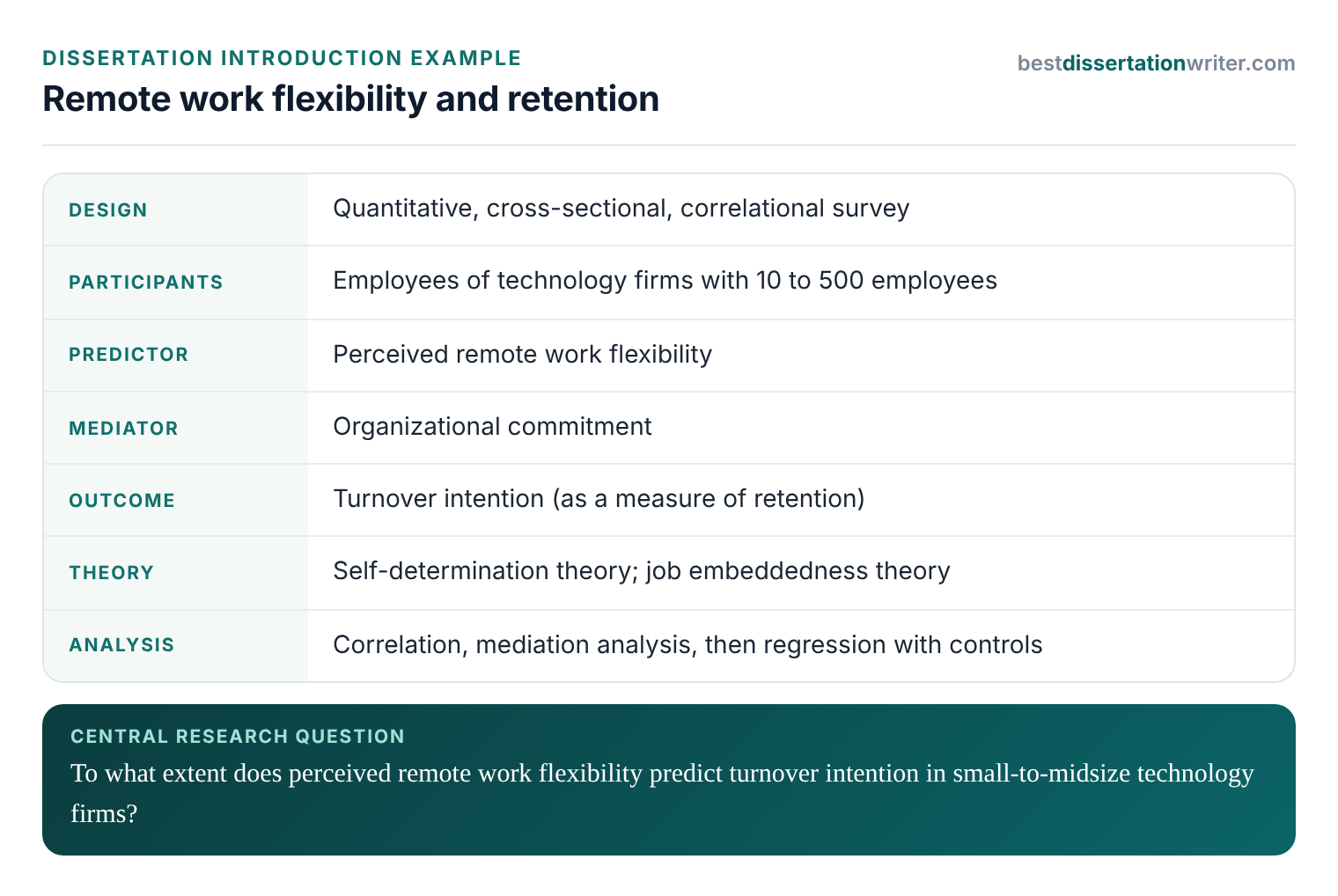
The purpose of this quantitative, correlational study is to examine the influence of remote work flexibility on employee retention, operationalized through turnover intention, among employees of small-to-midsize technology firms, defined as firms employing between 10 and 500 individuals.
The study will measure employees’ perceived remote work flexibility, turnover intention, job satisfaction, and organizational commitment through validated self-report instruments, and will use multivariable regression analysis to examine the independent predictive contribution of remote work flexibility to turnover intention after accounting for relevant covariates, including tenure, compensation satisfaction, and firm size.
Research Questions and Hypotheses
RQ1. To what extent does perceived remote work flexibility predict turnover intention among employees of small-to-midsize technology firms?
H1. Higher perceived remote work flexibility will be significantly associated with lower turnover intention.
RQ2. Does organizational commitment mediate the relationship between remote work flexibility and turnover intention?
H2. Organizational commitment will partially mediate the relationship between remote work flexibility and turnover intention.
RQ3. Does remote work flexibility remain a significant predictor of turnover intention after controlling for compensation satisfaction, tenure, and firm size?
H3. Remote work flexibility will remain a statistically significant independent predictor of turnover intention after accounting for compensation satisfaction, tenure, and firm size.
Significance and Theoretical Framework
Significance of the Study
This study carries significance for organizational theory, human resource practice, and the small-to-midsize technology sector specifically.
Theoretically, the study extends job embeddedness theory and self-determination theory into an organizational context, small-to-midsize technology firms, that has received comparatively limited direct empirical attention relative to large-enterprise remote work research, contributing evidence regarding whether the flexibility-retention relationship established in larger organizational contexts generalizes to firms with different structural and resource characteristics (Spurk & Straub, 2020).
Practically, findings may directly inform human resource and leadership decision-making within small-to-midsize technology firms regarding whether, and to what extent, investment in remote work flexibility represents an efficient use of limited organizational resources relative to other retention-focused interventions such as compensation adjustment or professional development investment (Newman & Ford, 2021).
Given the disproportionate financial impact of turnover on smaller organizations with constrained recruiting budgets, even modest improvements in evidence-based retention strategy may yield meaningful operational benefit (Chatterjee et al., 2022).
At the broader labor market level, this study contributes to ongoing policy and industry discussions regarding the long-term role of flexible work arrangements in a post-pandemic labor market, particularly for smaller employers competing against larger firms with greater compensation capacity (Rudolph et al., 2021).
Theoretical Framework
This study draws on two complementary theoretical frameworks. Self-determination theory conceptualizes autonomy, the experience of volition and self-direction in one’s activities, as a basic psychological need whose satisfaction is associated with increased intrinsic motivation, well-being, and commitment within work contexts (Deci et al., 2017).
Within this framework, remote work flexibility can be understood as an organizational practice that directly supports employees’ need for autonomy by granting greater self-direction over when, where, and how work is performed, theoretically strengthening employees’ psychological investment in and commitment to the organization (Wang et al., 2021).
This autonomy-based framework is paired with job embeddedness theory, which conceptualizes retention as a function of the degree to which employees are embedded within their organizational and community context across dimensions of fit, links, and sacrifice, positing that employees are less likely to leave organizations within which they feel a strong sense of connection and from which departure would require significant personal sacrifice (Mitchell et al., 2001).
Integrating these frameworks allows the study to examine remote work flexibility both as a direct autonomy-supporting practice with motivational consequences and as a structural feature that may reshape the nature of organizational embeddedness itself, particularly as remote arrangements alter the traditional geographic and social ties historically associated with retention.

Nature of the Study, Key Terms, Assumptions and Limitations
Nature of the Study
This study will employ a quantitative, cross-sectional, correlational design, appropriate for examining the strength and direction of relationships among remote work flexibility, turnover intention, and related organizational variables without manipulating any variables experimentally (Creswell & Creswell, 2023).
Participants will be recruited from small-to-midsize technology firms, defined as firms employing between 10 and 500 individuals, through organizational partnerships and professional networking platforms, and will complete an online survey comprising a validated remote work flexibility scale, a validated turnover intention scale, an organizational commitment scale, and a brief demographic and employment history questionnaire capturing tenure, compensation satisfaction, and firm size.
Data will be analyzed using Pearson correlation coefficients to examine bivariate relationships among remote work flexibility, turnover intention, and organizational commitment, followed by mediation analysis to test whether organizational commitment mediates the relationship between flexibility and turnover intention.
Multivariable linear regression will subsequently be used to determine the independent predictive contribution of remote work flexibility to turnover intention while controlling for tenure, compensation satisfaction, and firm size, allowing the study to address the specific predictive questions outlined in its research hypotheses.
Definitions of Key Terms
Employee retention: The degree to which an organization is able to retain its employees over time, commonly measured through actual turnover rates or, in cross-sectional research, through validated turnover intention as a behavioral proxy (Newman & Ford, 2021).
Job embeddedness: The combined forces of fit, links, and sacrifice that bind an employee to their current organization and community, theorized to reduce the likelihood of voluntary turnover.
Organizational commitment: An employee’s psychological attachment to, and identification with, their employing organization and its goals.
Remote work flexibility: The degree of autonomy an employee perceives regarding the location, scheduling, and structure of their work, encompassing both fully remote and hybrid work arrangements (Wang et al., 2021).
Small-to-midsize technology firm: A technology-sector organization employing between 10 and 500 individuals, as distinguished from large multinational technology enterprises (Chatterjee et al., 2022).
Turnover intention: An employee’s self-reported likelihood or intention to voluntarily leave their current organization within a defined future period, widely used as a validated proxy for actual turnover behavior (Rudolph et al., 2021).
Assumptions
This study operates under several assumptions. It is assumed that participants will respond to survey items honestly and with sufficient self-awareness of their own flexibility perceptions, commitment, and turnover intentions.
It is assumed that the validated instruments selected for this study possess adequate reliability and validity when applied within the small-to-midsize technology firm context, consistent with their established psychometric properties in prior organizational research (Wontorczyk & Rożnowski, 2022).
It is further assumed that turnover intention functions as a reasonably accurate proxy for eventual actual turnover behavior, consistent with prior meta-analytic evidence linking the two constructs, and that participating firms’ self-reported employee counts accurately reflect their small-to-midsize classification.
Scope and Delimitations
The scope of this study is delimited to employees of technology-sector firms employing between 10 and 500 individuals, excluding employees of large multinational technology enterprises and employees of non-technology firms, even where those firms offer comparable remote work arrangements.
The study is further delimited to employees currently engaged in remote or hybrid work arrangements, excluding employees in fully in-office roles for whom remote work flexibility is not an applicable condition of employment.
The study is delimited to turnover intention, rather than longitudinally tracked actual turnover behavior, as its primary retention-related outcome measure, and does not incorporate organizational-level turnover records due to access and confidentiality constraints across participating firms.
Limitations
Several limitations should be acknowledged. The cross-sectional design precludes causal inference regarding the direction of the relationship between remote work flexibility and turnover intention, and it remains possible that employees already inclined toward organizational commitment self-select into or perceive greater flexibility within their current roles.
Reliance on self-report measures introduces potential common-method bias and social desirability concerns, particularly regarding sensitive disclosures related to turnover intention (Newman & Ford, 2021). The use of turnover intention as a proxy for actual turnover, while empirically supported, does not guarantee that measured intentions will translate into actual departure behavior.
Finally, reliance on convenience and organizational-partnership sampling may limit the generalizability of findings to the broader population of small-to-midsize technology firms, particularly given potential differences between firms willing to participate in workplace research and those that are not.
Summary
This chapter introduced the background, problem, purpose, and theoretical grounding of a proposed quantitative study examining the influence of remote work flexibility on employee retention among employees of small-to-midsize technology firms.
While remote work flexibility has been broadly linked to improved retention-related outcomes in prior research, this evidence base has relied predominantly on large-enterprise and mixed-industry samples, leaving a meaningful gap in context-specific evidence for small-to-midsize technology firms, which differ structurally and organizationally from the large enterprises most commonly studied.
Grounded in self-determination theory and job embeddedness theory, this quantitative correlational study aims to clarify the independent predictive relationship between remote work flexibility and turnover intention within this specific organizational context, with implications for human resource strategy, leadership decision-making, and organizational theory.
Chapter Two will present a comprehensive review of the existing literature on remote work, employee retention, and organizational commitment, further situating this study within its scholarly context.
References
Chatterjee, S., Chaudhuri, R., & Vrontis, D. (2022). Does remote work flexibility enhance organization performance? Moderating role of organization policy and top management support. Journal of Business Research, 139, 1501–1512.
Choudhury, P., Foroughi, C., & Larson, B. (2021). Work-from-anywhere: The productivity effects of geographic flexibility. Strategic Management Journal, 42(4), 655–683.
Creswell, J. W., & Creswell, J. D. (2023). Research design: Qualitative, quantitative, and mixed methods approaches (6th ed.). SAGE Publications.
Deci, E. L., Olafsen, A. H., & Ryan, R. M. (2017). Self-determination theory in work organizations: The state of a science. Annual Review of Organizational Psychology and Organizational Behavior, 4, 19–43.
Kniffin, K. M., Narayanan, J., Anseel, F., Antonakis, J., Ashford, S. P., Bakker, A. B., … & Vugt, M. van. (2021). COVID-19 and the workplace: Implications, issues, and insights for future research and action. American Psychologist, 76(1), 63–77.
Mazmanian, M., Orlikowski, W. J., & Yates, J. (2013). The autonomy paradox: The implications of mobile email devices for knowledge professionals. Organization Science, 24(5), 1337–1357.
Mitchell, T. R., Holtom, B. C., Lee, T. W., Sablynski, C. J., & Erez, M. (2001). Why people stay: Using job embeddedness to predict voluntary turnover. Academy of Management Journal, 44(6), 1102–1121.
Newman, S. A., & Ford, R. C. (2021). Five steps to leading your team in the virtual COVID-19 workplace. Organizational Dynamics, 50(1), 100802.
Rudolph, C. W., Allan, B., Clark, M., Hertel, G., Hirschi, A., Kunze, F., … & Zacher, H. (2021). Pandemics: Implications for research and practice in industrial and organizational psychology. Industrial and Organizational Psychology, 14(1–2), 1–35.
Spurk, D., & Straub, C. (2020). Flexible employment relationships and careers in times of the COVID-19 pandemic. Journal of Vocational Behavior, 119, 103435.
Wang, B., Liu, Y., Qian, J., & Parker, S. K. (2021). Achieving effective remote working during the COVID-19 pandemic: A work design perspective. Applied Psychology, 70(1), 16–59.
Wontorczyk, A., & Rożnowski, B. (2022). Remote, hybrid, and on-site work during the SARS-CoV-2 pandemic and the consequences for stress and work engagement. International Journal of Environmental Research and Public Health, 19(4), 2400.
Yang, L., Holtz, D., Jaffe, S., Suri, S., Sinha, S., Weston, J., … & Teevan, J. (2022). The effects of remote work on collaboration among information workers. Nature Human Behaviour, 6(1), 43–54.
Why This Remote Work Flexibility Dissertation Introduction Example Works
Remote work is a crowded topic, so a strong introduction has to show what is still unknown. This remote work flexibility example does that in four steps.
- A specific setting: By focusing on smaller technology firms, the chapter targets organizations that feel turnover costs sharply and are less studied than large enterprises.
- Mechanism, not just effect: RQ2 asks why flexibility might matter by testing organizational commitment as a mediator.
- Rival explanations addressed: RQ3 checks whether flexibility still predicts turnover intention after pay satisfaction, tenure and firm size are controlled.
- Terms tied to measures: Turnover intention is defined as the measurable stand-in for retention, so readers know exactly what the survey captures.
Problem statement: weak vs. strong
Weak
“Remote work is popular, and companies want to know if it helps.”
This describes a trend but names no gap, population or consequence.
Strong
“While remote work flexibility is widely offered, it remains unclear whether it independently predicts turnover intention in small-to-midsize technology firms, where turnover costs fall hardest.”
This names the gap, the population and why the answer matters to the firms involved.
How to Adapt This Structure
If your study tests a mediator, give it its own research question and hypothesis, and make sure one of your theories explains why the mediator should matter. Name your control variables in the introduction so the analysis plan feels expected.
For section-by-section guidance, see how to write a problem statement, a testable hypothesis and the scope and delimitations. You can compare this chapter with the transformational leadership and psychological safety example, browse all dissertation introduction examples, or return to the how to write a dissertation hub.
The University of Leeds Library also keeps a collection of dissertation examples by subject.
FAQs About This Remote Work Flexibility Dissertation Introduction
Why measure turnover intention instead of actual employee turnover?
Actual turnover requires following employees over time, often for a year or more, and usually needs company records. Turnover intention can be measured in a single survey and is widely used as an early signal of leaving.
This example defines turnover intention as its measure of retention and admits in the limitations that intention does not always become departure. Doing the same in your own chapter shows the committee you understand the trade-off you made. It also explains how the survey captures intention.
What is a mediator in a dissertation, and how do I introduce one?
A mediator is a variable that explains how or why a predictor affects an outcome. Here, remote work flexibility is expected to raise organizational commitment, which in turn lowers turnover intention.
Introduce a mediator in three places. Name it in the purpose statement, give it a research question and hypothesis, and use theory to explain the link, as this chapter does with self-determination theory and job embeddedness theory. Report the indirect effect with a bootstrapped confidence interval in your results chapter.
How do I define a small-to-midsize firm in my research?
There is no single definition, so state the one you use and keep it consistent. This example defines small-to-midsize technology firms as those employing between 10 and 500 people.
Choose a cutoff that you can justify and verify during recruitment, such as an official size category used in your country or industry. Put the definition in your key terms and repeat it in your scope and delimitations so readers know who is excluded. A clear definition also makes your findings easier to compare with other studies.
Best Dissertation Writers
Want an introduction chapter like this for your topic?
Get a custom Chapter 1 written around your research problem, field and deadline.