

Social Media Use and Its Relationship to Body Image Perception Among Adolescent Girls
 By Dr. Robertson Prime, Research Fellow
Updated October 21, 2026
18 min read
About 3,600 words
By Dr. Robertson Prime, Research Fellow
Updated October 21, 2026
18 min read
About 3,600 words
This dissertation introduction example examines how social media use relates to body image perception among adolescent girls aged 13 to 17. It is written as a complete Chapter 1 for a mixed-methods study, so you can see how each section builds on the last.
Every reference in the chapter has been checked against its published source. Read it start to finish, then use the breakdown near the end to adapt the structure to your own topic.
On this page
What this example shows
- Gap first: the problem statement names the unresolved mechanism, not just the topic.
- Aligned design: two quantitative questions are paired with hypotheses; the third, qualitative question explains them.
- Two theories, one model: objectification theory and social comparison theory each supply a mediator.
- Honest limits: self-report bias and the cross-sectional design are named, along with what they mean for the findings.
Background of the Study: Social Media and Body Image
Introduction
Adolescent girls now spend a substantial portion of their daily lives engaging with image-centered social media platforms at precisely the developmental period when body image concerns are most likely to emerge and consolidate, raising sustained concern among researchers, clinicians, and parents regarding the role these platforms may play in shaping how young women perceive and evaluate their own bodies (Fardouly & Vartanian, 2015).
A substantial body of research has linked social media use, particularly image-based platforms emphasizing appearance-focused content, to elevated body dissatisfaction among adolescent girls, yet the literature also reflects considerable variability in effect size and mechanism across studies, suggesting that the relationship between platform use and body image is neither uniform nor fully explained by exposure alone (Holland & Tiggemann, 2016).
This chapter introduces the background, problem, purpose, and design of a mixed-methods study examining the relationship between platform use and body image perception among adolescent girls.
Background of the Study
Concern regarding media influence on adolescent body image predates the emergence of social media, with early research grounded in Festinger’s (1954) social comparison theory documenting that exposure to idealized media imagery prompted upward appearance comparisons associated with diminished body satisfaction among adolescent and young adult women (Perloff, 2014).
The shift from traditional media to interactive, image-centered social media platforms introduced features, including personalized content curation, peer-generated imagery, and quantifiable feedback such as likes and comments, that researchers have argued may intensify appearance-comparison processes relative to traditional media exposure by making comparison targets more numerous, more personally relevant, and more persistently available (Fardouly & Vartanian, 2015; Tiggemann & Slater, 2013).
Fredrickson and Roberts’ (1997) objectification theory offers a complementary theoretical account, proposing that repeated exposure to a cultural environment emphasizing the evaluation of female bodies as objects to be visually assessed leads girls and women to internalize an observer’s perspective on their own bodies, a process termed self-objectification that has been empirically linked to body shame, appearance anxiety, and disordered eating attitudes.
Vandenbosch and Eggermont (2016) found that adolescent girls’ social media use predicted increased self-objectification over time, which in turn predicted body surveillance and appearance-related concerns, suggesting that self-objectification may function as a mediating mechanism through which platform use translates into diminished body image rather than operating as a direct effect of exposure alone.
Holland and Tiggemann’s (2016) systematic review of social media and body image research found a consistent, though modest, association between image-based social media use and body dissatisfaction, while also identifying substantial heterogeneity across studies attributable to differences in platform type, content focus, and the specific comparison and internalization mechanisms examined.
Choukas-Bradley et al. (2020) extended this literature by examining appearance-related social media consciousness, the degree to which adolescents actively attend to and manage their online appearance presentation, finding that this construct predicted body image concerns above and beyond general platform use, suggesting that how adolescents engage with platforms may matter as much as how much they use them.
At the same time, other research has cautioned against treating platform use as uniformly harmful, noting that certain forms of engagement, including body-positive content consumption and selective following practices, have been associated with more favorable body image outcomes, indicating that content type and user agency substantially moderate the relationship under study (Cohen et al., 2019; de Vries et al., 2019).
Despite this substantial theoretical and empirical foundation, relatively few studies have combined rigorous quantitative measurement of social comparison and self-objectification mechanisms with qualitative exploration of how adolescent girls themselves describe and interpret their own social media experiences in relation to body image (McLean et al., 2015; Rousseau et al., 2017).
Problem Statement and Purpose of the Study
Statement of the Problem
Despite a substantial and growing body of research linking social media use to body dissatisfaction among adolescent girls, it remains unclear which specific mechanisms, upward appearance comparison, self-objectification, or appearance-related social media consciousness, most strongly account for this relationship, and how these mechanisms interact with the specific type and content of platform engagement (Fardouly & Vartanian, 2015; Holland & Tiggemann, 2016).
Existing quantitative research has frequently measured general platform use without adequately distinguishing between passive consumption, active appearance-focused engagement, and exposure to body-positive or appearance-neutral content, while qualitative research on adolescent girls’ own interpretations of these dynamics remains comparatively limited (Choukas-Bradley et al., 2020; Cohen et al., 2019).
This gap in the literature is problematic because parents, educators, and clinicians currently lack clear, empirically grounded guidance regarding which specific dimensions of social media engagement carry the greatest risk for body image concerns among adolescent girls, and which forms of engagement may be protective or neutral, limiting the precision of prevention and media literacy efforts aimed at supporting healthy body image development during adolescence (Perloff, 2014; Salomon & Brown, 2019).
Without integrated, mixed-methods evidence connecting specific comparison and self-objectification mechanisms to adolescent girls’ own accounts of their social media experience, researchers and practitioners risk relying on an overly broad characterization of social media as uniformly harmful, one that may not accurately reflect the more nuanced, content- and engagement-specific relationship suggested by recent research (de Vries et al., 2019).
Purpose of the Study
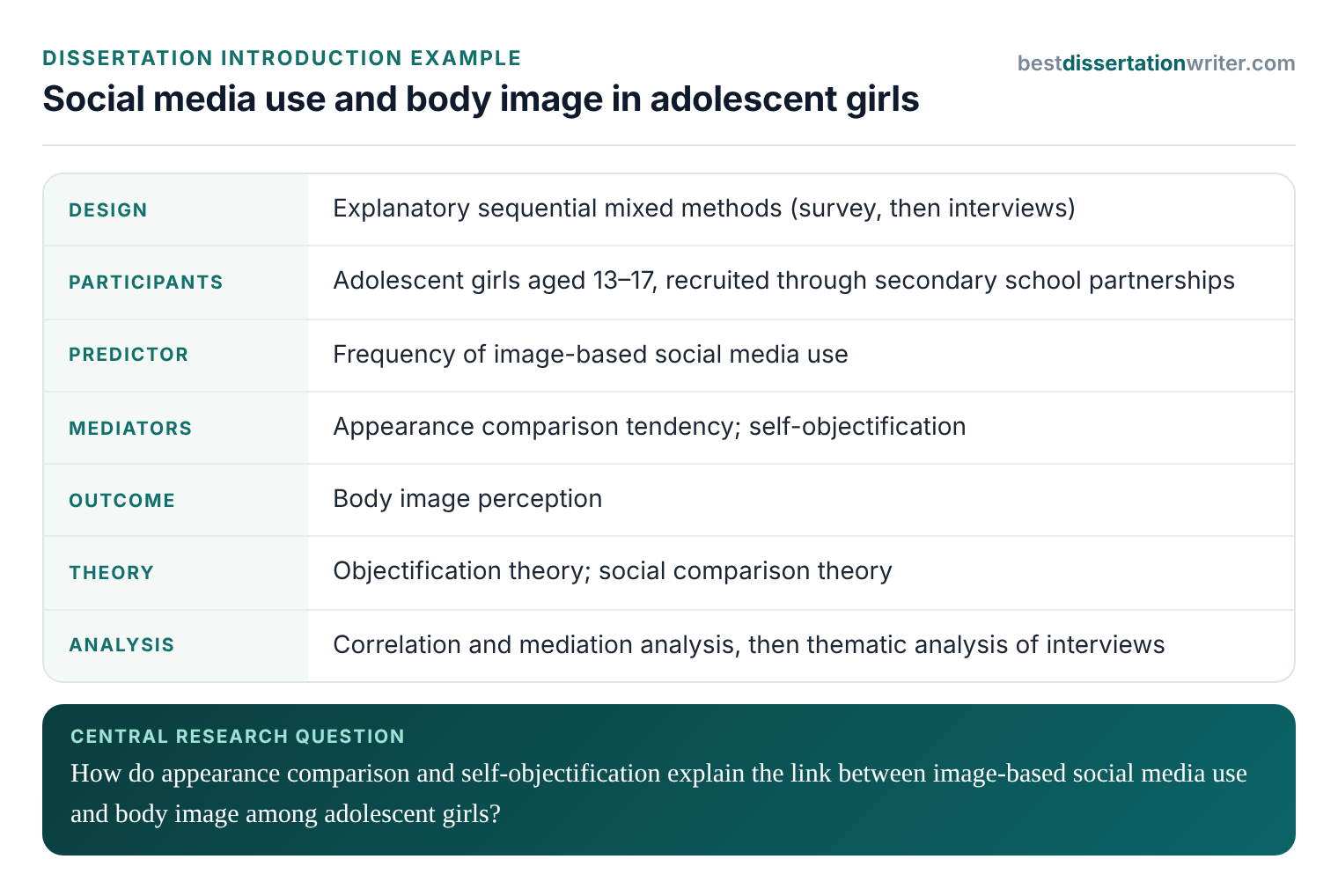
The purpose of this explanatory sequential mixed-methods study is to examine the relationship between adolescent girls’ patterns of social media use, including appearance comparison tendency and self-objectification, and their body image perception, and to explore how adolescent girls themselves interpret and describe this relationship in their own words.
In the first, quantitative phase, adolescent girls between the ages of 13 and 17 will complete validated survey instruments measuring platform use patterns, appearance comparison tendency, self-objectification, and body image perception.
In the second, qualitative phase, a purposive subsample of survey respondents will participate in semi-structured interviews designed to illuminate the personal experiences and interpretive processes underlying the quantitative relationships identified in phase one.
Research Questions and Hypotheses
RQ1. Is there a statistically significant relationship between frequency of image-based social media use and body image perception among adolescent girls?
H1. Adolescent girls with higher frequency of image-based social media use will report significantly lower body image satisfaction than those with lower frequency of use.
RQ2. Do appearance comparison tendency and self-objectification mediate the relationship between social media use and body image perception?
H2. Appearance comparison tendency and self-objectification will each significantly mediate the relationship between social media use and body image perception, accounting for a significant portion of the association between use and body dissatisfaction.
RQ3. How do adolescent girls describe the role social media plays in shaping their own body image, including any perceived protective or positive dimensions of their platform engagement?
Significance and Theoretical Framework
Significance of the Study
This study carries significance for developmental psychology theory, media literacy education, and adolescent mental health practice.
Theoretically, the study extends objectification theory and social comparison theory by directly testing appearance comparison and self-objectification as parallel mediating mechanisms within a single model, and by incorporating adolescent girls’ own qualitative accounts to refine understanding of how these mechanisms are subjectively experienced (Fredrickson & Roberts, 1997; Festinger, 1954).
Practically, findings may directly inform school-based media literacy curricula and parental guidance resources, providing evidence-based direction regarding which specific dimensions of social media engagement most warrant attention in prevention efforts aimed at supporting healthy body image development (Salomon & Brown, 2019).
Given the near-universal adoption of image-based social media platforms among contemporary adolescents, evidence clarifying which specific mechanisms and engagement patterns most strongly relate to body image outcomes carries substantial relevance for clinicians, educators, and platform designers alike (Tiggemann & Slater, 2013).
More broadly, the qualitative phase of this study contributes adolescent-centered accounts that can inform the design of developmentally appropriate media literacy and body image intervention programming (McLean et al., 2015).
Theoretical Framework
This study is grounded primarily in Fredrickson and Roberts’ (1997) objectification theory, which proposes that repeated exposure to a sociocultural environment emphasizing the visual evaluation of female bodies leads girls and women to internalize an observer’s perspective on their own bodies, a process of self-objectification associated with heightened body shame, appearance anxiety, and diminished body satisfaction.
This framework provides the theoretical basis for conceptualizing self-objectification as a key mechanism through which social media exposure may translate into body image concerns.
This framework is paired with Festinger’s (1954) social comparison theory, as extended to appearance-specific comparison processes by subsequent media effects research, which proposes that individuals evaluate their own attributes, including physical appearance, relative to others, and that upward comparisons to idealized appearance targets are associated with diminished self-evaluation (Perloff, 2014).
Integrating these two frameworks allows the study to test whether appearance comparison and self-objectification operate as distinct or overlapping mediating mechanisms in the relationship between social media use and body image perception, while the qualitative phase allows exploration of how adolescent girls themselves narrate and make sense of these psychological processes within their own social media experience (Vandenbosch & Eggermont, 2016).

Nature of the Study, Key Terms, Assumptions and Limitations
Nature of the Study
This study will employ an explanatory sequential mixed-methods design, in which quantitative survey data are collected and analyzed first, followed by a qualitative interview phase designed to explain and contextualize the quantitative findings (Creswell & Creswell, 2023).
Participants will be recruited from adolescent girls aged 13 to 17 through secondary school partnerships, with parental consent and adolescent assent obtained for all participants in accordance with research protections for minors.
In the quantitative phase, participants will complete a validated social media use and engagement scale, a validated appearance comparison scale, a validated self-objectification measure, and a validated body image perception instrument appropriate for adolescent populations.
Data will be analyzed using mediation analysis to test whether appearance comparison and self-objectification mediate the relationship between platform use and body image perception, controlling for relevant demographic variables.
In the qualitative phase, a purposive sample of 12 to 15 survey respondents representing a range of body image scores will participate in semi-structured interviews conducted with appropriate developmental and ethical safeguards, which will be analyzed using thematic analysis to identify recurring patterns in how participants describe the relationship between their social media engagement and their body image.
Definitions of Key Terms
Body image perception: An individual’s subjective evaluation of, and attitude toward, their own physical appearance, encompassing both cognitive and affective components (Perloff, 2014).
Appearance comparison: The cognitive process of evaluating one’s own physical appearance relative to that of another person, typically categorized as upward when the comparison target is perceived as more attractive (Festinger, 1954; Fardouly & Vartanian, 2015).
Self-objectification: The internalization of an observer’s perspective on one’s own body, resulting in habitual self-monitoring of physical appearance and heightened attention to how one’s body appears to others (Fredrickson & Roberts, 1997).
Image-based social media: Social media platforms in which visual content, particularly photographs and short-form video, constitutes the primary mode of user-generated and consumed content (Holland & Tiggemann, 2016).
Appearance-related social media consciousness: The degree to which an individual actively attends to, manages, and is preoccupied with their own appearance-related presentation and reception on social media platforms (Choukas-Bradley et al., 2020).
Body surveillance: The habitual monitoring of one’s own physical appearance from an external, observer-like perspective, considered a behavioral manifestation of self-objectification (Vandenbosch & Eggermont, 2016).
Assumptions
This study operates under several assumptions. It is assumed that adolescent participants will respond honestly and with adequate self-awareness to survey items regarding their social media use, appearance comparison tendencies, and body image, and that these self-reports meaningfully reflect their actual attitudes and behavior.
It is assumed that the validated instruments selected for this study possess adequate reliability and validity when applied to an adolescent population within the specific age range sampled (Salomon & Brown, 2019).
It is further assumed that interview participants will be willing and developmentally able to articulate their own experiences and interpretations regarding the relationship between their social media engagement and their body image, and that appropriate ethical safeguards will adequately protect participant wellbeing given the sensitive nature of the topic under study.
Scope and Delimitations
The scope of this study is delimited to adolescent girls between the ages of 13 and 17 recruited through secondary school partnerships, and does not extend to adult populations, adolescent boys, or younger children. The study is further delimited to image-based social media platforms and does not examine text-based or gaming-oriented platforms that do not center visual appearance-related content.
The study examines body image perception as its primary outcome and does not extend to clinical outcomes such as diagnosed eating disorders or depressive symptomatology, although these are acknowledged as potential downstream correlates of the body image concerns examined (Tiggemann & Slater, 2013).
Limitations
Several limitations should be acknowledged. Reliance on adolescent self-report for both social media use and body image variables introduces the possibility of recall and social desirability bias, and does not independently verify actual platform engagement patterns.
The cross-sectional nature of the quantitative phase precludes causal claims regarding the direction of the relationship between platform use and body image, and cannot capture how this relationship may evolve across the course of adolescent development.
The school-based recruitment strategy may limit generalizability to adolescent girls who are not enrolled in traditional secondary education or whose caregivers were unable or unwilling to provide consent for study participation.
Finally, the qualitative sample, while purposively selected for range, cannot be assumed to represent the full diversity of adolescent girls’ social media experiences, and findings regarding mechanism should be interpreted as illustrative rather than exhaustive (Rousseau et al., 2017).
Summary
This chapter introduced the background, problem, purpose, and theoretical grounding of a proposed mixed-methods study examining the relationship between social media use and body image perception among adolescent girls.
While existing research has documented a generally consistent, though modest and heterogeneous, association between image-based platform use and body dissatisfaction, the field has not fully integrated quantitative measurement of specific mediating mechanisms with adolescent girls’ own qualitative accounts of their social media experience.
Grounded in objectification theory and social comparison theory, this explanatory sequential mixed-methods study aims to clarify which specific mechanisms most strongly account for the relationship between platform use and body image, and how adolescent girls themselves interpret this relationship, with implications for media literacy education, adolescent mental health practice, and developmental psychology theory.
Chapter Two will present a comprehensive review of the existing literature on platform use, body image, and adolescent development, further situating this study within its scholarly context.
References
Choukas-Bradley, S., Nesi, J., Widman, L., & Galla, B. M. (2020). The Appearance-Related Social Media Consciousness Scale: Development and validation with adolescents. Body Image, 33, 164–174.
Cohen, R., Fardouly, J., Newton-John, T., & Slater, A. (2019). #BoPo on Instagram: An experimental investigation of the effects of viewing body positive content on young women’s mood and body image. New Media & Society, 21(7), 1546–1564.
Creswell, J. W., & Creswell, J. D. (2023). Research design: Qualitative, quantitative, and mixed methods approaches (6th ed.). SAGE Publications.
de Vries, D. A., Vossen, H. G. M., & van der Kolk-van der Boom, P. (2019). Social media and body dissatisfaction: Investigating the attenuating role of positive parent-adolescent relationships. Journal of Youth and Adolescence, 48(3), 527–536.
Fardouly, J., & Vartanian, L. R. (2015). Negative comparisons about one’s appearance mediate the relationship between Facebook usage and body image concerns. Body Image, 12, 82–88.
Festinger, L. (1954). A theory of social comparison processes. Human Relations, 7(2), 117–140.
Fredrickson, B. L., & Roberts, T.-A. (1997). Objectification theory: Toward understanding women’s lived experiences and mental health risks. Psychology of Women Quarterly, 21(2), 173–206.
Holland, G., & Tiggemann, M. (2016). A systematic review of the impact of the use of social networking sites on body image and disordered eating outcomes. Body Image, 17, 100–110.
McLean, S. A., Paxton, S. J., Wertheim, E. H., & Masters, J. (2015). Photoshopping the selfie: Self photo editing and photo investment are associated with body dissatisfaction in adolescent girls. International Journal of Eating Disorders, 48(8), 1132–1140.
Perloff, R. M. (2014). Social media effects on young women’s body image concerns: Theoretical perspectives and an agenda for research. Sex Roles, 71(11–12), 363–377.
Rousseau, A., Eggermont, S., & Frison, E. (2017). The reciprocal and indirect relationships between passive Facebook use, comparison on Facebook, and adolescents’ body dissatisfaction. Computers in Human Behavior, 73, 336–344.
Salomon, I., & Brown, C. S. (2019). The selfie generation: Examining the relationship between social media use and early adolescent body image. Journal of Early Adolescence, 39(4), 539–560.
Tiggemann, M., & Slater, A. (2013). NetGirls: The Internet, Facebook, and body image concern in adolescent girls. International Journal of Eating Disorders, 46(6), 630–633.
Vandenbosch, L., & Eggermont, S. (2016). The interrelated roles of mass media and social media in adolescents’ development of an objectified self-concept: A longitudinal study. Communication Research, 43(8), 1116–1140.
Why This Social Media Dissertation Introduction Example Works
A strong introduction chapter does more than describe a topic. Four choices make this example work, and each one is easy to copy in your own chapter.
- Mechanism-focused problem: The problem statement does not stop at “social media harms body image.” It names three candidate mechanisms and says the field cannot yet tell which one drives the effect.
- One theory per mediator: Each mediator in RQ2 comes straight from a named theory, so the framework section justifies the analysis rather than decorating it.
- Questions match the design: RQ1 and RQ2 are testable and carry hypotheses, while RQ3 is open-ended and explains the survey results, which is what an explanatory sequential design requires.
- Defined, measurable terms: Each key term is defined with a citation, so readers know exactly what the survey instruments will capture.
Problem statement: weak vs. strong
Weak
“Social media is bad for teenage girls’ body image, and more research is needed.”
This restates a common belief, offers no gap and gives the reader no reason to expect new findings.
Strong
“It remains unclear which mechanism, upward appearance comparison or self-objectification, most strongly accounts for the link between image-based social media use and body dissatisfaction among adolescent girls.”
This names a specific, unresolved question that the study’s design and analysis can actually answer.
How to Adapt This Structure
Keep the same order: background, problem, purpose, questions, significance, theory, design, terms, assumptions, scope, limitations and summary. Swap in your own predictor, mechanism and outcome, then check that every research question maps to one part of your theoretical framework.
For section-by-section guidance, see how to write a problem statement, a theoretical framework and the limitations of the study. You can compare this chapter with the emotion regulation and teacher burnout example, browse all dissertation introduction examples, or return to the how to write a dissertation hub. The University of Leeds Library also keeps a collection of dissertation examples by subject.
FAQs About This Social Media Dissertation Introduction
Why use a mixed-methods design for a body image study like this?
Survey data can show whether platform use is linked to body image and whether comparison or self-objectification carries that link. Numbers alone cannot show how girls experience their feeds or why some feel protected rather than harmed.
An explanatory sequential design answers both questions. The survey phase tests the hypotheses first, and the interviews that follow explain surprising or mixed results in the participants’ own words. That is why RQ3 is open-ended and placed after the two testable questions, so together the two phases give a fuller answer than either could alone.
Can I reuse this dissertation introduction example for my own topic?
You can reuse the structure, but not the text. Copying the wording would count as plagiarism, and your committee will expect a chapter built on your own literature search and research gap.
Instead, keep the section order and the logic that links each part. Start with your own problem, write one research question per gap, tie each question to a theory and define every variable you will measure. Then check each citation against its original source before you submit the chapter.
How many references should a dissertation introduction chapter include?
There is no fixed number. Chapter 1 usually cites fewer sources than the literature review, because it only needs enough evidence to establish the problem, the gap and the theory. This example uses 14 references.
Focus on quality and fit. Cite the foundational theory papers, one or two reviews that summarize the field and the recent studies that show the gap. Your full literature review in Chapter 2 is where you analyze the research in depth, so save the detailed comparisons for that chapter.
Best Dissertation Writers
Want an introduction chapter like this for your topic?
Get a custom Chapter 1 written around your research problem, field and deadline.