

The Role of Emotion Regulation Strategies in Predicting Burnout Among Early-Career Teachers
 By Dr. Robertson Prime, Research Fellow
Updated October 24, 2026
17 min read
About 3,300 words
By Dr. Robertson Prime, Research Fellow
Updated October 24, 2026
17 min read
About 3,300 words
This dissertation introduction example asks which emotion regulation strategies predict burnout among early-career teachers. It is a complete Chapter 1 for a quantitative, correlational study of teachers in their first five years at public K-12 schools.
Every reference in the chapter has been checked against its published source. Read the chapter first, then use the breakdown near the end to adapt its structure to your own topic.
On this page
What this example shows
- Strategy-level focus: the study compares three named strategies instead of treating regulation as one skill.
- Directional hypotheses: each research question has a hypothesis that predicts a clear direction.
- Two linked theories: Gross’s process model explains the strategies, and the Job Demands-Resources model explains burnout.
- Clear limits: the chapter admits that a cross-sectional design cannot show which variable comes first.
Background of the Study: Emotion Regulation and Teacher Burnout
Introduction
Teacher burnout has emerged as one of the most persistent and consequential problems facing K-12 education systems, with attrition rates among teachers in their first five years of practice remaining substantially higher than those of more experienced colleagues (Madigan & Kim, 2021).
Early-career teachers occupy a uniquely vulnerable position: they are simultaneously mastering instructional skills, classroom management, and institutional expectations while navigating the emotionally demanding interpersonal work of teaching, often with limited mentorship and few internalized coping resources.
Emotion regulation, defined broadly as the processes by which individuals influence which emotions they have, when they have them, and how they experience and express them, has increasingly been identified as a psychological mechanism that may help explain why some early-career teachers sustain their commitment to the profession while others experience rapid emotional exhaustion and depersonalization (Gross, 2015; Taxer & Frenzel, 2015).
This chapter introduces the background, problem, purpose, and structure of a study examining the relationship between specific emotion regulation strategies and burnout among early-career teachers, situating the inquiry within existing theoretical and empirical literature and outlining the scope and significance of the proposed research.
Background of the Study
Teaching has long been recognized as an emotionally laborious profession, requiring practitioners to continuously manage their own affective states while responding to the emotional needs of students, colleagues, and parents (Taxer & Frenzel, 2015).
This emotional labor is particularly pronounced for early-career teachers, who report higher levels of daily emotional exhaustion than their more experienced peers, even when controlling for workload and school context (Madigan & Kim, 2021).
The Job Demands-Resources model has been widely used to explain burnout as an outcome of chronic imbalance between occupational demands, such as classroom management challenges and administrative expectations, and the personal and organizational resources available to meet them (Bakker et al., 2023).
Within this framework, emotion regulation has been conceptualized as a personal resource capable of buffering the psychological cost of high-demand emotional labor, though the specific strategies teachers use to regulate emotion appear to differentially predict burnout outcomes (Braun et al., 2019).
A growing body of research grounded in Gross’s process model of emotion regulation has distinguished between antecedent-focused strategies, such as cognitive reappraisal, in which an individual reinterprets a stressful situation to alter its emotional impact, and response-focused strategies, such as expressive suppression, in which an individual inhibits the outward expression of an emotion already experienced (Gross, 2015; Chang, 2020).
Cognitive reappraisal has been consistently associated with lower emotional exhaustion and greater occupational well-being among teachers, while expressive suppression has been associated with elevated burnout, reduced job satisfaction, and diminished classroom relational quality (Chang, 2020; Wang et al., 2019).
However, much of this literature has drawn on samples of teachers with mixed or unspecified years of experience, leaving unresolved questions about whether these associations hold with comparable strength among teachers navigating the specific psychological demands of career entry.
Comparatively few studies have examined emotion regulation specifically within early-career teacher populations, and it remains unclear whether novice teachers, who are still forming a professional identity and establishing classroom authority, rely on different regulation strategies than their more experienced colleagues. This gap matters because the first years of practice are widely regarded as a critical window for attrition risk.
At the same time, several studies have highlighted the protective role of mindfulness-based and acceptance-oriented regulation strategies, which have shown promise in reducing burnout risk among novice educators independent of school-level structural supports (Roeser et al., 2022).
Despite this expanding evidence base, few studies have directly compared the relative predictive strength of multiple emotion regulation strategies within a single early-career teacher sample, leaving open questions about which specific strategies should be prioritized in professional development and induction programming (Braun et al., 2019; Wang et al., 2019).
Problem Statement and Purpose of the Study
Statement of the Problem
Teacher attrition during the early-career period continues to impose substantial costs on students, schools, and education systems, with national data indicating that between 20% and 30% of new teachers leave the profession within their first five years, disproportionately affecting under-resourced schools already facing staffing shortages (Madigan & Kim, 2021).
Burnout, characterized by emotional exhaustion, depersonalization, and reduced sense of personal accomplishment, has been linked to teachers’ intentions to leave the profession (Madigan & Kim, 2021), yet interventions designed to reduce burnout among novice teachers have shown inconsistent effectiveness, in part because they have not been systematically grounded in an understanding of which specific emotion regulation processes are most strongly associated with burnout risk in this population.
While emotion regulation has been established as theoretically and empirically relevant to teacher burnout broadly, the existing literature has not adequately isolated the relative contribution of distinct emotion regulation strategies, including cognitive reappraisal, expressive suppression, and mindfulness-based regulation, specifically within early-career teacher populations, who differ meaningfully from experienced teachers in professional identity development, classroom authority, and emotional coping repertoire (Braun et al., 2019; Roeser et al., 2022).
This gap limits the ability of teacher preparation programs, school leaders, and induction mentors to design targeted, evidence-based interventions that address the specific emotion regulation needs of teachers during their most attrition-vulnerable years.
Without a clearer understanding of which emotion regulation strategies most strongly predict burnout among early-career teachers specifically, professional development efforts risk applying generalized emotional wellness programming that may not address the mechanisms most responsible for early-career burnout and attrition.
Purpose of the Study
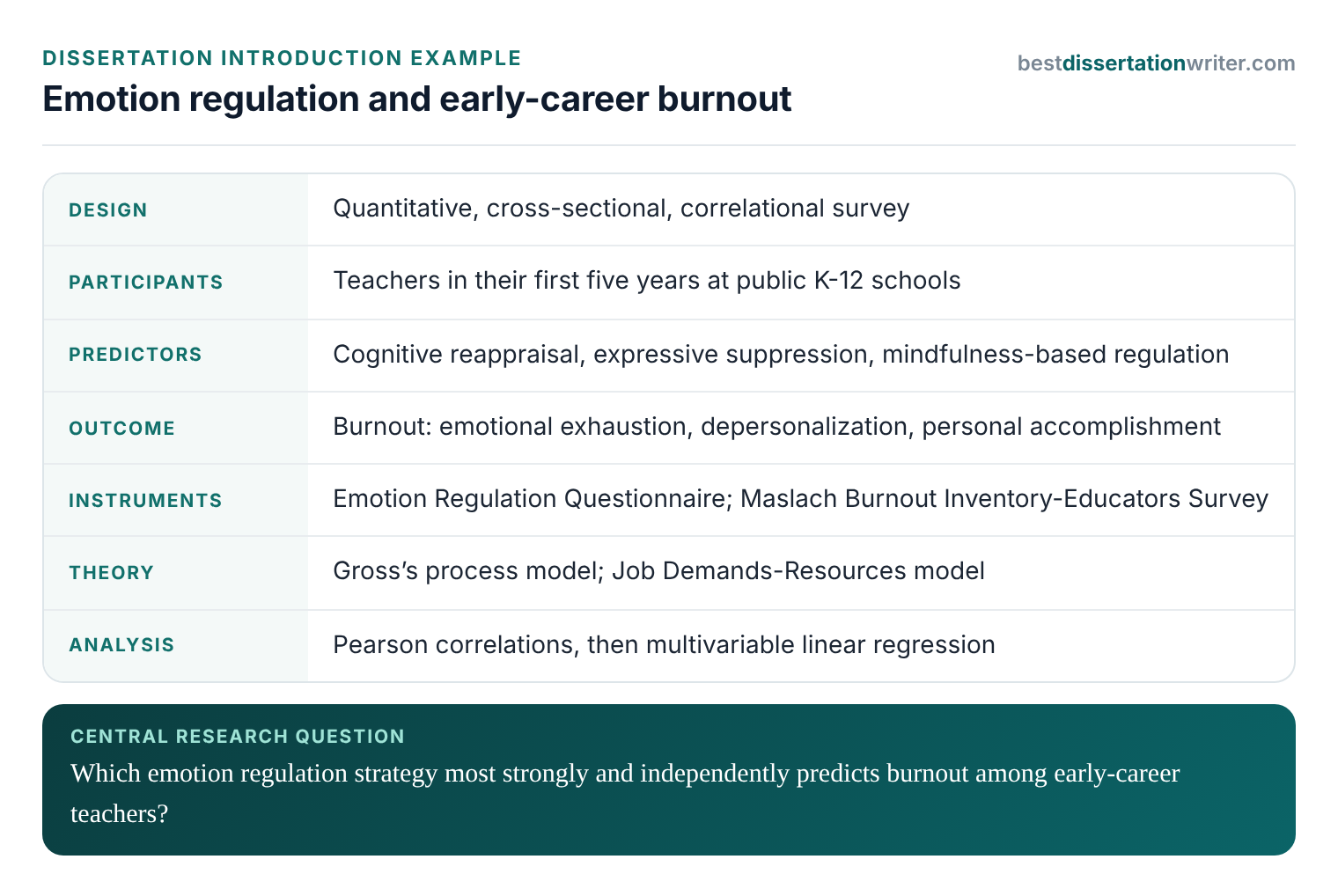
The purpose of this quantitative, correlational study is to examine the relationship between early-career teachers’ use of specific emotion regulation strategies, namely cognitive reappraisal, expressive suppression, and mindfulness-based regulation, and their levels of self-reported burnout, as measured across the three established dimensions of emotional exhaustion, depersonalization, and reduced personal accomplishment.
The study targets teachers within their first five years of classroom practice across public K-12 schools, with the aim of identifying which specific regulation strategies most strongly and independently predict burnout risk within this population, thereby informing the design of targeted induction and professional development interventions.
Research Questions and Hypotheses
RQ1. To what extent does early-career teachers’ use of cognitive reappraisal predict their levels of emotional exhaustion, depersonalization, and reduced personal accomplishment?
H1. Higher use of cognitive reappraisal will be significantly associated with lower levels of emotional exhaustion and depersonalization, and higher levels of personal accomplishment.
RQ2. To what extent does early-career teachers’ use of expressive suppression predict their levels of burnout across its three dimensions?
H2. Higher use of expressive suppression will be significantly associated with higher levels of emotional exhaustion and depersonalization, and lower levels of personal accomplishment.
RQ3. Which emotion regulation strategy, among cognitive reappraisal, expressive suppression, and mindfulness-based regulation, most strongly and independently predicts total burnout when examined together in a multivariable model?
H3. Cognitive reappraisal and mindfulness-based regulation will each independently and significantly predict lower total burnout after accounting for expressive suppression and relevant demographic covariates.
Significance and Theoretical Framework
Significance of the Study
This study carries significance for theory, practice, and policy.
Theoretically, the study extends the application of Gross’s process model of emotion regulation and the Job Demands-Resources model into a population, early-career teachers, that remains comparatively underexamined relative to the broader teacher burnout literature, contributing empirical evidence regarding how discrete emotion regulation strategies function as personal resources within a high-demand occupational context during a distinct developmental period of professional identity formation (Bakker et al., 2023; Gross, 2015).
Practically, findings from this study may inform the design of teacher induction programs, mentorship structures, and professional development curricula by identifying which specific emotion regulation strategies warrant explicit instructional focus during the critical early-career period, potentially improving the efficiency and effectiveness of limited induction resources (Roeser et al., 2022).
At the policy level, given the substantial financial and instructional costs associated with early-career teacher attrition, evidence identifying modifiable psychological predictors of burnout may support district and state-level investment in emotion regulation-focused wellness initiatives as a complement to structural retention strategies such as compensation and workload adjustment (Madigan & Kim, 2021).
Finally, this study holds significance for early-career teachers themselves and, indirectly, for the students they serve, given the documented association between teacher burnout and reduced instructional quality and classroom relational warmth (Wang et al., 2019).
Theoretical Framework
This study is grounded in Gross’s process model of emotion regulation, which conceptualizes emotion regulation as occurring at distinct points in the emotion-generative process, distinguishing antecedent-focused strategies such as cognitive reappraisal from response-focused strategies such as expressive suppression, and positing that these strategies differ systematically in their psychological and interpersonal consequences (Gross, 2015).
This framework provides the theoretical basis for hypothesizing differential relationships between specific regulation strategies and burnout outcomes, rather than treating emotion regulation as a unitary construct.
The study is further situated within the Job Demands-Resources model, which frames burnout as the product of chronic imbalance between occupational demands and available resources, and positions emotion regulation capacity as a personal resource that can moderate the psychological impact of high emotional-labor demands characteristic of teaching (Bakker et al., 2023).
Integrating these two frameworks allows the study to examine not only whether emotion regulation predicts burnout, but which specific regulatory mechanisms function most effectively as protective personal resources within the demand-intensive early-career teaching context (Chang, 2020; Braun et al., 2019).

Nature of the Study, Key Terms, Assumptions and Limitations
Nature of the Study
This study will employ a quantitative, cross-sectional, correlational design, appropriate for examining the strength and direction of relationships between emotion regulation strategy use and burnout without manipulating any variables (Creswell & Creswell, 2023).
Participants will be recruited from public K-12 schools and will complete two validated self-report instruments: the Emotion Regulation Questionnaire, which assesses habitual use of cognitive reappraisal and expressive suppression, and the Maslach Burnout Inventory-Educators Survey, which assesses emotional exhaustion, depersonalization, and personal accomplishment (Chang, 2020). A validated mindfulness-based regulation subscale will be administered concurrently.
Data will be analyzed using Pearson correlation coefficients to examine bivariate relationships between each regulation strategy and burnout dimension, followed by multivariable linear regression to determine the independent predictive contribution of each strategy while controlling for years of experience, school level, and self-reported workload.
Definitions of Key Terms
Burnout: A psychological syndrome comprising emotional exhaustion, depersonalization, and reduced personal accomplishment, arising from chronic occupational stress (Leiter & Maslach, 2017).
Cognitive reappraisal: An antecedent-focused emotion regulation strategy involving the reinterpretation of a potentially emotion-eliciting situation to alter its emotional impact before the emotional response fully develops (Gross, 2015).
Early-career teacher: A classroom teacher within the first five years of full-time, independent teaching practice following certification.
Emotion regulation: The processes by which individuals influence which emotions they experience, when they experience them, and how those emotions are expressed or suppressed (Gross, 2015).
Expressive suppression: A response-focused emotion regulation strategy involving the inhibition of outward emotional expression after an emotional response has already been generated (Chang, 2020).
Mindfulness-based regulation: An emotion regulation approach characterized by nonjudgmental, present-moment awareness of emotional experience used to reduce reactive emotional responding (Roeser et al., 2022).
Assumptions
This study operates under several assumptions. It is assumed that participants will respond to self-report instruments honestly and with sufficient self-awareness of their own emotion regulation habits and burnout symptoms. It is assumed that the validated instruments selected for this study possess adequate reliability and validity when applied to an early-career teacher population, consistent with prior psychometric research (Chang, 2020).
It is further assumed that participants’ reported years of teaching experience accurately reflect their early-career status, and that the cross-sectional data collected will be representative of participants’ typical emotional regulation patterns rather than reflecting an atypical period of acute situational stress.
Scope and Delimitations
The scope of this study is delimited to teachers within their first five years of full-time classroom practice in public K-12 schools, excluding pre-service teachers, long-term substitutes, and teachers in private or specialized alternative school settings.
The study is further delimited to three specific emotion regulation strategies, cognitive reappraisal, expressive suppression, and mindfulness-based regulation, selected based on their prominence in the existing literature, and does not examine other potentially relevant regulation strategies such as social sharing or problem-focused coping.
The study is delimited to self-reported burnout as measured by a single validated instrument at a single point in time, rather than incorporating longitudinal, observational, or supervisor-rated measures of burnout or teaching performance.
Limitations
Several limitations should be acknowledged. The cross-sectional design precludes causal inference regarding the direction of the relationship between emotion regulation strategy use and burnout, and it remains possible that burnout influences the emotion regulation strategies teachers adopt rather than, or in addition to, the reverse.
Reliance on self-report measures introduces potential social desirability and common-method bias, particularly given the stigma some teachers may associate with disclosing burnout symptoms (Madigan & Kim, 2021). The sample, while intended to represent a range of school contexts, may not capture the full diversity of early-career teaching experiences across geographic regions, subject areas, or school resource levels, limiting generalizability.
Finally, unmeasured variables such as school leadership quality, mentorship access, and student population characteristics may confound the observed relationships and were not directly controlled for in this study’s design.
Summary
This chapter introduced the background, problem, purpose, and theoretical grounding of a proposed study examining the relationship between emotion regulation strategies and burnout among early-career teachers.
Despite substantial evidence linking emotion regulation to teacher burnout broadly, the specific predictive contributions of distinct regulation strategies within the early-career teacher population remain insufficiently understood, limiting the field’s ability to design targeted, evidence-based induction and wellness interventions.
Grounded in Gross’s process model of emotion regulation and the Job Demands-Resources model, this quantitative correlational study aims to clarify which specific emotion regulation strategies most strongly predict burnout among early-career teachers, with implications for teacher preparation, induction programming, and retention policy.
Chapter Two will present a comprehensive review of the existing literature on emotion regulation, teacher burnout, and early-career teacher development, further situating this study within its scholarly context.
References
Bakker, A. B., Demerouti, E., & Sanz-Vergel, A. (2023). Job demands–resources theory: Ten years later. Annual Review of Organizational Psychology and Organizational Behavior, 10, 25–53.
Braun, S. S., Roeser, R. W., Mashburn, A. J., & Skinner, E. (2019). Middle school teachers’ mindfulness, occupational health and well-being, and the quality of teacher–student interactions. Mindfulness, 10(2), 245–255.
Chang, M.-L. (2020). Emotion display rules, emotion regulation, and teacher burnout. Frontiers in Education, 5, 90.
Creswell, J. W., & Creswell, J. D. (2023). Research design: Qualitative, quantitative, and mixed methods approaches (6th ed.). SAGE Publications.
Gross, J. J. (2015). Emotion regulation: Current status and future prospects. Psychological Inquiry, 26(1), 1–26.
Leiter, M. P., & Maslach, C. (2017). Burnout and engagement: Contributions to a new vision. Burnout Research, 5, 55–57.
Madigan, D. J., & Kim, L. E. (2021). Towards an understanding of teacher attrition: A meta-analysis of burnout, job satisfaction, and teachers’ intentions to quit. Teaching and Teacher Education, 105, 103425.
Roeser, R. W., Mashburn, A. J., Skinner, E. A., Choles, J. R., Taylor, C., Rickert, N. P., & Pinela, C. (2022). Mindfulness training improves middle school teachers’ occupational health, well-being, and interactions with students in their most stressful classrooms. Journal of Educational Psychology, 114(2), 408–425.
Taxer, J. L., & Frenzel, A. C. (2015). Facets of teachers’ emotional lives: A quantitative investigation of teachers’ genuine, faked, and hidden emotions. Teaching and Teacher Education, 49, 78–88.
Wang, H., Hall, N. C., & Taxer, J. L. (2019). Antecedents and consequences of teachers’ emotional labor: A systematic review and meta-analytic investigation. Educational Psychology Review, 31(3), 663–698.
Why This Emotion Regulation Dissertation Introduction Example Works
This chapter shows how to turn a broad interest in teacher stress into a precise, testable study. Four choices do most of the work.
- Named strategies: Rather than asking whether regulation “helps,” the chapter compares reappraisal, suppression and mindfulness-based regulation, which gives the study something new to find.
- Matched hypotheses: Each research question is paired with a hypothesis that predicts a direction, so the analysis plan follows directly from the questions.
- Theory explains each link: Gross’s model justifies why strategies should differ, and the Job Demands-Resources model explains why they matter for burnout.
- Honest design limits: The limitations section admits that burnout may shape regulation, not only the reverse, which shows the reader you understand the design.
Research question: weak vs. strong
Weak
“Does emotion regulation affect teacher burnout?”
This is too broad to test, names no strategy and does not say which part of burnout matters.
Strong
“To what extent does early-career teachers’ use of cognitive reappraisal predict their levels of emotional exhaustion, depersonalization, and reduced personal accomplishment?”
This names one strategy, one population and three measurable outcomes, so it maps cleanly onto a regression model.
How to Adapt This Structure
Keep the chapter’s order and swap in your own predictors and outcome. If you study several predictors, give each one its own research question and hypothesis, then add a final question that tests them together.
For section-by-section guidance, see how to write a research question, a testable hypothesis and the limitations of the study. You can compare this chapter with the remote work flexibility and retention example, browse all dissertation introduction examples, or return to the how to write a dissertation hub.
The University of Leeds Library also keeps a collection of dissertation examples by subject.
FAQs About This Emotion Regulation Dissertation Introduction
Why does this example study three emotion regulation strategies instead of one?
Studying three strategies lets the chapter ask a sharper question. Earlier research suggests that reappraisal and suppression work differently, so measuring them together shows which one matters most once the others are controlled.
This also gives RQ3 its purpose. A single-strategy study could only say whether that strategy is linked to burnout, while a comparison can tell schools which habits are worth building in training and mentoring programs for new teachers. Comparing strategies also tests the theory more directly than a single measure could.
What makes a good hypothesis in a dissertation introduction?
A good hypothesis predicts a direction, names the variables and can be tested with the data you plan to collect. In this example, H2 states that higher suppression will be linked to higher exhaustion and depersonalization.
Write one hypothesis for each quantitative research question and keep the wording close to the question. That way, readers can see exactly which statistical test will answer each one, and your results chapter can follow the same order. Clear alignment also makes your chapter easier for examiners to follow.
Can I use the Maslach Burnout Inventory in my own dissertation?
Many dissertations use it, but the inventory is a copyrighted instrument. You usually need to buy a license or request permission from the publisher before you collect data, and your ethics board may ask to see it.
Plan for this early, because licensing can take time. In Chapter 1, name the instrument and what it measures, as this example does, and save the full details of reliability and scoring for your methodology chapter. Check your institution’s rules on reproducing survey items in an appendix as well.
Best Dissertation Writers
Want an introduction chapter like this for your topic?
Get a custom Chapter 1 written around your research problem, field and deadline.