

Culturally Responsive Pedagogy and Its Effect on Academic Engagement Among First-Generation College Students
 By Dr. Robertson Prime, Research Fellow
Updated October 24, 2026
18 min read
About 3,500 words
This dissertation introduction example examines how culturally responsive pedagogy relates to academic engagement among first-generation college students. It is a complete Chapter 1 for an explanatory sequential mixed-methods study at a four-year public institution.
Every reference in the chapter has been checked against its published source. The breakdown near the end shows how an education dissertation links survey results to students’ own accounts.
On this page
What this example shows
- A defined population: first-generation status means neither parent completed a bachelor’s degree.
- Dimensions, not just totals: cultural validation, high expectations and critical reflection are tested separately.
- Mixed methods with purpose: interviews explain why engagement differs, not just whether it does.
- Layered theory: Ladson-Billings, Gay, Museus and Astin each support a different part of the model.
Background of the Study: Culturally Responsive Pedagogy and Engagement
Introduction
First-generation college students, commonly defined as students whose parents did not complete a four-year degree, now constitute roughly one-third of undergraduate enrollment nationally, yet they persist and graduate at substantially lower rates than their continuing-generation peers, a disparity that has proven resistant to more than two decades of institutional intervention (Ishitani, 2006; Pascarella et al., 2004).
A growing body of research suggests that part of this gap is not explained by academic preparation or financial resources alone, but by a mismatch between the cultural norms embedded in traditional classroom instruction and the cultural knowledge, communication styles, and community orientations that first-generation students bring with them into higher education (Museus, 2014; Stebleton et al., 2014).
Culturally responsive pedagogy, an instructional approach that deliberately affirms and builds upon students’ cultural backgrounds rather than treating them as deficits to be overcome, has been proposed as one mechanism through which this mismatch might be narrowed, yet empirical evidence isolating its effect specifically on the academic engagement of first-generation students remains fragmented and inconclusive (Gay, 2018; Ladson-Billings, 1995).
This chapter introduces the background, problem, purpose, and design of a mixed-methods study examining the relationship between culturally responsive pedagogy and academic engagement among first-generation college students.
Background of the Study
Culturally responsive pedagogy emerged from decades of scholarship on the achievement gaps experienced by historically marginalized students in K-12 settings, most notably through Ladson-Billings’ (1995) foundational theory of culturally relevant pedagogy, which identified academic success, cultural competence, and critical consciousness as three interdependent goals of effective instruction for culturally diverse learners.
Gay (2018) later extended this work into a broader framework of culturally responsive teaching, arguing that instruction which validates, facilitates, liberates, and empowers students by using their own cultural knowledge and frames of reference produces more meaningful and engaged learning than instruction that assumes a single, unmarked cultural norm.
While this literature developed primarily around K-12 classrooms, higher education scholars have increasingly argued that the same cultural mismatch dynamics operate in postsecondary settings, particularly for students who are the first in their families to navigate the unwritten rules, vocabulary, and expectations of college life (Museus & Quaye, 2009).
First-generation college students face a distinct set of challenges that differentiate them from continuing-generation peers, including lower levels of college knowledge, less access to family members who can model academic help-seeking behavior, and, in many cases, cultural values emphasizing family obligation and community interdependence that can sit uneasily alongside the individualistic, competitive norms embedded in many traditional academic environments (Stebleton et al., 2014).
Pascarella et al. (2004) found that first-generation students report lower levels of engagement in academically purposeful activities such as interacting with faculty and participating in collaborative learning, even after controlling for precollege academic preparation, suggesting that engagement gaps are not simply a function of readiness but may be shaped by whether students perceive the classroom environment as one in which their own backgrounds are recognized and valued.
Astin’s (1984) theory of student involvement and Kuh’s (2009) subsequent work on student engagement both position engagement, broadly defined as the time and psychological energy students invest in educationally purposeful activities, as one of the strongest predictors of persistence and degree completion, which has made engagement a central outcome of interest for institutions attempting to close equity gaps.
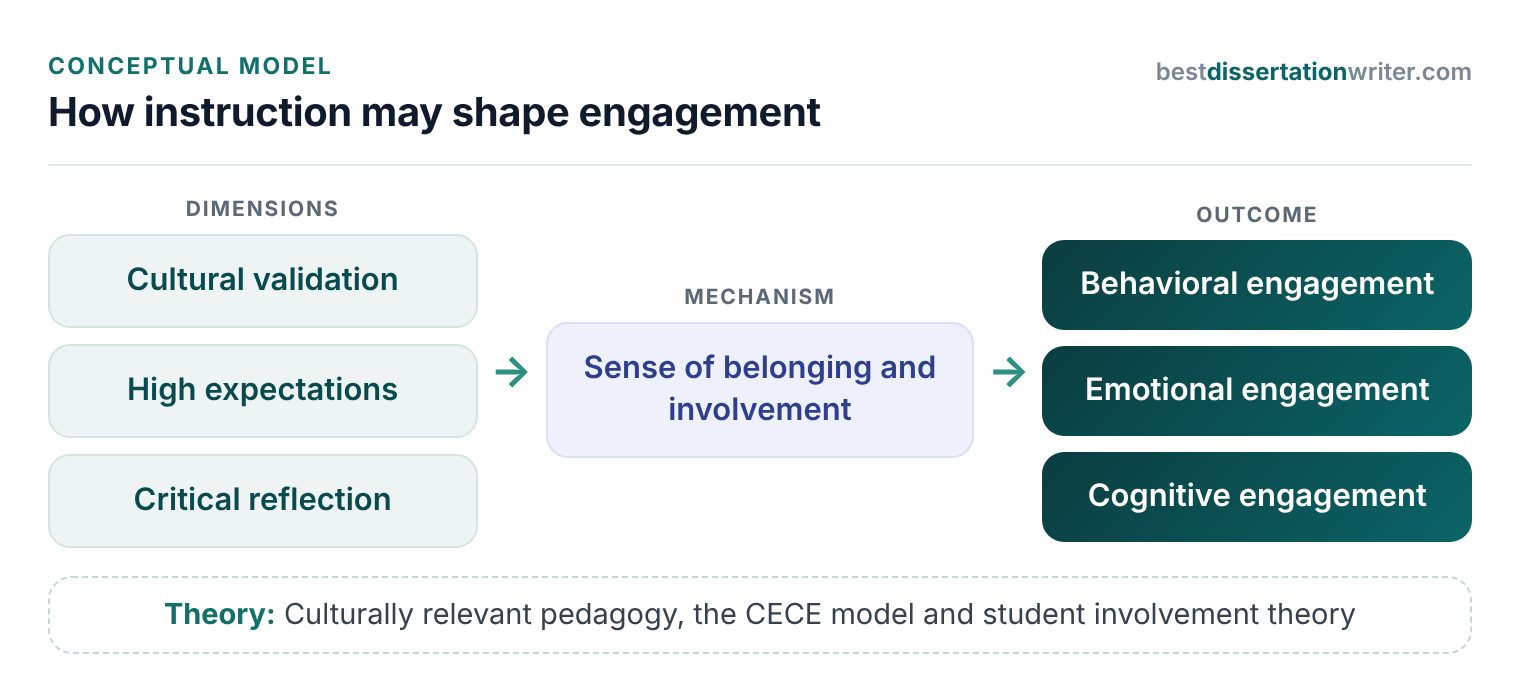
At the same time, Museus’s (2014) Culturally Engaging Campus Environments (CECE) model proposes that culturally engaging campus and classroom environments, those that are culturally validating, humanized, and holistically supportive, directly predict the sense of belonging and academic engagement of racially and culturally diverse college students, including first-generation students.
Despite the theoretical alignment between culturally responsive pedagogy and engagement theory, relatively few studies have directly tested whether classroom-level implementation of practices of culturally responsive pedagogy produces measurable gains in the academic engagement of first-generation students specifically, as opposed to diverse student populations considered more broadly (Byrd, 2016; Hurtado & Carter, 1997).
Problem Statement and Purpose of the Study
Statement of the Problem
Despite sustained institutional investment in first-year experience programs, learning communities, and other retention initiatives, first-generation college students continue to exhibit lower academic engagement and persistence than their continuing-generation peers, and it remains unclear whether classroom-level instructional practice, specifically the degree to which faculty employ culturally responsive pedagogy, contributes meaningfully to this persistent gap (Ishitani, 2006; Padgett et al., 2012).
Existing research on culturally responsive pedagogy has largely been conducted in K-12 contexts or has examined its effects on racially minoritized college students as an undifferentiated group, leaving the specific relationship between culturally responsive pedagogy and the engagement of first-generation students, who cut across racial and ethnic categories and carry a distinct set of cultural and social capital challenges, comparatively underexamined (Museus, 2014).
This gap in the literature is problematic because faculty development efforts and institutional policy around inclusive teaching are frequently designed without evidence specific to the first-generation population, meaning that resources may be directed toward instructional reforms whose actual effect on this group’s engagement and persistence has not been empirically established (Byrd, 2016).
Without a clearer, mixed-methods understanding of how first-generation students themselves experience and respond to practices of culturally responsive pedagogy, institutions risk implementing well-intentioned pedagogical reforms that do not address the specific mechanisms through which cultural mismatch undermines this population’s classroom engagement (Stebleton et al., 2014).
Purpose of the Study
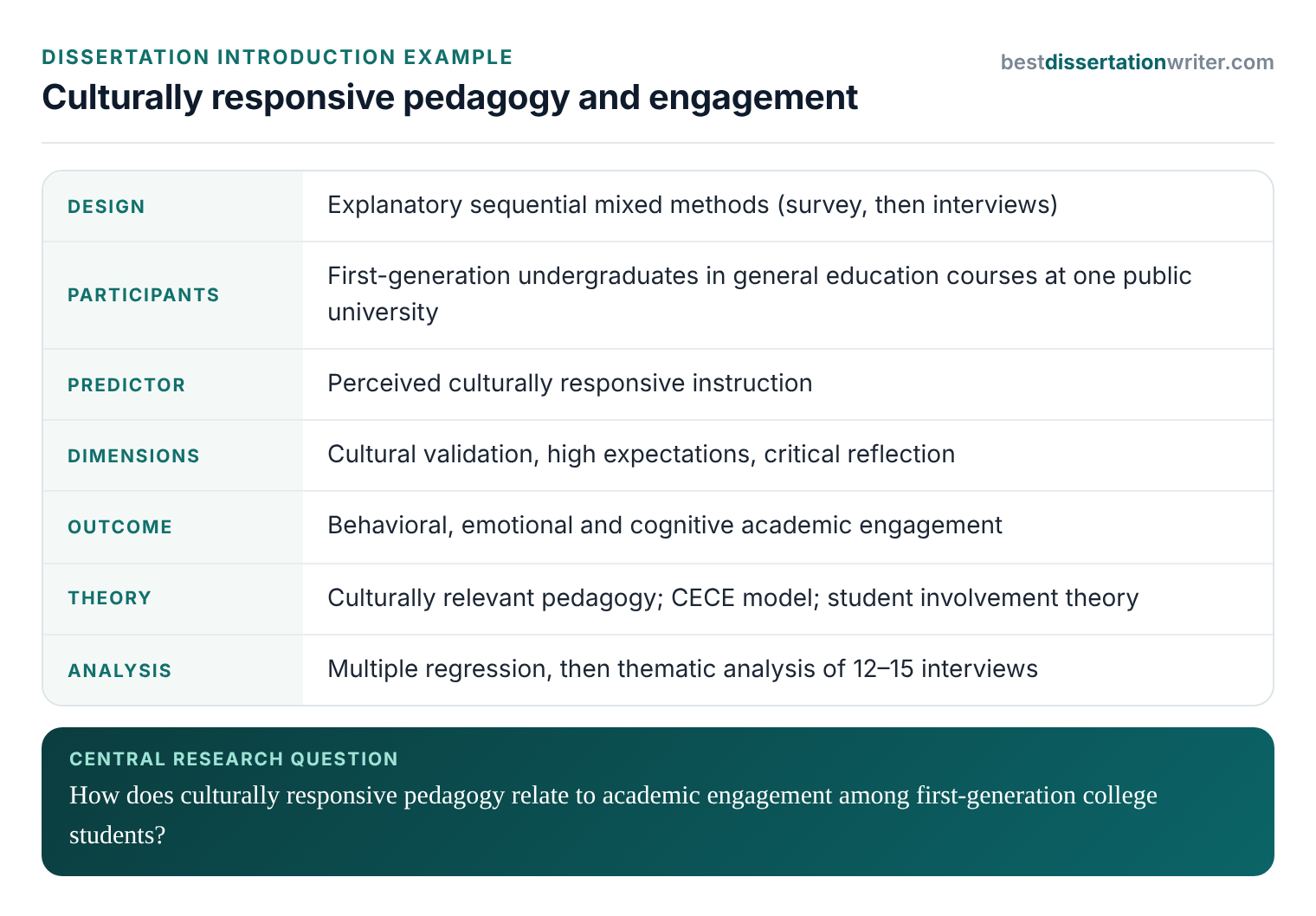
The purpose of this explanatory sequential mixed-methods study is to examine the relationship between faculty use of culturally responsive pedagogical practices and academic engagement among first-generation college students, and to explore how first-generation students themselves interpret and experience these practices in the classroom.
In the first, quantitative phase, first-generation undergraduates enrolled in general education courses will complete validated survey instruments measuring their perceptions of instructor cultural responsiveness and their own academic engagement. In the second, qualitative phase, a purposive subsample of survey respondents will participate in semi-structured interviews designed to illuminate the classroom experiences underlying the quantitative relationships identified in phase one.
Research Questions and Hypotheses
RQ1. Is there a statistically significant relationship between first-generation college students’ perceptions of instructor cultural responsiveness and their level of academic engagement?
H1. First-generation students who perceive higher levels of culturally responsive pedagogy will report significantly higher academic engagement than those who perceive lower levels of culturally responsive pedagogy.
RQ2. Do specific dimensions of culturally responsive pedagogy, namely cultural validation, high expectations, and critical reflection, differentially predict academic engagement among first-generation students?
H2. Cultural validation and high expectations will each independently and significantly predict academic engagement, over and above the variance explained by demographic and precollege academic preparation variables.
RQ3. How do first-generation college students describe the ways in which culturally responsive, or culturally unresponsive, instruction shapes their engagement, sense of belonging, and academic help-seeking behavior?
Significance and Theoretical Framework
Significance of the Study
This study carries significance for higher education pedagogy theory, faculty development practice, and institutional equity efforts.
Theoretically, the study extends Ladson-Billings’ (1995) culturally relevant pedagogy framework and Museus’s (2014) CECE model into a more precise empirical account of how specific dimensions of culturally responsive pedagogy relate to engagement within the first-generation student population specifically, addressing a gap left by studies that treat diverse and first-generation students as interchangeable categories (Museus & Quaye, 2009).
Practically, findings may directly inform faculty development programming, providing evidence-based guidance regarding which specific practices of culturally responsive pedagogy, such as validating students’ cultural knowledge, maintaining high expectations, or incorporating critical reflection, are most strongly associated with engagement gains for first-generation students (Gay, 2018).
Given that first-generation enrollment continues to grow across public and private institutions alike, evidence clarifying which instructional practices meaningfully narrow engagement and persistence gaps carries substantial relevance for institutional equity and retention strategy (Ishitani, 2006).
More broadly, the qualitative phase of this study contributes first-person accounts that can inform the design of first-year seminars, faculty training modules, and classroom observation protocols aimed at supporting first-generation student success (Stebleton et al., 2014).
Theoretical Framework
This study is grounded primarily in Ladson-Billings’ (1995) theory of culturally relevant pedagogy, which identifies three interrelated propositions, academic success, cultural competence, and sociopolitical or critical consciousness, as the defining features of instruction that successfully engages culturally diverse learners rather than requiring them to assimilate into a single dominant cultural framework.
Gay’s (2018) subsequent elaboration of culturally responsive teaching provides the study’s operational definition of the construct, characterizing responsive instruction as validating, comprehensive, multidimensional, empowering, transformative, and emancipatory in its treatment of students’ cultural backgrounds.
This pedagogical framework is paired with Museus’s (2014) Culturally Engaging Campus Environments model, which proposes that culturally engaging environments, operationalized through dimensions including cultural familiarity, cultural validation, and holistic support, directly shape college students’ sense of belonging and academic engagement.
Astin’s (1984) theory of student involvement provides the study’s conceptualization of academic engagement itself, defining involvement as the quantity and quality of the physical and psychological energy students invest in their academic experience, an outcome subsequently refined by Kuh’s (2009) National Survey of Student Engagement research program into measurable behavioral and affective indicators.
Integrating these three frameworks allows the study to test whether classroom-level culturally responsive pedagogy functions as a proximal driver of the broader engagement outcomes these theories identify as central to persistence.
Nature of the Study, Key Terms, Assumptions and Limitations
Nature of the Study
This study will employ an explanatory sequential mixed-methods design, in which quantitative survey data are collected and analyzed first, followed by a qualitative interview phase designed to explain and contextualize the quantitative findings (Creswell & Creswell, 2023).
Participants will be recruited from general education courses at a four-year public institution using a screening item to identify first-generation status, defined as neither parent having completed a bachelor’s degree.
In the quantitative phase, first-generation undergraduates will complete the Culturally Responsive Teaching Self-Efficacy scale adapted for student-perception use, alongside a validated academic engagement instrument measuring behavioral, emotional, and cognitive engagement dimensions. Data will be analyzed using multiple regression to test the predictive relationship between perceived cultural responsiveness and engagement, controlling for relevant demographic and precollege preparation variables.
In the qualitative phase, a purposive sample of 12 to 15 survey respondents representing a range of engagement scores will participate in semi-structured interviews, which will be analyzed using thematic analysis to identify recurring patterns in how students describe the relationship between instructional practice and their own engagement.
Definitions of Key Terms
Culturally responsive pedagogy: An instructional approach that validates, affirms, and builds upon students’ cultural knowledge, experiences, and frames of reference as legitimate vehicles for learning, rather than treating cultural difference as a deficit to be corrected (Gay, 2018).
First-generation college student: An undergraduate student neither of whose parents or legal guardians has completed a bachelor’s degree (Ishitani, 2006).
Academic engagement: The behavioral, emotional, and cognitive investment a student directs toward educationally purposeful activities, including class participation, interaction with faculty, and identification with academic goals (Kuh, 2009).
Cultural mismatch: A discrepancy between the cultural norms, values, and communication styles embedded in an institutional environment and those a student brings from their home or community culture (Stebleton et al., 2014).
Cultural capital: The accumulated knowledge, dispositions, and familiarity with institutional norms that facilitate navigation of educational systems, often unevenly distributed by family educational background (Yosso, 2005).
Sense of belonging: A student’s subjective perception that they are a valued, accepted, and legitimate member of their academic and campus community (Hurtado & Carter, 1997).
Assumptions
This study operates under several assumptions. It is assumed that participants will respond honestly and accurately to self-report survey items regarding both their perceptions of instructor cultural responsiveness and their own academic engagement, and that these self-reports meaningfully reflect actual classroom experience.
It is assumed that first-generation status, as determined by parental educational attainment, captures a coherent and theoretically meaningful population despite the substantial racial, ethnic, and socioeconomic diversity within that population.
It is further assumed that interview participants recruited from the quantitative sample will be willing and able to articulate specific classroom experiences relevant to the study’s research questions, and that the validated instruments selected possess adequate reliability and validity when applied to a first-generation subpopulation specifically.
Scope and Delimitations
The scope of this study is delimited to first-generation undergraduate students enrolled in general education courses at a single four-year public institution, and does not extend to first-generation students at community colleges, private institutions, or graduate programs.
The study is further delimited to students’ perceptions of instructor practice as reported through survey and interview data, and does not include direct classroom observation or faculty self-report measures of their own instructional practice.
The study examines academic engagement as its primary outcome and does not extend to longer-term outcomes such as persistence, GPA, or degree completion, although these are acknowledged as theoretically downstream of engagement (Kuh, 2009).
Limitations
Several limitations should be acknowledged. The single-institution design limits the generalizability of findings to first-generation students at institutions with different demographic compositions, resource levels, or institutional cultures.
Reliance on student self-report for both predictor and outcome variables introduces the possibility of common-method bias and does not independently verify the actual instructional practices to which students were exposed (Museus & Quaye, 2009).
The cross-sectional nature of the quantitative phase precludes causal claims regarding the direction of the relationship between perceived cultural responsiveness and engagement, and the qualitative sample, while purposively selected for range, cannot be assumed to represent the full diversity of first-generation student experience.
Finally, treating first-generation status as a single analytic category may obscure meaningful within-group variation associated with race, ethnicity, immigration background, and socioeconomic status, each of which independently shapes students’ relationship to cultural responsiveness in the classroom (Yosso, 2005).
Summary
This chapter introduced the background, problem, purpose, and theoretical grounding of a proposed mixed-methods study examining the relationship between culturally responsive pedagogy and academic engagement among first-generation college students.
While existing research has independently documented both the engagement and persistence gaps experienced by first-generation students and the theoretical promise of culturally responsive pedagogy, these literatures remain insufficiently integrated with respect to the first-generation population specifically, leaving faculty and institutions without clear, population-specific evidence to guide inclusive teaching reform.
Grounded in culturally relevant pedagogy theory, the Culturally Engaging Campus Environments model, and student involvement theory, this explanatory sequential mixed-methods study aims to clarify whether, and through what specific classroom mechanisms, culturally responsive pedagogy shapes the academic engagement of first-generation students, with implications for faculty development, institutional equity policy, and pedagogy theory.
Chapter Two will present a comprehensive review of the existing literature on culturally responsive pedagogy, first-generation student experience, and academic engagement, further situating this study within its scholarly context.
References
Astin, A. W. (1984). Student involvement: A developmental theory for higher education. Journal of College Student Personnel, 25(4), 297–308.
Byrd, C. M. (2016). Does culturally relevant teaching work? An examination from student perspectives. SAGE Open, 6(3), 1–10.
Creswell, J. W., & Creswell, J. D. (2023). Research design: Qualitative, quantitative, and mixed methods approaches (6th ed.). SAGE Publications.
Gay, G. (2018). Culturally responsive teaching: Theory, research, and practice (3rd ed.). Teachers College Press.
Hurtado, S., & Carter, D. F. (1997). Effects of college transition and perceptions of the campus racial climate on Latino college students’ sense of belonging. Sociology of Education, 70(4), 324–345.
Ishitani, T. T. (2006). Studying attrition and degree completion behavior among first-generation college students in the United States. Journal of Higher Education, 77(5), 861–885.
Kuh, G. D. (2009). The National Survey of Student Engagement: Conceptual and empirical foundations. New Directions for Institutional Research, 2009(141), 5–20.
Ladson-Billings, G. (1995). Toward a theory of culturally relevant pedagogy. American Educational Research Journal, 32(3), 465–491.
Museus, S. D. (2014). The Culturally Engaging Campus Environments (CECE) model: A new theory of college success among racially diverse student populations. In M. B. Paulsen (Ed.), Higher education: Handbook of theory and research (Vol. 29, pp. 189–227). Springer.
Museus, S. D., & Quaye, S. J. (2009). Toward an intercultural perspective of racial and ethnic minority college student persistence. Review of Higher Education, 33(1), 67–94.
Padgett, R. D., Johnson, M. P., & Pascarella, E. T. (2012). First-generation undergraduate students and the impacts of the first year of college: Additional evidence. Journal of College Student Development, 53(2), 243–266.
Pascarella, E. T., Pierson, C. T., Wolniak, G. C., & Terenzini, P. T. (2004). First-generation college students: Additional evidence on college experiences and outcomes. Journal of Higher Education, 75(3), 249–284.
Stebleton, M. J., Soria, K. M., & Huesman, R. L. (2014). First-generation students’ sense of belonging, mental health, and use of counseling services at public research universities. Journal of College Counseling, 17(1), 6–20.
Yosso, T. J. (2005). Whose culture has capital? A critical race theory discussion of community cultural wealth. Race Ethnicity and Education, 8(1), 69–91.
Why This Culturally Responsive Pedagogy Dissertation Introduction Example Works
Education dissertations need to connect classroom practice to measurable student outcomes. This culturally responsive pedagogy example makes that connection in four ways.
- A persistent problem: The chapter notes that retention programs have not closed the engagement gap for first-generation students, which makes instruction worth studying.
- Testable dimensions: RQ2 breaks culturally responsive pedagogy into three dimensions, so the study can show which practices matter most.
- Student voice: RQ3 asks students to describe responsive and unresponsive teaching, which explains the survey results in their own words.
- Clear boundaries: The scope is one four-year public institution and general education courses, and the limitations explain what that means.
Background paragraph: weak vs. strong
Weak
“First-generation students have a hard time in college, and teachers should be more inclusive.”
This mixes a broad claim with an opinion and cites no evidence or theory.
Strong
“Despite sustained investment in retention initiatives, first-generation students continue to show lower engagement than continuing-generation peers, and it remains unclear how classroom instruction contributes to this gap.”
This acknowledges existing efforts, states the persistent gap and points to the unexplored role of instruction.
How to Adapt This Structure
If your key concept has several dimensions, test each one in its own research question. In a mixed-methods study, describe how the interview sample will be chosen from survey respondents.
For section-by-section guidance, see how to write the background of the study, the purpose of the study and a theoretical framework. You can compare this chapter with the social media and body image example, browse all dissertation introduction examples, or return to the how to write a dissertation hub.
The University of Leeds Library also keeps a collection of dissertation examples by subject.
FAQs About This Culturally Responsive Pedagogy Dissertation Introduction
What is the difference between culturally relevant and culturally responsive pedagogy?
Ladson-Billings introduced culturally relevant pedagogy, built on academic success, cultural competence and critical consciousness. Gay’s culturally responsive teaching focuses more on how instructors use students’ cultural knowledge and experiences in teaching.
This example draws on both and uses culturally responsive pedagogy as its umbrella term. Defining the term clearly in your key terms section prevents confusion, because the two labels are often used interchangeably in the literature. Consistent wording across your chapters then keeps readers from wondering whether two different concepts are being studied.
Why use an explanatory sequential design for this topic?
The survey phase can show whether perceived culturally responsive pedagogy predicts engagement, but it cannot explain how students experience it. The interviews that follow fill that gap.
Participants for the interviews are chosen from survey respondents across a range of engagement scores. This lets the study compare students who are highly engaged with those who are not, and it ties the qualitative findings directly to the numbers from the first phase. The two phases are then integrated in the discussion chapter to give a fuller answer than either could alone.
How do I define first-generation college students in my dissertation?
Definitions vary, so state yours clearly. This example defines first-generation students as those whose parents have not completed a bachelor’s degree and uses a screening item to identify them.
Some studies use stricter definitions, such as no parent attending any college. Whichever you choose, include it in your key terms, apply it consistently during recruitment, and explain in the limitations how a different definition might change who is included. Consistent use of the definition also makes your results easier to compare with other studies.
Best Dissertation Writers
Want an introduction chapter like this for your topic?
Get a custom Chapter 1 written around your research problem, field and deadline.