
Consumer Trust and Purchase Intention in AI-Generated Marketing Content Across Generational Cohorts
 By Dr. Robertson Prime, Research Fellow
Updated October 24, 2026
17 min read
About 3,400 words
This dissertation introduction example tests whether labeling marketing content as AI-generated changes consumer trust and purchase intention, and whether that effect differs across generations. It is a complete Chapter 1 for a between-subjects experimental survey.
Every reference in the chapter has been checked against its published source. The breakdown near the end shows how an experimental design shapes each section of the chapter.
On this page
What this example shows
- A true manipulation: only the disclosure label changes, so differences in trust can be traced to it.
- Two outcomes: consumer trust and purchase intention each get their own question and hypothesis.
- A moderator: generational cohort tests whether the effect is the same for every age group.
- Theory per variable: the machine heuristic explains the main effect and generational cohort theory explains the moderator.
Background of the Study: Consumer Trust and AI-Generated Marketing
Introduction
The rapid adoption of generative artificial intelligence tools within marketing practice has fundamentally changed how brands produce advertising copy, product descriptions, social media content, and personalized promotional messaging, raising new questions about how consumers perceive and respond to content they know, or suspect, was generated by an algorithm rather than a human copywriter (Campbell et al., 2022).
While AI-generated content offers marketers substantial efficiency gains, its effect on two outcomes central to marketing effectiveness, consumer trust and purchase intention, remains incompletely understood, particularly given growing evidence that consumers do not respond uniformly to AI-generated content and that generational cohort may significantly shape this response (Noble et al., 2022).
This chapter introduces the background, problem, purpose, and design of a quantitative study examining the influence of AI-generated marketing content on consumer trust and purchase intention, and whether this influence differs meaningfully across generational cohorts.
Background of the Study
Artificial intelligence has moved from a peripheral marketing tool to a central component of content production pipelines, with generative systems now capable of producing advertising copy, email campaigns, and social media posts at scale and with increasing sophistication (Huang & Rust, 2021).
This shift has prompted a growing body of consumer research examining how awareness that content was AI-generated, as opposed to human-authored, shapes consumer evaluation of that content, with findings suggesting a complex and sometimes contradictory pattern of responses (Puntoni et al., 2021).
A substantial line of research has documented what has been termed algorithm aversion, a tendency for consumers to trust and prefer human-generated judgments and content over algorithmically generated equivalents, particularly in domains perceived as requiring subjective or emotionally nuanced judgment, a category into which persuasive marketing content plausibly falls (Longoni et al., 2022; Shin, 2021).
At the same time, other research has identified conditions under which consumers exhibit algorithm appreciation rather than aversion, particularly when AI systems are perceived as more objective, consistent, or data-driven than human alternatives, suggesting that consumer response to AI-generated content is highly context-dependent rather than uniformly negative (Yalcin et al., 2022).
Sundar’s machine heuristic framework offers one explanation for this variability, proposing that consumers apply a cognitive heuristic in which machine-generated content is automatically assumed to be more objective and less biased than human-generated content, a heuristic that can either enhance or undermine trust depending on the specific marketing context and consumer’s prior beliefs about AI (Sundar, 2020).
Generational cohort has emerged as a potentially important, though underexamined, factor shaping these responses.
Generational cohort theory proposes that individuals who come of age during a shared historical and technological period develop relatively stable, shared attitudes and behavioral tendencies that persist across the life course, suggesting that cohorts differing in their formative exposure to digital and AI technologies may hold systematically different baseline attitudes toward AI-generated content (Twenge, 2023).
Empirical research on disclosure of algorithmically generated or native advertising content has found generational differences in both recognition of and trust response to disclosed content, with younger cohorts generally demonstrating greater familiarity with, though not necessarily greater trust in, AI-generated material (Wojdynski & Golan, 2016).
However, direct empirical comparison of how AI-generated marketing content specifically affects consumer trust and purchase intention across multiple generational cohorts within a single controlled study remains limited, with much of the existing literature examining either generational technology attitudes or AI-content trust in isolation rather than jointly (Kietzmann et al., 2018; Noble et al., 2022).
Problem Statement and Purpose of the Study
Statement of the Problem
As marketing organizations increasingly adopt generative AI tools for content production, they face growing uncertainty regarding whether disclosed or detectable AI-generated content undermines the consumer trust and purchase intention that marketing content is designed to build, and whether this effect varies meaningfully across the generational cohorts that constitute a brand’s customer base (Campbell et al., 2022; Luo et al., 2021).
While existing research has independently documented both algorithm aversion effects in consumer judgment and generational differences in technology attitudes, these two bodies of literature have not been sufficiently integrated to clarify whether generational cohort meaningfully moderates the trust and purchase-intention consequences of AI-generated marketing content specifically (Shin, 2021; Twenge, 2023).
This gap is problematic because marketing organizations currently lack clear, empirically grounded guidance regarding whether AI-generated content strategies should be differentiated by target generational cohort, and whether disclosure of AI involvement in content creation carries different reputational and conversion risks depending on the generational composition of a brand’s audience (Wojdynski & Golan, 2016).
Without controlled empirical evidence directly comparing consumer trust and purchase intention responses to AI-generated versus human-generated marketing content across cohorts, marketers risk applying a uniform content strategy that may be well-suited to some generational segments while inadvertently undermining consumer trust and conversion among others (Noble et al., 2022; Yalcin et al., 2022).
Purpose of the Study
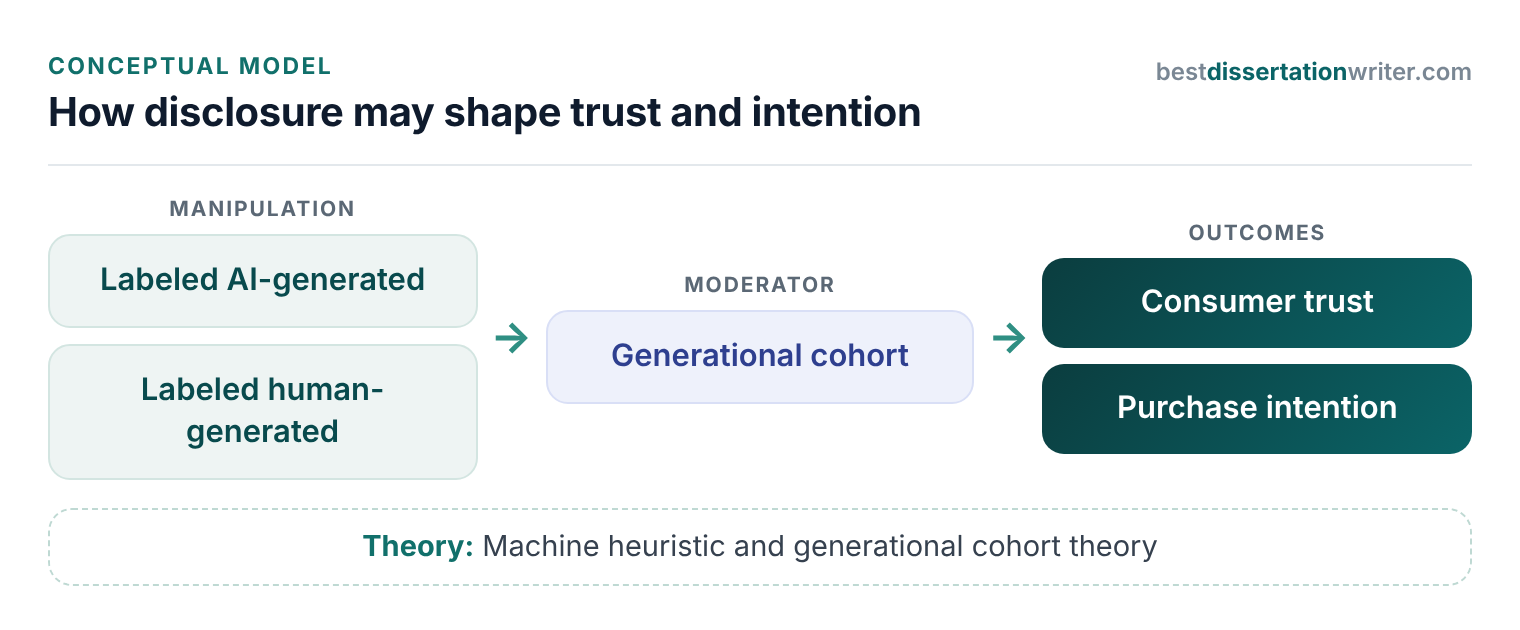
The purpose of this quantitative, between-subjects experimental-survey study is to examine the influence of AI-generated marketing content, relative to human-generated marketing content, on consumer trust and purchase intention, and to determine whether this influence differs significantly across generational cohorts.
Participants will be randomly assigned to view marketing content labeled as either AI-generated or human-generated, with underlying message content held constant across conditions, and will subsequently report their consumer trust in the content and their purchase intention toward the advertised product.

Research Questions and Hypotheses
RQ1. Does disclosed content source (AI-generated versus human-generated) significantly influence consumer trust in marketing content?
H1. Consumers exposed to content disclosed as AI-generated will report significantly lower consumer trust than consumers exposed to content disclosed as human-generated.
RQ2. Does disclosed content source significantly influence consumer purchase intention?
H2. Consumers exposed to content disclosed as AI-generated will report significantly lower purchase intention than consumers exposed to content disclosed as human-generated.
RQ3. Does generational cohort moderate the effect of disclosed content source on consumer trust and purchase intention?
H3. The effect of disclosed content source on consumer trust and purchase intention will differ significantly across generational cohorts, with younger cohorts (Generation Z and Millennials) exhibiting a smaller trust and purchase-intention gap between AI-generated and human-generated content than older cohorts (Generation X and Baby Boomers).
Significance and Theoretical Framework
Significance of the Study
This study carries significance for consumer behavior theory, marketing practice, and generational technology research. Theoretically, the study extends the machine heuristic framework and algorithm aversion literature by directly testing whether generational cohort functions as a significant moderator of AI-content trust responses, integrating two previously largely separate research streams within a single controlled design (Sundar, 2020; Twenge, 2023).
Practically, findings may directly inform marketing content strategy, providing evidence-based guidance regarding whether AI-generated content disclosure should be differentiated, contextualized, or paired with specific trust-repair messaging depending on the generational composition of a target audience (Campbell et al., 2022).
Given the accelerating adoption of generative AI tools across marketing departments of all sizes, evidence clarifying the conditions under which AI-generated content helps or harms consumer trust and conversion carries substantial commercial relevance (Huang & Rust, 2021).
More broadly, this study contributes to ongoing public and regulatory discussions regarding AI content disclosure requirements in advertising, offering empirical evidence relevant to debates about whether, and for whom, AI disclosure meaningfully changes consumer response (Luo et al., 2021).
Theoretical Framework
This study is grounded in Sundar’s machine heuristic framework, which proposes that consumers apply a cognitive shortcut in which machine-generated content is automatically evaluated as more objective, mechanical, and potentially less trustworthy in emotionally persuasive contexts than human-generated content, a heuristic that shapes trust judgments independent of the actual quality of the content itself (Sundar, 2020).
This framework provides the theoretical basis for hypothesizing that disclosed AI authorship will directly influence consumer trust and purchase intention, independent of message content, which is held constant across experimental conditions in this study’s design.
This substantive framework is paired with generational cohort theory, which proposes that individuals who come of age during a shared sociotechnological period develop relatively stable, shared attitudes toward emerging technologies that persist across the life course and differentiate them from adjacent cohorts (Twenge, 2023).
Integrating these two frameworks allows the study to test not only whether the machine heuristic operates as a general effect across consumers, but whether its strength is systematically moderated by generational cohort, reflecting differences in cohorts’ formative exposure to, and baseline familiarity with, AI-driven technologies.
Nature of the Study, Key Terms, Assumptions and Limitations
Nature of the Study
This study will employ a quantitative, between-subjects factorial experimental-survey design, in which content source (AI-generated versus human-generated, disclosed via labeling) is manipulated while underlying marketing message content is held constant, and generational cohort is treated as a naturally occurring categorical moderating variable (Creswell & Creswell, 2023).
Participants will be recruited through an online panel using quota sampling to ensure adequate representation across four generational cohorts: Generation Z, Millennials, Generation X, and Baby Boomers, classified according to established birth-year cohort boundaries.
Participants will be randomly assigned to view one of two versions of an identical marketing advertisement, differing only in a disclosure label identifying the content as either AI-generated or human-generated, after which they will complete validated measures of consumer trust and purchase intention.
Data will be analyzed using two-way factorial ANOVA to test the main effects of content source and generational cohort, as well as their interaction effect, on both consumer trust and purchase intention. Significant interaction effects will be followed by simple effects analysis to determine which specific generational cohorts exhibit statistically significant differences in response to AI-disclosed versus human-disclosed content.
Definitions of Key Terms
Algorithm aversion: The tendency of individuals to trust and prefer human judgment or human-generated content over algorithmically generated equivalents, particularly in domains perceived as requiring subjective judgment (Longoni et al., 2022).
Consumer trust: A consumer’s confidence in the honesty, reliability, and credibility of marketing content or the brand presenting it (Shin, 2021).
Generational cohort: A group of individuals who were born within a similar time period and who share formative historical and technological experiences that shape relatively stable, common attitudes and behaviors (Twenge, 2023).
Machine heuristic: A cognitive shortcut in which machine-generated content is automatically evaluated as more objective and mechanical, and potentially less trustworthy in emotionally persuasive contexts, than human-generated content (Sundar, 2020).
Purchase intention: A consumer’s self-reported likelihood of purchasing a product or service following exposure to marketing content (Puntoni et al., 2021).
AI-generated marketing content: Advertising copy, product descriptions, or promotional messaging produced, in whole or in part, by a generative artificial intelligence system rather than a human author (Campbell et al., 2022).
Assumptions
This study operates under several assumptions. It is assumed that participants will attend to and accurately process the content-source disclosure label presented within each experimental condition, and that this disclosure will be perceived as credible rather than dismissed.
It is assumed that participants’ self-reported generational cohort, based on birth year, accurately reflects the formative technological and sociocultural experiences theorized to shape generational attitudes toward AI (Twenge, 2023).
It is further assumed that the validated consumer trust and purchase intention instruments selected for this study possess adequate reliability and validity across all four generational cohorts sampled, and that holding message content constant across experimental conditions effectively isolates the influence of disclosed content source from confounding message-quality effects.
Scope and Delimitations
The scope of this study is delimited to consumer response to a single product category and a single marketing content format, presented as short-form advertising copy, and does not examine other content formats such as video, influencer-generated content, or long-form editorial content.
The study is further delimited to four generational cohorts, Generation Z, Millennials, Generation X, and Baby Boomers, using established birth-year classification boundaries, and does not include participants from cohorts falling outside these ranges.
The study is delimited to a single disclosure condition in which AI or human authorship is explicitly labeled, and does not examine undisclosed or ambiguously disclosed AI-generated content, nor does it examine longitudinal changes in trust following repeated exposure over time.
Limitations
Several limitations should be acknowledged. The use of a single product category and content format limits the generalizability of findings to other marketing contexts, product types, and content formats not examined in this study.
Reliance on an online panel sample, while enabling quota-based generational representation, may not fully capture the diversity of consumer attitudes within each generational cohort, and panel participants may differ systematically from the broader consumer population in technology familiarity or survey-taking behavior.
The experimental design’s reliance on explicit disclosure labeling does not reflect the full range of real-world marketing contexts, in which AI involvement in content creation is often undisclosed or only partially disclosed, potentially limiting the ecological validity of observed effects.
Finally, the cross-sectional, single-exposure nature of this study cannot capture how trust and purchase intention responses to AI-generated content may evolve with repeated exposure or increasing marketplace familiarity with generative AI tools over time (Yalcin et al., 2022).
Summary
This chapter introduced the background, problem, purpose, and theoretical grounding of a proposed quantitative study examining the influence of AI-generated marketing content on consumer trust and purchase intention, and whether this influence is moderated by generational cohort.
While existing research has independently documented both algorithm aversion effects and generational differences in technology attitudes, these two literatures remain insufficiently integrated with respect to AI-generated marketing content specifically, leaving marketers without clear, cohort-specific evidence to guide content strategy.
Grounded in the machine heuristic framework and generational cohort theory, this quantitative, between-subjects experimental-survey study aims to clarify whether, and for which generational cohorts, disclosed AI authorship meaningfully undermines consumer trust and purchase intention, with implications for marketing practice, consumer behavior theory, and AI disclosure policy.
Chapter Two will present a comprehensive review of the existing literature on AI-generated content, consumer trust, and generational technology attitudes, further situating this study within its scholarly context.
References
Campbell, C., Plangger, K., Sands, S., & Kietzmann, J. (2022). Preparing for an era of deepfakes and AI-generated ads: A framework for understanding responses to manipulated advertising. Journal of Advertising, 51(1), 22–38.
Creswell, J. W., & Creswell, J. D. (2023). Research design: Qualitative, quantitative, and mixed methods approaches (6th ed.). SAGE Publications.
Huang, M.-H., & Rust, R. T. (2021). Engaged to a robot? The role of AI in service. Journal of Service Research, 24(1), 30–41.
Kietzmann, J., Paschen, J., & Treen, E. (2018). Artificial intelligence in advertising: How marketers can leverage artificial intelligence along the consumer journey. Journal of Advertising Research, 58(3), 263–267.
Longoni, C., Fradkin, A., Cian, L., & Pennycook, G. (2022). News from generative artificial intelligence is believed less. In FAccT ’22: Proceedings of the 2022 ACM Conference on Fairness, Accountability, and Transparency (pp. 97–106). ACM.
Luo, X., Qin, M. S., Fang, Z., & Qu, Z. (2021). Artificial intelligence coaches for sales agents: Caveats and solutions. Journal of Marketing, 85(2), 14–32.
Noble, S. M., Mende, M., Grewal, D., & Parasuraman, A. (2022). The fifth industrial revolution: How harmonious human-machine collaboration is triggering a retail and service revolution. Journal of Retailing, 98(2), 199–208.
Puntoni, S., Reczek, R. W., Giesler, M., & Botti, S. (2021). Consumers and artificial intelligence: An experiential perspective. Journal of Marketing, 85(1), 131–151.
Shin, D. (2021). The effects of explainability and causability on perception, trust, and acceptance: Implications for explainable AI. International Journal of Human-Computer Studies, 146, 102551.
Sundar, S. S. (2020). Rise of machine agency: A framework for studying the psychology of human-AI interaction (HAII). Journal of Computer-Mediated Communication, 25(1), 74–88.
Twenge, J. M. (2023). Generations: The real differences between Gen Z, Millennials, Gen X, Boomers, and Silents—and what they mean for America’s future. Atria Books.
Wojdynski, B. W., & Golan, G. J. (2016). Native advertising and the future of mass communication. American Behavioral Scientist, 60(12), 1403–1407.
Yalcin, G., Lim, S., Puntoni, S., & van Osselaer, S. M. J. (2022). Thumbs up or down: Consumer reactions to decisions by algorithms versus humans. Journal of Marketing Research, 59(4), 696–717.
Why This Consumer Trust Dissertation Introduction Example Works
Experimental studies need an introduction that makes the manipulation and its logic obvious. This consumer trust example gets four things right.
- Isolated cause: The chapter explains that the advertisement stays identical except for its label, which makes the study’s causal claim credible.
- Parallel outcomes: Trust and purchase intention are handled in matching question-and-hypothesis pairs, which keeps the analysis plan easy to follow.
- Moderation explained: Generational cohort is not added as an afterthought; a named theory explains why cohorts might react differently.
- Realistic scope: The chapter limits itself to one product category and one content format and says what that means for generalizability.
Hypothesis: weak vs. strong
Weak
“AI marketing will affect consumers differently.”
This names no outcome, no direction and no comparison group, so it cannot be tested.
Strong
“Consumers exposed to content disclosed as AI-generated will report significantly lower trust than consumers exposed to content disclosed as human-generated.”
This states the comparison, the outcome and the expected direction, which matches a factorial ANOVA.
How to Adapt This Structure
In an experimental introduction, describe the manipulation in the purpose statement and again in the nature of the study. Give each outcome its own hypothesis, and add a moderator question only when a theory explains why the effect should vary.
For section-by-section guidance, see how to write the purpose of the study, a testable hypothesis and a theoretical framework. You can compare this chapter with the remote work flexibility and retention example, browse all dissertation introduction examples, or return to the how to write a dissertation hub.
For related research on buyers, see this case study on consumer behavior. The University of Leeds Library also keeps a collection of dissertation examples by subject.
FAQs About This Consumer Trust Dissertation Introduction
Why does this example manipulate only the AI disclosure label?
Keeping the advertisement identical and changing only the label means that any difference in consumer trust or purchase intention can be attributed to the disclosure itself, not to differences in the writing or design.
This is the core logic of a between-subjects experiment. If the content also changed, the study could not tell whether readers reacted to the label or to the message, which would weaken every conclusion the chapter hopes to draw. Random assignment to the two labels then protects the comparison.
What is the machine heuristic in consumer trust research?
The machine heuristic is a mental shortcut described by Sundar, in which people judge machine-produced content by their general beliefs about machines rather than by the content itself.
In this example, the heuristic explains why a disclosure label alone might change consumer trust. Because it makes a clear prediction about labeled AI content, it supports the chapter’s directional hypotheses and gives the study a theoretical reason to expect an effect. It is a useful anchor for any study of AI-generated content.
Why include generational cohort as a moderator?
Generational cohort theory suggests that people who grow up with similar technologies share lasting attitudes toward them. If that holds, younger and older consumers may not respond to AI-labeled content in the same way.
Testing cohort as a moderator lets the study show whether the effect of AI disclosure on consumer trust is universal or depends on age group. That answer is useful for marketers deciding whether to disclose AI use differently for different audiences. It also adds a practical recommendation to the significance section.
Best Dissertation Writers
Want an introduction chapter like this for your topic?
Get a custom Chapter 1 written around your research problem, field and deadline.