
Dissertation Introduction Examples: 14 Full Chapter One Samples and How to Write Your Own
 By Dr. Robertson Prime, Research Fellow
Updated October 24, 2026
12 min read
About 2,400 words
These dissertation introduction examples show how a complete Chapter 1 looks across 14 topics, from nursing and psychology to economics and bioethics. Each one is a full introduction chapter with a problem statement, research questions, theoretical framework, limitations and a verified reference list.
Use these dissertation introduction examples in two ways. First, browse the list to find one close to your own field or research design. Then, use the breakdown and step-by-step guide below to write your own introduction chapter.
On this page
Key takeaways
- One shared structure: all 14 dissertation introduction examples move from background to problem, purpose, questions, theory, design and limits.
- Design changes the details: quantitative chapters use hypotheses, qualitative chapters use open questions, and conceptual chapters use propositions.
- The problem statement carries the chapter: every strong example names a specific gap, not just a topic.
- Verified sources only: every reference in the examples has been checked against its published source.
What Is a Dissertation Introduction Chapter?
The introduction chapter is the first chapter of your dissertation or thesis. It tells the reader what you are studying, why it matters, and how you will investigate it.
A well-written introduction chapter usually covers these elements:
- Background of the study: the wider context that leads the reader toward your topic.
- Problem statement: the specific gap in research or practice that your study addresses.
- Purpose of the study: one clear statement of what the study will do and how.
- Research questions: the questions your study will answer, with hypotheses for quantitative designs.
- Significance and theory: why the findings matter and which theory frames the study.
- Design, terms and limits: a short preview of the method, key definitions, assumptions, scope and limitations.
Examiners often form their first impression of your work in this chapter. Every later chapter, from the literature review to the conclusion, refers back to the problem, purpose and questions you set out here.
That is why reading dissertation introduction examples before you write is so useful. You can see how other writers handle the same structural requirements and then apply that pattern to your own topic.
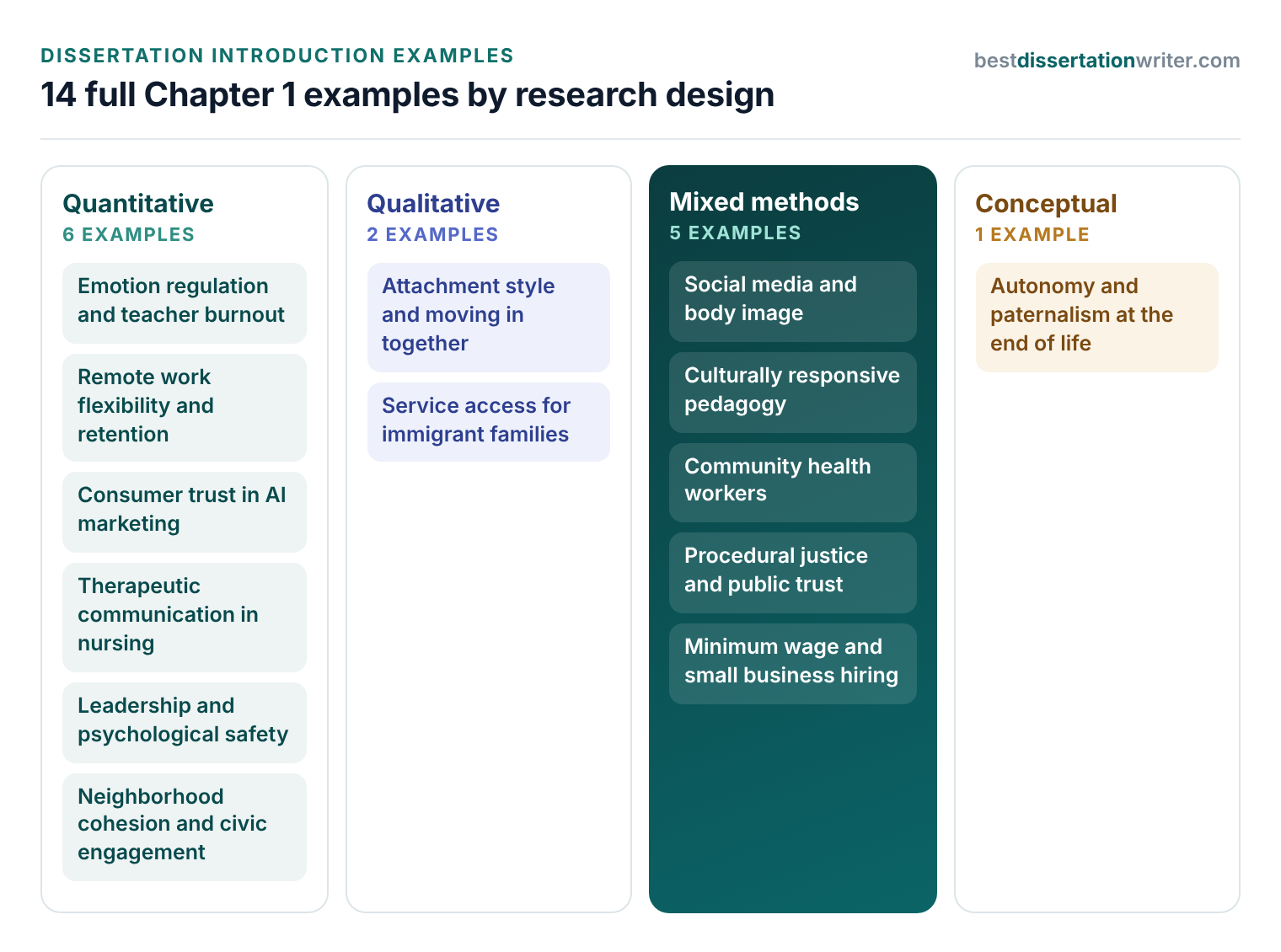
Dissertation Introduction Examples by Field and Research Design
Each of the dissertation introduction examples below is a complete Chapter 1. Choose one that matches your discipline or your research design, because the design shapes how the questions, theory and limitations are written.
All of these dissertation introduction examples include a verified reference list and a short analysis explaining why the chapter works. That makes them useful for learning the logic of each section, not just its format.
How to Use These Dissertation Introduction Examples
- Read the whole chapter first: notice how each section sets up the next before you look at any one part closely.
- Map the alignment: trace how the problem statement leads to the purpose, the research questions and the theory.
- Compare two designs: read a quantitative and a qualitative example side by side to see how questions and limitations change.
- Use the analysis sections: each example ends with a breakdown of why it works and a weak-versus-strong comparison you can learn from.
Chapter One Breakdown: The Parts Every Example Shares
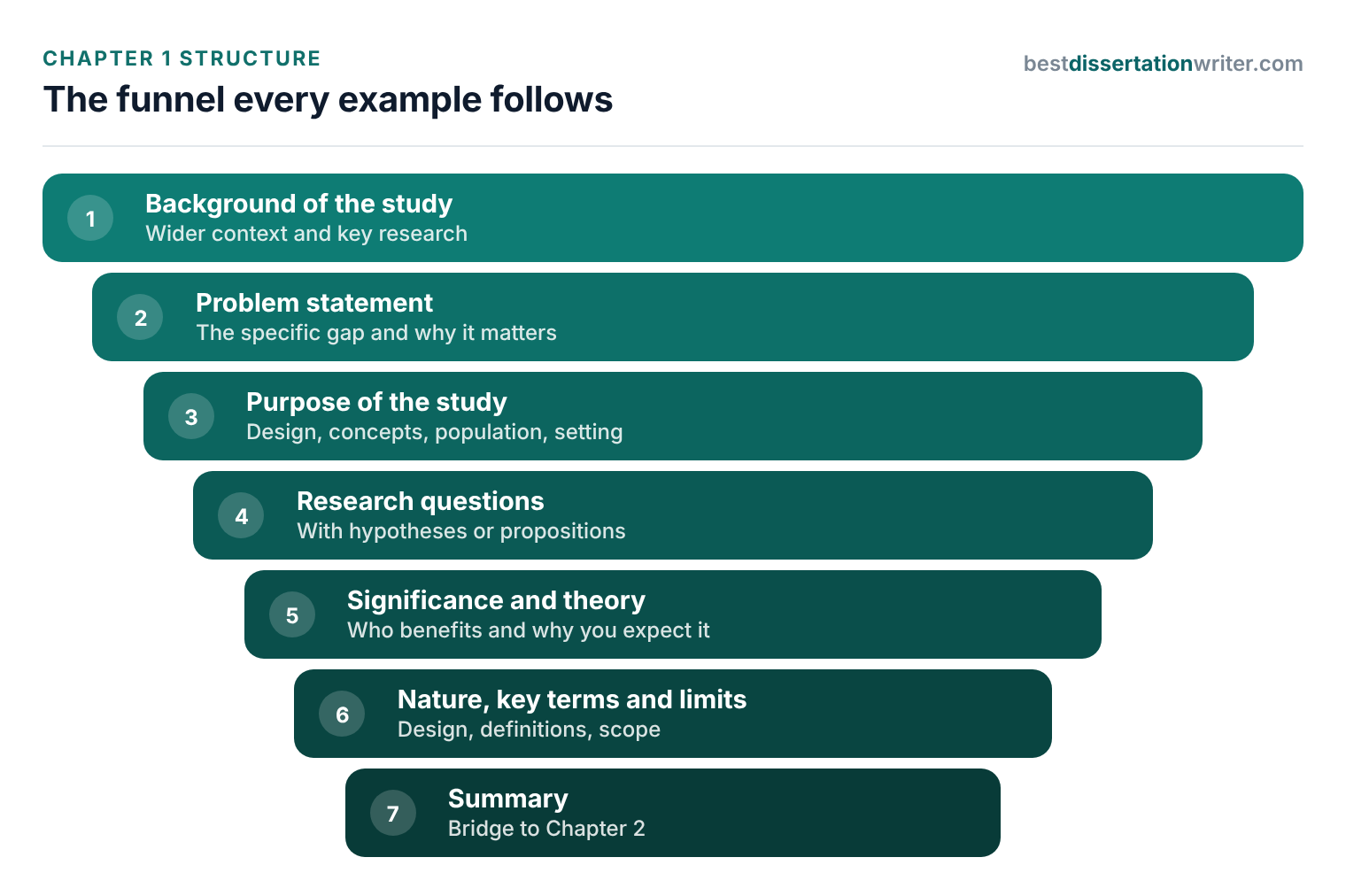
Although the topics differ, these dissertation introduction examples follow the same funnel. They start broad, narrow to one specific problem, and then explain exactly how the study will address it.
1. Background of the Study
The background moves from the wider context to the specific area your study addresses. It should cite key sources and lead the reader toward a gap without yet stating it in full.
Example: social media and body image
The social media and body image example opens with earlier research on media and body image, then introduces social comparison theory and objectification theory, and closes by noting mixed findings across studies. That sequence prepares the reader for the gap.
2. Problem Statement
The problem statement names exactly what is unknown and why it matters. It is usually short, specific and supported by evidence.
Example: minimum wage and small business hiring
The minimum wage example does not argue that economists disagree. Instead, it states that it remains unclear whether wage increases affect small businesses differently from the wider labor market, which is a gap one study can address.
3. Purpose of the Study
The purpose statement summarizes the study in one or two sentences. It names the design, the main concepts or variables, the population and the setting.
Example: transformational leadership and psychological safety
The leadership example states that its quantitative, correlational study will test whether psychological safety mediates the link between transformational leadership and team innovation in cross-functional project teams.
4. Research Questions and Hypotheses
Research questions follow directly from the purpose. Quantitative studies pair each question with a hypothesis, while qualitative studies use open “how” and “what” questions.
Example: attachment style and relationship transitions
The attachment style example is qualitative, so it uses four open research questions and no hypotheses. Each question asks how participants describe or make sense of their experience, which suits its interpretive design.
5. Significance and Theoretical Framework
The significance section explains who will use the findings and how. The theoretical framework explains why you expect the relationships or patterns your questions ask about.
Example: community health workers
The community health workers example frames these workers as an enabling resource within Andersen’s behavioral model, which gives the study a clear theoretical reason to expect better disease control.
6. Nature of the Study, Key Terms and Limits
The chapter closes by previewing the design, defining key terms and stating assumptions, scope, delimitations and limitations. Some programs also ask for a short roadmap of the remaining chapters.
Example: autonomy and paternalism
The autonomy and paternalism example is a conceptual analysis, so its limitations admit that the framework cannot be tested statistically and depends on the strength of its arguments.
How to Write a Dissertation Introduction That Grabs Attention
A strong introduction does more than tick each box. It earns the reader’s attention from the first sentence and keeps the argument moving. The strongest dissertation introduction examples share the habits below.
- Open with your actual topic: start with a specific, sourced observation about your field rather than a sweeping statement about history or society.
- Name the gap early: within the first page, the reader should know what existing research has and has not addressed.
- Write plainly: clear academic writing is more persuasive than jargon, so prefer short sentences and precise terms.
- Signal your design: say early whether the study is quantitative, qualitative, mixed methods or conceptual.
- Make the “so what?” obvious: by the end of the chapter, the reader should be able to say why the study matters and to whom.
- Revise the opening last: once the rest of the chapter is written, you know exactly what your first paragraph needs to set up.
Opening sentence: weak vs. strong
Weak
“Throughout history, communication has always been important in healthcare.”
This could open almost any paper. It names no population, setting or problem, so the reader learns nothing about the study.
Strong
“Mental health nurses are expected to use therapeutic communication techniques to build working relationships with patients, yet it remains unclear which techniques patients themselves value most.”
This names the population, the practice and the gap in one sentence, so the reader knows exactly where the chapter is heading.
Introduction vs. Conclusion: How the Two Chapters Connect
The introduction and conclusion mirror each other. The introduction narrows from context to a specific question, while the conclusion starts from the findings and widens back out to their implications.
| Element | In the introduction | In the conclusion |
|---|---|---|
| Research problem | Stated as an open gap | Revisited in light of the findings |
| Research questions | Posed and justified | Answered directly, one by one |
| Aims and objectives | Set out as intentions | Confirmed as met, partly met or not met |
| Significance | Expected contribution | Actual contribution and implications |
| Limitations | Anticipated limits of the design | Limits that affected the results |
| Future research | Not usually included | Specific recommendations |
Keep the framing consistent across both chapters. If your introduction describes an exploratory qualitative study, your conclusion should not suddenly make statistical claims.
The conclusion should also avoid introducing major new material. Anything substantial belongs in the literature review, results or discussion chapters.
How to Write a Strong Dissertation Introduction, Step by Step
Use these steps to turn your topic into a complete first chapter. The dissertation introduction examples above follow the same sequence.
- Narrow your topic to one question. Turn a broad interest, such as social media and well-being, into a specific question about a defined population, setting and outcome.
- Draft the background. Write a few paragraphs that move from the general context to your specific angle. Keep detailed analysis of studies for your literature review.
- State the gap in one or two sentences. Say exactly what existing research has not yet answered and why that gap matters in practice or theory.
- Write the purpose and research questions. Name your design, variables or concepts, population and setting, then write one question for each part of the gap.
- Justify significance and choose your theory. Explain who will use the findings and which theory explains the relationships or experiences you will study.
- Preview the design and set the limits. Summarize your method, define key terms, and state your assumptions, scope, delimitations and limitations.
- Compare your draft with dissertation introduction examples. Read two or three that match your design and check that your chapter is just as specific and well aligned.
Template
Despite [what is already known], it remains unclear [specific gap] among [population] in [setting]. The purpose of this [design] study is to [examine/explore] [concepts or variables]. Findings may help [audience] to [practical action].
Dissertation Introduction Checklist and Section Guides
Before you submit, check your chapter against this list, which summarizes what the dissertation introduction examples on this page do well. Then use the guides below to strengthen any section that falls short.
- Specific opening: does the first paragraph name your actual topic?
- Clear gap: does the problem statement say exactly what is unknown?
- Aligned questions: does every research question follow from the purpose statement?
- Design signaled: is it clear whether the study is quantitative, qualitative, mixed methods or conceptual?
- Theory linked: does the theoretical framework explain each relationship or pattern you plan to study?
- Honest limits: are the main limitations named, with what they mean for the findings?
For a full overview, read our guide to the dissertation introduction chapter. Section-by-section guides cover the background of the study, the problem statement, the purpose of the study and the significance of the study.
You can also learn how to write a research question, a theoretical framework, the scope and delimitations and the limitations of the study. For the wider project, return to the how to write a dissertation hub.
The University of Leeds Library also keeps a collection of dissertation examples by subject, which is useful for seeing how complete dissertations are organized in different fields.
FAQs About Dissertation Introduction Examples
How long should a dissertation introduction chapter be?
Length depends on your program, level and discipline, so there is no single correct word count. Your handbook or supervisor is the best guide, and many programs set a target range for each chapter. Reading dissertation introduction examples from your own department can also show what is typical there.
Focus on covering every required section clearly rather than on hitting a number. The examples on this page are full doctoral-style chapters, so a master’s or undergraduate introduction will often be shorter, with briefer background and theory sections.
Can I copy a dissertation introduction example?
No. Copying the wording of any example, even with small changes, counts as plagiarism and can lead to serious academic penalties. Use dissertation introduction examples to learn structure and logic, not as text to reuse.
A safe approach is to note how an example moves from background to problem to questions, then write your own chapter from your own literature search. Check every source you cite against the original, as was done for each example here. Your university’s similarity checker will flag copied passages, so original writing protects you as well as your grade.
Should I write the introduction first or last?
Most students draft the introduction early, because it clarifies the problem, purpose and questions that guide the rest of the work. A proposal usually requires an early version anyway, and drafting it first gives your supervisor something concrete to review.
However, plan to revise it once your results and conclusion are written. Your findings may sharpen the gap, change how you describe significance, or show which limitations mattered most, so the final introduction should match the dissertation you actually completed. Comparing your revised draft with dissertation introduction examples is a quick final check.
Best Dissertation Writers
Want an introduction chapter like this for your topic?
Get a custom Chapter 1 written around your research problem, field and deadline.