

Attachment Style as a Lens on Relationship Satisfaction Following Long-Distance to Co-Located Transitions in Young Adult Couples
 By Dr. Robertson Prime, Research Fellow
Updated October 24, 2026
17 min read
About 3,400 words
This dissertation introduction example explores how attachment style shapes young adults’ experience of moving from a long-distance relationship to living in the same place as their partner. It is a complete Chapter 1 for a qualitative study using Interpretative Phenomenological Analysis (IPA).
Every reference in the chapter has been checked against its published source. Because this is a qualitative study, it uses open research questions instead of hypotheses, and you can see how that changes each section.
On this page
What this example shows
- A clear transition: the study focuses on one turning point, the move from long-distance to co-located living.
- Open questions: four “how” and “what” questions fit an interpretive design, so there are no hypotheses.
- Theory as a lens: attachment theory guides interpretation instead of supplying variables to test.
- Method fit: IPA’s double hermeneutic is defined and explained, not just named.
Background of the Study: Attachment Style and Relationship Transitions
Introduction
The transition from a long-distance relationship to physical co-residence represents one of the most psychologically significant turning points in the life course of a young adult romantic partnership, requiring couples to renegotiate autonomy, daily routine, conflict management, and intimacy under conditions fundamentally different from those that shaped the relationship’s earlier development.
While existing research has shown that this transition can be a turbulent period for couples (Stafford & Merolla, 2007), comparatively little is known about how individual differences in attachment style shape the way young adults subjectively experience and make sense of this shift, and how that sense-making relates to their felt satisfaction within the relationship.
This chapter introduces the background, problem, purpose, and design of a qualitative study exploring how attachment style informs young adults’ lived experience of the long-distance to co-located transition, situating the inquiry within the theoretical traditions of attachment theory and interpretative phenomenology.
Background of the Study
Long-distance romantic relationships have become increasingly common among young adults, driven by geographically dispersed higher education, early-career mobility, and the normalization of digitally mediated intimacy (Jiang & Hancock, 2013).
Research on long-distance relationships has generally found that, while physically separated, many couples report relationship quality comparable to or exceeding that of geographically close couples, a pattern attributed in part to idealization processes and more deliberate, effortful communication during periods of separation (Stafford & Merolla, 2007).
However, the eventual transition to co-located living has been identified as a potentially destabilizing period, during which previously idealized or selectively curated interactions give way to the unfiltered, continuous proximity of shared daily life, often producing a period of adjustment marked by unexpected conflict, disillusionment, or renegotiation of relational expectations (Stafford & Merolla, 2007).
Attachment theory offers a well-established framework for understanding how individuals respond to relational transitions involving changes in proximity, availability, and interdependence (Mikulincer & Shaver, 2016).
Securely attached individuals are theorized to approach increased closeness with relative equanimity, drawing on an internalized sense of the partner as a reliable source of comfort, whereas individuals higher in attachment anxiety may experience increased proximity as an opportunity for reassurance but remain hypervigilant to signs of rejection, and individuals higher in attachment avoidance may experience the same increased proximity as a threat to autonomy, prompting withdrawal or deactivation of relational needs (Feeney & Fitzgerald, 2019).
Quantitative research has demonstrated that attachment anxiety and avoidance are each associated with lower relationship satisfaction across a range of relational contexts and transitions, and several studies conducted since 2020 have specifically examined attachment-related variation in adjustment following relocation or the resumption of physical proximity after separation (Fraley & Roisman, 2019).
Despite this growing quantitative evidence base, the existing literature has relied almost exclusively on variable-centered, self-report survey methodologies that treat attachment style as a fixed predictor and relationship satisfaction as a discrete outcome, an approach that, while valuable for establishing statistical association, is not well suited to capturing the subjective, interpretive processes through which young adults actually experience and make meaning of this transition in real time.
Qualitative inquiry into how attachment-related tendencies manifest within individuals’ own accounts of a major relational transition remains notably limited, leaving open important questions about the lived texture of this experience that quantitative moderation models, by design, cannot address.
Problem Statement and Purpose of the Study
Statement of the Problem
Young adult couples transitioning from long-distance to co-located living represent a population at elevated risk for relational instability during a developmentally significant period, yet existing support resources and relationship education programs offer little guidance specifically tailored to how individual attachment differences shape this particular transition (Dargie et al., 2015).
Quantitative research has established that attachment style is associated with relationship satisfaction (Mikulincer & Shaver, 2016), but this body of work, by relying on pre-established survey instruments and cross-sectional or longitudinal correlational designs, cannot illuminate how young adults themselves interpret, narrate, and emotionally process the specific experience of moving from a long-distance to a co-located relationship structure.
This gap is problematic because it limits the field’s understanding of the mechanisms underlying the statistical associations already documented between attachment style and satisfaction, and it constrains the ability of couples counselors, relationship educators, and young adults themselves to anticipate and address the specific psychological experiences that accompany this transition.
Without qualitative accounts that capture how attachment-related patterns of thinking, feeling, and relating actually surface in couples’ own descriptions of adjusting to co-located life, interventions designed to support this population risk being generic rather than responsive to the differentiated ways individuals with varying attachment styles experience the same objective transition.
Purpose of the Study
The purpose of this qualitative study, employing Interpretative Phenomenological Analysis (IPA), is to explore how young adults’ attachment styles shape their lived experience of transitioning from a long-distance to a co-located romantic relationship, and how this experience relates to their sense of relationship satisfaction.
The study will purposively recruit young adults, ages 18 to 29, who have transitioned from a long-distance relationship to cohabitation or sustained physical proximity with a romantic partner within the past six to eighteen months, sampling across a range of self-reported attachment styles to explore both individual and patterned variation in how the transition is subjectively experienced.

Research Questions
RQ1. How do young adults with differing attachment styles describe their subjective experience of transitioning from a long-distance to a co-located romantic relationship?
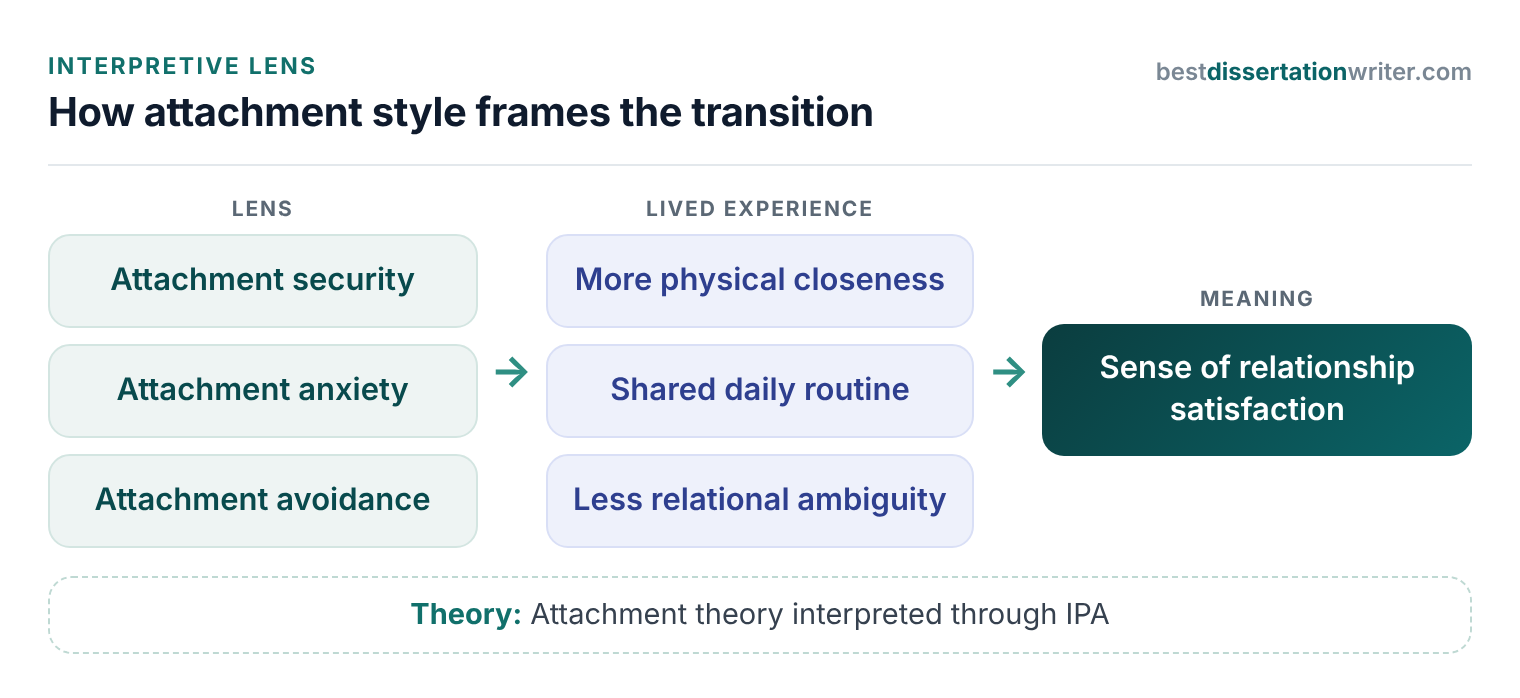
RQ2. In what ways do participants’ accounts of increased physical proximity, shared daily routine, and reduced relational ambiguity reflect attachment-related patterns of thinking, feeling, and behaving?
RQ3. How do participants describe the relationship between their experience of this transition and their overall sense of satisfaction within the relationship?
RQ4. What convergent and divergent patterns of meaning-making emerge across participants when accounts are compared according to differing attachment styles?
Significance and Theoretical Framework
Significance of the Study
This study holds significance for theory, clinical practice, and the young adult population it centers.
Theoretically, the study extends attachment theory beyond its predominantly variable-centered application by using an idiographic, meaning-focused methodology to examine how attachment-related tendencies are subjectively experienced and narrated during a specific, developmentally significant relational transition, contributing interpretive depth to a literature that has largely relied on statistical moderation models (Feeney & Fitzgerald, 2019).
For clinical and educational practice, findings may inform the work of couples counselors, premarital and pre-cohabitation counseling programs, and relationship educators by offering rich, first-person illustrations of how attachment-related patterns manifest during the reunion adjustment period, potentially improving the specificity and relevance of guidance offered to couples anticipating or currently navigating this transition (Dargie et al., 2015).
For the young adult population under study, this research offers the potential for increased self-understanding, as participants’ own accounts, and the resulting themes, may help normalize and contextualize experiences that individuals might otherwise interpret as signs of relational failure rather than as recognizable, attachment-related adjustment processes.
Finally, the study contributes methodologically to a small but growing body of relationship science research applying IPA to attachment-related phenomena, demonstrating the value of idiographic qualitative inquiry as a complement to the field’s dominant quantitative tradition.
Theoretical Framework
This study is theoretically grounded in attachment theory, which conceptualizes early caregiving experiences as shaping internal working models of self and others that continue to organize expectations, emotions, and behaviors within adult romantic relationships, particularly during periods of heightened relational demand such as separation, reunion, or increased interdependence (Mikulincer & Shaver, 2016).
Within this framework, attachment security is understood to support flexible, low-threat engagement with relational change, while attachment anxiety and avoidance are understood to organize distinct, patterned responses to increased closeness, namely hyperactivation of proximity-seeking and reassurance needs in the case of anxiety, and deactivation of emotional expression and proximity-seeking in the case of avoidance.
This substantive theoretical framework is paired with the epistemological and methodological commitments of Interpretative Phenomenological Analysis, which is grounded in phenomenology, hermeneutics, and idiography, and is concerned with understanding how individuals make sense of significant personal experiences through a process Smith and colleagues term the “double hermeneutic,” in which the researcher engages in a sense-making process about the participant’s own sense-making of their experience (Smith et al., 2022).
This combination allows the study to use attachment theory as a substantive lens for interpretation while remaining methodologically committed to allowing participants’ own accounts, rather than pre-specified theoretical categories, to drive the emergence of themes (Pietkiewicz & Smith, 2014).
Nature of the Study, Key Terms, Assumptions and Limitations
Nature of the Study
This study will employ a qualitative design using Interpretative Phenomenological Analysis, selected for its established suitability in exploring how individuals make sense of significant, identity-relevant life experiences, and for its idiographic commitment to detailed, case-by-case analysis prior to cross-case comparison (Smith et al., 2022).
Participants will be recruited using purposive and criterion sampling, targeting young adults aged 18 to 29 who transitioned from a long-distance relationship to co-located living with a current romantic partner within the past six to eighteen months.
A brief, validated attachment measure, the Experiences in Close Relationships-Revised (ECR-R) questionnaire, will be administered prior to interview solely for descriptive and sampling purposes, ensuring the inclusion of participants reflecting a range of attachment styles, rather than for quantitative hypothesis testing (Fraley & Roisman, 2019).
Data will be collected through semi-structured, in-depth individual interviews lasting approximately 60 to 90 minutes, using an interview guide designed to elicit detailed, experience-near accounts of participants’ transition from long-distance to co-located living, while allowing flexibility for participant-led elaboration consistent with IPA interviewing conventions. Interviews will be audio-recorded and transcribed verbatim.
Analysis will follow the established IPA process: close, case-by-case reading and annotation of each transcript, development of emergent themes within each individual case, and subsequent cross-case analysis to identify patterns of convergence and divergence across participants, with particular attention to how these patterns relate to participants’ attachment styles (Pietkiewicz & Smith, 2014).
Researcher reflexivity will be maintained throughout through the use of a reflexive journal, acknowledging the researcher’s active interpretive role in the double hermeneutic process central to IPA.
Definitions of Key Terms
Attachment style: A relatively stable pattern of thought, emotion, and behavior in close relationships, typically categorized along dimensions of attachment anxiety and attachment avoidance, shaped by internalized working models of self and others (Mikulincer & Shaver, 2016).
Co-located relationship: A romantic relationship in which both partners reside in the same geographic location and maintain regular, unmediated physical proximity, as distinct from a long-distance relationship structure.
Double hermeneutic: The two-layered interpretive process central to Interpretative Phenomenological Analysis, in which the researcher makes sense of the participant’s own sense-making of their lived experience (Smith et al., 2022).
Interpretative Phenomenological Analysis (IPA): A qualitative methodology concerned with exploring how individuals make meaning of significant personal experiences, characterized by idiographic, case-by-case analysis prior to cross-case comparison (Smith et al., 2022).
Long-distance relationship: A committed romantic relationship in which partners are geographically separated and rely primarily on mediated communication to sustain intimacy and connection (Jiang & Hancock, 2013).
Relationship satisfaction: An individual’s subjective evaluation of the overall quality, fulfillment, and positivity of their romantic relationship.
Reunion adjustment: The period of psychological and relational recalibration that follows the transition from physical separation to sustained proximity or cohabitation within a romantic relationship (Stafford & Merolla, 2007).
Assumptions
This study operates under several assumptions consistent with its qualitative, interpretive design. It is assumed that participants are able and willing to reflect on and articulate their subjective experience of the relationship transition with reasonable honesty and depth during the interview process.
It is assumed that language, as elicited through semi-structured interviewing, provides meaningful access to participants’ internal sense-making processes, consistent with the phenomenological assumptions underlying IPA (Smith et al., 2022).
It is further assumed that the researcher’s reflexive engagement with the double hermeneutic process, supported by ongoing journaling and peer debriefing, will allow for a sufficiently rigorous and transparent interpretive account, and that participants’ self-reported attachment style, as assessed through the ECR-R, reasonably approximates their broader relational tendencies for the purposes of purposive sampling.
Scope and Delimitations
The scope of this study is delimited to young adults between the ages of 18 and 29 who have transitioned from a long-distance romantic relationship to co-located living with the same partner within the past six to eighteen months, excluding individuals whose relationships ended during or shortly after this transition and individuals in relationships that were never geographically distant.
The study is further delimited to individual, rather than dyadic or couple-level, interviews, in order to preserve each partner’s independent voice and reduce the influence of partner presence on disclosure, and does not attempt to triangulate or compare both partners’ accounts within a given relationship.
The study is delimited methodologically to Interpretative Phenomenological Analysis and does not incorporate quantitative measurement of relationship satisfaction beyond descriptive, sampling-oriented use of the ECR-R.
Limitations
Several limitations should be acknowledged. As with all IPA research, findings are not intended to be statistically generalizable to the broader population of young adult couples, but rather to offer rich, transferable insight into the lived experience of a purposively selected sample (Pietkiewicz & Smith, 2014).
Reliance on retrospective self-report interviewing introduces the possibility of memory reconstruction or narrative smoothing, particularly for participants whose transition occurred toward the upper end of the eighteen-month recruitment window. The use of individual, rather than dyadic, interviews means the study captures only one partner’s perspective within each relationship, potentially omitting relevant relational dynamics visible only through both partners’ accounts.
Finally, the researcher’s own interpretive stance, while managed through reflexive practice, remains an inherent and acknowledged feature of the double hermeneutic process central to IPA, shaping the analysis in ways that another researcher might interpret differently.
Summary
This chapter introduced the background, problem, purpose, and methodological grounding of a proposed qualitative study exploring how attachment style shapes young adults’ lived experience of transitioning from a long-distance to a co-located romantic relationship, and how this experience relates to relationship satisfaction.
While quantitative research has established statistical associations between attachment style and relationship satisfaction across various transitions, the subjective, meaning-making processes underlying these associations remain insufficiently understood, particularly within the specific context of the long-distance to co-located transition among young adults.
Grounded in attachment theory and employing Interpretative Phenomenological Analysis, this study aims to offer rich, idiographic insight into how attachment-related patterns surface within participants’ own accounts of this significant relational transition, with implications for attachment theory, couples counseling, and relationship education.
Chapter Two will present a comprehensive review of the existing literature on attachment theory, long-distance relationships, and relational transitions, further situating this study within its scholarly and methodological context.
References
Dargie, E., Blair, K. L., Goldfinger, C., & Pukall, C. F. (2015). Go long! Predictors of positive relationship outcomes in long-distance dating relationships. Journal of Sex & Marital Therapy, 41(2), 181–202.
Feeney, J. A., & Fitzgerald, J. (2019). Attachment, conflict and relationship quality: Laboratory-based and clinical insights. Current Opinion in Psychology, 25, 127–131.
Fraley, R. C., & Roisman, G. I. (2019). The development of adult attachment styles: Four lessons. Current Opinion in Psychology, 25, 26–30.
Jiang, L. C., & Hancock, J. T. (2013). Absence makes the communication grow fonder: Geographic separation, interpersonal media, and intimacy in dating relationships. Journal of Communication, 63(3), 556–577.
Mikulincer, M., & Shaver, P. R. (2016). Attachment in adulthood: Structure, dynamics, and change (2nd ed.). Guilford Press.
Pietkiewicz, I., & Smith, J. A. (2014). A practical guide to using interpretative phenomenological analysis in qualitative research psychology. Czasopismo Psychologiczne – Psychological Journal, 20(1), 7–14.
Smith, J. A., Flowers, P., & Larkin, M. (2022). Interpretative phenomenological analysis: Theory, method and research (2nd ed.). SAGE Publications.
Stafford, L., & Merolla, A. J. (2007). Idealization, reunions, and stability in long-distance dating relationships. Journal of Social and Personal Relationships, 24(1), 37–54.
Why This Attachment Style Dissertation Introduction Example Works
Qualitative introductions are often harder to write than quantitative ones because there is no hypothesis to anchor them. This attachment style example solves that in four ways.
- A bounded phenomenon: The study looks at one transition in one age group, which gives the interviews a clear focus and makes the sample criteria easy to defend.
- Questions that invite meaning: Each research question asks how participants describe or make sense of their experience, which is what IPA is designed to answer.
- Theory used with care: Attachment theory sensitizes the analysis without turning attachment style into a variable to test, and the chapter says so directly.
- Limits framed for qualitative work: The limitations section speaks of transferability rather than statistical generalizability, the standard a qualitative committee expects.
Purpose statement: weak vs. strong
Weak
“This study will prove that insecure attachment lowers relationship satisfaction after couples move in together.”
“Prove” and a predicted effect belong to a quantitative design, so this clashes with an IPA method.
Strong
“The purpose of this qualitative study is to explore how young adults’ attachment styles shape their lived experience of transitioning from a long-distance to a co-located romantic relationship.”
This uses exploratory language, names the phenomenon and keeps the purpose aligned with an interpretive design.
How to Adapt This Structure
For any qualitative introduction, replace hypotheses with three or four open research questions and explain how your theory guides interpretation. Define your method’s key terms, as this chapter does with the double hermeneutic.
For section-by-section guidance, see how to write the purpose of the study, a research question and the limitations of the study. You can compare this chapter with the immigrant families and child welfare service access example, browse all dissertation introduction examples, or return to the how to write a dissertation hub.
The University of Leeds Library also keeps a collection of dissertation examples by subject.
FAQs About This Attachment Style Dissertation Introduction
Why are there no hypotheses in this attachment style example?
Hypotheses predict relationships between variables, which suits quantitative designs. This study uses IPA, which aims to understand how people make sense of an experience, so a fixed prediction would steer the interviews and the analysis.
Instead, the chapter uses four open research questions. Attachment style appears in them as a lens for comparing accounts, not as a variable to test, and the brief attachment measure is used only to make sure the sample includes a range of styles. That choice is explained in the nature of the study.
How many participants does an IPA dissertation need?
IPA studies usually use small, fairly similar samples because the method analyzes each case in depth before comparing them. Doctoral IPA projects often include somewhere between about four and ten interviews, though your program may set its own norms.
Explain your choice in Chapter 3 and link it to the idiographic aims of IPA. In the introduction, it is enough to describe who will take part and how they will be selected, as this example does. Quality of analysis matters far more than the number of participants.
Can attachment theory be used in qualitative research?
Yes. Although most attachment research is quantitative, the theory can guide qualitative work as a sensitizing lens that shapes which experiences the researcher notices and how accounts are interpreted.
The key is to be clear about this role. This example states that attachment theory informs interpretation while IPA’s focus on participants’ own sense-making stays central, which helps avoid forcing the interview data into categories chosen in advance. Reflexive journaling helps you keep that balance visible, and this chapter plans for it from the start.
Best Dissertation Writers
Want an introduction chapter like this for your topic?
Get a custom Chapter 1 written around your research problem, field and deadline.